WORLD
WORLD
Mankara-waka-ya-pirna
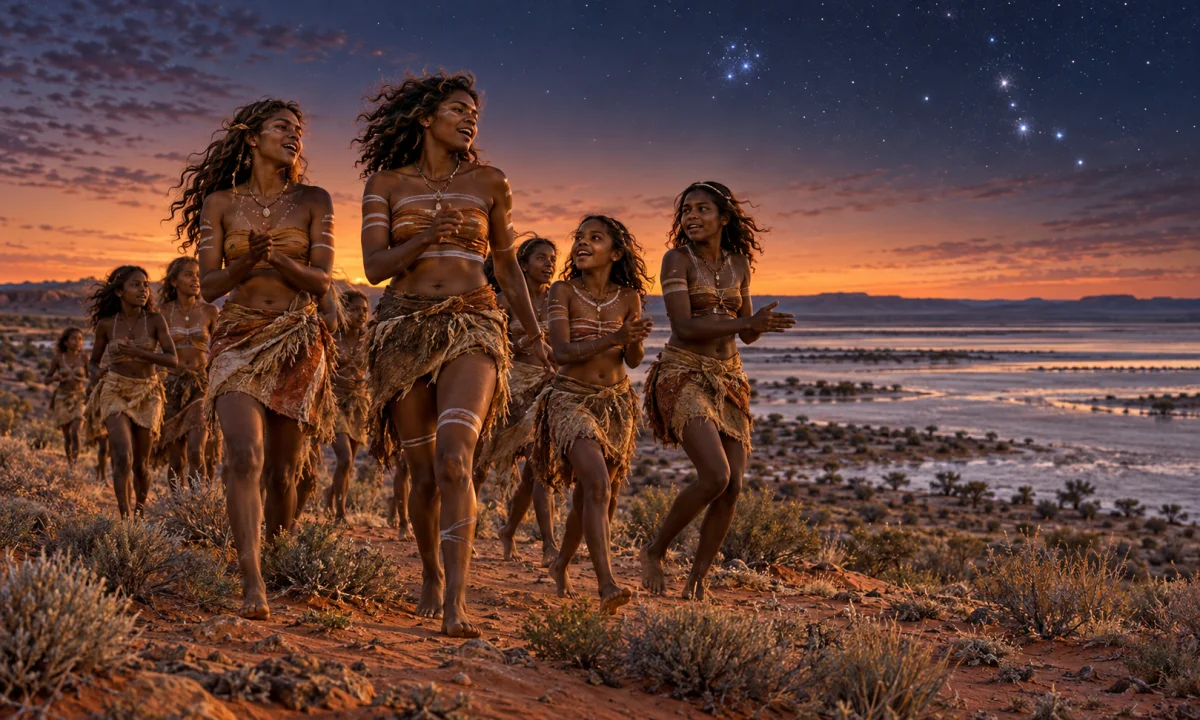
Mankara-waka-ya-pirna is a name associated in some modern English-language listings with Australian Aboriginal mythology. Its identity, cultural origin and meaning are not securely established in the widely available record, however. There is no single body of “Aboriginal mythology”: Aboriginal and Torres Strait Islander peoples have many distinct languages, laws, ancestral traditions and story systems. A name without a confirmed community, language or recording context should therefore not be treated as the name of a being known uniformly across Australia.
Identity and cultural setting
The form Mankara-waka-ya-pirna is presented as a compound or hyphenated expression rather than as a clearly documented personal name. The spelling may reflect an English-language transcription, an editorial reconstruction, or an attempt to represent words from an Aboriginal language. Without knowing the original language and the circumstances in which the name was recorded, its components cannot be translated with confidence.
That uncertainty is important. Aboriginal languages are not dialects of one common Australian language, and words that look or sound similar in English transcription may have entirely different meanings in different languages. Even within one language, spelling conventions have changed over time. A name copied from a secondary list can lose the information that would identify its country, pronunciation, grammatical structure or ceremonial setting.
There is also no reliable basis for describing Mankara-waka-ya-pirna as a pan-Aboriginal deity or monster. Traditional knowledge belongs to particular peoples and places. Some stories concern ancestral beings who shaped the land, established social rules and remain present in named features of Country. Others involve dangerous spirits, warnings, animal beings, human ancestors or figures connected with ritual knowledge. These categories do not correspond neatly to the European division between gods, ghosts and monsters.
What can be established
The name has circulated in modern compilations of mythological beings, but the surviving publicly accessible information attached to it is exceptionally limited. A secure identification would require at least one of the following: a named Aboriginal community or language group, a documented place, a transcription made by a competent recorder, a published traditional account, or a clear explanation from knowledge holders.
Those details are not consistently supplied with the name. As a result, claims that Mankara-waka-ya-pirna is specifically a serpent, water spirit, giant, cannibal, ancestral hero or guardian cannot be treated as established traditional information merely because they appear in an unsourced catalogue. The same caution applies to supposed descriptions of its appearance, habitat, powers, relationships and preferred victims.
This does not prove that the name has no traditional basis. Many Aboriginal traditions were transmitted orally, and some knowledge is restricted according to age, gender, initiation or custodial authority. Other material was never recorded in writing, or was recorded under an approximate spelling that is difficult to identify today. A lack of accessible documentation means that the figure cannot presently be described in detail with confidence; it does not justify dismissing Aboriginal knowledge that has not entered public sources.
Name, spelling and interpretation
The spelling Mankara-waka-ya-pirna should be retained with caution rather than silently regularised. Hyphens may have been added by a compiler to divide an unfamiliar expression, although they do not necessarily correspond to the original language. The final element may be a word with grammatical or descriptive significance, but its meaning cannot be inferred reliably from English, from another Aboriginal language, or from superficial resemblance to words elsewhere in Australia.
Pronunciation is equally uncertain. English-language spellings often fail to represent sounds that are important in Aboriginal languages, including distinctions between several kinds of consonants. A small spelling difference can identify a different word, a different place or a different language. It is therefore misleading to offer a confident translation or to claim that the name literally means “great monster”, “water devil” or any similar phrase without a documented linguistic basis.
The name may also be a phrase describing an entity rather than an individual’s proper name. In many traditional systems, beings are known through relationships with Country, actions, physical places, kinship, ceremonial roles or descriptive titles. A phrase can be transformed into a fixed “creature name” when it is extracted from an oral account and placed in an English list. That possibility makes the original context especially important.
Attributes and supposed powers
No stable traditional profile can presently be assigned to Mankara-waka-ya-pirna. In particular, the following details should not be presented as facts without a community-specific source:
- its physical form or size;
- whether it is an animal, spirit, ancestor, human-like being or force of nature;
- the landscape in which it is said to live;
- whether it is benevolent, dangerous, protective or morally ambiguous;
- its connection with water, caves, the sky, storms, death or illness;
- the people, animals or ancestral figures with whom it is associated;
- any ritual practices, taboos or ceremonies concerning it.
These gaps are preferable to filling the record with familiar motifs borrowed from better-known Australian figures. A dangerous being near a waterhole, for example, might easily be confused with a bunyip, but “bunyip” is itself a broad English label applied to traditions from different parts of southeastern Australia. A serpent might be confused with Rainbow Serpent traditions, yet those traditions vary greatly among communities and cannot be reduced to one universal character. Similarity of theme does not establish identity.
Relationship to Australian ancestral traditions
Australian Aboriginal religious traditions commonly understand ancestral events as continuing realities rather than as stories belonging only to a distant mythical past. An ancestor may have travelled across Country, created or named places, established laws, taught people how to live, or become associated with a hill, watercourse, rock formation or celestial object. The relevant concept is often described in English through terms such as Dreaming or Dreamtime, but those terms are broad translations and do not carry exactly the same meaning for every community.
If Mankara-waka-ya-pirna belongs to a particular local tradition, its importance would need to be understood through that tradition’s relationship with Country and law. It would not be enough to identify a shape or supernatural ability. The central questions would include: whose Country is involved, who has authority to speak about the being, what places or obligations are connected with it, and whether the knowledge is public at all.
Public descriptions can also distort the status of a figure. A being with a serious ancestral or ceremonial role may be recast as a “monster” because that is the nearest category available in a European-language database. Conversely, a warning story about a dangerous place may be presented as a supernatural biography. Neither interpretation should be assumed without the testimony and terminology of the relevant custodians.
Distinction from better-known figures
The Rainbow Serpent
Mankara-waka-ya-pirna should not automatically be identified with the Rainbow Serpent. Rainbow Serpent traditions occur under many different names and forms across Australia, and individual communities have their own accounts of creation, water, fertility, law and ancestral power. The appearance of a serpent motif in an unsourced modern description would not be enough to establish a connection.
The bunyip
Nor should the name be treated as an alternative spelling of bunyip. Bunyip is an English rendering associated especially with Aboriginal traditions of southeastern Australia, though later popular culture has given the word a broad national reach. Reports of a water-dwelling monster, if attached to Mankara-waka-ya-pirna in a modern retelling, would not demonstrate that the two names refer to the same figure.
Regional spirit and animal beings
Australia has numerous local traditions concerning ancestral animals, dangerous spirits, guardians of places and beings associated with the sea, rivers, caves or the night. Names such as Tiddalik, Yara-ma-yha-who and Muldjewangk belong to particular story traditions and should not be used as substitutes for an undocumented name. Combining motifs from separate regions creates a fictional composite rather than a reliable account of Mankara-waka-ya-pirna.
Sources, transmission and responsible description
Much published information about Aboriginal mythology was collected by outsiders, sometimes without adequate understanding of language, kinship, ceremonial authority or local restrictions. Early records may preserve valuable material, but they can also contain altered spellings, mistranslations and assumptions imposed by European categories. Later encyclopedias and internet lists sometimes repeat one another without identifying an original informant or place.
For a name as obscure as Mankara-waka-ya-pirna, source criticism is essential. A responsible account should distinguish between a statement made by a named knowledge holder, an observation by an ethnographer, a linguistic interpretation, a compiler’s classification and a modern invention. It should also preserve uncertainty rather than convert an attractive possibility into a fact.
Cultural permission matters as well. Not every traditional account is intended for unrestricted publication. Some stories may be appropriate only for particular people or occasions, while the public form may omit important details. Treating the absence of information as an invitation to speculate can be disrespectful as well as inaccurate. The most reliable future clarification would come from the relevant Aboriginal custodians, language specialists and Indigenous-led cultural institutions.
Modern reception
Mankara-waka-ya-pirna does not have a well-established presence in internationally recognised popular culture, literature, film or games. Its appearance in modern lists of mythological creatures is therefore better understood as a matter of cataloguing than as evidence of a major contemporary tradition. Such lists can preserve an unusual name, but they may also detach it from its language, Country and cultural authority.
When the name is reused in fiction, fantasy art or online “monster” collections, the result should be labelled as a modern adaptation. A fictional depiction may give the figure a body, personality, habitat or set of powers for artistic purposes, but those additions should not be presented as Aboriginal tradition. In the absence of a verified account, the most accurate description remains a limited one: Mankara-waka-ya-pirna is an obscure name associated with Australian Aboriginal mythology whose language, community, meaning and traditional identity are not securely documented in the available public record.