WORLD
WORLD
Yara-ma-yha-who
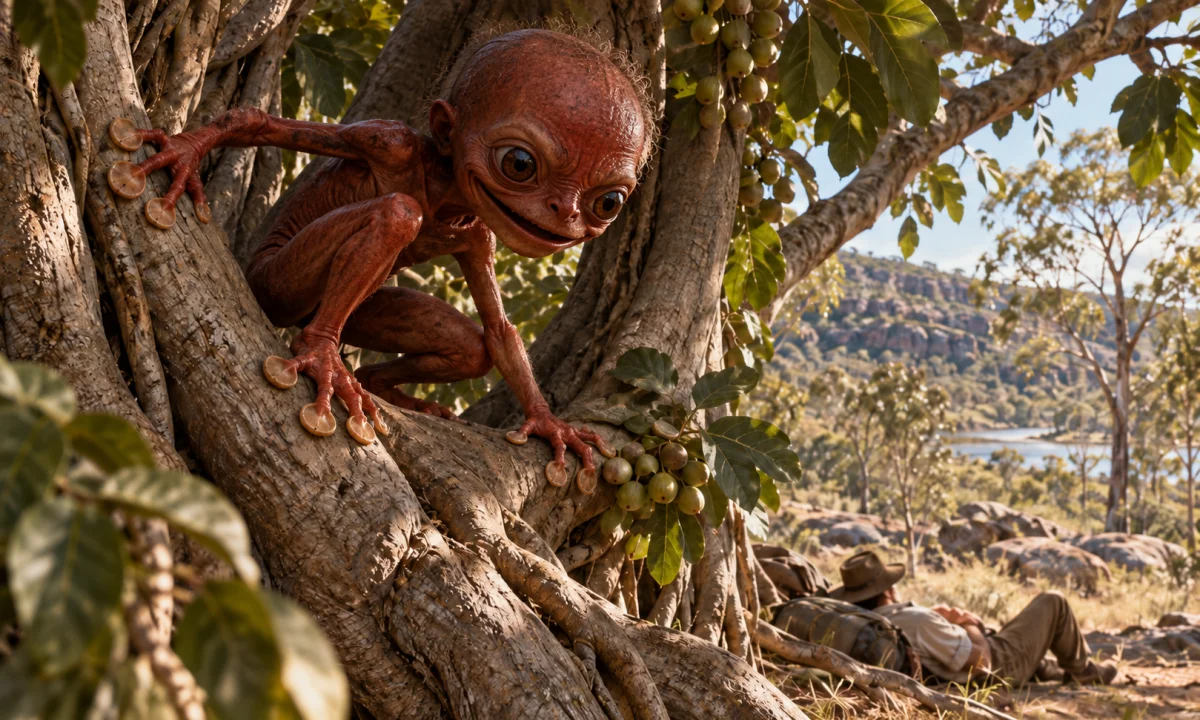
Yara-ma-yha-who is a dangerous blood-drinking being associated with Aboriginal tradition in Australia. In commonly repeated accounts, it is a small red figure that waits in a fig tree and attacks people who come within reach. Instead of teeth or weapons, it uses sucker-like structures on its fingers and toes to draw blood from its victim. The creature is also known for swallowing an attacked person and later bringing them back up, after which the assault may be repeated.
The name is usually written Yara-ma-yha-who, although spelling varies considerably in English-language sources. It is sometimes treated as a “vampire” or “goblin” in modern descriptions, but those labels are approximate comparisons rather than traditional Aboriginal classifications. The figure belongs to a particular body of Aboriginal storytelling recorded in English, not to a single, unified mythology shared by every Aboriginal nation in Australia.
Cultural setting and surviving accounts
Aboriginal Australia contains hundreds of distinct peoples, languages and cultural traditions. Stories about ancestral beings, dangerous spirits, animal persons and extraordinary creatures are connected to particular places, communities and systems of knowledge. Consequently, the broad label Australian Aboriginal mythology can conceal important differences between traditions.
Information about Yara-ma-yha-who comes principally through written collections and retellings rather than through one universally recognised sacred text. European and Australian writers recorded Aboriginal stories from the nineteenth century onward, often using their own spelling systems and categories. In the process, a local name could be transcribed in several ways, while a complex cultural figure might be described with familiar English terms such as “monster,” “devil” or “vampire.”
The surviving English accounts should therefore be read with care. They preserve valuable evidence that the story circulated in Aboriginal oral tradition, but they do not always identify the original language, community, storyteller or setting with enough precision for modern readers to treat every detail as universal. Some popular summaries also combine details from different retellings. The best-supported description is that Yara-ma-yha-who is a small, red, tree-dwelling predator with blood-sucking fingers and a distinctive power of swallowing and regurgitating its victims.
Name and identity
The spelling Yara-ma-yha-who reflects an attempt to represent an Aboriginal name through English orthography. Variants may omit or alter hyphens, change vowels, or use forms such as Yara-ma-yha-wah and other near spellings. These differences do not necessarily indicate different beings; they may result from differences in transcription, pronunciation or publication.
The meaning of the name is not securely established in general English-language reference works. It is unwise to break the name into English words or to assume that the final element is an English question word. Without a clearly identified source language and linguistic context, proposed translations remain uncertain.
Nor is the being consistently classified in traditional terms. “Spirit,” “creature,” “man,” “demon” and “monster” are convenient English descriptions, but none should be assumed to reproduce an Aboriginal category exactly. The creature is better understood through its behaviour and narrative function than through a rigid label.
Appearance
Yara-ma-yha-who is generally described as small and human-like, with red skin or a strikingly red body. The creature has a large mouth but no ordinary teeth. Its most distinctive features are the suckers attached to its fingers and toes. These allow it to cling to a victim and draw blood, giving the being a predatory role similar in one limited respect to that of a vampire.
Descriptions sometimes portray the creature as physically strange or frog-like, but details of its body are not consistent across all modern retellings. The large mouth is especially important because it enables the creature to swallow a person whole. Its lack of teeth makes the attack more unsettling: the danger comes not from biting but from the suckers and the creature’s ability to consume its victim in an unusual way.
Popular illustrations often exaggerate its redness, enlarge its mouth or give it pointed teeth. Such features belong to later visual interpretation, not to the characteristic traditional description. A toothed, bat-like vampire is not an accurate representation of the figure as it appears in the best-known accounts.
The attack in the fig tree
The usual setting is a fig tree, where Yara-ma-yha-who hides among the branches. A person may stop beneath the tree or climb it while searching for food. The creature then reaches down with its unusually long or adhesive fingers and attaches itself to the victim. The suckers draw blood, weakening the person and making escape difficult.
In some retellings, the victim collapses or becomes unconscious. Yara-ma-yha-who then swallows the person whole. This is not presented as a simple act of killing and eating. The creature later regurgitates the victim, leaving the person alive but severely weakened. The attack may happen again if the victim remains within the creature’s reach.
The repeated pattern is central to the story. Each encounter makes the victim weaker, smaller and more altered. If the person cannot escape, the process eventually transforms them into another Yara-ma-yha-who, or into a being resembling the attacker. The exact mechanics differ between summaries, and not every account gives the same number of attacks or the same explanation of the transformation.
This narrative creates a distinctive form of danger. The victim is not merely killed by a hidden predator; they risk losing their human identity. The creature’s appetite and its power to reproduce itself through repeated assault make the encounter both physical and transformative.
Blood, swallowing and transformation
Blood is the creature’s immediate source of nourishment. The image of blood being drawn through fingers connects Yara-ma-yha-who with a broader worldwide group of supernatural beings that feed on vital substance. However, the similarities should not obscure the differences. European vampires, for example, are often associated with corpses, graves, nocturnal haunting and fangs. Yara-ma-yha-who is instead associated with a living tree, sucker-like fingers, swallowing and regurgitation.
The swallowing episode also distinguishes the story from a simple attack tale. In many mythologies, being swallowed by a monster represents death, a journey into another realm or a crisis followed by rebirth. It is not certain that the Yara-ma-yha-who story should be interpreted through any one of these universal patterns. The recorded narrative does, however, use swallowing as part of a cycle in which the victim returns but is no longer safe or unchanged.
The possibility of becoming another creature gives the story a particularly strong warning structure. A person who treats the fig tree as harmless, approaches without caution or fails to escape may gradually cross the boundary between human and monster. Interpretations that describe this as a literal “curse” should be treated cautiously unless they are tied to a specific traditional version. The transformation is clearly part of the narrative pattern, but its wider cultural meaning is not fully recoverable from brief English summaries.
Habitat and behaviour
The fig tree is more than a decorative location. Trees are important sources of food and places of shelter in many Australian environments, so a dangerous being concealed in a tree turns an ordinary landscape feature into a site requiring caution. The story places supernatural danger close to everyday activities such as climbing, gathering food or resting beneath shade.
Yara-ma-yha-who is usually portrayed as an ambush predator rather than a being that openly pursues people over long distances. It waits until a person is close enough for its fingers to reach them. This behaviour explains why the creature’s body is adapted to gripping and feeding rather than to chasing. The fig tree functions as both its home and its hunting platform.
Some modern descriptions call Yara-ma-yha-who a “water monster” or connect it with other Australian beings that inhabit rivers and billabongs. That identification is not secure. The commonly circulated account places Yara-ma-yha-who in a fig tree, and it should not automatically be merged with water spirits, serpent beings or other predatory figures simply because their stories also involve human danger.
Interpretation and significance
At the most immediate level, the story warns against approaching an apparently ordinary place without care. A person who climbs into a tree or stands beneath it may believe the environment is familiar, yet the story reveals a hidden danger. In oral storytelling, such a narrative can entertain while also reinforcing attentiveness to surroundings and respect for places associated with risk.
The figure can also be understood as a story about depletion. The victim is drained of blood, swallowed, returned and drained again. The repeated loss of strength makes the physical consequences easy to imagine, while the final transformation suggests a complete loss of former identity. The creature does not simply consume the body; it threatens to remake the person in its own image.
Interpretations should not be presented as definitive religious doctrines. The available written accounts are too limited and too detached from their original performance contexts to establish one agreed symbolic meaning. It is possible to discuss themes such as danger, bodily transformation and the uncertainty of the landscape, but these are scholarly or literary interpretations rather than proven statements about what every traditional storyteller intended.
There is also a significant difference between a story’s cultural importance and the amount of information preserved in print. A brief published account may represent only one local version, translated and edited by someone outside the community. The absence of further details in English sources does not demonstrate that no further details existed in the original tradition.
Distinction from similar beings
Yara-ma-yha-who is often confused with other supernatural figures because English-language writers place many unrelated beings under broad headings such as “Australian monsters” or “Aboriginal vampires.” Those comparisons are useful only when their limits are made clear.
- It is not automatically a bunyip. The bunyip is a separate and highly variable figure associated in many accounts with waterways. Descriptions of the bunyip differ widely, but a river or swamp setting should not be added to Yara-ma-yha-who without evidence from a particular version.
- It is not a generic Aboriginal devil. The word “devil” was historically used by some outsiders as a loose translation for unfamiliar spiritual beings. It does not establish that Yara-ma-yha-who belongs to a single pan-Aboriginal category of evil spirits.
- It is not simply an Australian vampire. The blood-sucking comparison highlights one feature, but the creature’s tree habitat, sucker-covered fingers, swallowing and regurgitation are distinctive elements of its own story.
- It should not be merged with other tree beings. A creature that lives in a tree is not necessarily Yara-ma-yha-who. Similar habitats occur in many traditions, while the name and combination of traits identify this particular figure.
Modern reception
Yara-ma-yha-who appears today mainly in encyclopedic lists, books about monsters, fantasy discussions and online retellings of Aboriginal mythology. Modern writers often present it as an Australian equivalent of a vampire, sometimes adding horror conventions such as fangs, night vision or a preference for attacking at midnight. These additions make the figure easier to place within international horror fiction, but they are not part of the characteristic traditional account.
Illustrators and game designers may also turn the being into a conventional humanoid monster. Such adaptations can introduce the name to new audiences, yet they should be identified as creative reinterpretations rather than evidence about Aboriginal tradition. The most recognisable traditional features remain the small red body, the fig-tree ambush, the sucker-like fingers and toes, the blood-drinking attack, and the cycle of swallowing, regurgitation and possible transformation.
Respectful discussion also requires acknowledging the limits of the record. Yara-ma-yha-who is not a mascot for all Aboriginal cultures, nor is its story representative of every tradition in Oceania. Its history belongs within the diversity of Aboriginal Australia, where local languages, communities and relationships to Country shape the meaning and transmission of traditional stories.