WORLD
WORLD
Mamaragan
Mamaragan is a powerful ancestral being associated with thunder, lightning and storms in traditions connected with the Yolngu peoples of north-eastern Arnhem Land in the Northern Territory of Australia. English-language accounts often call him a “thunder god” or “lightning spirit”, but those labels can be misleading if they suggest a figure belonging to a single, universally fixed pantheon. Yolngu religious knowledge is expressed through ancestral law, ceremony, song, dance, visual art and relationships with Country. Mamaragan is therefore better understood as a storm-associated ancestral power than as a god in the narrow classical sense.
Cultural setting
The Yolngu peoples live primarily in north-eastern Arnhem Land, including the Gove Peninsula and surrounding islands. Yolngu society contains many distinct clans, languages and ceremonial traditions. Their religious understanding of the world is commonly discussed in English through the word Dreaming, although that translation does not fully convey the range of Yolngu concepts involved.
The ancestral beings of the Dreaming are not merely characters from stories set in a distant mythological past. They established law, shaped the land, created relationships between people and Country, and continue to have significance in the present. A river, hill, animal, plant, weather event or ceremonial design may be connected with ancestral action and law. Stories about such beings can therefore contain religious, geographical, ethical and social knowledge at the same time.
Information about Mamaragan has reached wider audiences through missionary writings, ethnographic records, popular books and later online summaries. These accounts do not all preserve the same details, and some present Yolngu traditions through categories borrowed from European mythology. There is no single canonical narrative of Mamaragan that can safely be treated as the complete version for every Yolngu community.
Name and identity
The name is commonly written Mamaragan, but spelling and pronunciation may vary when an Indigenous name is represented in English. Forms such as Mamarakan and other transcriptional variants may appear in secondary material. Differences can arise from the sounds of the original language, from the use of different Yolngu languages, or from the decisions of individual writers recording oral traditions.
The meaning of the name should not be asserted simply from its English appearance. Popular sources sometimes describe Mamaragan as if the name were a direct equivalent of “thunder” or “lightning”, but a secure interpretation requires knowledge of the relevant language and context. The name may also be used in ways that carry ceremonial or ancestral meanings not captured by a short dictionary definition.
Mamaragan is frequently described as a male figure, particularly in English-language retellings. Such descriptions may reflect particular stories or conventions of translation rather than a complete account of how Yolngu people understand the being. The term “spirit” is also an approximation. Mamaragan is not necessarily comparable to the ghosts, fairies or disembodied souls implied by that word in English-speaking folklore.
Thunder, lightning and storms
Mamaragan’s principal associations are with the dramatic forces of a storm. He is linked with thunder and the flashes of lightning that cross the sky, and he is often imagined as moving through or with storm clouds. Retellings commonly describe him as throwing lightning, sometimes represented as a spear, club or other weapon. These images express the dangerous, sudden and commanding character of a tropical storm.
In Arnhem Land, storms are especially significant because the wet season brings intense rain, powerful winds and frequent lightning after the long dry season. Weather is not simply a background event in such a setting. It affects travel, hunting, food supplies, water, fire and the condition of Country. A storm-associated ancestral being can therefore be connected with both fear and renewal.
Some accounts say that Mamaragan strikes people with lightning, particularly when they have violated ancestral law or behaved improperly. This detail should be treated cautiously. It appears in widely circulated summaries, but such summaries often remove the ceremonial, local and linguistic context in which a story has meaning. The idea nevertheless reflects a wider principle found in many Indigenous Australian traditions: powerful ancestral beings maintain law, and breaches of law can have consequences in the human and natural worlds.
The destructive side of lightning does not make Mamaragan an embodiment of evil. Thunder and lightning may threaten life, but rain can also replenish waterholes, support plants and animals, and mark the return of a productive season. Ancestral power is often morally and environmentally complex rather than divided into a simple opposition between good and evil.
Appearance and representations
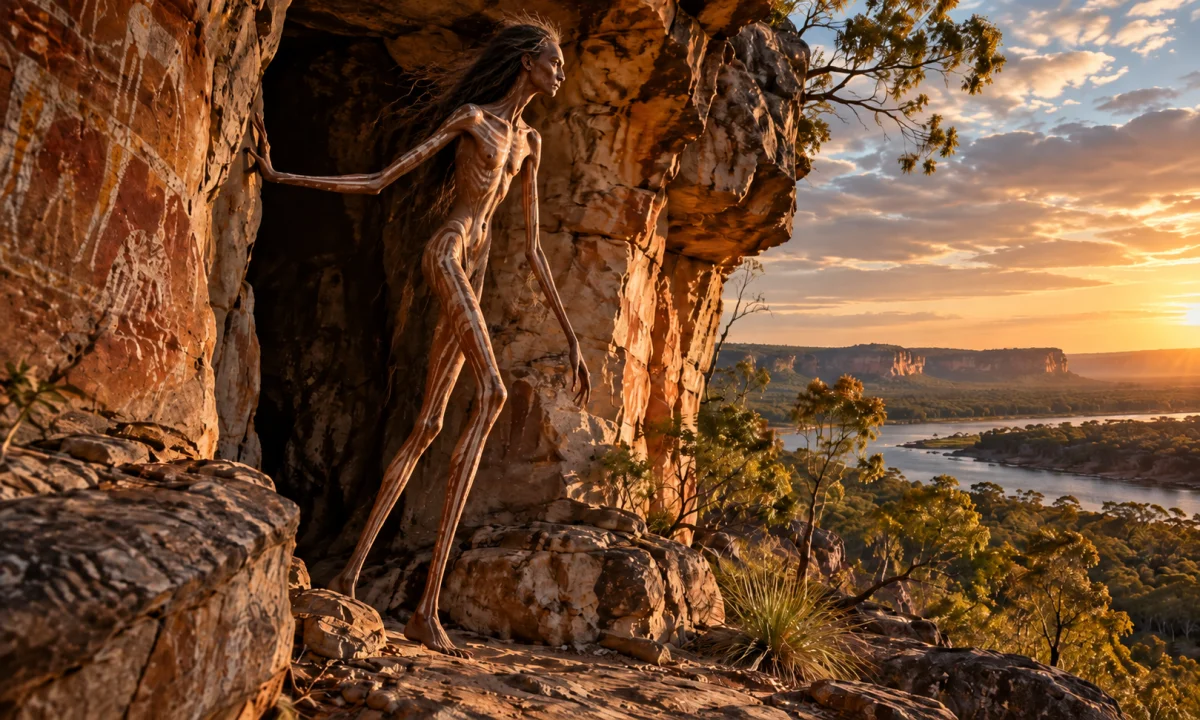
Descriptions of Mamaragan’s appearance are not consistent across modern retellings. He may be presented as a human-like ancestral man associated with a cloud, or as a being whose presence is shown through lightning, darkness and thunder rather than through a stable bodily form. These variations are not necessarily contradictions. Oral traditions and ceremonial representations can emphasise different aspects of an ancestral being according to the purpose of a story or performance.
Images of storm beings in Aboriginal Australian art should not automatically be treated as portraits in the European sense. Designs can refer to a being, an event, a place, a ceremonial relationship or a body of law. The significance of a particular depiction depends on the artist, clan, medium, language group and cultural permissions surrounding it.
English sources sometimes give Mamaragan a thunderbolt or stone weapon. This is a useful visual shorthand for lightning, but it should not be assumed that every Yolngu tradition describes him in precisely that way. Nor should details from one Indigenous nation be transferred to another merely because both traditions include a storm being.
Stories and traditional knowledge
There is no securely documented universal cycle of Mamaragan stories comparable to the connected literary cycles of gods found in some ancient written religions. Yolngu knowledge has traditionally been preserved through oral transmission and through integrated forms of performance, including song, dance, painting and ceremony. Much of that knowledge is also held by particular people, clans or ceremonial groups, and not every element is intended for unrestricted publication.
As a result, accounts available to the general public tend to be brief. They commonly identify Mamaragan with thunder and lightning, describe him as travelling in a storm cloud, and connect his violent power with the enforcement of law. Some versions mention a dwelling or association with a particular rocky place or waterhole, while other versions focus almost entirely on the sky and the storm. Such differences may reflect local traditions, incomplete recording, translation choices or the simplification of complex knowledge for a general readership.
It is important not to combine these fragments into an invented master narrative. A short description repeated in several websites does not necessarily demonstrate that every detail belongs to one ancient story. The surviving public record is uneven, and the absence of a detail from a published account does not prove that it is absent from Yolngu tradition.
Religious and cultural significance
Mamaragan’s importance lies not only in explaining why thunder occurs. A storm ancestor can express the relationship between human conduct, ancestral law and the living landscape. Thunder announces a force greater than an individual person, while lightning makes that force visible for an instant. The imagery naturally lends itself to ideas of authority, warning, judgement and transformation.
These meanings should not be reduced to a primitive “weather explanation”. Traditional religious systems frequently address several questions at once: how a natural event occurs, why it matters, how people should respond to it, and how the event relates to obligations inherited from ancestors. Mamaragan belongs to that wider framework of relationship rather than to a detached catalogue of supernatural causes.
The figure also demonstrates why the category “Australian Aboriginal mythology” must be used carefully. Aboriginal and Torres Strait Islander peoples do not share one mythology. Australia contains many distinct Indigenous nations, language groups and ceremonial systems. A being from Yolngu tradition has a particular cultural setting and should not be presented as representative of all Aboriginal Australian beliefs.
Distinction from other Australian storm beings
Mamaragan is sometimes confused with Namarrkon or Namarrgon, a lightning-associated ancestral being known in Kunwinjku and related traditions of western Arnhem Land. Namarrkon is often called the Lightning Man and is represented in ways connected with lightning emerging from parts of his body. Although both figures are associated with storms and Arnhem Land, they belong to different cultural and linguistic contexts. They should not be merged simply because English summaries describe both as thunder or lightning gods.
Mamaragan should also be distinguished from major ancestral figures such as Wandjina, Baiame and Bunjil. These beings come from different Indigenous traditions and have different relationships to creation, law, Country and ceremony. The fact that an English-language source uses the broad word “god” for several of them does not make them members of one shared Aboriginal pantheon.
Even within discussions of Yolngu religion, it is unwise to assume that every named ancestral being has a fixed role equivalent to a Greek or Norse deity. Yolngu cosmology includes complex relationships among ancestral beings, clans, places, animals, celestial bodies and ceremonial responsibilities. A figure may have a specialised association while still participating in a much wider network of meaning.
Sources, transmission and uncertainty
Much of the publicly available information about Mamaragan comes through non-Indigenous recording and later popularisation. Early observers often translated Indigenous religious concepts into terms such as “god”, “devil”, “spirit” or “myth”. Those choices can preserve valuable information, but they can also obscure distinctions made in the original languages and cultural systems.
Modern descriptions should therefore separate what is broadly consistent from what is uncertain. Mamaragan’s association with thunder, lightning and storms is well established in the commonly available accounts. His exact appearance, weapons, dwelling place, relationships and role in particular narratives vary or are not consistently documented in public sources. Claims about a single spouse, family or detailed adventure should not be repeated unless they can be tied to a clearly identified tradition.
Respect for cultural authority is especially important where knowledge is connected with ceremony, restricted designs or particular clan estates. Public descriptions can acknowledge Mamaragan’s significance without claiming to disclose every aspect of Yolngu religious knowledge.
Modern reception
Mamaragan has occasionally been reused in modern fantasy, comics and popular discussions of mythology. The most conspicuous example is DC Comics’ Mamaragan, a fictional wizard associated with the superhero Shazam. That character belongs to modern comic-book continuity and should not be treated as a direct account of Yolngu religion. Similarity of name does not establish that the comic character possesses the traditional identity, stories or ceremonial significance of the Yolngu storm being.
Modern adaptations may borrow a name because it evokes thunder, magical authority or an ancient supernatural figure. Such borrowing can introduce the name to new audiences, but it can also detach it from Country, language and living cultural tradition. The traditional Mamaragan is not merely a generic thunder god available for use in fantasy settings; he is part of a specific Indigenous religious context whose meanings are held and transmitted by Yolngu communities.