WORLD
WORLD
Kuu
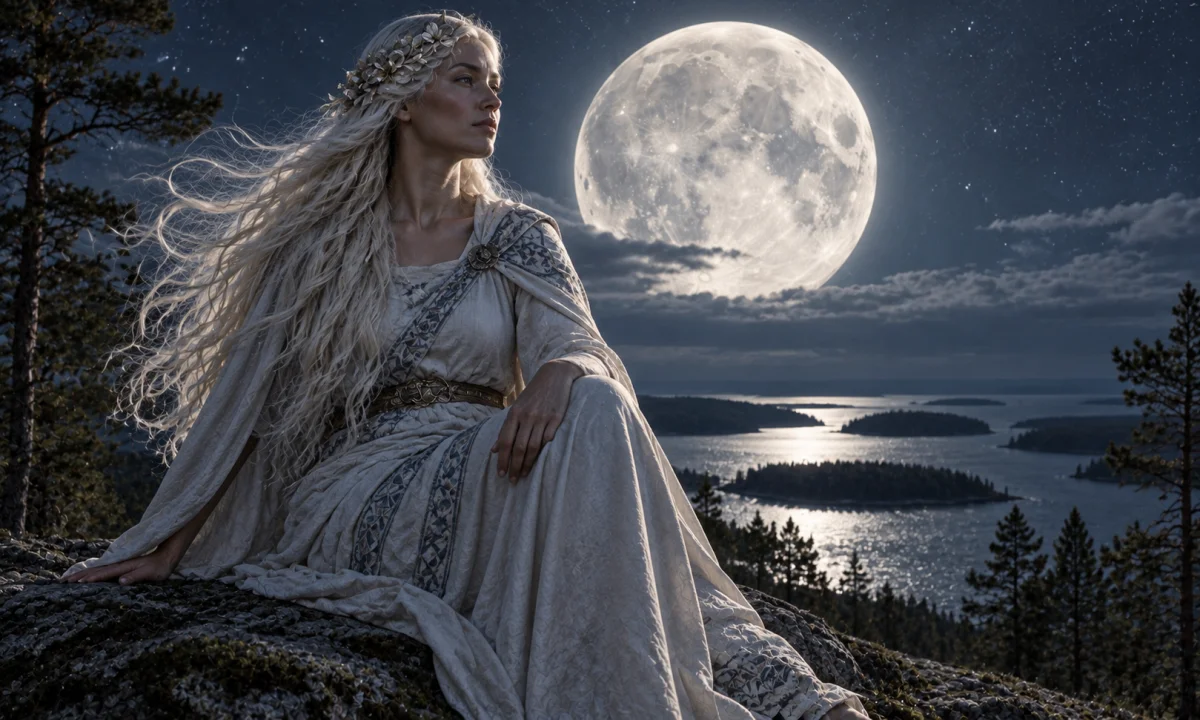
Kuu is the Finnish word for the Moon and, in discussions of Finnish mythology, may refer either to the celestial body itself or to a personified lunar power. It is sometimes presented in modern summaries as a Finnish moon god or goddess, but that description needs caution. Unlike figures such as Väinämöinen, Ilmarinen, Louhi and Ukko, Kuu is not consistently portrayed in surviving Finnish tradition as a fully developed deity with a fixed biography, family and cult. The Moon appears chiefly as a powerful feature of the cosmic world, while poetic figures associated with it—especially Kuutar, the “Moon-Maiden” or “Lady of the Moon”—occupy a more personal and mythic form.
The meaning of Kuu
In modern Finnish, kuu means “moon.” The word can also occur in compounds and expressions connected with the lunar month. In mythology and folklore, however, ordinary words for natural phenomena can be treated as living or acting powers without necessarily becoming individual gods in the later classical sense.
This distinction is important because the name Kuu is often used by encyclopedic websites, fantasy works and popular accounts as though it were the proper name of a single lunar deity. The traditional evidence is less uniform. Finnish oral poetry frequently gives the Sun, Moon, stars, fire, wind and other natural forces an active role, but poetic personification does not always establish a separate divine personality. In some contexts, Kuu is simply the Moon; in others, it is imagined as a being or power that can be hidden, released, questioned or represented by a human-like figure.
The feminine figure Kuutar is especially relevant. Her name is formed from kuu, “moon,” with a suffix that can indicate a female being or personification. Kuutar is therefore best understood as a poetic Moon-Maiden or lunar woman rather than automatically as a universally recognized Finnish moon goddess. The exact function and prominence of Kuutar vary between poetic passages and later interpretations.
Finnish religious and cultural setting
Traditional Finnish religion developed within a wider Finnic cultural environment and was transmitted primarily through oral tradition. Its supernatural world included household spirits, ancestors, local beings, nature powers, ritual specialists and figures later preserved in heroic poetry. It did not possess one standardized canon comparable to the mythology of ancient Greece or a single authoritative sacred book.
Before and alongside Christianization, the rhythms of the natural world were central to life in northern Europe. The Moon marked the passage of months, affected visibility during the long winter, and provided a dependable sign in a landscape where seasonal change could be severe. Lunar observation was therefore practical as well as religious. The Moon belonged to a larger cosmic order that included the Sun, stars, the sky, the earth and the underworld.
Finnish oral poetry was recorded in many forms, including charms, songs and mythic narratives. Much of the material known internationally comes from the Kalevala, the nineteenth-century epic assembled by Elias Lönnrot from oral poems collected in Finland and Karelia. The Kalevala is invaluable for understanding Finnish and related Karelian poetic traditions, but it is not a direct transcript of one ancient Finnish scripture. Lönnrot selected, arranged and sometimes connected materials that had existed in different local and oral contexts.
Consequently, statements about Kuu must distinguish between traditional poetic motifs, the editorial form of the Kalevala and later mythological interpretation. A passage in the epic may preserve an old image while presenting it within a literary structure created in the nineteenth century.
Kuu and the structure of the sky
The Moon belongs to the upper or celestial realm, but Finnish mythic poetry does not always describe that realm through a single, systematic cosmology. Celestial bodies can be treated as visible lights, divine creations, inhabitants of the sky or participants in events that affect the human world.
In the Kalevala, the Sun and Moon are associated with the ordered functioning of the world. One of the best-known episodes tells how Louhi, mistress of the northern land Pohjola, removes or conceals the Sun and Moon. Their disappearance plunges the world into darkness and creates a crisis that affects both gods and humans. The story presents celestial light as essential to life and social order, not merely as a distant natural object.
The episode is not a simple myth of Kuu as an independent lunar god. The Moon functions as part of a paired cosmic system with the Sun. When the lights are absent, the problem is communal and universal: the world loses its normal rhythm, and even powerful beings must respond. The narrative reflects a recurring mythic idea found in many cultures—the theft, imprisonment or obstruction of heavenly light—but its Finnish poetic setting and relationship to Pohjola give it a distinctive form.
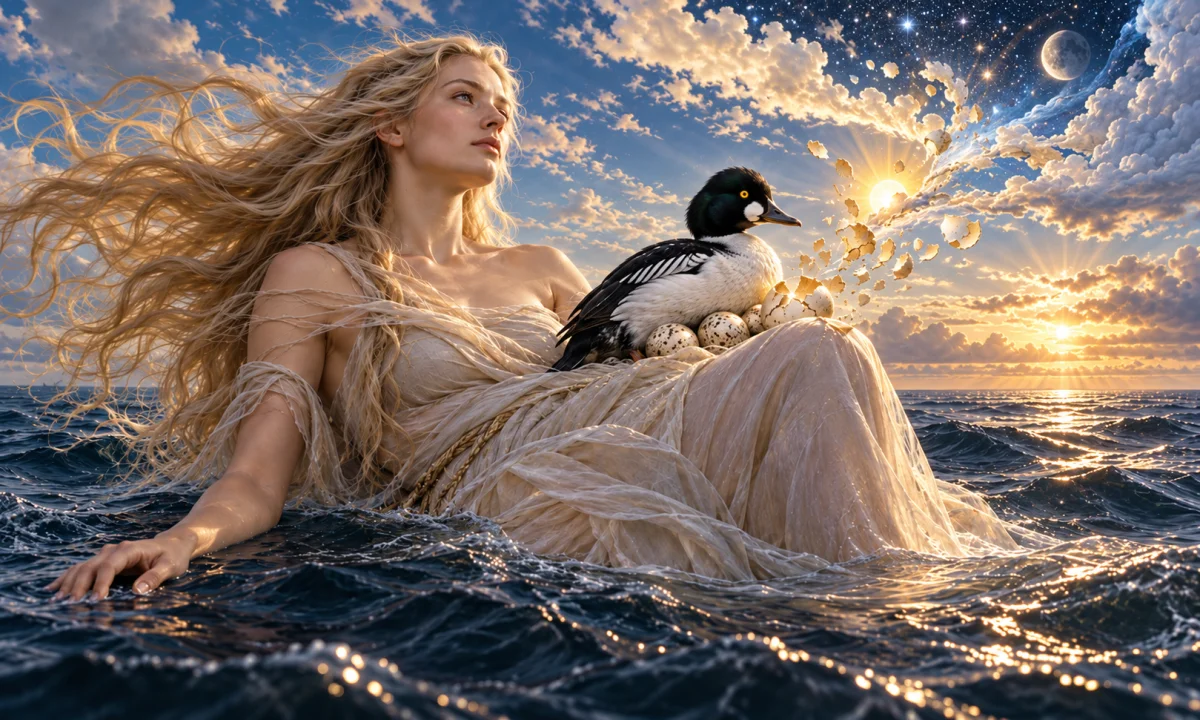
Other poems portray the Sun and Moon through female figures, often named Päivätär and Kuutar. Their names can be translated approximately as “Sun-Maiden” and “Moon-Maiden,” although translations differ in tone. They may appear as radiant women, celestial maidens or supernatural figures associated with precious metals, clothing and craftsmanship. These scenes should not be flattened into a single official family tree. The poems are varied, and the figures do not consistently act as characters with one stable mythology.
Kuutar, the Moon-Maiden
Kuutar is the most important named personification connected with Kuu. In Finnish poetic language, she belongs to a group of feminine natural beings whose beauty and radiance express the qualities of the celestial world. The association is often paired with Päivätär, the Sun-Maiden, creating a contrast between lunar and solar light.
Descriptions connected with Kuutar and Päivätär may involve adornment, precious materials and the production of garments or ornaments. Gold and silver are particularly appropriate symbols for solar and lunar brightness in northern oral poetry. Such imagery does not necessarily mean that Kuutar ruled a kingdom or possessed a temple. It turns the light of the Moon into something that can be imagined as woven, worn or shaped by supernatural hands.
The poetic women of the sky are also linked to the traditional importance of textile work. Weaving, spinning, sewing and ornament-making were fundamental domestic skills, and mythic poetry often presents them on a cosmic scale. A celestial maiden’s clothing can therefore symbolize both heavenly radiance and the idealized work of women within the human community.
Because Kuutar is a poetic personification, her identity should not be confused with that of every lunar female figure in Finnish or neighbouring traditions. Some passages may use a name as an ornamental title, while others treat the figure more vividly as a supernatural woman. The evidence supports her importance as a lunar image, but not a detailed standardized biography.
Appearance and symbolism
Kuu’s traditional appearance is not fixed. When the Moon is described directly, its principal qualities are its light, changing shape, position in the sky and relationship to darkness. When personified, it may take the form of a radiant celestial being, often feminine through the figure of Kuutar.
Several symbolic themes are associated with the Moon:
- Light in darkness: Moonlight offers orientation and visibility during the night, especially in northern regions where winter darkness has great practical significance.
- Change and recurrence: The lunar phases provide a visible pattern of growth, fullness and disappearance. Traditional interpretations need not assign one fixed meaning to each phase, but the cycle naturally suggests renewal and return.
- Timekeeping: The Moon is connected with the measurement of months and the organization of seasonal life.
- Celestial beauty: Through Kuutar, lunar light becomes feminine radiance, adornment, silver or finely made clothing.
- Cosmic balance: The Moon’s relationship with the Sun expresses the ordered alternation of day and night.
- Vulnerability of order: In stories where the Moon is hidden, the darkness demonstrates how dependent the world is on the continued presence of celestial lights.
These are interpretive themes rather than a list of powers belonging to a universally defined goddess called Kuu. Finnish folklore contains many local beliefs about the Moon, but they do not all form one system.
Moon lore and folk belief
Beyond epic poetry, the Moon was part of everyday folk knowledge. People observed its phases, associated particular times with agricultural and domestic activities, and incorporated lunar references into charms, sayings and customary practices. Such beliefs were not necessarily “worship” of the Moon. They belonged to a practical and symbolic relationship with the natural environment.
In agrarian societies, timing mattered. The phase of the Moon could be considered when planning work, cutting materials or carrying out household tasks, although beliefs varied by region and period. Similar lunar customs occur across northern Europe, so a practice cannot automatically be labeled uniquely Finnish. The Finnish evidence is best understood as part of a broad northern tradition shaped by local language, environment and custom.
Older Finnish charms often address natural forces directly. A speaker may ask, command or persuade a phenomenon to behave in a particular way. This style of speech does not always identify the addressed power as a god. It reflects a worldview in which words, names and relationships can influence the balance between humans and the forces around them.
Christianization also changed the interpretation of celestial phenomena. Older motifs could survive within a Christian cultural setting, sometimes as folklore rather than formal religion. Later collectors and scholars frequently recorded beliefs after centuries of religious change, making it difficult to separate pre-Christian practice from medieval, Christian or more recent interpretation.
The disappearance of the Sun and Moon
The episode involving Louhi and the stolen celestial lights is the clearest major narrative in which the Moon has a central function in Finnish epic tradition. Louhi imprisons the Sun and Moon, and the world is left in darkness. The crisis demonstrates the power of the mistress of Pohjola while also revealing the limits of that power: hiding the lights disrupts the entire cosmic order.
In the Kalevala, attempts are made to restore light, and the heavenly bodies are eventually recovered. The narrative includes efforts to create substitute lights from valuable materials, but artificial brightness cannot simply replace the true Sun and Moon. This contrast emphasizes that cosmic powers are not easily manufactured by human or heroic skill.
The story should not be treated as a biography of Kuu. The Moon has no consistent individual voice, personality or set of personal adventures in the way Väinämöinen does. Its importance comes from what it represents: the continuation of the world’s natural order and the fragile boundary between light and darkness.
Relationships with other figures
Kuu is most closely linked with the Sun. In poetic personification, Kuutar and Päivätär may appear as complementary celestial women. The relationship is one of parallel status rather than a consistently narrated marriage, siblinghood or rivalry. Claims that they are always sisters, spouses or daughters of a particular god should be treated as interpretations unless tied to a specific passage.
Ukko, the powerful sky-associated figure in Finnish tradition, is sometimes connected with the ordering of weather and the heavens. However, the evidence does not support simply making Kuu a subordinate child or spouse of Ukko. Finnish mythological figures do not always fit into a single genealogical pantheon, and later diagrams can impose a structure that the oral material does not possess.
Louhi’s relationship with the Moon is antagonistic in the episode of concealment. She is not a lunar goddess, nor is Kuu a form of Louhi. Louhi belongs to the mythic world of Pohjola and is associated with powerful magic, sovereignty and opposition to the heroes. The Moon is one of the lights affected by her actions.
Distinguishing Kuu from similar figures
Kuu and Kuutar: Kuu is the Finnish Moon or its personified power; Kuutar is a named lunar maiden or feminine poetic embodiment. They are related, but the names should not automatically be treated as two separate deities in a formal pantheon.
Kuu and Päivätär: Päivätär is associated with the Sun, while Kuutar is associated with the Moon. They are complementary figures, not interchangeable names for one goddess.
Kuu and Selene or Artemis: Greek Selene and Artemis belong to different religious and literary systems. Comparisons may help explain the general idea of a lunar personification, but they do not establish that Kuu had the same powers, myths or cult practices.
Kuu and Máni: Máni is the named Moon figure in Old Norse mythology. Finnish Kuu belongs to a different language and tradition. Shared northern themes do not prove that the two figures were the same being or directly borrowed from one another.
Kuu and modern moon goddesses: Contemporary pagan and fantasy sources may turn Kuu or Kuutar into a fully developed goddess with a defined sacred history. Such representations can be meaningful within modern practice or fiction, but they should be identified as modern interpretations rather than presented as an uncontested account of Finnish tradition.
Interpretation and cultural significance
Kuu is significant precisely because Finnish tradition does not require every supernatural force to have a detailed human-like mythology. The Moon can be sacred, active and symbolically powerful without possessing a fixed temple cult or complete divine genealogy. This reflects the flexible character of oral tradition, in which a natural phenomenon may be addressed as a person in one poem and described more impersonally in another.
The figure also reveals how Finnish poetry connects the cosmic and domestic worlds. Lunar light becomes a woman’s beauty, silver ornament, woven clothing and skilled handiwork. At the same time, the disappearance of the Moon becomes a crisis affecting the whole world. Kuu therefore occupies both intimate and cosmic dimensions: it belongs to the night sky, but it is also part of the seasonal, agricultural and household life of the people who observed it.
Modern presentations are most accurate when they describe Kuu as the Moon in Finnish mythology and folklore, while explaining that Kuutar provides the clearest named feminine personification. Calling Kuu a “moon god” or “moon goddess” without qualification can suggest a standardized deity that the surviving evidence does not clearly establish. The older material is richer when its variations are preserved rather than forced into a rigid pantheon.