WORLD
WORLD
Päivätär
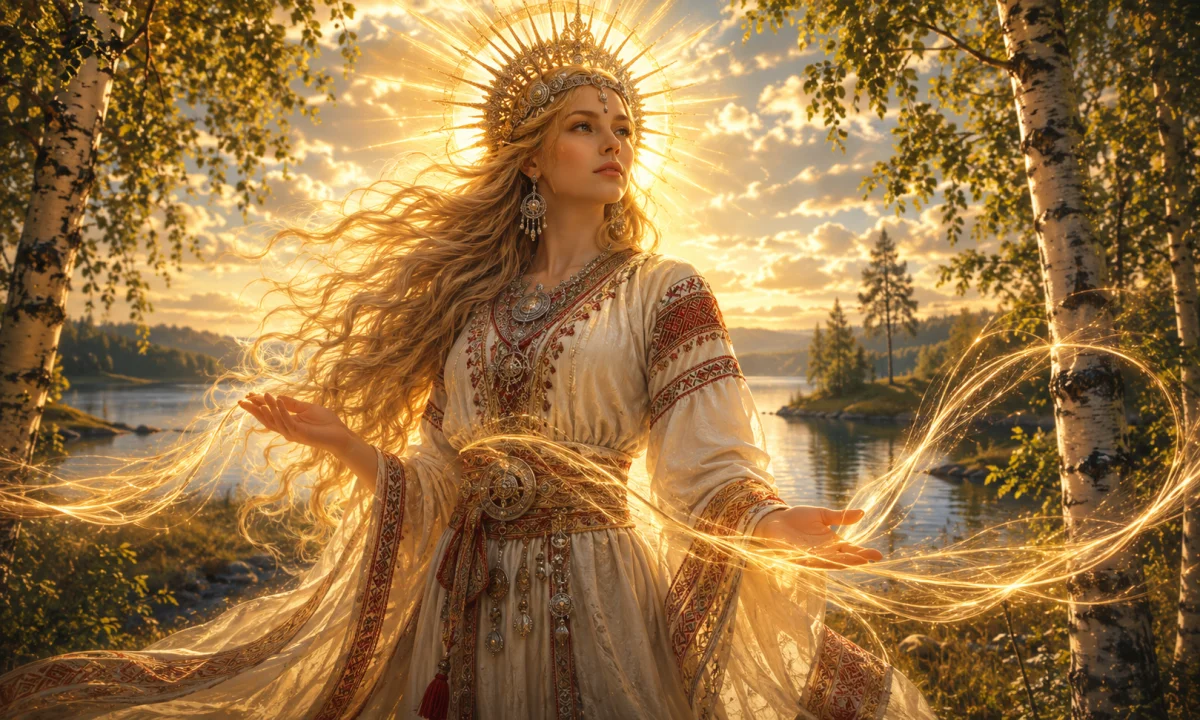
Päivätär is a feminine personification of daylight in Finnish mythology. Her name is usually understood as “Lady of the Day” or “Mistress of the Day,” from the Finnish word päivä, meaning “day.” She is often described in modern summaries as a sun goddess, but that label can be misleading if it suggests a single, clearly defined deity with a fixed mythology. In the surviving Finnish material, Päivätär is better understood as a poetic and mythic figure associated with daylight, the sun’s radiance, and the celestial world.
Her most familiar portrayals come from the poetic tradition represented by the Kalevala, the national epic compiled by Elias Lönnrot from Finnish and Karelian oral poetry. The Kalevala does not present a systematic pantheon comparable to the gods of Greek or Norse mythology. Its supernatural figures emerge from songs, charms, narratives, and regional traditions that were shaped by generations of oral singers. As a result, Päivätär’s identity is not defined by one complete biography or a universally consistent set of myths.
Origins in Finnish tradition
Finnish traditional religion developed in a largely oral cultural environment. Before the spread of Christianity, people expressed ideas about nature, fate, healing, fertility, death, and the structure of the cosmos through stories, ritual formulas, songs, and relationships with local spirits. Christianization introduced new religious ideas, but older beliefs continued in transformed or blended forms. Much of the evidence for pre-Christian Finnish religion was recorded only in the eighteenth and nineteenth centuries, by which time the material had already passed through long periods of cultural change.
The poems later gathered into the Kalevala were collected primarily in Finland and Karelia. Lönnrot arranged and edited this material into an extended epic, first published in an earlier form in 1835 and in a much expanded form in 1849. The epic is an invaluable record of Finnish and Karelian poetic culture, but it should not be treated as a direct transcript of an ancient Finnish scripture. Its characters and episodes may combine motifs from different regions and poetic traditions.
Päivätär belongs to this fluid mythological environment. She is not known from a single surviving ancient temple tradition, canonical prayer book, or independent cycle of legends. Her importance comes from the way daylight and celestial beauty are expressed through female figures in Finnish poetry. The name also reflects a common feature of Finnish mythic language: natural forces may be represented as persons, maidens, mothers, sons, or powerful beings without belonging to a rigid family tree.
Name and classification
The name Päivätär contains päivä, “day,” together with the feminine-forming suffix -tar. This suffix appears in several traditional female names and titles, including figures associated with natural or cosmic phenomena. The name therefore conveys something like “she of the day” rather than necessarily identifying a goddess in the institutional sense.
Translations commonly call Päivätär a goddess of the sun, a goddess of daylight, or a sun maiden. “Goddess” is convenient in English, but it imposes a category that Finnish oral tradition does not always use in the same way. Päivätär may be treated as a divine or supernatural woman in a poetic passage, while elsewhere the sun or day is described through ordinary nouns, impersonal forces, or other personifications.
The relationship between Päivätär and the sun is therefore interpretive as well as descriptive. She is strongly linked with daylight and solar brightness, yet she should not automatically be equated with every occurrence of the Finnish word for the sun, aurinko, or with every mythic reference to day. Different sources and modern retellings can give her a more definite personality than the older material itself supports.
Päivätär and Kuutar
Päivätär is frequently paired with Kuutar, the female personification of the moon. Their names form a natural opposition: Päivätär belongs to the day, while Kuutar belongs to the night and moonlight. Together they represent the two great luminous cycles of the sky.
In poetic imagery, Päivätär and Kuutar appear as radiant maidens or heavenly women. They are associated with beautiful clothing, shining ornaments, and precious materials. Gold is especially suitable for solar imagery, while silver is commonly connected with moonlight. The precise assignment of these materials can vary according to translation and poetic context, so descriptions of Päivätär’s garments should not be treated as a fixed costume recorded in every Finnish tradition.
The pair also demonstrates how Finnish mythology often gives a human and domestic form to cosmic processes. The sun and moon are not only distant objects in the sky; they may be imagined as women who work, dress, adorn themselves, or perform crafts. Such images make the movement of the heavens part of the familiar human world while preserving their supernatural brilliance.
Appearance and attributes
Päivätär’s traditional image is one of radiance rather than of a warrior, ruler, or monster. She is generally imagined as a beautiful celestial maiden whose brightness reflects the power of day. Golden hair, shining ornaments, and luminous clothing are recurring motifs in modern descriptions, although not every detail belongs to a single, stable account of her.
One important motif connected with Päivätär and Kuutar is textile work. The heavenly maidens may be represented as weaving or preparing splendid fabrics, especially cloth of gold and silver. Weaving was an ordinary and highly significant domestic craft in traditional Finnish society, but in mythic poetry it could also symbolize the ordering and beautifying of the cosmos. The image of a celestial woman making precious cloth joins household skill with supernatural power.
Other poetic images associate the maidens with hair, combs, adornment, and radiant beauty. These details should be read as part of a broader style of Finnish oral poetry, in which precious metals, finely made objects, and shining natural phenomena are used to express wonder. They do not necessarily establish a complete set of magical tools or powers belonging exclusively to Päivätär.
Her principal “power” is the presence and quality of daylight. In symbolic interpretation, this can include illumination, warmth, visibility, regularity, growth, and the return of order after darkness. These associations are reasonable ways of understanding her symbolism, but they are not all stated as formal doctrines in Finnish sources. The practical importance of sunlight in an agricultural and northern environment also gives the figure an obvious cultural resonance without requiring a detailed solar theology.
Daylight, seasonal life, and the northern environment
Daylight had an exceptional importance in the Finnish and Karelian environment. The yearly contrast between long summer days and short winter days shaped travel, work, agriculture, animal husbandry, and social life. Sunlight brought warmth and supported the growth of crops, while darkness and winter imposed real physical limits. A female figure representing day could therefore evoke more than brightness alone: she could suggest the dependable return of useful light and the life-giving force of the sun.
It would nevertheless be too strong to describe Päivätär as a fully documented fertility goddess or agricultural goddess. Such descriptions often arise from modern comparative interpretation rather than from a consistent body of Finnish stories. Her connection with daylight allows associations with growth and seasonal renewal, but the evidence does not establish a single official sphere of authority comparable to the domains assigned to deities in some other mythological systems.
Finnish mythic poetry often treats the sky as a region inhabited by beings who possess beauty, skill, and cosmic importance. Päivätär belongs to this elevated world. She is not usually an active protagonist in a long adventure, and she does not have a large cycle of individual exploits. Her significance lies in the poetic role she plays when singers describe the sun, day, brightness, or heavenly craftsmanship.
Presence in the Kalevala
The Kalevala provides the best-known literary setting for Päivätär in English-language discussions. Its poetry contains images of radiant maidens connected with the sun and moon, as well as references to the celestial powers that govern the alternation of light and darkness. Päivätär’s appearances are poetic and episodic rather than the parts of a continuous character arc.
Readers should be cautious when treating an English translation as evidence for an exact Finnish identity. Translators sometimes use expressions such as “sun maiden,” “goddess of day,” or “daughter of the sun” to convey the sense of a passage. These renderings may clarify the imagery for an English audience, but they can also make a fluid poetic figure seem more like a formally defined deity. Different translations may handle names, grammatical forms, and relationships differently.
The Kalevala also contains major episodes concerning the sun and moon being hidden or deprived from the world. These episodes express the danger of cosmic disorder when light is removed. They should not automatically be read as stories solely about Päivätär. In some passages, the celestial bodies are treated directly as sun and moon, while in others mythic personifications or heavenly maidens appear. The names and roles do not always align neatly across every version of the poetry.
For this reason, Päivätär should not be assigned every event involving the Finnish sun. She is connected with the daylight tradition, but the collected epic preserves several overlapping ways of imagining celestial light. The figure’s exact presence may depend on the particular poem, manuscript, translation, or interpretive tradition being considered.
Religious and symbolic significance
In the context of Finnish folk religion, natural forces were not necessarily separated from human concerns by a strict division between “religion” and “magic.” Songs and incantations could address beings associated with the heavens, forests, waters, animals, disease, or the household. A name connected with daylight could therefore carry a religious, poetic, and practical meaning at the same time.
Päivätär’s imagery reflects several important themes:
- Light and visibility: daylight reveals the world and makes movement and work possible.
- Warmth and life: solar brightness is associated with the conditions that sustain plants, animals, and people.
- Cosmic rhythm: her contrast with Kuutar evokes the recurring alternation of day and night.
- Radiant beauty: gold, shining hair, precious clothing, and fine workmanship express the splendour of the heavens.
- Female creative skill: weaving and adornment connect cosmic order with valued domestic crafts.
These themes are interpretive categories rather than a list of commandments or official attributes. Finnish tradition was regionally varied, and the evidence does not indicate that every community understood Päivätär in precisely the same way.
Distinction from related figures
Kuutar
Kuutar is Päivätär’s most important counterpart. Kuutar is associated with the moon and moonlight, while Päivätär belongs to the day and solar brightness. They are often presented as complementary celestial maidens. The pair should not be collapsed into one generic “sun and moon goddess,” because their names and symbolic fields are distinct even when they occur together.
The sun and aurinko
Päivätär is not simply another name for the Finnish sun. Aurinko is the ordinary Finnish word for “sun,” and traditional poetry can speak of the sun without invoking Päivätär. The sun may also be personified in forms that do not match the image of a female day-maiden. Calling Päivätär “the sun” is therefore a useful shorthand only when the context makes her personifying role clear.
Other Finnish female spirits
Päivätär should also be kept separate from figures such as Mielikki, associated in later tradition with the forest, and Vellamo, associated with waters. These beings belong to different areas of Finnish mythic imagination. Similar English descriptions such as “goddess of nature” can obscure the distinctions among celestial, forest, and water traditions.
Later reception
Päivätär has had a modest but persistent presence in modern presentations of Finnish mythology. Encyclopaedias, fantasy writing, neopagan discussions, games, and illustrated retellings often give her a clearer personality, genealogy, costume, and set of powers than the traditional evidence provides. She may be portrayed as a majestic solar queen, a radiant maiden, or the sister of a moon goddess. These are modern interpretations unless they can be tied to a specific traditional passage.
Her continued appeal comes from the clarity of the image: a female embodiment of the long northern day, paired with a lunar counterpart and surrounded by gold, silver, weaving, and heavenly light. That image belongs meaningfully to Finnish poetic tradition, but modern creative works should be distinguished from the fragmentary and varied evidence preserved in oral poetry and the Kalevala.