WORLD

Findbhair
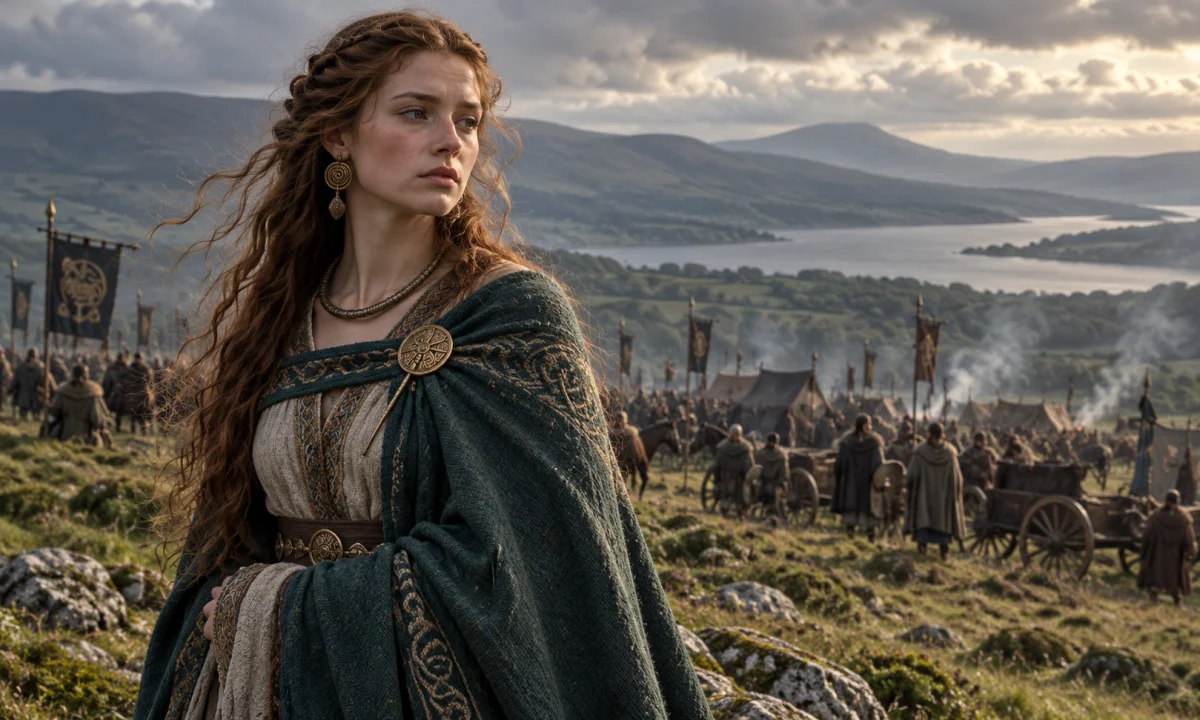
Findbhair is a figure of Irish mythology best known under the spellings Findabair and Finnabair. She is presented in medieval Irish literature as the daughter of Medb, queen of Connacht, and Ailill mac Máta. Findbhair belongs chiefly to the Ulster Cycle, particularly the stories surrounding the Táin Bó Cúailnge, or Cattle Raid of Cooley, and the related tale Táin Bó Fraích. She is not generally depicted as a goddess or supernatural being. Instead, she is a royal woman whose beauty, marriage prospects and family position become part of the political and military conflicts of the heroic age.
Name and identity
The form Findbhair reflects one modern Irish spelling, while medieval and English-language discussions more often use Findabair, Finnabair or Finnavar. The spelling varies because Irish names were transmitted through manuscripts written in different periods and later adapted into modern Irish and English. These forms normally refer to the same Connacht princess, although names resembling Findabair can occur elsewhere in Irish tradition.
The name is often interpreted as containing find, meaning “fair,” “white” or “bright.” It is sometimes explained as referring to a “fair brow” or “white brow,” but the exact historical formation and meaning should not be treated as certain. Medieval Irish names do not always preserve an obvious literal description, and later popular explanations can be more confident than the surviving linguistic evidence allows.
Findbhair is the daughter of Medb and Ailill in the principal stories associated with her. Her parents rule Connacht from Crúachan, usually identified with Rathcroghan in County Roscommon, one of the most important royal sites in Irish tradition. Her family therefore places her at the centre of the Connacht royal household and connects her directly with the rivalry between Connacht and Ulster.
Cultural and literary setting
Findbhair belongs to the Ulster Cycle, a group of medieval Irish narratives concerned with the heroes of Ulster, the kings and warriors of Connacht, and conflicts between rival kingdoms. The cycle includes heroic combats, cattle raids, royal feasts, prophetic episodes and stories about marriage alliances. Its best-known hero is Cú Chulainn, who defends Ulster almost single-handedly during the Connacht invasion described in the Táin Bó Cúailnge.
The stories were written down by Christian-era scribes, probably from older oral and literary materials. The surviving manuscripts are medieval, and the tales exist in different versions and textual recensions. They should not be read as straightforward records of an identifiable historical princess or as unchanged survivals from pre-Christian Ireland. At the same time, they preserve important ideas about early Irish heroic society, including the relationship between kingship, cattle wealth, honour, marriage and military reputation.
Findbhair’s role is shaped by this social world. A royal daughter is not merely a private individual in these stories. Her marriage can strengthen an alliance, reward a warrior or express the power of her family. The narratives therefore use her as part of the economy of honour and obligation that drives the actions of kings and champions.
Findbhair in Táin Bó Fraích
The tale Táin Bó Fraích gives Findbhair one of her clearest narrative roles. It centres on Fráech, a celebrated warrior associated with the Connacht and Ulster heroic traditions, and his desire to marry her. Findbhair and Fráech are presented as lovers, but their relationship is also subject to the demands of her powerful parents.
In the story, marriage is negotiated through gifts, status and the expectations of the royal household. Fráech must meet the conditions imposed by Ailill and Medb, and the negotiations become entangled with the wealth and honour of both families. The tale reflects a recurring feature of Irish heroic literature: a love match may be genuine, but it cannot easily escape the political and economic structures surrounding a noble marriage.
Findbhair is not simply a passive prize in this narrative. Her affection for Fráech gives the story its emotional centre, and the relationship places her in opposition to the calculations of her parents. Nevertheless, the story is told within a patriarchal aristocratic framework in which her family exercises considerable control over her marriage. Her wishes matter, but they do not automatically determine the outcome.
Fráech’s courtship of Findbhair also establishes his credentials as a hero. To win a royal bride, he must demonstrate wealth, courage and social worth. The episode is therefore both a romantic narrative and a test of heroic status. Findbhair’s position makes her desirable, but it also makes her marriage a measure of Fráech’s standing among the warrior elite.
Findbhair and the Táin Bó Cúailnge
Findbhair appears in the wider story of the Táin Bó Cúailnge, where her mother Medb leads the army of Connacht and its allies against Ulster. The purpose of the expedition is to seize the great bull Donn Cúailnge from Cooley. The raid is motivated by the rivalry between Medb and Ailill, their competition over wealth and status, and the extraordinary value attached to cattle in the heroic world.
As Cú Chulainn delays the invading army through a series of single combats, Findbhair’s name becomes connected with the promises Medb makes to encourage warriors. In some passages and versions, her hand is offered as a reward to men willing to confront the Ulster champion. The exact sequence and details vary among texts, but the underlying pattern is clear: the princess is used as a royal incentive within a military crisis.
This treatment does not necessarily mean that Findbhair has no personal agency in every version. Rather, it shows how the narrative frames the authority of Medb and the vulnerability of a royal daughter. Medb can invoke Findbhair’s marriage as a political resource because she is queen and because her daughter’s future is tied to the prestige of the Connacht dynasty. The episode also reveals the grim logic of heroic values: men seek fame, rewards and marriage alliances even when the promised prize is connected with almost certain death.
The relationship between Findbhair and Medb is especially significant. Both are royal women, but they occupy very different narrative positions. Medb acts openly as ruler, military leader and political strategist. Findbhair is more often represented as the daughter whose identity is controlled by the decisions of others. Her presence helps show the difference between a woman who possesses sovereign power and a woman whose rank gives her value but not equivalent authority.
The death associated with her name
In accounts connected with the end of the cattle raid, Findbhair becomes the cause, or supposed cause, of a disastrous competition among warriors. The exact form differs between versions, but the general story is that Medb promises her to champions who will defeat Cú Chulainn. When the consequences of these promises lead to the deaths of numerous men, Findbhair dies from grief, shame or shock after learning what has happened.
Some versions describe her death as resulting from the terrible number of warriors who have died for her sake. Other tellings place more emphasis on the absurdity and cruelty of the competition generated by Medb’s promise. It is important not to treat every detail found in modern retellings as belonging equally to all medieval texts. The Táin survives in more than one form, and episodes can be expanded, shortened or presented differently.
Her death is often interpreted as a tragic criticism of the heroic system that turns a person into a reward. Findbhair herself does not create the contest, command the warriors or choose the terms under which they fight. Yet she is made symbolically responsible for its consequences because her marriage has been used as the prize. The tragedy exposes the gap between the value assigned to a royal woman and her limited control over the decisions made in her name.
Some traditions associate her burial with a place-name or a mound bearing a form of her name. Such associations belong to the broader Irish practice of linking legendary figures with landscapes, burial places and ancient monuments. They should be understood as elements of mythic geography rather than secure archaeological evidence that Findbhair was a historical person.
Character and narrative function
Unlike Cú Chulainn, Medb or Fráech, Findbhair is not defined by a long sequence of heroic feats. Her importance comes from the position she occupies within other people’s ambitions. She is a daughter, a desired bride and a political instrument, but the stories also give her emotional significance through her love for Fráech and her distress at the deaths associated with her.
Her character is consequently more tragic than martial. The surviving narratives do not present her as a warrior, prophetess or shape-shifter. There is no consistent tradition granting her magical weapons, divine ancestry or special supernatural powers. Descriptions of extraordinary beauty may occur as part of the conventions of aristocratic romance, but they do not make her a goddess or an otherworldly being.
Findbhair’s story also demonstrates how Irish heroic literature can place women at the centre of political conflict without giving them equal narrative control. Medb’s actions show that women could be imagined as rulers, negotiators and commanders, while Findbhair’s experiences show the constraints imposed upon a royal daughter. The contrast is not a simple statement about historical Irish women; it is a feature of the literary relationships constructed by the tales.
Variants and distinctions
The name Findbhair should not automatically be applied to every figure called Findabair or Finnabair in Irish tradition. Medieval Irish literature contains repeated personal names, and genealogical or local traditions may preserve individuals who are not the daughter of Medb and Ailill. The Connacht princess is identified by her relationship to those rulers and by her appearances in the stories of Fráech and the cattle raid.
Findbhair is also distinct from other famous women of the Ulster Cycle. She is not Deirdre, whose tragedy centres on Naoise and the sons of Uisliu; she is not Emer, the wife of Cú Chulainn; and she is not Medb, the queen who commands the Connacht army. Confusion can arise when modern retellings regularise different spellings or use shortened forms of names without explaining the characters’ family relationships.
She should likewise not be confused with Fionnuala, Finnuala or other names beginning with Finn- or Fionn-. These names may share elements associated with fairness or brightness, but they belong to different traditions and figures. Similar spelling is not evidence that the characters are versions of one another.
Interpretation and significance
Findbhair’s episodes illuminate the importance of marriage and gift exchange in the imagined aristocratic society of the Ulster Cycle. A bride from the Connacht royal family represents alliance, wealth and prestige. Her value is not only personal or romantic; it is embedded in negotiations between households and kingdoms. The stories use this system to generate both heroic opportunity and tragedy.
Her fate also reflects the narrative’s suspicion of excessive competition. The warriors who pursue her as a reward are motivated by the heroic pursuit of honour, yet their actions reveal the destructive side of that ideal. Findbhair becomes the human focus of a contest that treats reputation as more important than life. Her death gives emotional form to the consequences of turning marriage into a military prize.
At the same time, the stories should not be reduced to a single modern moral. Medieval audiences could have understood Findbhair through several overlapping frameworks: the grief of a princess, the danger of rash promises, the authority of a queen, the obligations of kinship and the unstable nature of heroic fame. Her significance lies partly in this ambiguity. She is both a person within the story and a symbol of the social values that the story tests.
In modern discussions of Irish mythology, Findbhair is sometimes overshadowed by Medb, Cú Chulainn and Deirdre. Her comparatively limited independent tradition makes it difficult to reconstruct a complete biography or a stable personality beyond the surviving episodes. What can be said with confidence is that she is a Connacht princess of the Ulster Cycle, connected with Fráech, used in the political and military schemes of her parents, and remembered in tragic traditions associated with the Táin Bó Cúailnge.