WORLD
WORLD
Iae
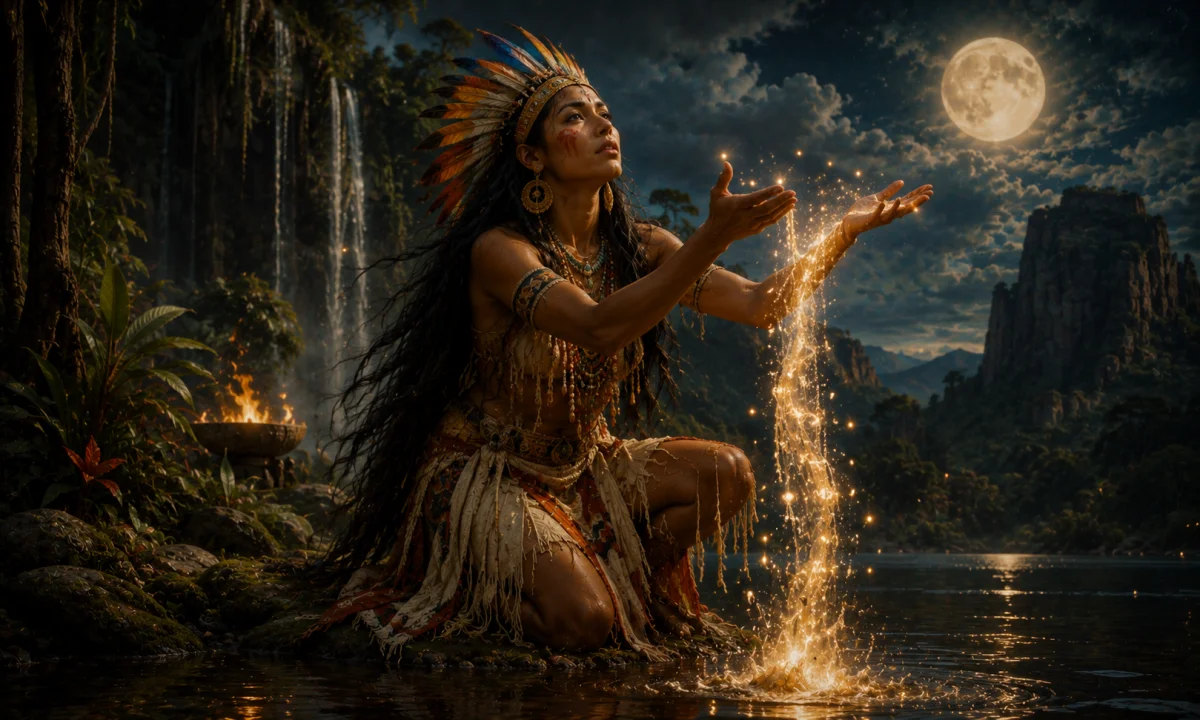
Iae is a name associated in some modern mythology lists with South American tradition, but its identity and cultural origin are uncertain. No single, widely recognised indigenous tradition securely establishes Iae as a god, spirit, hero or legendary creature. The name is sometimes presented without a community, language, story or historical source, making it difficult to distinguish a genuine traditional figure from a spelling error, a mistranscription or a later compilation.
Identity and cultural setting
South America contains hundreds of Indigenous cultural traditions, each with its own languages, religious practices and systems of naming. A name recorded in one colonial document, missionary vocabulary or modern reference work cannot automatically be treated as a figure shared across the continent. This is especially important for short names such as Iae, whose spelling may have been altered when an unfamiliar Indigenous word was written using European conventions.
The name Iae does not have a firmly established place in the better-known mythological traditions of the Andes, Amazonia, the Guianas, the Southern Cone or Brazil. It is not generally recognised as a standard name in the major surviving bodies of Quechua, Aymara, Mapuche, Guarani, Tupi or well-documented Caribbean mythology. That does not prove that the name never belonged to a local tradition. Many oral traditions were recorded incompletely, and numerous Indigenous languages remain poorly represented in older English-language reference works. It does mean that a specific identity should not be assigned without evidence.
Some websites and popular encyclopaedic lists describe Iae as though the name referred to a clearly defined South American deity. These descriptions often omit the community that supposedly revered the figure, the language in which the name occurs and the story in which Iae appears. Without those details, claims about gender, powers, appearance or religious function remain unverified.
The problem of the name
Iae may represent several different things:
- a local name recorded only rarely;
- a variant spelling created by a colonial or modern transcriber;
- a shortened or altered form of another Indigenous name;
- a confusion with a better-known figure whose name resembles it; or
- a modern entry repeated from one unsourced mythology list to another.
Indigenous names were often written down by outsiders who did not speak the relevant language. The same word might therefore appear with different vowels, accents, consonants or word divisions. Oral transmission also allows names and descriptions to vary between neighbouring communities. However, spelling variation must not be used as an excuse to merge unrelated figures. A resemblance between Iae and another name is not enough to establish that they are the same being.
The absence of a clear etymology is another warning sign. There is no generally accepted translation of Iae, nor is there a securely established Indigenous language in which the name can confidently be interpreted. It should therefore not be given an invented meaning such as “creator,” “moon spirit” or “guardian of the forest.” Those descriptions sometimes appear in popular summaries of obscure mythological names, but they require independent cultural evidence.
Attributes and classification
No consistent traditional description of Iae has been established. In particular, there is no reliable basis for presenting Iae as a specific type of being, such as a creator deity, nature spirit, ancestor, demon, culture hero or animal-transformer. There is also no securely documented appearance, sacred object, ritual role, family relationship or area of authority that can be attributed to the name across South American mythology.
This uncertainty is significant because religious classification differs widely between cultures. An English word such as “god” may be used by an early observer for a powerful ancestor, a master of animals, a spirit of a place or a being encountered in dreams. Likewise, “demon” may reflect Christian missionary language rather than an Indigenous category. Applying one of these labels to Iae without knowing the original cultural context could distort the tradition rather than explain it.
Claims that Iae controls the weather, rules the dead, governs fertility or protects a particular animal should therefore be treated cautiously unless they can be connected to a named people and a documented narrative or ritual practice. At present, these attributes cannot be regarded as established features of a widely recognised Iae tradition.
Stories and relationships
No canonical cycle of stories about Iae is known. There is no consistently recorded account of Iae's birth, creation of the world, conflict with another spirit, marriage, descent into the underworld or encounter with human beings. Nor is there a stable group of companions, enemies or descendants associated with the name.
That lack of narrative evidence distinguishes Iae from major figures whose traditions survive through multiple recorded accounts. For example, Andean traditions include figures such as Viracocha and Pachamama, although even these names encompass regional differences and changing interpretations. Guarani traditions include powerful beings such as Ñamandu and Tupã in particular cultural and historical contexts, while Mapuche religious traditions include Ngenechen, spirits of place and the dead, and the dangerous beings often described under the broad term wekufe. These traditions have identifiable cultural settings and bodies of evidence. Iae does not presently have an equally secure framework.
It is possible that a local story containing a similar name exists in an Indigenous language or unpublished oral tradition. Oral cultures should not be judged incomplete simply because they were not preserved in books. The more precise statement is that a sufficiently documented, widely identifiable tradition of Iae is not available in the standard material from which broad English-language mythology summaries are usually made.
Possible confusions with other figures
The name Iae should not automatically be identified with Iara, Yara or Iemanjá. Iara is a Brazilian water being whose modern image combines Indigenous, colonial and folkloric elements; the name has also developed different spellings and interpretations. Iemanjá is an important orisha of Yoruba origin whose worship became influential in Brazil and elsewhere in the Atlantic world. She belongs to a distinct religious history and should not be treated as a variant of an uncertain name such as Iae.
Iae should also not be confused with Jaci, the moon figure found in accounts of Tupi-related Brazilian mythology, or with Jasy, a Guarani word and mythological name associated with the moon in particular traditions. Similar vowel patterns do not demonstrate a historical relationship. Nor should Iae be merged with Aia, Aya, Ia or other short names appearing in records from different parts of the continent.
Such distinctions matter because South American mythology is sometimes presented as a single system, with names from Brazil, the Andes, the Caribbean and the southern regions placed together as though they belonged to one religion. They do not. A Tupi-speaking community, a Quechua-speaking community and a Mapuche community have different histories, languages and religious concepts. A name that is uncertain in one context cannot be made clearer by borrowing attributes from another.
Sources, transmission and interpretation
The uncertainty surrounding Iae illustrates the difficulties of studying traditions transmitted orally. Indigenous religious knowledge may be held by specialists, families or particular communities rather than expressed in a single sacred book. Some narratives are told only at appropriate times or in specific ceremonial settings. Colonial violence, forced conversion, displacement and language loss also disrupted the transmission of many traditions.
At the same time, the limitations of the surviving record do not justify filling gaps with speculation. A responsible account separates three levels of information:
- Documented tradition: a name can be connected to a people, language, narrative or ritual record.
- Scholarly interpretation: researchers compare variants and propose meanings while acknowledging uncertainty.
- Modern compilation: a name is repeated in websites, lists or popular books without a traceable cultural context.
Iae currently belongs primarily to the third category in the material commonly encountered by general readers. That classification does not declare the name fictitious. It indicates that its traditional status has not been demonstrated clearly enough to support a detailed mythological biography.
Researchers investigating the name would need to establish where it was recorded, which community used it, what language it belongs to, how the original word was spelled or pronounced and whether the record describes a religious being at all. They would also need to compare the name with local variants without assuming that similar sounds indicate a shared origin. Consultation with Indigenous scholars and knowledge holders would be particularly important, since external catalogues can overlook local meanings or impose categories that the community itself does not use.
Cultural significance of uncertainty
Uncertainty is not merely a technical problem of spelling. It affects how Indigenous cultures are represented. Assigning an unsupported role to Iae can create the impression that South American religions contain a fixed list of gods comparable to a classical pantheon. Many Indigenous traditions instead emphasise relationships among humans, animals, ancestors, landscapes and powerful beings. Their categories may not map neatly onto the distinctions between “god,” “spirit” and “monster” used in English.
It is therefore more respectful and more accurate to preserve the limits of the evidence. Iae can be mentioned as an uncertain name associated in some modern sources with South American mythology, but it should not be described as a universally recognised South American deity. Any future identification would depend on locating a dependable cultural and linguistic context.
Modern reception
Iae has no well-established role in major modern films, novels, games or popular religious movements. Its presence is mainly connected with the circulation of short mythology entries online and in general lists of obscure divine names. In that setting, a brief unverified description can be copied repeatedly until it appears authoritative, even when the original attribution is missing.
Modern readers should distinguish that internet or reference-list presence from living Indigenous religion. Repetition does not turn an uncertain name into a confirmed traditional figure, and an appealing description should not be treated as evidence of an ancient cult. Until a specific community, language and body of tradition can be identified, Iae is best regarded as an unresolved name rather than a figure with securely established mythology.