WORLD
WORLD
Huecuvus
Huecuvus is a name associated with a harmful supernatural being in Mapuche tradition of south-central Chile and western Argentina. It is also written in forms such as Huecuve, Huecuvé, or Huecuvü, depending on the language system and the period of transcription. Older Spanish-language descriptions often call Huecuvus an “evil spirit” or “demon,” but those labels can be misleading if they suggest a direct equivalent of the Christian Devil. In Mapuche religious thought, harmful supernatural forces belong to a broader and more complex field of beings, powers, illnesses, and spiritual disturbances.
The available information about Huecuvus is limited and uneven. It does not appear in a single universally accepted myth with a fixed appearance, genealogy, and sequence of adventures. Instead, the name occurs in colonial and later descriptions of Mapuche beliefs, where it may refer to a dangerous spirit or to a force associated with disease, death, misfortune, and threatening places. Some accounts connect it with the wilderness, violent natural phenomena, or volcanic regions, but these details are not consistent enough to be treated as a complete traditional biography.
Mapuche cultural setting
The Mapuche are an Indigenous people whose historic homeland includes much of south-central Chile and parts of present-day Argentina. Their religious traditions have been preserved through oral teaching, ritual practice, family knowledge, and the work of religious specialists. Mapuche communities have experienced centuries of warfare, colonial pressure, Christian missionary activity, state expansion, and cultural change. As a result, written accounts of Mapuche supernatural beings must be read carefully: many were recorded by outsiders, often in Spanish, and sometimes interpreted through European Christian categories.
Mapuche understandings of the world commonly emphasize relationships among human beings, ancestors, animals, landscapes, weather, illness, and spiritual powers. Mountains, rivers, springs, forests, caves, and other places may possess importance that is religious as well as geographical. The natural world is not simply a neutral setting in which supernatural events occur. It can be a source of life, danger, healing, obligation, and spiritual communication.
Within this setting, sickness or misfortune may be understood through several possible causes. A person can suffer from an ordinary physical condition, but illness may also involve spiritual imbalance, harmful intention, a violation of social or ritual obligations, or the action of a hostile being. The work of a machi, a Mapuche religious specialist and healer, traditionally involves diagnosing and treating such conditions through ritual knowledge, prayer, plants, ceremony, and communication with spiritual powers.
The name and its uncertain identity
The form Huecuvus reflects an older written transcription rather than a standardized modern Mapuche spelling. Mapuche languages, particularly Mapudungun, have been represented in several different orthographies. Spanish-speaking missionaries, colonial officials, ethnographers, and later writers often attempted to reproduce sounds that do not correspond neatly to Spanish spelling. This produced numerous variations in the written forms of Mapuche names.
Huecuvus is therefore sometimes discussed under related forms including Huecuve, Huecuvé, Huecuvü, and similar spellings. The exact relationship between every form cannot always be established from brief dictionary entries or generalized mythology collections. Some may represent differences in transcription; others may reflect regional usage, changes in pronunciation, or the tendency of older writers to treat related spiritual concepts as though they were one named creature.
The identity of Huecuvus is also uncertain in classification. It is often described as a demon, devil, or malevolent spirit, while other discussions place it near the Mapuche concept of the wekufe. In contemporary writing, wekufe is frequently used as a broad term for a harmful or disruptive supernatural being. It does not necessarily designate one individual with a stable personality. A wekufe may be associated with sickness, death, conflict, spiritual pollution, or other forms of disorder.
Huecuvus should not automatically be treated as a simple synonym for every use of wekufe. The two terms have different histories of documentation, and older sources do not always use them with precision. The safest description is that Huecuvus is a traditionally reported harmful spirit or supernatural power, probably related to wider Mapuche ideas about wekufe, but not securely documented as a single, universally defined being.
Attributes and harmful influence
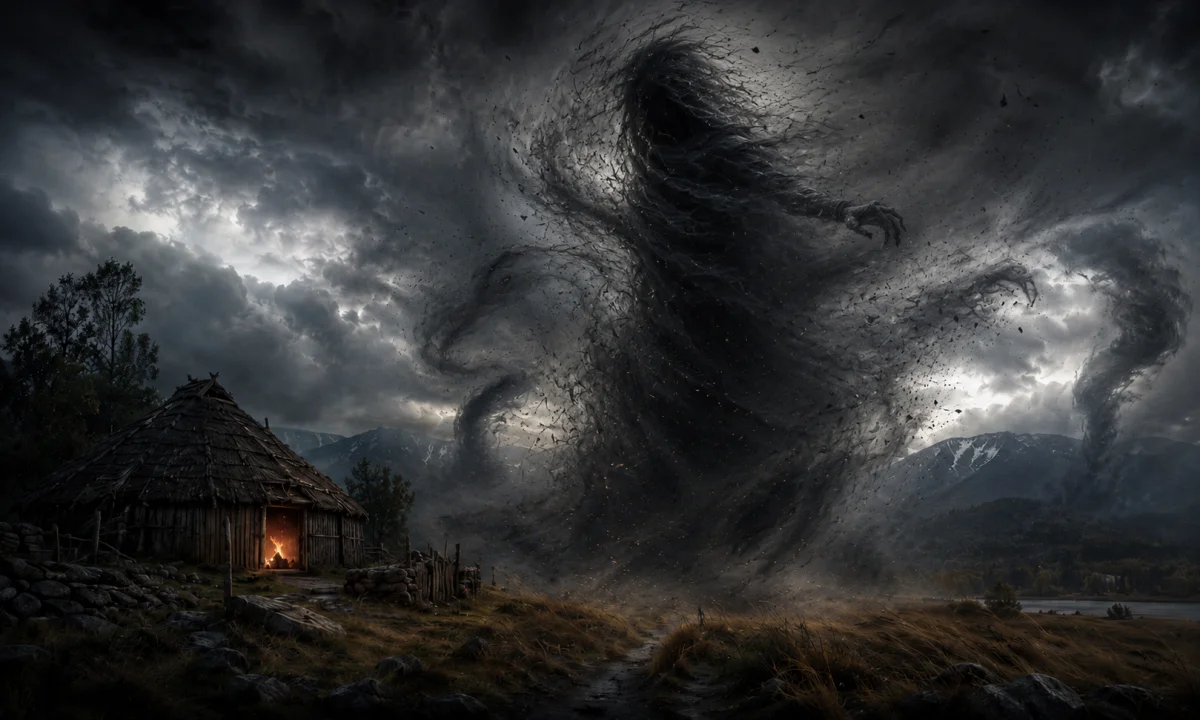
Descriptions of Huecuvus generally emphasize its dangerous character rather than a distinctive physical form. It is commonly associated with illness, death, fear, and misfortune. In some summaries, the being is said to inhabit or haunt wild places, remote regions, or locations linked with dangerous natural forces. Other accounts connect the name with destructive winds, volcanic landscapes, or invisible spiritual attack. These associations vary according to the source and should not be presented as one fixed set of attributes.
Huecuvus is not consistently described as a horned humanoid, an animal, or a monster with a recognizable body. The absence of a stable appearance is significant. Many harmful beings in Indigenous religious traditions are not defined primarily by visual form. Their presence may be perceived through illness, unusual events, dreams, frightening sounds, environmental disturbance, or the consequences of broken relationships between people and the spiritual world.
Older European observers sometimes transformed such beings into figures resembling demons in Christian theology. A spirit that caused sickness or opposed beneficial powers could be placed in a moral framework of good versus evil and described using words such as “devil” or “demon.” Such translations communicate that the being was feared and harmful, but they do not necessarily preserve the original Mapuche meaning.
For this reason, Huecuvus is better understood as a potentially hostile spiritual agency within a wider cosmology than as a fully developed equivalent of Satan. Mapuche religious concepts do not have to fit the theological categories used by missionaries or European mythographers. A being may be dangerous without belonging to a neatly organized kingdom of evil, and spiritual danger may be connected with imbalance, violated obligations, malevolent action, or an invasive force rather than with an abstract principle of wickedness.
Relationship to illness and ritual healing
The strongest recurring theme in descriptions of Huecuvus is its connection with harm to human beings. In traditions where supernatural causes of sickness are recognized, a hostile spirit may be understood as attacking a person, entering the body, or contributing to a condition that requires ritual treatment. However, the existence of a harmful spirit does not mean that every illness is attributed to the same cause. Diagnosis is culturally specific and may distinguish between different kinds of physical, emotional, social, and spiritual problems.
Mapuche healing traditions involve more than removing an imagined monster. A machi may seek to identify the origin of an affliction, restore balance, protect the patient, and repair damaged relationships involving people, ancestors, places, and spiritual powers. In this setting, a being such as Huecuvus represents the danger that healing practices must confront, but the full religious significance lies in the network of ritual knowledge and obligations surrounding the illness.
Some accounts describe hostile spirits as agents used by malicious people or as forces that can be directed against others. Such ideas should be treated cautiously because they may reflect particular regional traditions, colonial interpretation, or the broader category of harmful supernatural action rather than a specific property of Huecuvus in all Mapuche communities. There is no reliable basis for assigning one universal method of attack or one standard ritual for dealing with it.
Landscape, wilderness, and natural danger
References connecting Huecuvus with remote or dangerous landscapes reflect an important feature of Mapuche religious imagination: places can have spiritual character. Mountains and volcanoes, in particular, have great significance in the geography of the region. They may be associated with power, ancestral presence, weather, fertility, danger, and communication between different levels of existence.
Yet a landscape linked with a threatening spirit should not be interpreted as merely “haunted” in the European gothic sense. A forest, mountain, or volcanic area may be respected because it is powerful or spiritually inhabited, not because it is inherently evil. The same environment can support life and present danger. Descriptions of Huecuvus in wild places may therefore express caution toward places where humans must behave appropriately, rather than claim that the wilderness is the dwelling of a single monster.
Natural disasters and severe weather have also been interpreted in different ways by different observers. When a colonial writer linked a destructive event with a demon, the account may tell us as much about the writer’s religious vocabulary as about the Mapuche explanation. Modern readers should distinguish between Indigenous ideas about spiritually significant natural forces and an outsider’s translation of those ideas into the language of supernatural evil.
Stories and variants
No single major cycle of stories about Huecuvus is securely preserved in the commonly available record. The name is better documented as a classificatory or descriptive term than as the protagonist of an extensive narrative tradition. There is no widely attested canonical story giving Huecuvus a universally accepted origin, spouse, parentage, physical form, or final defeat.
Brief references may present the being as a source of disease or death, while later compilations may expand the description by adding a dwelling place, a monstrous appearance, or a more individualized personality. These additions are not necessarily part of a continuous oral tradition. They may result from the way folklore collections combine dictionary definitions, missionary reports, ethnographic notes, and popular retellings.
Regional and historical variation is especially important in Mapuche mythology. A name recorded in one area may not have exactly the same meaning in another. Religious vocabulary can also change as communities respond to Christianity, neighboring Indigenous traditions, Spanish influence, and modern cultural movements. A short description of Huecuvus should therefore be treated as evidence of a reported tradition, not as a complete account of belief held identically by all Mapuche people.
Huecuvus and other Mapuche spiritual beings
Huecuvus is sometimes confused with other figures because older sources use broad words such as “spirit,” “demon,” and “monster.” It should not be casually merged with the Wekufe as though both names always identify one character. Wekufe can function as a general category for harmful supernatural entities, whereas Huecuvus is a particular name or name-form recorded in connection with that field of belief.
Huecuvus is also distinct from Pillán, although both may be associated in outside accounts with powerful or dangerous forces. Pillán refers to a complex class of powerful spirits or beings in Mapuche tradition and has been interpreted in different ways depending on the source. It is not simply another name for Huecuvus. Nor should Huecuvus be confused with Ngenechen, a supreme or creator-associated divine figure in many descriptions of Mapuche religion, or with Ngene beings connected with the guardianship of particular natural places.
Popular lists of “South American demons” sometimes place Huecuvus beside beings from unrelated Indigenous cultures. Such lists can be useful for discovering names, but they often flatten important differences in language, region, religious function, and historical context. Huecuvus belongs to Mapuche cultural history and should not be presented as a generic Andean, Amazonian, or pan-South American devil.
Interpretation and cultural significance
Huecuvus is significant less because of a large body of surviving adventure stories than because the name reveals how Mapuche supernatural traditions were recorded and translated. It stands at the meeting point of Indigenous concepts of illness and spiritual danger, colonial attempts to classify unfamiliar beliefs, and later folklore writing that sought compact entries for named beings.
The figure also demonstrates why the word “mythology” must be used carefully. A mythology is not always a collection of stories about clearly individualized characters. It can include ritual concepts, accounts of illness, local place traditions, categories of spiritual beings, explanations of misfortune, and rules governing relationships with the unseen world. Huecuvus belongs to this wider religious and folkloric context.
For Mapuche communities, spiritual traditions are not merely a catalogue of creatures from the past. Mapuche identity, language revitalization, land rights, ritual practice, and cultural continuity remain living concerns. Information about beings such as Huecuvus should therefore avoid treating Mapuche religion as an extinct curiosity or reducing it to a collection of frightening monsters.
Later reception
Huecuvus has appeared mainly in encyclopedic folklore, mythology websites, lists of legendary demons, and occasional modern retellings rather than in a major body of internationally recognized fiction. These treatments often give the being a more definite shape and personality than the historical evidence supports. A modern illustration may show a horned creature, a shadowy humanoid, or an animal-like monster, but such imagery should be understood as artistic interpretation unless it is specifically grounded in a documented tradition.
Contemporary fantasy and horror may also use the name as a label for a villain or supernatural antagonist. Such uses can introduce Mapuche-derived vocabulary to new audiences, but they are modern adaptations, not proof that the adapted appearance or powers belong to traditional belief. The most responsible presentations retain the uncertainty surrounding the name and distinguish recorded Mapuche religious concepts from later inventions.