WORLD
WORLD
Huallepen
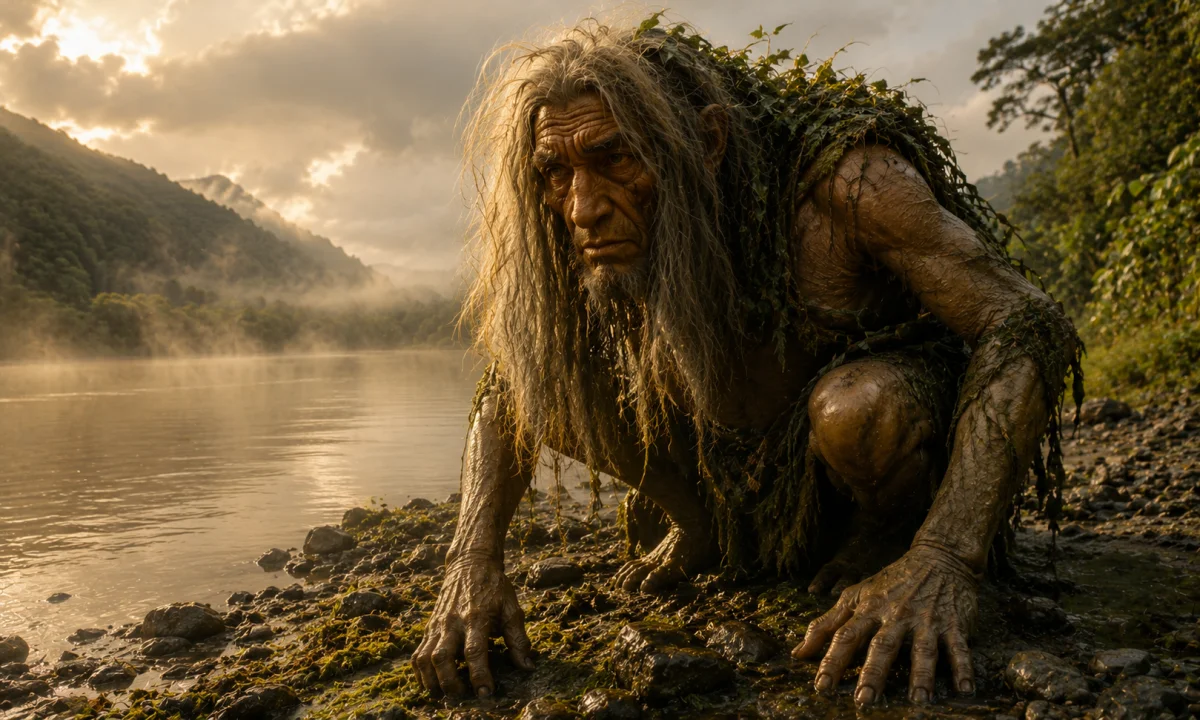
Huallepen is a little-known aquatic being associated with the mythology and folklore of southern Chile, especially the island of Chiloé and the wider cultural world of the Mapuche and Huilliche peoples. The name appears in several forms, including Huallipén, Huallipen, and Guallipén. Descriptions vary considerably between retellings, so Huallepen is better understood as a regional folkloric creature with changing features than as a single figure whose identity was fixed across all traditions.
Origins and cultural setting
Huallepen belongs to the rich body of supernatural folklore connected with southern Chile’s rivers, lakes, marshes, channels, and sea inlets. These landscapes are central to life in Chiloé and neighbouring regions. Communities have traditionally depended on fishing, shellfish gathering, farming, livestock, and travel by water. In such an environment, unfamiliar animals, dangerous currents, fog, sudden storms, and isolated shorelines naturally became part of local stories about beings that lived beyond ordinary human experience.
Chilote mythology is not a single, formally organised religious system. It is a layered tradition shaped by Indigenous beliefs, local oral storytelling, colonial Christianity, and later popular collections of folklore. Mapuche and Huilliche cultural influences are especially important in the mythology of southern Chile, but individual legends were also reshaped through contact with Spanish-speaking communities. As a result, a creature recorded in a nineteenth- or twentieth-century folklore collection may reflect several stages of transmission rather than an unchanged pre-colonial belief.
There is no universally accepted ancient text that establishes Huallepen’s appearance, powers, or role. Most information comes from folklore records, regional descriptions, and later retellings. These sources do not always agree, and some descriptions may have been altered by spelling conventions, translation, or attempts by writers to classify local beings according to European ideas of “monsters” and “mythological creatures.”
Name and identity
The spelling Huallepen is one of several forms used for the name. Other versions include Huallipén, Huallipen, and Guallipén. The variation is not unusual in records of Indigenous and regional names. Spanish orthography was used to represent sounds from local languages, and writers did not always follow the same conventions.
The precise meaning and linguistic origin of the name are uncertain. It is often treated as a name from the Mapudungun linguistic sphere, but a confident translation should not be presented without a reliable linguistic analysis. Similar-looking names in folklore should also not automatically be assumed to refer to the same being. Regional traditions frequently preserve names in several forms, while modern websites and popular summaries sometimes standardise or combine them without explaining the differences.
Huallepen is commonly classified as a water spirit or aquatic monster. That classification is useful but approximate. In some accounts it resembles a malformed land animal that lives near water; in others it is presented as a distinctly amphibious or aquatic creature. It is not consistently described as a god, an ancestor, or an object of formal worship. The evidence supports treating it primarily as a folkloric being associated with warnings, omens, and the dangerous or uncanny character of particular places.
Appearance
The most frequently repeated descriptions give Huallepen an unusual combination of animal features. It may have the body of a sheep or another four-legged farm animal and the head of a calf. Other accounts describe a seal-like or amphibious body with bovine features. Some portray it as deformed, misshapen, or difficult to identify, rather than providing a precise anatomical description.
These differences matter because there is no single canonical image of Huallepen. Illustrations and encyclopedic summaries often present one standard form—usually a sheep-bodied creature with a calf’s head—but that image represents one strand of the tradition, not an uncontested definition. The being’s mixed appearance may be part of its significance: it belongs neither fully to the domestic world of livestock nor fully to the wild environment of the water.
Descriptions may also emphasise the creature’s physical abnormality. It can be portrayed as having an awkward body, distorted limbs, or an appearance that inspires fear and unease. Such details should be read in the context of older folklore, where unusual bodies and hybrid animals were often used to express danger, taboo, or the unsettling boundary between familiar categories. They should not be treated as evidence for a consistent biological “species” in the modern sense.
Habitat and behaviour
Huallepen is generally said to inhabit water or the margins between water and land. Rivers, lagoons, marshy ground, ponds, and secluded shores are the settings most compatible with the surviving descriptions. The creature’s association with these places gives it a role similar to that of many water beings found throughout the world: it marks locations where ordinary rules appear less reliable and where people must be cautious.
Unlike some South American legendary beings, Huallepen is not consistently described as a hunter that deliberately attacks and kills human beings. Its danger is more often indirect or symbolic. In several retellings, merely seeing the creature is ominous, particularly for a pregnant woman. The sight of Huallepen is said to cause a child to be born with a physical abnormality or deformity. Other accounts connect the creature with abnormal offspring among livestock.
These motifs belong to a wider pattern in traditional belief. Pregnancy and birth were often understood as vulnerable stages of life, and many communities developed rules about frightening sights, taboo places, disturbing animals, and supernatural encounters. Such stories could explain misfortune, discourage people from approaching dangerous waters, or give moral and emotional meaning to events that had no obvious cause. They should be understood as cultural beliefs and narrative motifs, not as medical explanations.
Stories and recurring motifs
Huallepen stories are usually brief rather than elaborate myths with a long sequence of adventures. A typical account places the creature near water, where it is glimpsed by a person travelling, tending animals, or passing along the shore. The encounter is memorable because the animal looks familiar and yet profoundly wrong: its body suggests a domestic creature, while its head or habits reveal something unnatural.
One recurring motif concerns contact with livestock. In some versions, Huallepen approaches sheep or other farm animals and mates with them. The resulting offspring are said to be malformed or strange. This detail links the creature to the practical concerns of rural communities, where the health and reproduction of animals were directly tied to household survival. It also reinforces the idea that Huallepen disrupts boundaries: wild and domestic, land and water, ordinary birth and abnormal birth.
Another motif concerns the gaze of the supernatural. The harmful event may not require physical contact. A person who sees the creature, especially under the circumstances specified by the local tale, may later experience misfortune. This kind of story turns looking into a dangerous act and gives an otherwise remote creature influence over human life. It also makes the creature difficult to disprove within the logic of the tale, since the supposed consequence may occur long after the sighting.
Because Huallepen has been transmitted mainly through oral and folkloric traditions, individual stories may not agree about whether it is solitary, how large it is, or whether it intentionally seeks human beings. Claims that it has a detailed family history, a fixed lair, or a clearly defined set of supernatural abilities should therefore be treated cautiously unless they can be tied to a particular regional version.
Meaning and cultural significance
Huallepen’s importance lies less in a single dramatic narrative than in the relationships it establishes between people, animals, landscape, and uncertainty. Its hybrid form reflects a world in which categories are not always secure. A farm animal can appear in an unexpected place; a wetland can conceal a threat; a familiar head can be attached to an unfamiliar body. The creature represents the unease produced when the boundaries of the everyday world are crossed.
The legend also reflects the significance of reproduction and animal husbandry in rural southern Chile. Birth, fertility, and the condition of offspring were matters of great practical importance. A story about a being that produces or causes abnormal births can function as an explanation for distressing events, but it can also express fears about heredity, pregnancy, and the fragility of life. Its supernatural logic does not make the underlying concerns any less real.
Huallepen may also be interpreted as a warning about landscape. Water in Chiloé is both a source of food and a route of travel, but it can also isolate settlements and conceal hazards. A creature lurking by a river or lagoon gives narrative form to the risks of entering places that are difficult to see or control. As with many water legends, the story may have helped reinforce caution without taking the form of a simple practical instruction.
It is important not to describe Huallepen as a major deity or as a figure worshipped throughout Mapuche society. The available material does not support that claim. Nor is it possible to assume that every story now labelled “Mapuche mythology” originated in exactly the same community or period. The creature is better approached as part of the regional folklore of southern Chile, with Indigenous and local cultural influences that require careful distinction rather than a single simplified origin.
Distinction from similar beings
Huallepen is sometimes confused with other legendary beings from Chile and Chiloé, but the similarities are limited.
- The Cuero is a dangerous water monster traditionally imagined as a hide-like creature that attacks or drags people beneath the water. Its form and behaviour are quite different from the livestock-like hybrid usually associated with Huallepen.
- The Caleuche is a legendary ghost ship of Chiloé. It is connected with sailors, the sea, supernatural travel, and the fate of the dead, not with a misshapen animal living in rivers or lagoons.
- The Camahueto is generally described as a powerful horned creature resembling a young bull or calf, often associated with rivers, magical horns, and destructive force. Because both beings can be connected with water and bovine imagery, modern summaries sometimes blur them, but they are distinct figures in folklore classifications.
- The Pincoya is a human-like female spirit of the sea, associated in Chilote tradition with marine abundance and scarcity. She should not be treated as another name for Huallepen.
- The Trauco is a forest-dwelling humanoid being from Chiloé. Although stories about the Trauco also involve sexuality, pregnancy, and unusual births, its habitat, form, and narrative role differ from those attributed to Huallepen.
Similarities between these beings are understandable because the same regional folklore environment contains many stories about water, fertility, animals, illness, and dangerous supernatural encounters. Similar themes do not prove that the figures are interchangeable.
Recorded tradition and modern representation
Huallepen has had a relatively modest presence in international popular culture. It appears mainly in lists of Chilean or South American mythological creatures, regional folklore compilations, illustrated bestiaries, and online summaries. These modern presentations often choose one appearance and repeat it as though it were universal. Some also exaggerate the creature’s size, violence, or supernatural powers without distinguishing older regional descriptions from later embellishment.
Contemporary illustrations commonly depict Huallepen as a dramatic hybrid of sheep, calf, and aquatic animal. Such artwork can make the being easier to recognise, but it is an interpretation rather than a recovered traditional image. The same caution applies to fantasy novels, games, videos, and cryptid-style discussions that present Huallepen as a fully defined monster with statistics, a fixed anatomy, or an elaborate mythology. Those adaptations may be creative uses of the name, but they should not be confused with the surviving folklore.
In its traditional context, Huallepen is most meaningfully understood as a regional water-associated being whose shifting form expresses anxieties about abnormality, dangerous places, animal reproduction, and the limits of human knowledge. The uncertainty surrounding its name and description is not a flaw to be concealed; it is part of the history of a legend preserved through oral transmission and later written interpretation.