WORLD
WORLD
Hikule’o
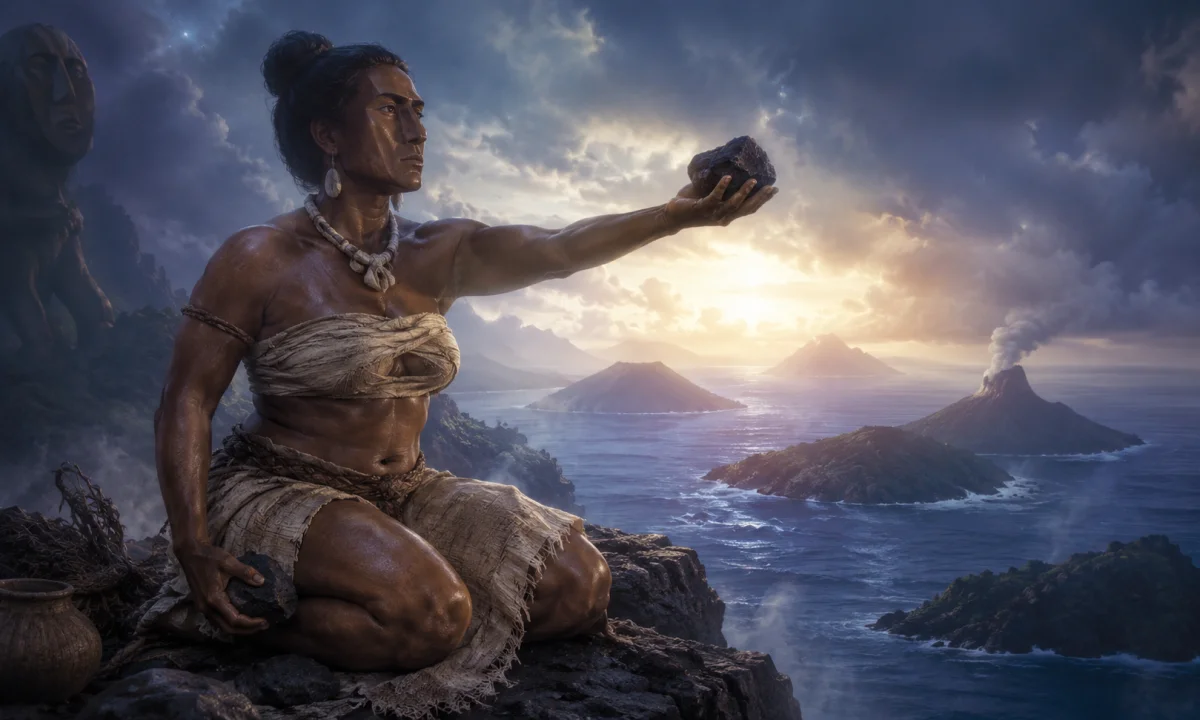
Hikuleʻo is a major figure in traditional Tongan mythology, especially in stories concerning Pulotu, the realm of the dead and the dwelling place of powerful supernatural beings. His name is also written Hikule’o, Hikuleo, or Hikuleʻō in English-language works. The variation reflects different ways of representing the Tongan glottal stop and vowel length rather than necessarily indicating different beings.
Hikuleʻo is commonly described as the ruler or principal lord of Pulotu. English summaries often call him an “underworld god,” but that phrase can be misleading. Pulotu is not simply equivalent to the Christian Hell or to a place of punishment. In Tongan religious thought, it is a mysterious otherworld connected with the dead, ancestral existence, divine power, fertility, and the continuing renewal of life. Hikuleʻo therefore belongs to a complex religious landscape rather than to a simple opposition between a benevolent heaven and an evil underworld.
Tongan cultural and religious setting
Tonga is an island kingdom in western Polynesia, east of Fiji and west of Samoa. Tongan society developed around ocean travel, agriculture, chiefly authority, kinship, and relationships with a large number of islands and reefs. Traditional religious ideas reflected this environment. The sea was a route between communities, a source of food, and a realm of danger and supernatural power. Islands, caves, storms, reefs, and distant horizons could all be associated with the presence or activity of beings beyond the ordinary human world.
Before the spread of Christianity, Tongans recognised many atua, or supernatural beings, whose roles varied from place to place and whose importance could be connected with particular families, localities, natural forces, or social institutions. Some figures occupied a broad pan-Tongan position in mythic accounts, while others belonged more strongly to local traditions. Hikuleʻo is usually presented as one of the most prominent beings in the wider Tongan religious system.
Traditional Tongan religion was not organised around a single surviving scripture or a universally fixed mythology. Knowledge was transmitted through oral narratives, ritual practice, genealogies, place traditions, and specialist knowledge. Missionaries and later European observers recorded some of these traditions, but they did so after major cultural changes had already begun. Their accounts sometimes translated Tongan concepts into familiar Christian or classical categories. Later scholars, Tongan writers, and cultural historians have therefore had to compare different records and consider the limits of each one.
The name and identity of Hikuleʻo
The spelling Hikuleʻo is generally preferred when the name is written in a form closer to modern Tongan orthography. Older English texts may omit the glottal mark and write Hikuleo, while other publications use Hikule’o. These forms should not automatically be treated as separate names.
Hikuleʻo is most consistently identified as the powerful lord of Pulotu. Depending on the source, he may be called a god, spirit, ruler, or supernatural being. The English word “god” is useful for indicating his high status, but it does not reproduce every feature of the Tongan concept of an atua. His nature is not always described in the same way, and the surviving accounts do not provide one agreed biography, genealogy, or physical portrait.
Some accounts place Hikuleʻo within a group of major male deities associated with the origin and ordering of the world. In these traditions, he is discussed alongside figures such as Tāngaloa and Māui. Their exact relationships vary in genealogical and mythological accounts. A story that presents them as brothers, relatives, or members of a single divine generation should not be assumed to represent every Tongan tradition.
Pulotu, the realm of the dead
Pulotu is central to understanding Hikuleʻo. It is often located beyond the familiar human world, sometimes in a western direction or beneath the sea, although descriptions differ. The name has parallels elsewhere in Polynesia, but related words and ideas do not always carry precisely the same meaning in every island society. A Tongan account should therefore be interpreted in its own cultural setting rather than treated as a direct copy of another Polynesian afterlife tradition.
In many descriptions, the dead travel to Pulotu after death. The realm is not portrayed merely as an empty shadow-world. It can be abundant, fertile, and socially ordered. The dead may continue to exist there in recognisable forms, while divine or ancestral powers remain active. Pulotu consequently combines ideas that modern readers might separate into an underworld, an ancestral homeland, a divine residence, and a source of renewed life.
Hikuleʻo’s authority over Pulotu gives him power over the boundary between human life and the otherworld. He is connected with death because the dead pass into his domain, but this does not make him simply a personification of death. His position also relates to the fertility and continuity associated with Pulotu. In Polynesian religious traditions, a realm of the dead could be both dangerous and life-giving: it was a place of loss, but also a source from which life, prosperity, and ancestral legitimacy might be understood to emerge.
Attributes and powers
Descriptions of Hikuleʻo’s appearance are not consistent enough to establish a single traditional form. Some modern retellings give him a gigantic or monstrous body, while other accounts concentrate more on his authority than on his appearance. Claims that he always has a particular number of arms, a fixed animal form, or one standard physical shape should be treated cautiously unless tied to a specific Tongan source.
His most secure attribute is his sovereignty over Pulotu. He is consequently associated with:
- the realm of the dead and the spirits of ancestors;
- the boundary between human life and the supernatural world;
- power over forces that humans cannot safely control;
- the hidden sources of fertility, abundance, and renewal; and
- the authority of an ancient, chiefly, and otherworldly ruler.
Some accounts also connect Hikuleʻo with the sea, storms, earthquakes, or other destructive natural powers. These associations are plausible within the wider imagery of a being who rules an inaccessible supernatural realm, but they are not equally prominent in all records. It is safer to describe such powers as variant attributes rather than as universally established features of Hikuleʻo.
His power is often imagined as immense and difficult for ordinary beings to resist. Like many powerful beings in Polynesian mythology, he should not be reduced to a moral category such as “evil.” He may be frightening, dangerous, or hostile in a particular story without being the embodiment of wickedness. The relationship between humans and divine beings is frequently one of respect, caution, obligation, and negotiation rather than simple worship of good figures and rejection of bad ones.
Stories and mythic relationships
Hikuleʻo appears most often in mythic material concerning the structure of the cosmos and the distribution of supernatural authority. Accounts involving major Tongan deities may describe different beings as governing different regions or dimensions of existence. Hikuleʻo’s sphere is Pulotu, while other figures are associated with the sky, the visible world, creation, culture, or the sea. These divisions are not always presented as a systematic theology, and the boundaries between divine roles can change from one narrative to another.
Stories of Māui are particularly important when discussing Hikuleʻo because Māui occupies a different mythic role. In Tongan tradition, Māui is associated with extraordinary feats, the shaping of the world, and the acquisition of benefits for human beings. Hikuleʻo, by contrast, represents an older and more remote authority linked with the otherworld. Their relationship in particular narratives may be competitive, familial, or symbolic, but the surviving material does not support one universally accepted cycle of stories comparable to a single epic.
There are also differences in the way Tongan traditions describe the relationship between Hikuleʻo and Tāngaloa. Tāngaloa is widely recognised across Polynesia under related names, but his role differs substantially between island cultures. In Tongan accounts he may appear as a creator or high-ranking divine figure, while Hikuleʻo remains the ruler of Pulotu. Genealogical statements connecting the two should be read as features of particular traditions, not as evidence for one fixed Polynesian family tree.
Many summaries of Tongan mythology combine details from oral traditions, nineteenth-century recordings, later retellings, and general Polynesian comparisons. As a result, a dramatic episode attributed to Hikuleʻo in one publication may be absent from another. This does not necessarily mean that one version is fraudulent; oral traditions commonly exist in multiple forms, and records may preserve different local or historical layers. It does mean that specific plot details require more caution than the broad identification of Hikuleʻo as lord of Pulotu.
Symbolism and cultural significance
Hikuleʻo can be understood as a figure of the limits of human control. Ocean voyaging, volcanic landscapes, storms, illness, death, and social upheaval all reminded island communities that human life depended on forces that could not be mastered completely. A ruler of Pulotu embodied the hidden power behind the boundary between the known world and the unseen one.
His association with the dead also gave Pulotu a social and ancestral significance. Tongan identity has traditionally been grounded in descent, rank, land, and relationships between living and dead members of a community. A supernatural realm inhabited by ancestors was not merely a distant location after death; it was part of the moral and genealogical imagination through which communities understood continuity. Hikuleʻo’s authority over that realm placed him near the deepest questions of belonging, mortality, and inherited power.
The fertility associated with Pulotu adds another dimension. In many traditional religions, the land of the dead is not only a destination but also a concealed source of life. Seasonal abundance, the growth of crops, human reproduction, and the persistence of a chiefly line can all be imagined as connected with ancestral or divine realms. Hikuleʻo’s significance therefore includes both danger and generative power.
It is also important not to interpret Pulotu solely through European descriptions of an underworld. Missionary writers often used familiar terms such as hell, heaven, devil, or pagan god when describing unfamiliar Tongan beliefs. Such translations can be historically valuable, but they may flatten distinctions within Tongan religious thought. Hikuleʻo’s traditional identity is better understood through his role, relationships, and cultural setting than through the label “demon” or “devil.”
Hikuleʻo and similar figures
Hikuleʻo is sometimes confused with other Polynesian rulers of the dead or with major deities whose names resemble his. These comparisons can be useful when studying shared Polynesian concepts, but they do not establish that the figures are identical.
- Pulotu is the realm associated with Hikuleʻo, not another name for Hikuleʻo himself.
- Māui is a culture hero and trickster-like figure in many Polynesian traditions. Although Tongan stories may place Māui in a family or mythic relationship with Hikuleʻo, the two have different roles.
- Tāngaloa is a major deity known throughout much of Polynesia, but his attributes and genealogies vary from island to island. A Tongan Tāngaloa should not automatically be equated with every figure called Tangaroa, Tangaloa, or Taʻaroa elsewhere.
- Hine-nui-te-pō of Māori tradition and Hine-nui-te-pō or related female rulers of the dead in other traditions belong to different cultural systems. They should not be merged with Hikuleʻo merely because all are connected with death or the afterlife.
- Beings associated with the Samoan, Māori, Tahitian, or Hawaiian underworlds may share broad Polynesian themes with Hikuleʻo, but their names, stories, gender, relationships, and religious functions remain distinct.
Sources, change, and modern understanding
Knowledge of Hikuleʻo comes through a combination of Tongan oral tradition, early written records, missionary descriptions, ethnographic accounts, linguistic study, and later cultural interpretation. These sources preserve valuable information, but they were produced under different conditions and for different purposes. Some were written by outsiders unfamiliar with Tongan categories; others reflect later Christian understandings; and oral accounts themselves may vary by island, family, performer, and historical period.
Christian conversion transformed the public religious environment of Tonga. Traditional deities were often reclassified as false gods, spirits, or demonic beings, and older stories were sometimes preserved mainly as mythology rather than as living religious teaching. That change affects how Hikuleʻo is encountered today. A modern description may present him as a “mythological underworld god” even though the older cultural meaning of Pulotu was broader and more complex.
Contemporary Tongan identity does not depend on treating traditional mythology as a single unchanging system. Hikuleʻo may be discussed in cultural history, education, literature, genealogy, or comparative studies of Polynesian religion. Retellings can preserve important themes while adapting language and narrative emphasis. At the same time, modern fantasy illustrations and internet summaries sometimes give him standardised horns, tentacles, armour, or a fixed monstrous body that are products of artistic invention rather than securely documented Tongan tradition.
The most reliable description of Hikuleʻo remains a careful one: he is a powerful Tongan supernatural ruler associated above all with Pulotu, the otherworld of the dead and divine beings. His significance lies not only in death but also in ancestral continuity, hidden fertility, supernatural authority, and the uncertain boundary between the human world and the powers beyond it.