WORLD
WORLD
Aku-aku
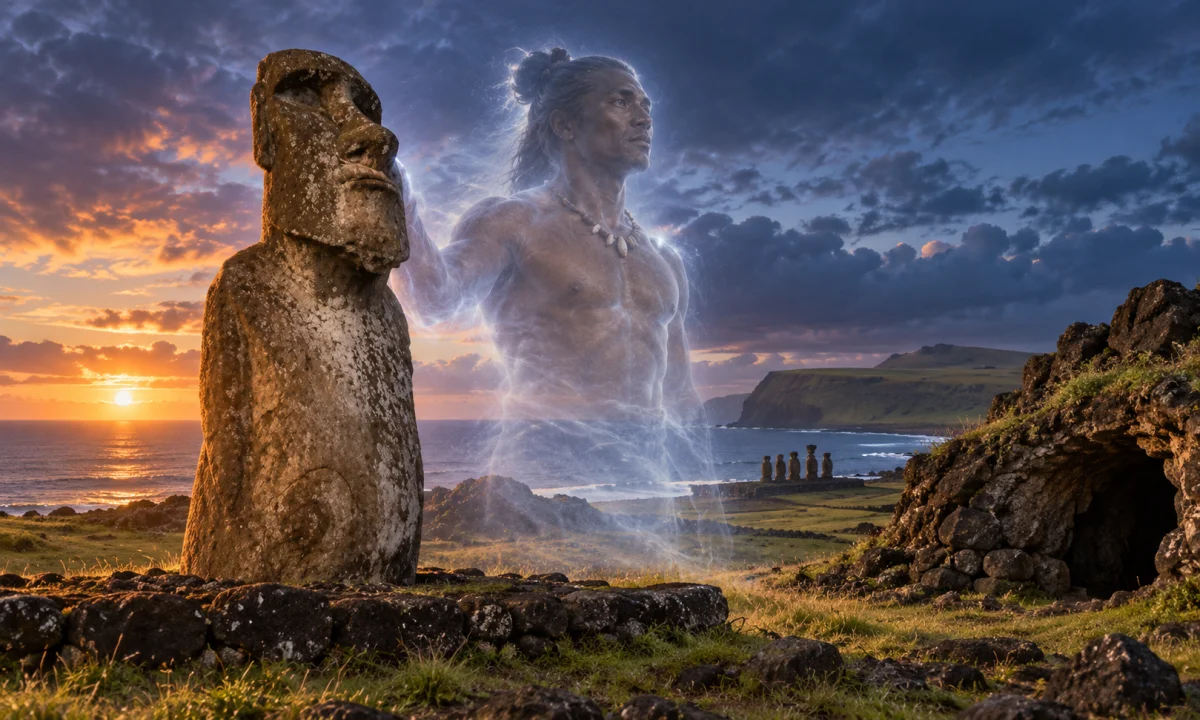
Aku-aku is a term from the traditional religious and folkloric vocabulary of Rapa Nui, the Polynesian people of Easter Island. It is commonly used for spirits of the dead, ancestral beings, or other supernatural presences associated with particular places and families. English-language accounts often translate aku-aku as “ghosts,” “spirits,” or even “demons,” but none of these words captures the full range of the term. Its meaning depends on the Rapa Nui context, the period being described, and the interpretation of the source.
Rapa Nui lies in the southeastern Pacific and forms one of the most isolated inhabited islands in Polynesia. Its culture is widely known for the moai, the monumental stone images erected for chiefly and ancestral purposes, but Rapa Nui religion also included a complex world of gods, spirits, sacred places, ritual restrictions, and relationships between the living and the dead. Aku-aku belong to this wider spiritual landscape. They should not be treated as a single named creature with one fixed appearance or biography.
Origins and cultural setting
Rapa Nui society developed within the wider Polynesian cultural sphere, although the island’s long isolation produced distinctive institutions, artistic traditions, and religious practices. Before sustained European contact, communities organized much of their ritual life around kinship, chiefly authority, the control of sacred power, and the proper treatment of ancestors. The dead were not necessarily understood as disappearing from the social world. Their presence could continue through memory, lineage, sacred sites, dreams, warnings, and supernatural encounters.
In this setting, aku-aku were connected with the continuing agency of the dead and with places regarded as spiritually dangerous or important. Caves, cliffs, burial areas, abandoned settlements, and other locations could be associated with spirits. Such places were often subject to restrictions, especially those involving tapu, a Polynesian concept of sacred prohibition and ritual danger. A person who entered a forbidden place, disturbed a burial, or violated a prescribed custom might risk supernatural punishment or misfortune.
Knowledge of pre-Christian Rapa Nui religion is incomplete. Much of it was transmitted orally, and the island experienced population loss, social disruption, enslavement, epidemic disease, missionary activity, and the suppression or transformation of older religious practices during the nineteenth century. European visitors and later researchers recorded fragments of local traditions, but their accounts were shaped by translation, Christian assumptions, personal theories, and the limitations of cross-cultural observation. As a result, the meaning of aku-aku cannot be reconstructed as a completely uniform doctrine.
The name and its meaning
The spelling aku-aku is common in English, although forms such as akuaku may also appear in discussions of Rapa Nui language and tradition. The repeated form should not automatically be interpreted as the name of one individual being. In Polynesian languages, repetition can have grammatical, lexical, or stylistic functions, and the exact meaning of a term must be established within its particular language and context.
Older European descriptions sometimes treated aku-aku as equivalent to “devils,” “demons,” or malevolent ghosts. Such translations reflect the vocabulary available to Christian observers as much as they reflect Rapa Nui ideas. In a traditional Polynesian religious setting, a spirit could be dangerous without being the equivalent of a Christian devil. Ancestral beings might protect their descendants, enforce customary rules, punish disrespect, or simply belong to a category of existence different from that of living humans.
For this reason, “spirit” or “ancestral spirit” is generally safer than “demon,” provided that the limits of the translation are acknowledged. Aku-aku may refer to more than one kind of supernatural presence in different accounts, and it is unwise to impose a single rigid classification on every use of the word.
Identity and classification
Aku-aku are best understood as a category of supernatural beings rather than as one person. Some accounts associate them particularly with the spirits of deceased ancestors. Other descriptions emphasize their connection with caves, rocks, burial places, or named localities. A spirit might therefore be known through its relationship to a family, a place, or a particular story rather than through a standardized appearance or genealogy.
Rapa Nui religious terminology included other kinds of beings and powers, including gods and ancestral figures whose names and roles are recorded unevenly. The word atua, widely used across Polynesia for gods or powerful supernatural beings, should not simply be treated as a synonym for aku-aku. Nor should every Rapa Nui spirit, ghost, deity, or legendary being be grouped under the term. The categories overlap in some translated accounts, but they are not interchangeable.
The distinction is also important because early observers sometimes compressed a varied religious system into a few familiar European categories. A local spirit could be called a “god,” “idol,” “ghost,” or “devil” depending on the observer’s purpose. These labels may conceal differences between ancestral presence, divine power, a guardian associated with a location, and a frightening apparition encountered in a story.
Appearance and manifestations
There is no universally established physical form for an aku-aku. Traditional accounts do not provide a single canonical image comparable to the standardized visual form of a dragon, mermaid, or giant. Descriptions can present spirits as invisible presences, apparitions, or beings recognized through supernatural effects rather than through detailed bodily features.
Some later accounts describe aku-aku as having human-like forms or as appearing in frightening ways. Such reports should be treated cautiously. They may preserve elements of oral tradition, reflect an individual storyteller’s version, or be influenced by the expectations of foreign visitors. They do not establish a fixed appearance shared by all aku-aku.
The association with caves is especially significant in discussions of Rapa Nui spirits. Caves could serve as burial places, hiding places, ritual locations, or sites with strong ancestral associations. Their darkness, difficult access, and separation from ordinary settlement life made them natural settings for stories about supernatural encounters. However, the presence of a cave in a story does not mean that all caves were considered homes of aku-aku, nor that every spirit was imagined as a cave-dweller.
Roles and powers
Aku-aku were commonly understood through their capacity to affect the living world. Their powers were not necessarily displayed as spectacular magical abilities. Instead, they might appear through illness, unusual sounds, dreams, warnings, bad luck, unexplained movements, or a sense that a sacred rule had been violated.
Possible roles associated with such spirits include:
- Ancestors and family spirits: the dead could remain connected to their descendants and to the places where their lineages had lived.
- Guardians of locations: a spirit might be linked with a cave, burial area, rock, or other site and make unauthorized access dangerous.
- Enforcers of tapu: supernatural consequences could reinforce prohibitions concerning sacred objects, bodies, food, places, or ritual conduct.
- Warnings and omens: encounters or dreams could communicate danger, disapproval, or the need for caution.
- Sources of fear: stories about spirits helped explain threatening places and the consequences of ignoring communal rules.
These roles should not be separated too sharply. In traditional religious systems, a dead relative could also be a guardian, and a guardian could also be feared. Protection and danger were not mutually exclusive. A spirit might benefit people who behaved correctly while harming those who showed disrespect.
Stories, names, and local traditions
Rapa Nui supernatural traditions were often local and relational. A spirit could be known by a personal name, associated with a particular lineage, or remembered in connection with a precise landscape feature. This means that two accounts may use the general term aku-aku while describing different beings and different forms of interaction.
Stories about haunted or restricted places should not automatically be treated as interchangeable versions of one myth. One narrative may explain why a cave is avoided, another may preserve the memory of an ancestor, and another may be a later tale shaped by Christian teaching or foreign storytelling. Rapa Nui oral tradition also changed as communities responded to new religious institutions, demographic crises, and outside interpretations.
The famous stone monuments of Rapa Nui are sometimes brought into discussions of aku-aku. The moai represented powerful ancestral presences or chiefly ancestors and were connected with ceremonial platforms called ahu. They were not simply statues of aku-aku. A moai was a monumental image with a specific social, religious, and political context, whereas aku-aku refers to spirits or supernatural beings in a broader sense. The two subjects may meet in discussions of ancestors, but they should not be collapsed into one category.
Relationship with Rapa Nui ancestors and the dead
The idea that the dead could continue to influence the living is central to understanding aku-aku. In many Polynesian societies, ancestry was not merely a matter of genealogy. It could support political authority, establish rights to land, define obligations, and connect present communities with sacred history. Rapa Nui traditions likewise placed great importance on ancestral relationships, although the surviving evidence does not allow every practice or belief to be reconstructed in detail.
Aku-aku therefore belong to a world in which the boundary between the living and the dead was permeable rather than absolute. The dead could be remembered in ritual, represented through monuments, or encountered as spiritual presences. Yet this does not mean that every deceased person automatically became an aku-aku in exactly the same sense. The terminology and status of the dead could vary according to local tradition, social position, manner of death, and later interpretation.
Christian contact and changing interpretations
Roman Catholic missionaries began working on Rapa Nui in the nineteenth century, after the island had already suffered catastrophic population decline and external exploitation. Missionary activity introduced new religious categories and often judged older practices through a Christian framework. Traditional spirits could consequently be described as idols, devils, or superstitions, while older rituals were discouraged or reinterpreted.
This historical context matters because many written records of aku-aku were produced after major cultural disruption. A text may preserve valuable information while still reflecting the recorder’s assumptions. Terms translated as “demon” may have referred to a local spirit, an ancestor, or a dangerous supernatural presence rather than to a being with the theological meaning of Satan or a Christian demon.
Later ethnographers and visitors attempted to collect oral histories, place traditions, genealogies, and accounts of spirits. Their work helped preserve material that might otherwise have been lost, but it also introduced another layer of interpretation. Rapa Nui knowledge should therefore be approached through comparison, linguistic care, and respect for living cultural perspectives rather than through a single outsider’s description.
Aku-aku in modern popular culture
The word became widely known outside Rapa Nui through the Norwegian explorer Thor Heyerdahl’s book Aku-Aku: The Secret of Easter Island, published in 1957. The book presented travel observations, archaeological discussions, and stories about the island’s supernatural traditions to a large international readership. Its title helped make “Aku-Aku” an exotic general label for the mysterious spiritual world of Easter Island.
Heyerdahl’s work is historically important as part of the modern reception of Rapa Nui, but it should not be treated as a definitive account of traditional religion. His interpretations of Rapa Nui history and cultural origins have been disputed, and his dramatic presentation contributed to popular images of secretive spirits, hidden caves, and supernatural guardians. Modern tourism, fiction, games, documentaries, and other media may use Aku-Aku as a name for a monster, ghost, mask, guardian, or magical creature. These adaptations are inventions or reinterpretations unless they can be connected to a specific Rapa Nui tradition.
The most responsible use of the term keeps its cultural setting visible. Aku-aku are not simply Polynesian demons, generic ghosts, or fantasy monsters. They are part of the Rapa Nui understanding of spirits, ancestors, sacred places, and the consequences of violating religious and social boundaries. Because the surviving record is partial and varied, their significance is best described with appropriate caution rather than reduced to one fixed supernatural character.