WORLD

Gadriel
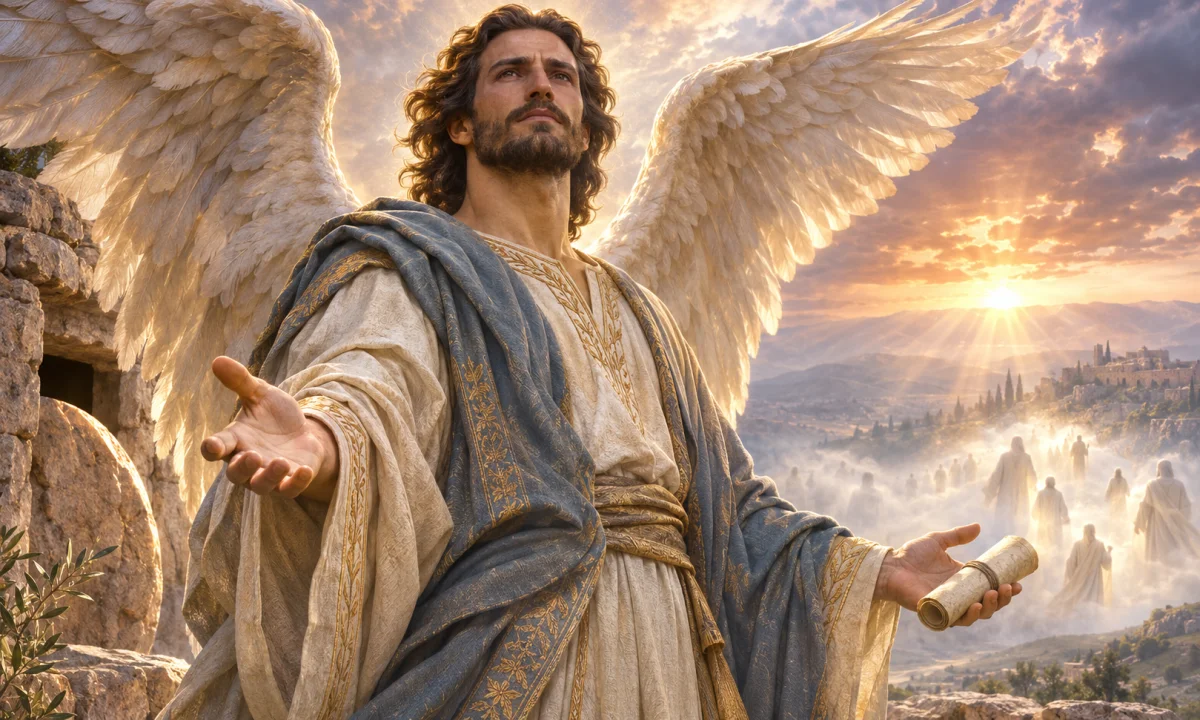
Gadriel is a name associated chiefly with Gadreel, an angelic figure in the Jewish apocalyptic work known as 1 Enoch. In that text, Gadreel belongs to the group of heavenly beings who transgress against the divine order and teach destructive knowledge to humanity. He is connected both with the deception of Eve and with the introduction of weapons and violence. The spelling Gadriel is common in later retellings, while Gadreel is closer to the form found in many translations of the ancient Enochic material.
Origins in Enochic Tradition
The most important source for Gadreel is 1 Enoch, a collection of Jewish religious writings composed and edited over several centuries during the Second Temple period. The work expands upon the brief and enigmatic account in Genesis 6:1–4, where “sons of God” descend to earth, take human women as wives and produce extraordinary offspring. In 1 Enoch, these beings are developed into the Watchers, angels who abandon their proper place and become responsible for corruption among human beings.
The Watchers teach humanity forms of knowledge that the Enochic tradition regards as dangerous or premature. Their instruction includes magical practices, astrology, the use of plants and cosmetics, metalworking, weapon-making and other arts. The result is social disorder, violence and the growth of the giants, whose existence further contributes to the destruction of the earth.
Gadreel appears in a section of 1 Enoch that lists several angelic transgressors and describes the knowledge associated with them. The surviving text is preserved most fully in Ethiopic, with additional evidence from older fragments and translations. As with many names in ancient religious literature, the spelling can vary according to language, manuscript tradition and modern transliteration.
The Name Gadriel or Gadreel
The forms Gadreel, Gadriel and occasionally Gaderel reflect attempts to represent an ancient Semitic name in other alphabets. The exact original form and meaning are not completely certain. The name is often connected with a Semitic root related to a wall, enclosure or fortification, combined with -el, a common element meaning “God” or referring to the divine.
On that basis, the name is sometimes interpreted as “wall of God,” “fortress of God” or a similar expression. These interpretations are plausible rather than definitive. Ancient names were copied through several languages, and the consonants and vowels recorded in later versions do not always allow a single certain reconstruction.
The spelling Gadriel does not automatically indicate a separate angel. In many modern books and online accounts, it is simply a variant of Gadreel. At the same time, later angelological lists sometimes assign different functions to similarly named beings. Those later uses should not be treated as evidence that every figure called Gadriel belongs to the same continuous tradition.
Gadreel among the Watchers
In the Enochic account, Gadreel is not presented as one of the principal archangels who protect or guide humanity. He is instead associated with the rebellious or fallen Watchers. The term “fallen angel” is useful in modern English, but the classifications in 1 Enoch are more specific: the Watchers are heavenly beings who descend to earth, violate divine boundaries and are condemned for their actions.
Gadreel’s role is described in two connected ways. First, he is said to have led Eve astray. Second, he is associated with teaching human beings the instruments and methods of warfare. A translation may mention shields, armor and swords, or more generally “the weapons of death.” The larger meaning is clear: Gadreel represents knowledge that increases humanity’s capacity for violence and mortality rather than wisdom that supports justice or spiritual understanding.
Gadreel is therefore not merely a generic spirit of battle. The Enochic passage treats warfare as part of a wider pattern of forbidden instruction. The Watchers take powers or knowledge belonging to the heavenly realm and make them available to humans without divine permission. Their teaching contributes to a world dominated by bloodshed, exploitation and moral disorder.
Gadreel and Eve
The reference to Eve is one of the most distinctive features of Gadreel’s tradition. The Enochic text states that he led Eve astray, linking him to the temptation narrative in Genesis. This creates an additional explanation for humanity’s fall beyond the account given in Genesis itself.
The passage does not clearly state that Gadreel was the serpent. It also does not provide a detailed conversation between Gadreel and Eve or describe the precise form of his deception. Later interpreters may have imagined him speaking through the serpent, appearing as the serpent or acting behind it, but those details are developments rather than explicit features of the Enochic passage.
This distinction matters because Gadreel is sometimes presented as though he were simply another name for Satan, Samael or the serpent of Eden. The surviving ancient material does not establish that identity. It places Gadreel in a similar conceptual field of deception, transgression and human corruption, but similarity of function is not the same as identity.
The Enochic reference may be understood as an attempt to connect several ancient traditions: the disobedience of Adam and Eve, the descent of the Watchers and the spread of violence before the Flood. By assigning Eve’s deception to a named heavenly transgressor, the text integrates the Eden story into its larger explanation of why the human world became corrupted.
Weapons and the Knowledge of Death
Gadreel’s association with weaponry gives him a distinctive place among the Watchers. Other angelic transgressors in 1 Enoch are connected with practices such as enchantment, astrology, metallurgy, cosmetics or the teaching of secret signs. Gadreel’s lesson concerns the practical technologies of war.
The wording emphasizes not only weapons but also “the blows of death.” This expression gives the subject a moral dimension. The issue is not simply that humans learn to make swords or armor. The deeper concern is that knowledge is used to inflict death, and that violence becomes organized, repeatable and increasingly powerful.
In this setting, metalworking can have an ambivalent meaning. The ability to shape metal is a major human achievement, yet the Enochic tradition focuses on its use for swords, shields and other instruments of combat. Gadreel consequently symbolizes the corruption of useful skill when it becomes a means of domination and killing.
Judgment of the Watchers
The Watchers’ actions lead to divine judgment. In 1 Enoch, the rebellious angels are condemned and restrained until a final reckoning. The giants produced through the union of heavenly beings and human women bring further violence upon the earth, and the Flood becomes part of the divine response to this corruption.
Gadreel is not given a long individual narrative of punishment comparable to the more developed accounts of some other Watchers. His importance comes from the role assigned to him within the collective myth. He is one of the figures who explain how forbidden heavenly knowledge entered human society and helped create the violent world that required judgment.
This framework differs from later Christian ideas in which a single supreme devil becomes the primary source of temptation and evil. The Enochic story distributes responsibility among several transgressive angels. Gadreel is one participant in that network, not necessarily its leader or ultimate ruler.
Religious and Cultural Setting
1 Enoch belongs to the diverse religious literature of ancient Judaism. Its visions address questions about evil, divine justice, cosmic order and the apparent success of corrupt powers. The Watchers story offers an explanation for why the world contains knowledge, violence and injustice that seem to exceed ordinary human wrongdoing.
The work was influential in some ancient Jewish and Christian circles, and parts of its worldview appear alongside other traditions about angels, giants and the period before the Flood. It is not, however, equally authoritative in all religious communities. 1 Enoch is not part of the Jewish biblical canon and is not included in the biblical canons of most Christian churches. It is preserved as scripture in the Ethiopian Orthodox Tewahedo tradition, where it has a distinctive religious status.
Because of these differences, statements about Gadreel should be qualified. He is a significant figure within Enochic angelology, but he is not a universally recognized angel in Judaism or Christianity. Mainstream religious teachings generally do not assign him a standard liturgical role, feast day or universally accepted system of powers.
Gadriel, Satan, Samael and Other Similar Figures
Gadreel is often confused with other figures because several traditions connect them with temptation, death or rebellion against God.
- Satan: Gadreel is not simply another universally accepted name for Satan. In the Enochic material, he is one transgressive angel among several, whereas later Jewish and Christian concepts of Satan vary considerably and often give that figure a broader adversarial role.
- Samael: Samael appears in later Jewish mystical, legendary and theological traditions with roles that can include accusation, death or opposition. The identification of Gadreel with Samael is a later association, not an established feature of the Enochic account.
- The serpent of Eden: Gadreel is linked to Eve’s deception in 1 Enoch, but the text does not plainly say that he was the serpent or that he possessed it.
- Azazel: Azazel is another prominent Watcher-like figure associated with forbidden knowledge and corruption. Some retellings combine the roles of Azazel and Gadreel, but they are named separately in the Enochic tradition.
- Gabriel: The names Gadriel and Gabriel look and sound similar in English, but the figures have different traditions. Gabriel is a major messenger angel in Jewish, Christian and Islamic sources, while Gadreel is chiefly associated with the rebellious Watchers of 1 Enoch.
Later Interpretations
After the ancient Enochic period, Gadreel received less consistent attention than names such as Michael, Gabriel, Raphael or Uriel. Later occult catalogues and angel books sometimes describe Gadriel as an angel connected with war, sexuality, Mars, temptation or other subjects. These assignments are not part of a single, stable ancient tradition. Many derive from modern compilations, speculative correspondences or attempts to systematize names from different religious and magical sources.
Modern popular culture also tends to simplify the figure. Fiction may portray Gadriel as a fallen archangel, a direct rival of Satan, the true identity of the serpent or a supernatural embodiment of war. Such portrayals can draw inspiration from the Enochic themes of forbidden knowledge and deception, but they should be understood as creative adaptations rather than straightforward descriptions of the ancient source.
The most securely grounded interpretation remains narrower. Gadreel, also called Gadriel in many later spellings, is an Enochic transgressor associated with the deception of Eve and the teaching of weapons. His significance lies in the way he connects the fall of humanity, the spread of destructive knowledge and the Enochic explanation of violence before the Flood.