WORLD

Gabriel
Gabriel is one of the best-known angelic figures in Jewish, Christian and Islamic traditions. He appears by name in the Book of Daniel as an interpreter of visions, in the Gospel of Luke as the messenger who announces the births of John the Baptist and Jesus, and in Islam as Jibril, the angel associated with delivering divine revelation to the prophets. His roles, status and imagery differ among these traditions, so Gabriel should not be treated as a single figure with an identical biography in every religious context.
Name and identity
Gabriel is usually written in Hebrew as Gavri’el, in Greek as Gabriēl, and in Arabic as Jibrīl or Jibrā’īl. The Hebrew name is commonly understood as meaning “God is my strength” or “strong man of God,” although translations of ancient names can vary according to how their elements are analysed. The name combines a form related to strength with El, a traditional Semitic word for God.
In modern English, Gabriel is often called an archangel. That title is firmly established in later Jewish, Christian and Islamic usage, but the earliest biblical passages do not present Gabriel in exactly the same way. In the Book of Daniel, Gabriel appears as a supernatural interpreter who is described as having the appearance of a man. The text does not explicitly call him an archangel. The title became more common through later religious interpretation, apocryphal writings, theology, liturgy and devotional tradition.
Gabriel is also associated with several related names and titles. In Islamic tradition, Jibril is the most familiar Arabic form, while titles such as the “Trustworthy Spirit” and the “Holy Spirit” are connected with the angel’s revelatory function in interpretation of the Qur’an. These titles should not automatically be treated as simple translations of the name Gabriel, since their interpretation has been discussed within Islamic scholarship and may refer to the angel through descriptive language rather than by a personal name.
Gabriel in the Book of Daniel
The earliest surviving biblical appearances of Gabriel are in the Book of Daniel, a Jewish work shaped in the context of the religious and political crises of the second century BCE, although its stories are set in the earlier period of the Babylonian and Persian empires. Daniel presents visions concerning kingdoms, persecution, judgment and the future restoration of Jerusalem.
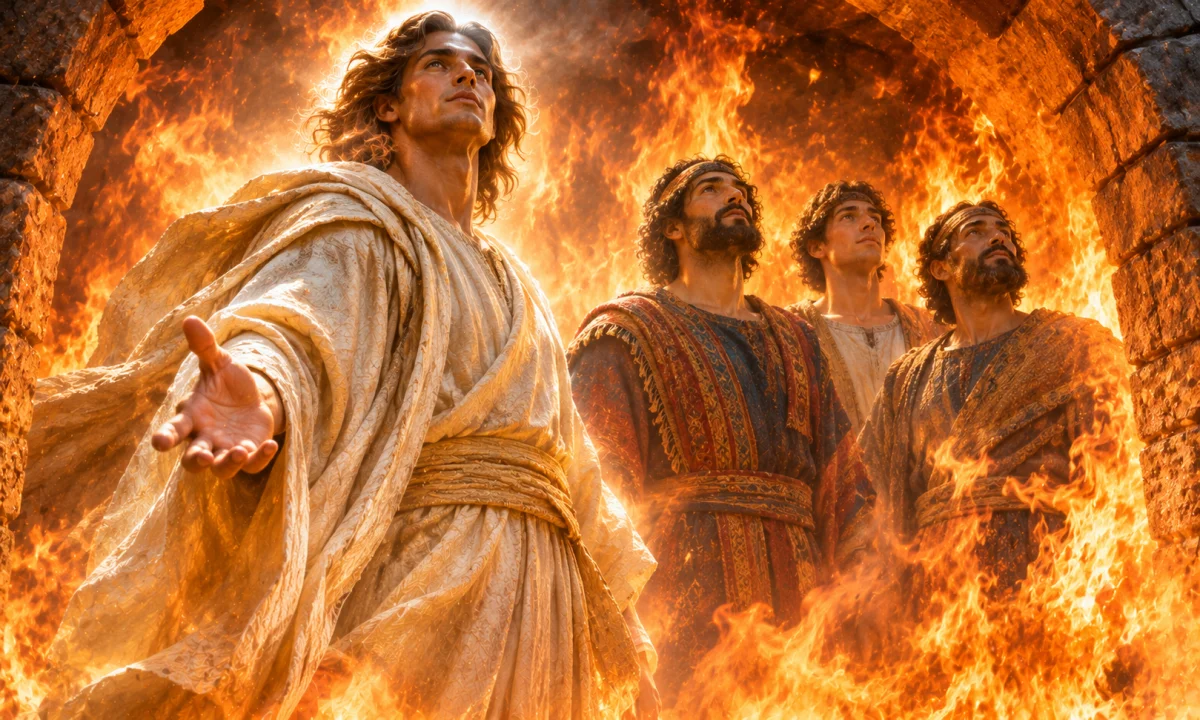
In one vision, a figure described as having the appearance of a man approaches Daniel and identifies himself as Gabriel. He explains the meaning of a vision involving a ram and a goat, symbols that are traditionally understood as representing rival empires. Gabriel’s task is therefore interpretive: he makes obscure and frightening imagery intelligible to the human visionary.
Gabriel appears again when Daniel is troubled by a vision concerning Jerusalem, sin, exile and restoration. He comes at the time of the evening offering and gives an explanation of the vision commonly known as the prophecy of the seventy weeks. The passage has been interpreted in different ways by Jewish and Christian readers, and its chronology and symbolism remain subjects of scholarly debate. Gabriel’s role in the passage is not to act as an independent deity or object of worship, but to communicate and interpret a divine message.
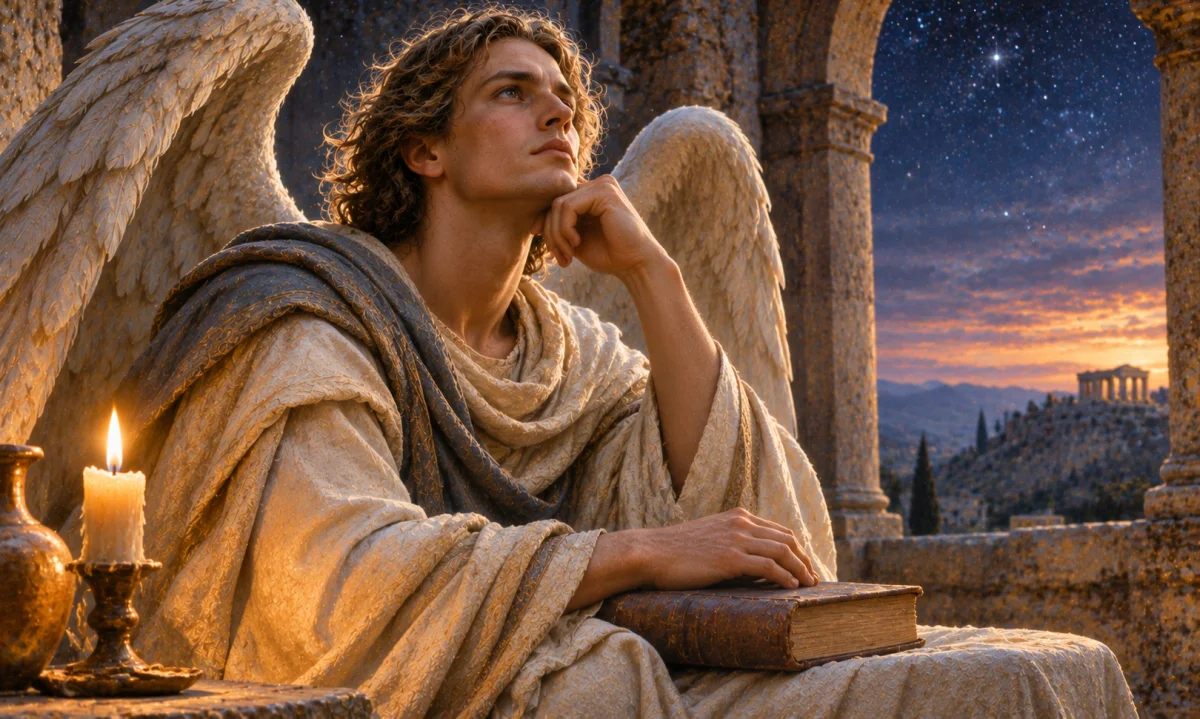
Daniel’s presentation is important because it establishes several features that remain central to Gabriel’s later identity. He is a heavenly messenger, he has access to divine knowledge, and he serves as an intermediary between the transcendent world and a human recipient. His appearance is humanlike, but his knowledge and authority are supernatural. The text does not give him a detailed physical description, and it does not describe him with the elaborate wings and clothing that later became common in art.
Gabriel in Jewish tradition
Jewish traditions developed a richer angelology over time. Angels came to be discussed as members of a heavenly court, servants of God, guardians, messengers, warriors and interpreters of divine mysteries. Gabriel became one of the most prominent named angels in this expanding religious imagination, alongside Michael and, in later texts, Raphael and other figures.
In some Second Temple Jewish writings, Gabriel belongs to a group of exalted angels who stand before God and carry out special responsibilities. The First Book of Enoch, a collection of Jewish apocalyptic writings preserved in several forms, names Gabriel among important heavenly beings. In its various sections, he is connected with judgment and with the punishment of the wicked. The exact presentation differs across the work’s traditions, and it should not be assumed that every passage reflects one uniform angelic hierarchy.
Later Jewish literature also assigns Gabriel military, judicial and protective functions. Rabbinic discussions sometimes portray Michael and Gabriel as especially powerful heavenly servants, with different tasks or symbolic associations. Gabriel may be represented as an angel of judgment or strength, while Michael is more often associated with mercy, protection or advocacy, although these patterns are not universal and should not be reduced to a fixed system shared by all Jewish sources.
In Jewish mystical traditions, angels can be placed within elaborate symbolic structures that relate the heavenly realm to divine attributes, cosmic order and the spiritual life of human beings. Gabriel’s association with strength, judgment or disciplined power became influential in some later interpretations. These developments belong to particular strands of Jewish thought rather than to the whole of Judaism, whose communities and texts have never maintained one single angelology.
Gabriel in Christianity
Gabriel’s most influential Christian appearances are in the Gospel of Luke. He first appears to the priest Zechariah while Zechariah is serving in the Temple. Gabriel announces that Zechariah’s wife Elizabeth will have a son, John, who will become an important prophetic figure. When Zechariah asks how he can know this, Gabriel identifies himself as one who stands in the presence of God and declares that he has been sent to speak this good news.
Gabriel later appears to Mary in the announcement commonly called the Annunciation. He tells her that she will conceive and bear Jesus, who will be called the Son of the Most High. The exchange between Gabriel and Mary is one of the central scenes of Christian theology and devotion. It concerns divine initiative, prophecy, incarnation and Mary’s response to an extraordinary message. The Gospel does not describe Gabriel as the father of Jesus or as a divine being equal to God. He is a messenger who announces an event understood by Christian faith as God’s action.
Luke does not explicitly use the term “archangel” for Gabriel in these scenes. Christian tradition nevertheless came to class him among the archangels because of his proximity to God and his role in announcing events of exceptional importance. The archangel title is also supported in popular usage by Gabriel’s position alongside Michael and Raphael in later Christian devotion. The New Testament explicitly calls Michael an archangel, but it does not use the same designation for Gabriel in a direct statement.
Gabriel’s importance in Christianity is reflected in feast days, prayers, hymns and religious art. In the Roman Catholic calendar, Gabriel is celebrated together with Michael and Raphael on 29 September. Eastern Christian traditions commemorate him in their own liturgical calendars, often in connection with gatherings or synaxes of the archangels and other bodiless powers. Dates and forms of observance differ among churches.
Gabriel in Islam
In Islam, Gabriel is known primarily as Jibril and is one of the greatest angels. His central task is to convey God’s revelation to the prophets. Islamic tradition teaches that Jibril transmitted the Qur’an to Muhammad over the course of the Prophet’s revelatory career. The Qur’an refers to the angel by name in passages concerning opposition to him and describes him through titles associated with trustworthy or holy spirit. Muslim interpretation commonly identifies several other Qur’anic references to a powerful spirit or bearer of revelation with Jibril.
Jibril’s role is not limited to delivering written or spoken information in a narrow sense. He is the intermediary through whom divine revelation reaches the prophetic world, and he appears in accounts concerning instruction, confirmation and divine support. In the Qur’an, the revelation is presented as coming from God, while Jibril functions as the faithful messenger who conveys it. This distinction is central: Jibril is honoured as a mighty servant of God, not worshipped as a deity.
Hadith and later Islamic accounts provide additional details about Jibril’s appearances. Some traditions describe him taking the form of a human being, sometimes appearing as a man known to the early Muslim community. Other traditions describe a majestic angelic form with an immense number of wings. These reports are not equivalent to the sparse descriptions in Daniel or Luke, and they belong to Islamic traditions about the nature of angelic manifestation and revelation.
Jibril is also associated with major events in the life of Muhammad, including the beginning of revelation and the Night Journey traditions. In accounts of the Night Journey and Ascension, Jibril serves as a guide and companion through stages of a journey involving the heavens. The details vary among sources and interpretations, but the recurring image is of a supreme angel accompanying the prophet while remaining subordinate to God.
Gabriel’s Islamic identity should not be treated as merely a borrowed version of the Christian Gabriel. Islam places Jibril within its own theology of revelation, prophecy and angels. The similarities among Jewish, Christian and Islamic traditions reflect shared ancient Near Eastern and Abrahamic histories, while the differences are significant and religiously meaningful.
Attributes and symbolism
Gabriel is most consistently associated with communication from the divine realm. He interprets visions in Daniel, announces births in Luke and conveys revelation in Islam. This makes him a figure of disclosure: hidden knowledge is made available, a future event is announced, or a prophet receives a message that must be transmitted to a community.
He is also linked with strength, authority and judgment. These associations arise partly from the meaning traditionally assigned to his name and partly from Jewish, Christian and Islamic interpretations of his heavenly rank. In some traditions, Gabriel is a warrior or defender; in others, his principal function is intellectual and prophetic. The roles are compatible in religious symbolism, but not every source gives him all of them.
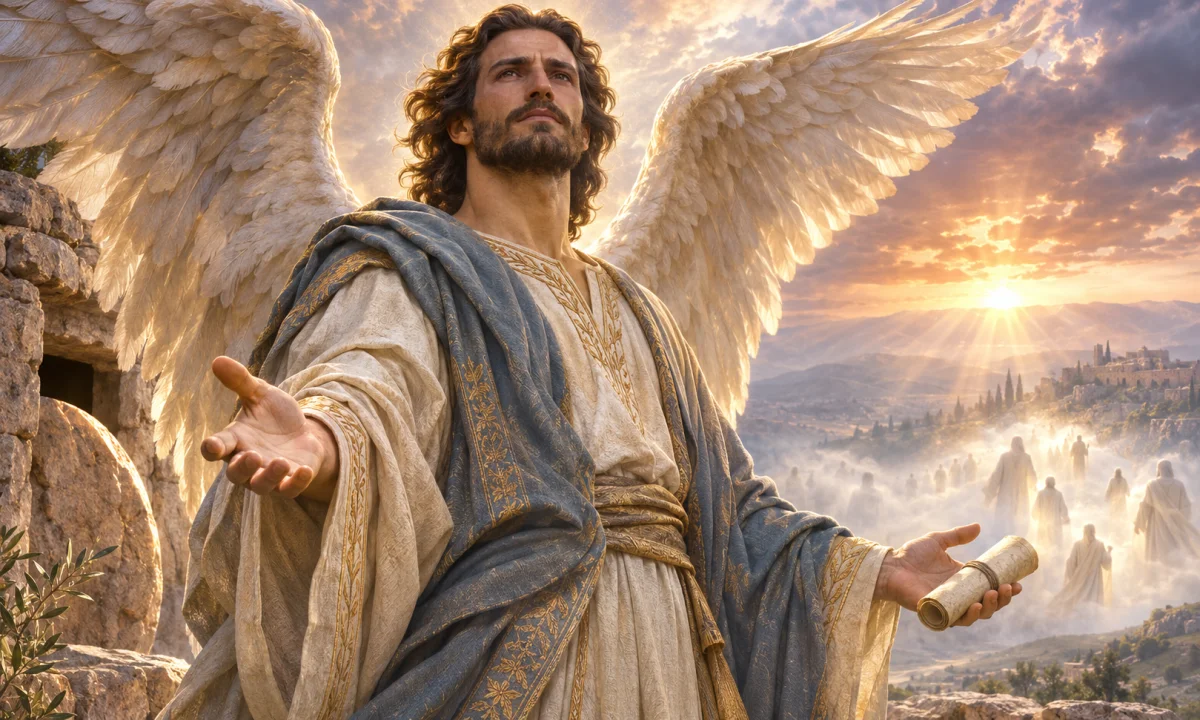
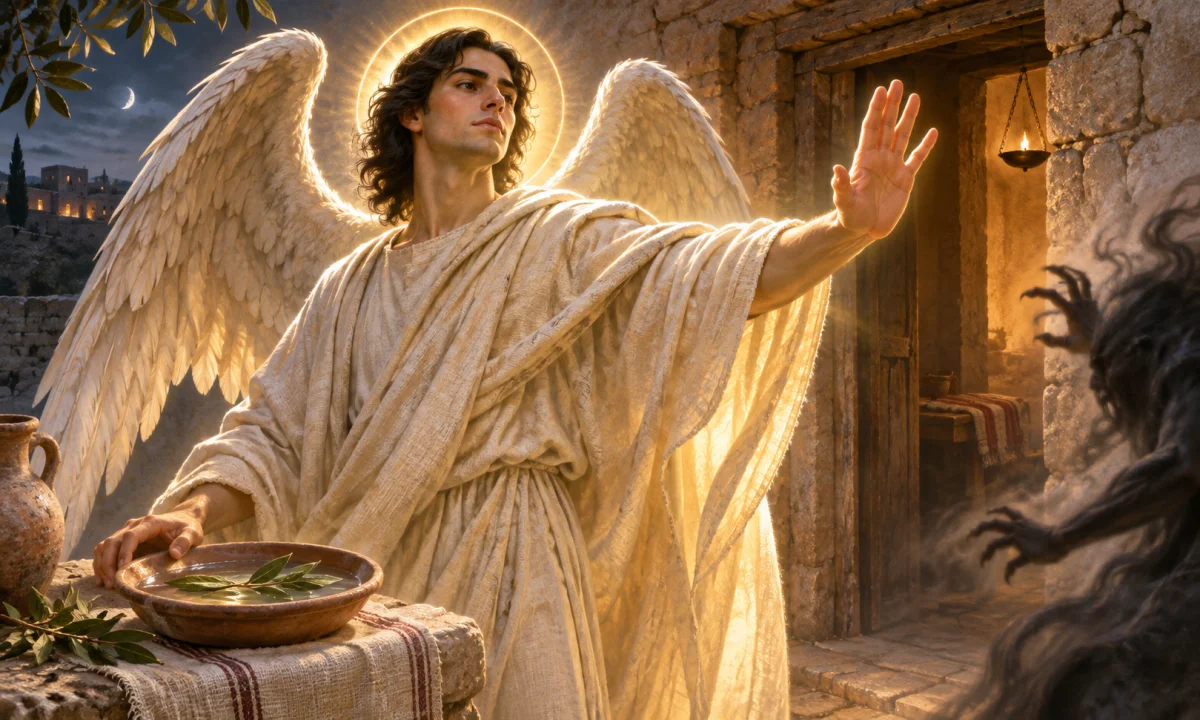
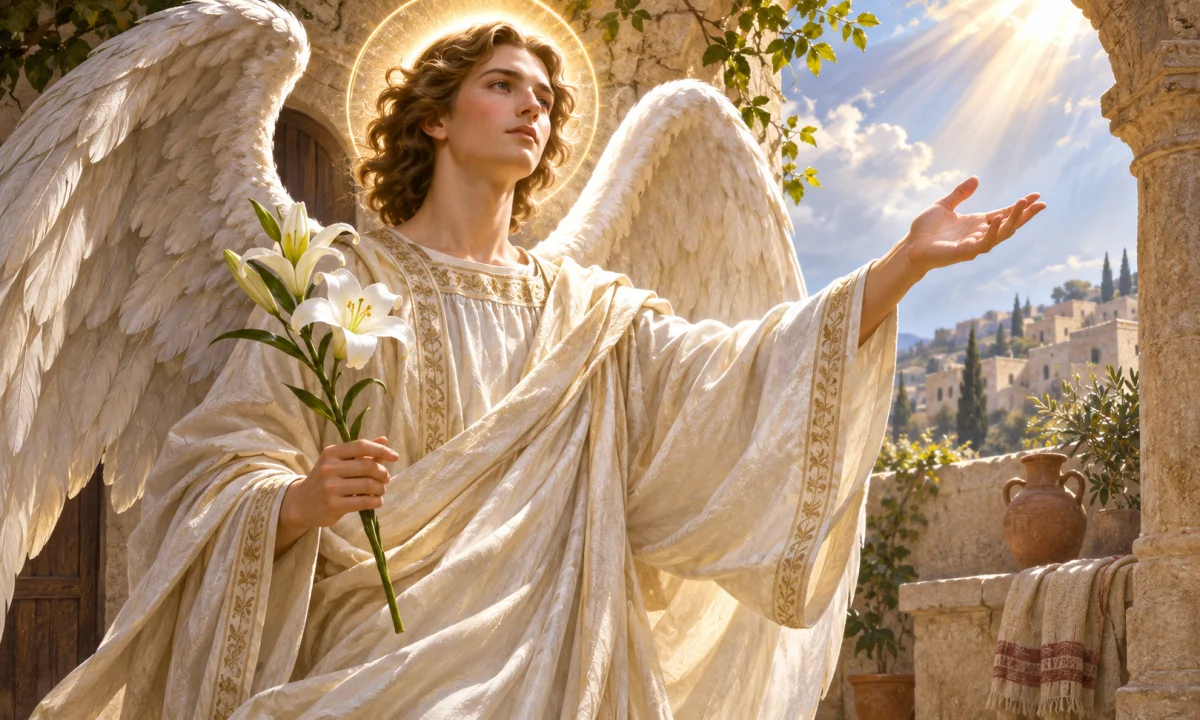
No single physical appearance belongs to Gabriel across all traditions. Daniel presents him in humanlike form. Luke gives no detailed description of his body or clothing. Islamic reports may describe either a human manifestation or a vast winged form. Christian and Jewish art often supplies wings, bright garments, a staff, a scroll, a trumpet or a lily, but these are conventional artistic symbols rather than details consistently stated in scripture.
The lily is especially associated with Gabriel in Western Christian art of the Annunciation. It may represent purity and the virginity of Mary. A scroll or book can indicate Gabriel’s role as a bearer of divine speech, while a trumpet may express proclamation and eschatological announcement. These symbols belong to artistic and devotional traditions and should not be confused with a universal description of the angel.
Important relationships and variants
Gabriel is frequently placed alongside Michael. Both are named in Jewish and Christian traditions and are treated as high-ranking heavenly beings in later interpretation. Their functions, however, are not identical. Michael is commonly associated with heavenly warfare, protection and defense, whereas Gabriel is more often the messenger and interpreter. These distinctions are patterns of tradition, not absolute rules found in every text.
Raphael is another figure often grouped with Gabriel and Michael, particularly in Christian discussions of archangels. Raphael is named in the Book of Tobit and is associated there with healing, travel and protection. He is not simply another name for Gabriel, and the two angels have separate identities and narrative roles.
Gabriel should also be distinguished from the Holy Spirit in Christian theology. The angel announces the conception of Jesus in Luke, and the passage refers separately to the Holy Spirit. Gabriel is therefore not the Holy Spirit under another name. Similarly, in Islam, Jibril is not identical with God, nor is he interchangeable with the divine spirit in every passage where the expression “spirit” occurs.
Names such as Gabriel, Gavriel, Gabriël, Gabrielle and Jibril reflect linguistic and cultural adaptations, but they do not always indicate identical traditions. The feminine form Gabrielle in modern personal naming is a linguistic counterpart, not a separate angel in the major religious sources. Other angelic names that sound similar should not be merged with Gabriel without evidence.
Cultural significance and later reception
Gabriel has had an exceptional influence on religious art, music, poetry and personal naming. The Annunciation made him a central figure in Christian visual culture, while Islamic devotional and scholarly traditions emphasize Jibril’s role in revelation. Jewish literature and mystical interpretation contributed to his image as a powerful member of the heavenly court. Across these settings, Gabriel often represents the moment when divine purpose enters human history through speech.
Modern popular culture frequently uses Gabriel as a character in fantasy novels, films, television series, comics and games. Such works may portray him as a warrior, antagonist, rebellious angel or supernatural hero. These portrayals can draw on the traditional name while substantially changing the figure’s theology, personality and relationships. A fictional Gabriel should therefore be identified as a modern adaptation rather than assumed to describe Jewish, Christian or Islamic belief.
In traditional religious contexts, Gabriel’s significance rests less on a detailed personal mythology than on his function as a trustworthy intermediary. He stands at the boundary between the heavenly and human worlds, interpreting visions, announcing divine acts and transmitting revelation. The precise meaning of that role depends on the tradition: Daniel presents an interpreter of apocalyptic visions, Luke presents a herald of prophetic births and the incarnation, and Islam presents Jibril as the principal angelic bearer of revelation to the prophets.