WORLD
WORLD
Forneus

Forneus is a demon in the ceremonial-magical tradition known as the Ars Goetia, the first section of the seventeenth-century grimoire commonly called the Lesser Key of Solomon. He is listed as the thirtieth spirit and is described as a great marquis of Hell who appears as a vast sea monster. His principal abilities concern eloquence, languages, learning and social influence. Unlike figures drawn from a clearly documented ancient mythology, Forneus is known chiefly from early modern European demonological literature.
Origins in Goetic demonology
Forneus belongs to a cataloguing tradition rather than to a single continuous mythology. The Ars Goetia presents a hierarchy of spirits, giving each one a title, a visual form, a number of legions under its command and particular powers that may be requested by a magician. Its descriptions reflect the intellectual and religious environment of Christian Europe, where older magical materials, biblical language, medieval demonology and Renaissance occult philosophy were combined into elaborate systems.
The surviving form of the Ars Goetia was transmitted through manuscripts and printed editions associated with the seventeenth century, although parts of its material have earlier precedents. It should not be treated as a direct record of an ancient cult or as evidence that Forneus was worshipped in antiquity. The text gives no myth explaining his birth, family, independent adventures or relationship with a particular ancient god. Instead, it offers a concise ritual profile suitable for use within a system of ceremonial invocation.
Forneus also appears in related early modern demonological catalogues, including versions of the Pseudomonarchia Daemonum. The wording and arrangement can vary between manuscripts and editions. Such variation is common in grimoires, which were copied, edited and reorganised over time. The broad identity of Forneus remains recognisable, but individual details should not automatically be assumed to have been fixed across every version.
Name and classification
The name is generally written Forneus. Its original meaning and etymology are uncertain. There is no securely established ancient language from which the name can be confidently derived, and proposed explanations should therefore be treated cautiously. The spelling belongs to the transmission history of European demonological texts rather than to a widely attested pre-Christian religious tradition.
In the Ars Goetia, Forneus holds the rank of marquis. This title places him within a quasi-feudal hierarchy of Hell, a structure that reflects European political and aristocratic terminology. The ranks assigned to demons—kings, dukes, princes, marquises, presidents and others—do not describe a consistent theology shared by all Christian traditions. They are organisational features of grimoire literature, helping to arrange a large number of spirits into a formal infernal court.
Forneus is said to command twenty-nine legions. In this context, a legion is a conventional unit of demonic followers, not a force documented by historical observation. The numbers in the Ars Goetia contribute to the appearance of military and bureaucratic order that characterises the catalogue. They are part of the literary and ritual presentation of the spirits.
Appearance and attributes
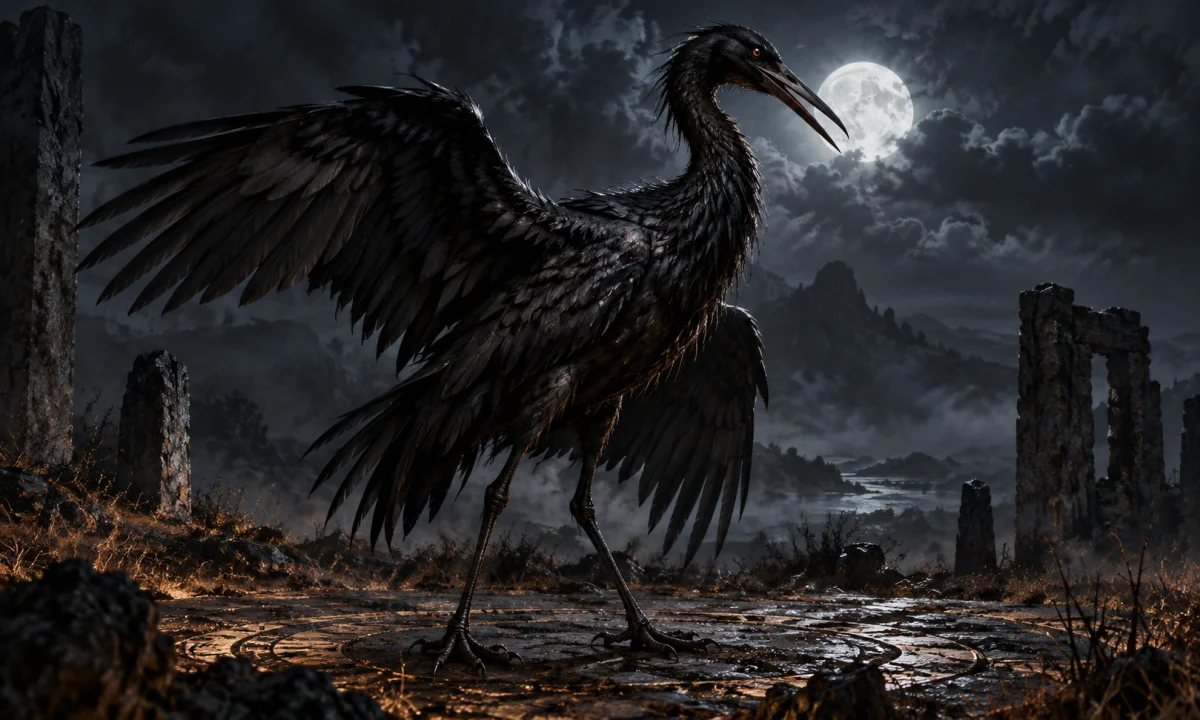
Forneus is described as appearing in the form of a great sea monster. The text does not provide a detailed anatomy, species identification or consistent visual portrait. It does not specify whether the creature resembles a whale, serpent, fish, dragon or another familiar maritime being. Later artists and occult writers have consequently had considerable freedom when depicting him.
The marine form is significant, but its meaning is not explicitly explained in the source material. A sea monster can evoke the threatening and uncontrollable character of the deep, the biblical imagery of monstrous waters, or the broader medieval association between oceans and unknown creatures. It may also function simply as a striking manifestation appropriate to a powerful spirit. Any more precise symbolic interpretation is a later reading rather than a statement made by the Ars Goetia itself.
Forneus is primarily associated with speech, learning and persuasion. His listed powers include teaching arts and sciences, granting knowledge of languages and making a person beloved by friends and enemies. Some presentations particularly emphasise rhetoric or eloquence, although the exact wording differs between editions and summaries. These powers connect Forneus with the practical and social uses of knowledge: speaking effectively, communicating across linguistic boundaries, gaining acceptance and influencing other people.
The promise that he can make someone loved by both friends and foes is especially notable. It does not merely concern romantic attraction. In the context of the grimoire, it suggests a form of social favour or persuasive influence that may help an individual navigate relationships, disputes and hostile audiences. The description belongs to a magical catalogue and should not be confused with a historical claim that people used Forneus worship to obtain popularity.
Knowledge, language and rhetoric
Forneus occupies a distinctive position among goetic spirits because his powers are not mainly described through physical strength, treasure, prophecy or sexual temptation. His profile centres on the communicative and intellectual abilities that were highly valued in classical education and early modern learned culture. Mastery of languages could provide access to foreign texts, diplomatic exchange, religious writings and scholarly debate. Rhetoric, meanwhile, was associated with public argument, persuasion and the ability to shape an audience’s judgement.
These associations fit the educational world in which grimoires circulated. The period’s occult writers often regarded language as more than a neutral tool. Correct words, names and formulas were believed to possess ritual significance, while knowledge of unfamiliar languages could be connected with ancient wisdom and hidden authority. Forneus’s linguistic gifts therefore suit the broader magical interest in speech as a means of commanding, interpreting and transforming experience.
His powers also reveal a recurring concern in demonological literature: the desire to obtain knowledge without following ordinary academic or moral processes. A spirit that teaches arts and sciences provides a supernatural shortcut to expertise. Christian authors often treated such attempts to gain knowledge from demons as dangerous or illicit, even when the desired knowledge itself—languages, rhetoric or natural philosophy—was not considered evil. The moral issue lay in the alleged source and method of acquisition.
Forneus within the Ars Goetia
The Ars Goetia assigns each spirit a seal or emblem used in the ritual system. Forneus is associated with a sigil presented as his identifying mark. These seals are part of the manuscript tradition and should not be understood as ancient symbols independently attested in archaeology or classical religion. Their forms can vary according to the edition or source from which they are copied.
In ceremonial instructions accompanying the catalogue, spirits are approached through a structured process involving divine names, protective boundaries, ritual tools and formal commands. The operator is not simply invited to worship a demon as a deity. The system generally presents the magician as acting under the authority of God while compelling or negotiating with spirits. This distinction is important: goetic practice developed inside a Christian magical worldview, even though it drew on many non-Christian, Jewish and classical materials.
The catalogue’s language also reflects the tension between fascination and condemnation. Demons are portrayed as possessing useful knowledge and remarkable powers, but they remain morally suspect beings within the framework of Christian demonology. The text’s promises of learning, favour and influence are therefore accompanied by the assumption that contact with infernal spirits is perilous. Forneus is not presented as a benevolent teacher in the manner of a culture hero, saint or tutelary deity.
Stories and relationships
Forneus has no substantial narrative cycle in the surviving goetic material. The Ars Goetia supplies a formal description rather than a biography. There are no well-established stories of his battles, loves, ancestry or personal conflicts with angels or other demons. The text does not identify him as the servant, child or rival of a particular major infernal figure.
His relationship to the other spirits is administrative. He is given a rank, a number of legions and a place in the sequence of the catalogue. This arrangement should not be mistaken for a fully developed infernal mythology. The proximity of two names in a list does not necessarily imply kinship or shared origin.
Forneus is sometimes discussed alongside other aquatic or monstrous demons, but the source does not establish a special alliance between them. Nor is there adequate evidence to identify him with a sea god, a dragon from a particular folklore tradition or a monster from biblical narrative. Similar imagery does not prove identity.
Forneus and Foras: a necessary distinction
Forneus is frequently confused with Foras, also written Forcas in some traditions. The names are similar and the two spirits appear near one another in common versions of the Ars Goetia, but they are separate entries. Forneus is the thirtieth spirit, a marquis appearing as a sea monster and associated with languages, learning and favour. Foras is the thirty-first spirit, generally described as a president who appears in human form and teaches properties of herbs and stones, logic, ethics and other subjects while also revealing hidden things.
The similarity between the names may reflect copying, spelling variation or the transmission history of demonological lists, but it does not justify merging the figures. A modern illustration or occult website may occasionally blur their attributes, especially when relying on abbreviated lists. The traditional catalogue itself distinguishes them by rank, appearance and powers.
Interpretation and cultural significance
Forneus can be read as an example of how early modern demonology organised anxieties and desires surrounding knowledge. The ability to speak persuasively, master foreign languages and win over hostile people was socially valuable, but it could also appear morally ambiguous. Eloquence might support education and diplomacy, or it might enable deception and manipulation. The demon’s profile brings these possibilities together without explaining how the powers should be used.
His sea-monster form creates a contrast with his intellectual abilities. Visually, he is associated with the frightening unknown of the ocean; functionally, he is associated with cultivated speech and learning. This contrast is characteristic of grimoire catalogues, where a spirit’s appearance does not always directly illustrate its powers. A monstrous body may embody the danger of the source even when the promised gift is refined or scholarly.
From the perspective of religious history, Forneus illustrates the difference between demonological classification and popular folklore. Many legendary beings have been preserved through oral stories, local customs or ritual practice. Forneus, by contrast, is known primarily through written occult compilations. His identity depends on the texts that list and describe him, and those texts were themselves shaped by copying, editorial decisions and changing ideas about magic.
There is no strong evidence for an ancient cult devoted to Forneus, nor for a continuous folk tradition independent of the grimoire material. Claims that he was originally a pre-Christian sea deity or an ancient pagan monster require evidence that the surviving sources do not provide. The safest historical description is that Forneus is an early modern goetic spirit whose marine appearance may draw on wider European imagery of the monstrous sea.
Later occult reception
Interest in Forneus increased with the revival of ceremonial magic in the nineteenth and twentieth centuries. Occultists reproduced the spirit’s name, seal, rank and powers in new editions and commentaries on the Lesser Key of Solomon. Some writers expanded his association with rhetoric, diplomacy, education or multilingual communication, but these elaborations should be distinguished from the shorter descriptions found in the older catalogues.
Modern practitioners may interpret Forneus symbolically, psychologically or spiritually rather than as a literal external demon. In such settings, the figure can represent the disciplined use of language, the desire for intellectual mastery, or the risks of seeking influence over others. These interpretations belong to modern occult practice and personal symbolism; they are not equivalent to historical evidence about the origins of the name.
Forneus has not achieved the same level of recognition in mainstream popular culture as figures such as Lucifer, Beelzebub or Astaroth. When he appears in games, novels, comics or other entertainment, creators commonly redesign him as a sea beast or as a powerful infernal intellectual. Such portrayals may borrow his name and general attributes while adding personalities, histories and relationships absent from the goetic sources. They should be identified as creative adaptations rather than as part of the traditional description.