WORLD
WORLD
Flauros
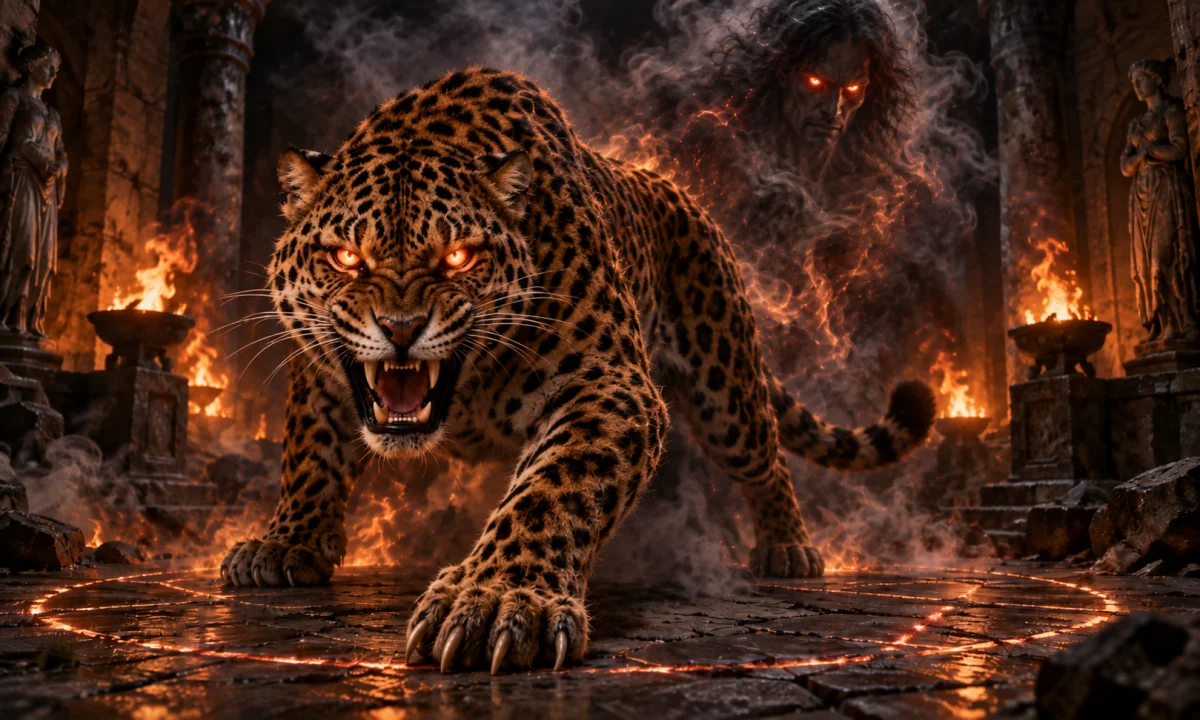
Flauros is a demon listed in early modern European grimoires, most notably the Ars Goetia, the first section of the Lesser Key of Solomon. He is described as a powerful duke who initially appears as a leopard and can take human form when commanded. In that form, Flauros has fiery eyes and a frightening expression. His traditional profile combines claims of supernatural knowledge with the destructive functions commonly assigned to demons in Christian magical literature.
Origins in Solomonic demonology
Flauros belongs to the catalogue of spirits associated with Goetia, a form of ritual magic concerned with summoning and controlling spirits. The best-known version of this catalogue appears in the Ars Goetia, which survives in manuscripts and printed traditions connected with the broader Lesser Key of Solomon. The work was assembled in its recognizable form during the early modern period, although it draws on older magical books, demonological lists and traditions of uncertain and mixed origin.
He is not a demon known from the Bible, ancient Mesopotamian religion, classical mythology or a continuous pre-Christian folk tradition. His documented identity belongs primarily to the learned tradition of European grimoires. Those books presented spirits within a Christian cosmological framework, often treating them as fallen angels, hostile spirits or beings subordinate to infernal authorities.
A significant predecessor to the Ars Goetia is Johann Weyer’s Pseudomonarchia Daemonum, published in 1577 as part of a larger work on witchcraft and demonic deception. The name and description associated with Flauros appear in related forms in this earlier catalogue. The transmission of these texts was not perfectly uniform, so spellings, numbering and small details can vary between manuscripts and editions.
Name and identity
The name is commonly written as Flauros in English-language editions of the Ars Goetia. Other forms include Hauras, Haures and Flauros with minor spelling variations. These differences reflect the unstable transmission of names through handwritten manuscripts, translation and printing.
The original meaning of the name is uncertain. It is sometimes connected by modern writers with possible Latin or other linguistic forms, but no etymology has achieved universal acceptance. The spelling alone does not establish a definite relationship with a deity, spirit or monster from an earlier religion. In particular, Flauros should not automatically be identified with every legendary being whose name resembles Hauras, Haures or another variant.
Within the Ars Goetia, Flauros is the sixty-fourth spirit. He is assigned the rank of duke and is said to command thirty-six legions of spirits. These numbers are part of the grimoire’s formal hierarchy. They do not represent historical evidence for an actual religious organization, and different catalogues may assign different ranks or numerical positions to related names.
Appearance
Flauros is first described as a leopard. The animal form places him among the many grimoire spirits whose appearances combine recognizable creatures with threatening or unusual supernatural identities. A leopard can suggest speed, violence, stealth and predatory power, although the text does not provide an elaborate symbolic explanation for the choice.
When ordered to do so, Flauros changes into the shape of a man. His human appearance is marked by fiery eyes and a terrible or frightening countenance. The transformation is important to the structure of the description: the leopard is his initial manifestation, while the human form is the one in which he communicates with the ritual magician.
Later illustrations inspired by the Ars Goetia often portray Flauros as a hybrid creature, a leopard-headed or leopard-bodied demon, or a humanoid figure accompanied by flames. Such images are artistic interpretations rather than fixed elements of the earliest written description. The texts do not provide a single universally authoritative portrait, and the visual conventions familiar today largely come from later occult editions and modern artwork.
Powers and functions
The grimoire attributes several abilities to Flauros. He is said to answer questions about things past, present and future. This places him within the fortune-telling and divinatory side of ceremonial magic. Such claims were common in spirit catalogues, where demons and angels might be assigned knowledge of hidden events, secrets, languages or natural phenomena.
His supposed revelations are accompanied by an important warning. The description states that Flauros will speak truthfully about certain matters when properly constrained, but that he may deceive the operator if he is not brought into the ritual’s designated protective space, usually described as the triangle of art. In the logic of the grimoire, the triangle is not merely decorative. It is a place where the spirit is commanded to appear and where its ability to threaten or mislead the magician is ritually controlled.
The text also says that Flauros can discuss the fall of the angels and the destruction of his own spiritual enemies. This detail reflects the Christian theological setting of the catalogue. Demons are not presented simply as independent nature spirits; they are placed within a narrative of rebellion, fall and conflict between divine and infernal forces. The wording is brief, and it does not provide a full myth of Flauros’s own fall.
Flauros is additionally credited with the power to destroy enemies. In some versions, he is said to kill and burn them, while also protecting the magician from other spirits. These functions reveal the practical concerns of ceremonial magic: a spirit might be invoked for information, protection, revenge or the removal of an obstacle. The descriptions are catalogued claims within a magical text, not independently verified accounts of supernatural events.
Flauros in the Ars Goetia
The entry for Flauros follows a standard pattern found throughout the Ars Goetia. It gives his rank, his visual form, the number of legions under his command and a list of services or powers. This structure makes the catalogue resemble an administrative hierarchy, with each spirit occupying a particular office. Titles such as duke, king, president and marquis imitate human political organization while placing it within an imagined infernal kingdom.
His position as a duke does not necessarily indicate a developed mythology or a long-standing cult. Many spirits in the catalogue are known only through brief entries, and Flauros is one of them. There are no widely attested ancient temples, devotional traditions or medieval narrative cycles devoted specifically to him. Most of the information associated with his identity comes from the grimoire description and from later interpretations of it.
The entry’s concern with truth and falsehood is also typical of demonological literature. Christian writers often portrayed demons as deceptive beings that could provide convincing but spiritually dangerous knowledge. Grimoires sometimes turned this theological problem into a technical ritual problem: if the spirit was properly summoned, constrained and questioned, its answers were presented as more reliable. This tension between demonic deception and magical command is central to Flauros’s profile.
Religious and cultural context
Flauros should be understood within the history of Christian demonology and ceremonial magic, rather than as a straightforward survival of an ancient pagan god. Early modern demonological books often drew material from several sources, including biblical ideas about fallen angels, medieval discussions of spirits, magical manuals, astrology and folklore. The result was a layered system in which names and attributes could be copied, altered or reorganized over time.
The grimoires also reflect a world in which magic, theology and natural philosophy had not yet been separated in the modern sense. A learned practitioner might regard the control of spirits as part of a larger theory of the cosmos, while religious authorities could condemn the same practices as illicit or demonic. The descriptions of spirits therefore tell historians about early modern ideas concerning authority, knowledge, danger and the boundaries of legitimate religious practice.
Flauros’s leopard form and his association with fire fit broader European associations between predatory animals, violence and infernal power. However, the surviving text does not explain that symbolism in detail. It is safer to describe these as plausible interpretive associations than to claim that the leopard had a fixed, ancient meaning specifically connected with Flauros.
Stories and relationships
Flauros has no substantial cycle of myths comparable to the stories of figures such as Lucifer, Astaroth or Beelzebub. His traditional narrative is limited mainly to the encounter imagined by the grimoire: a magician summons a powerful duke, observes him in leopard form, commands him to assume human shape and questions him under ritual restraint.
The references to the fall of the angels place him in the same broad theological universe as other demons in Christian demonology, but they do not establish a specific family relationship or personal history. The text does not identify a spouse, parent, rival or patron for him. Nor does it clearly state that he is a subordinate of a particular infernal monarch, despite the hierarchical titles used in the catalogue.
Some modern occult writers expand his personality, motives or mythology, but those additions should be distinguished from the short traditional entry. They may represent individual ritual practice, symbolic interpretation or creative reconstruction rather than information preserved in the early modern sources.
Distinguishing Flauros from similar figures
Flauros is sometimes confused with other leopard-like or animal-shaped demons in modern lists. The Ars Goetia contains many spirits with bestial appearances, but their ranks, powers and names are different. A leopard form alone does not establish that two entries describe the same being.
He may also be confused with Furfur, another spirit in the Ars Goetia whose name is similar in sound and whose description includes an animal form. Furfur is generally described as an angel who appears as a winged deer or stag, although he takes on an angelic or human form when compelled. The names and attributes are distinct, and there is no firm textual basis for treating Furfur and Flauros as alternate identities.
Nor should Flauros be automatically equated with every demon called Haures or Hauras in later occult literature. Those names are related through the transmission of grimoire catalogues, but individual authors may use variant spellings inconsistently. Careful identification depends on the surrounding description, rank and list position, not on a name considered in isolation.
Interpretation and significance
Flauros illustrates how demonological catalogues transform fearsome or ambiguous supernatural beings into organized entries within a system. His leopard shape gives him an immediate animal menace, while his title and assigned legions make him part of a bureaucratic infernal hierarchy. His ability to reveal hidden knowledge creates a second aspect: he is dangerous, but also useful to a practitioner who claims the authority to command him.
The warning that he may lie about divine matters is especially revealing. It expresses a fundamental concern in Christian magical writing: supernatural knowledge may be real, but its source may be morally corrupt or deliberately deceptive. Flauros therefore represents not only violence and fire but also the uncertainty of information obtained from a forbidden spirit.
From a historical perspective, Flauros is best treated as a figure of grimoire demonology. The evidence supports discussion of his written description, changing name forms and place within the Solomonic tradition. It does not support confident claims about an ancient cult, a pre-Christian origin or a continuous popular belief independent of those texts.
Modern reception
Flauros has gained renewed visibility through modern occult publishing, demonology databases, fantasy fiction, role-playing games and visual media. These portrayals commonly emphasize his leopard or feline form, flames, divination and destructive power. Some give him elaborate biographies, alliances or personalities that are absent from the early catalogues.
Such adaptations can make Flauros more recognizable, but they should not be mistaken for ancient mythology. The historically documented figure remains the relatively brief grimoire spirit: a duke, a leopard who can become a frightening man, a supposed revealer of past, present and future events, and a hostile power associated with fire, destruction and protection against other spirits.