WORLD
WORLD
Furfur
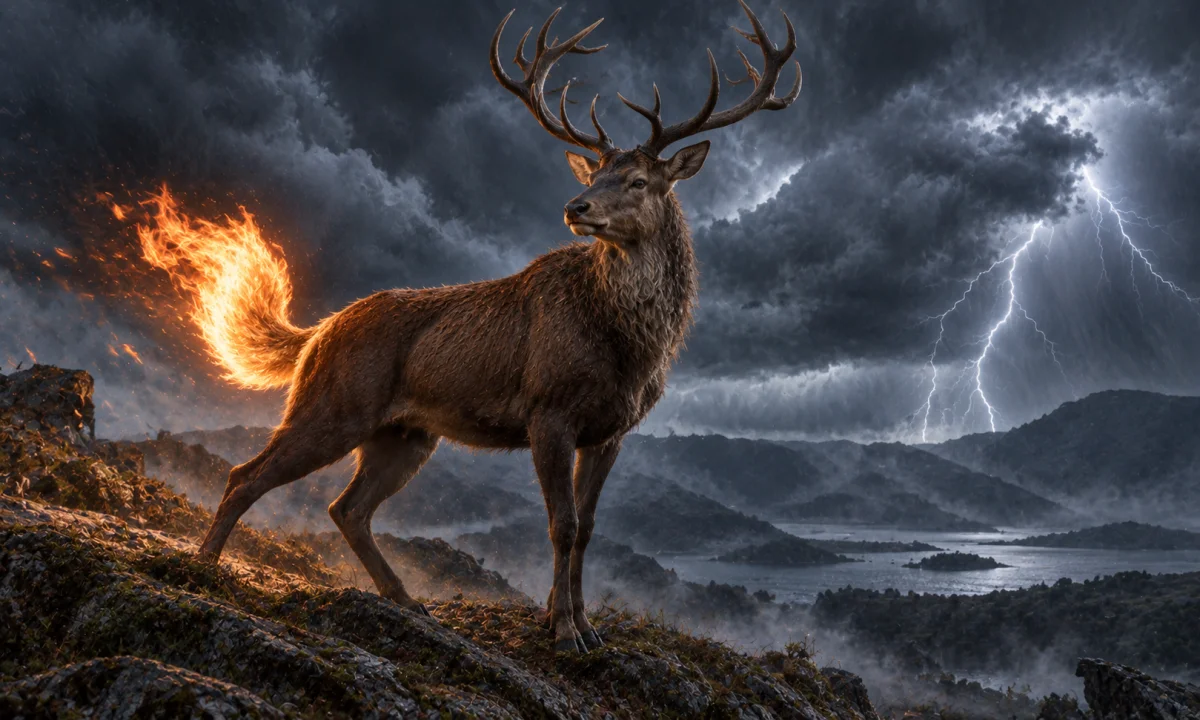
Furfur is a demon recorded in early modern European grimoires, especially the Ars Goetia, the first section of the Lesser Key of Solomon. He is usually described as a great earl who appears as a hart with a fiery tail, although he may also take the form of an angel. In the traditional texts, Furfur is associated with sexual love, storms, thunder, lightning and hidden knowledge. He belongs to the ceremonial demonology of Christian Europe rather than to a clearly documented ancient pagan religion.
Origins in Western demonology
Furfur appears within the literary and ritual tradition commonly called Solomonic magic. This tradition presents magical knowledge as having been revealed to, or controlled by, the biblical King Solomon. The texts associated with Solomon were not written in the biblical period, however. They developed through the copying, adaptation and rearrangement of magical and demonological material in medieval and early modern Europe.
The most familiar account of Furfur comes from the Ars Goetia, a catalogue of seventy-two spirits included in the Lesser Key of Solomon. The Lesser Key survives in manuscripts from the seventeenth century, although much of its material is older. The Ars Goetia is closely related to Johann Weyer’s Pseudomonarchia Daemonum, or “False Monarchy of Demons,” published in 1577. Weyer’s work itself drew on earlier demonological and magical materials.
These books should be understood as products of learned occult literature, not as neutral records of a single, continuous ancient belief system. Their lists combine Christian ideas about demons with material from magical handbooks, astrological associations, biblical names, literary invention and traditions whose original sources are sometimes uncertain. Furfur’s entry is therefore important as evidence of grimoire tradition, but it does not demonstrate that a demon of the same identity was worshipped in antiquity.
Name and identity
The spelling Furfur is standard in the Ars Goetia, while related texts may preserve variant forms such as Furtur. The meaning and origin of the name are uncertain. A similar-looking Latin word, furfur, can refer to bran or chaff, but there is no secure evidence that this ordinary Latin term explains the demon’s name. Attempts to derive Furfur from a specific ancient deity, language or mythological figure remain speculative.
The name should also not be treated as proof that Furfur belongs to a pre-Christian European animal cult. The hart, storm powers and fiery imagery may invite comparisons with older mythologies, but resemblance alone does not establish historical identity. Grimoire authors often employed traditional religious imagery without preserving the original context of the figures they described.
In the hierarchy of the Ars Goetia, Furfur is the thirty-fourth spirit. He is identified as a great earl and is said to command twenty-six legions of spirits. The rank of earl is part of the elaborate social and military structure imposed on the spirits in the grimoire. It should not be confused with a historical title held by a human nobleman or with a rank found in a universal demonological system.
Appearance and manifestations
The principal form attributed to Furfur is a hart with a fiery tail. In modern English, “hart” means a mature male deer, especially a stag. This detail gives Furfur one of the more distinctive animal forms in the Goetic catalogue. The combination of a horned deer and fire can suggest wildness, vitality, danger and untamed natural power, although the grimoire does not provide a symbolic interpretation of the image.
Furfur may also appear in the form of an angel. Within Christian demonology, this does not make him a benevolent angel or place him among the angels of orthodox religious teaching. Demons were often imagined as fallen spirits capable of deception, disguise or false displays of holiness. The angelic appearance is therefore best understood within the grimoire’s ritual logic: a potentially misleading manifestation that requires magical control and testing.
The text also describes Furfur as speaking with a hoarse voice. This vocal quality contributes to the impression of an uncanny, nonhuman presence. It is one of the few sensory details supplied by the traditional description, and it appears alongside the warnings about truthfulness rather than as part of a longer narrative about the demon’s life or deeds.
Powers and functions
Furfur’s powers fall into three main groups: erotic influence, control of weather and revelation of hidden matters.
- Love and sexual attraction: Furfur is said to cause love between a man and a woman. In the language of early modern demonological catalogues, this generally refers to the production or intensification of erotic desire rather than to a modern ideal of mutual emotional companionship.
- Storms and atmospheric phenomena: He is associated with thunder, lightning, powerful winds or blasts, and heavy rain. These abilities place him among the spirits whose supposed powers imitate or manipulate forces of nature.
- Secret knowledge: Furfur is said to answer questions concerning hidden or divine matters. The promise of concealed knowledge is typical of ceremonial magic, where spirits are summoned to provide information unavailable through ordinary human means.
His weather powers are especially notable because storms carried strong religious significance in premodern Europe. Thunder and lightning were often interpreted through divine providence, biblical imagery or supernatural agency. In a grimoire, control over such phenomena elevates the spirit beyond the role of a private tempter: Furfur is presented as a being connected with dramatic forces that affect the wider world.
The warning about truthfulness
One of the defining features of Furfur’s entry is the warning that he does not speak truth unless he is compelled to do so within a magical triangle. Outside that condition, he may deceive the operator. This reflects a recurring theme in ceremonial demonology: demons possess knowledge, but they are considered morally unreliable and must be constrained by divine names, ritual procedures, protective symbols and prescribed spaces.
The triangle is an important element of the ritual environment described in Goetic magic. The operator is generally positioned within a protective circle, while the summoned spirit is directed into a triangle placed outside it. The triangle functions as a designated space for manifestation and containment. In the literature, it is not simply a geometric ornament; it helps define the relationship between the human magician, the spirit and the sacred authority invoked during the rite.
Furfur’s alleged dishonesty also distinguishes him from a simple oracle. The traditional account does not say that he freely grants reliable wisdom. Instead, it presents knowledge as something that must be extracted under ritual compulsion. This reflects the broader Christian view of demons as beings that may possess genuine supernatural knowledge while using it to mislead, corrupt or entrap human beings.
Furfur and the language of Christian demonology
In Christian demonological writing, a demon is not merely a frightening animal or a personification of bad weather. Demons are commonly understood as hostile or fallen spirits opposed to God and capable of influencing human conduct. The Goetic catalogues organize these spirits into ranks, assign them legions and give them specialized powers. Such descriptions transform abstract theological ideas about temptation and spiritual danger into a structured magical taxonomy.
Furfur’s combination of seduction, storms and deception fits this setting. Erotic desire could be treated by religious writers as a source of temptation; violent weather could evoke the limits of human control; and secret knowledge could represent the danger of seeking forbidden wisdom. The entry brings these concerns together in a single named spirit.
At the same time, the Goetic texts are practical manuals as well as demonological works. Their descriptions are accompanied by ritual instructions, seals, names of authority and procedures for summoning or dismissing spirits. The catalogue therefore has a different purpose from a theological treatise explaining the nature of demons. It presents a system for magical operations, even though Christian moral and religious assumptions shape that system.
The seal and ritual representation
Like most spirits in the Ars Goetia, Furfur is assigned a distinctive seal, a diagram intended to represent or identify him during ritual work. The seal is part of the grimoire’s system of symbolic control. Its forms vary somewhat between manuscripts, editions and later occult reproductions, so there is no single archaeological object that can be treated as Furfur’s original or ancient emblem.
The seal should also be distinguished from a sigil in every modern sense of the word. Contemporary occultists may use sigils as personal symbols, psychological tools or artistic designs, while the Goetic seal belongs to a ritual tradition that treats the sign as a formal mark associated with a particular spirit. Later practitioners may reinterpret it, but those reinterpretations should not be confused with the meaning assigned to it in early modern manuscripts.
Stories and relationships
Furfur does not possess a substantial myth cycle in the manner of figures such as Heracles, Odin or Anansi. The traditional sources provide a compact catalogue entry rather than a narrative describing his birth, family, exploits or conflicts with other demons. His identity is defined primarily by his rank, appearance, powers and ritual behavior.
There is also no securely established traditional relationship between Furfur and a particular demon, deity or legendary animal. Some modern writers have tried to connect Goetic spirits with older gods or with beings from other mythologies, but such connections often rest on similar names, shared motifs or later speculation. Furfur should not automatically be equated with a storm god, a horned forest deity, a psychopomp or a were-animal from folklore.
The reference to love between a man and a woman likewise does not make Furfur a traditional matchmaker or love deity. In the grimoire, the ability is a magical function attributed to a demon. It belongs to a system of coercive spirit operations, not to a cult centered on marriage, fertility or romantic devotion.
Distinguishing Furfur from similar figures
Furfur is sometimes confused with other named spirits because Goetic catalogues contain many unfamiliar names and overlapping powers. Furcas, for example, is a separate spirit in the Ars Goetia. Furcas is described as a knight associated with philosophy, logic, rhetoric, astronomy and related forms of instruction. Despite the similarity of the names, Furcas and Furfur are not the same figure.
Furfur should also be distinguished from Focalor, another Goetic spirit associated with wind and the sea, and from Bael, whose animal forms and rank differ from Furfur’s. Similarities in weather, animals or titles do not erase the separate entries given to these spirits in the grimoire tradition.
Nor should Furfur be confused with every horned or deer-like supernatural being in world mythology. Deer spirits, antlered gods, forest guardians and shape-shifting animals occur in many unrelated cultures. Their images may resemble aspects of Furfur’s description, but resemblance does not establish a common origin or shared identity.
Interpretation and cultural significance
Furfur is significant less because of a long-standing popular cult than because he illustrates how early modern occult literature classified supernatural danger. His profile brings together several anxieties and ambitions: the desire to control romantic attraction, the wish to command destructive natural forces and the pursuit of knowledge hidden from ordinary people.
The image of a fiery-tailed hart is also a good example of the visual economy of demonological catalogues. A brief combination of animal, fire and supernatural rank creates a memorable figure without requiring a developed mythology. The form may evoke the wilderness and the elemental power of storms, while the possible angelic appearance introduces uncertainty and deception.
From a historical perspective, the most cautious description is that Furfur is a grimoire demon. He is well attested in the textual tradition of the Ars Goetia and related demonological catalogues, but evidence for a much older, independent Furfur tradition is lacking. Claims that identify him with a pre-Christian god or with a figure from a specific ancient religion go beyond what the surviving sources securely establish.
Later reception
Furfur continued to circulate through later occult editions, dictionaries of demons and studies of ceremonial magic. His unusual appearance and combination of storm and love powers have made him recognizable among the spirits of the Goetic catalogue. Modern occult practitioners may treat him as a literal spirit, a symbolic figure, an archetype or a name within a historical magical system; these approaches belong to later interpretation rather than to a single universally accepted tradition.
He has also appeared occasionally in fantasy literature, role-playing games, visual art, music and other popular forms. Such works may expand his personality, redesign his body or connect him to other demons and deities. Those portrayals are creative adaptations. The traditional Furfur remains the earl of the Goetic catalogues: a stag-like or angelic spirit with a hoarse voice, powers over storms and erotic attraction, and a reputation for deceptive answers unless ritually constrained.