WORLD
WORLD
Fa’ahotu
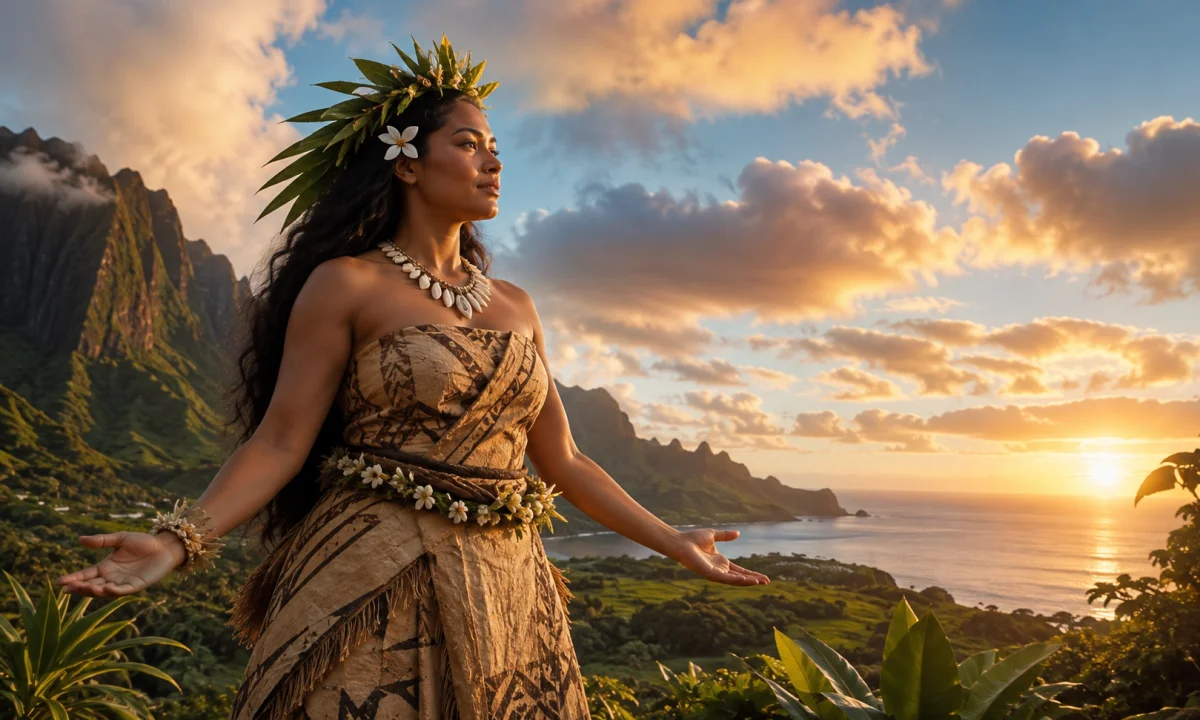
Fa’ahotu is a female figure associated chiefly with the traditional mythology of Tahiti and the Society Islands in eastern Polynesia. She is generally described as the consort of Atea, a primordial being connected with the ordering of the cosmos, and as one of the ancestral figures from whom important gods emerged. Her name and role are not represented uniformly in every account, however. Surviving information comes largely through recorded oral traditions, linguistic material and later ethnographic descriptions, so details can differ between sources.
Origins in Tahitian and Polynesian tradition
Fa’ahotu belongs to a group of early beings found in Tahitian creation traditions. These accounts do not form a single, universally fixed sacred narrative. As in many Polynesian cultures, religious knowledge was transmitted through oral performance, priestly expertise, genealogy, chant and local tradition. Different islands, districts and historical informants could preserve different versions of the relationships between primordial beings.
In the best-known Tahitian framework, the supreme or originating god Ta’aroa is associated with the beginning of the cosmos. Ta’aroa is sometimes portrayed as existing within a shell or enclosed cosmic space before bringing forth or arranging the world. Among the beings connected with this creative ordering are Atea and Fa’ahotu. Their union expresses a generative pairing from which other divine powers and ancestral figures arise.
These traditions should not be treated as evidence of a single “Polynesian religion” with an identical mythology everywhere. Polynesia contains many related but distinct religious systems. Names such as Atea, Ta’aroa, Tāne and Rongo may appear in several island groups, but their relationships and functions can change substantially from one tradition to another.
Name and identity
The name is commonly written Fa’ahotu, with an ʻokina marking the glottal stop. Older European records and modern publications may omit the ʻokina or use forms such as Faahotu. Orthography varies because Polynesian languages were written down by outsiders using changing conventions, and because modern spelling practices are not identical across island communities.
The precise meaning of the name is not securely established in widely available English-language discussions. It is therefore better not to assign it a confident literal translation without linguistic evidence from the relevant Tahitian context. A personal name in a sacred genealogy does not necessarily function as a simple descriptive label, and apparent similarities with words from other Polynesian languages do not by themselves prove an identity or a shared meaning.
Fa’ahotu is usually classified as a goddess or primordial female deity, but that description reflects the language of modern mythology handbooks more than a standardized ancient category. Tahitian religious concepts did not depend on a single universal division between “gods,” “spirits” and “ancestors” corresponding exactly to modern categories. A figure could possess divine status, belong to a sacred genealogy and also represent a cosmic or generative principle.
Fa’ahotu and Atea
Fa’ahotu’s most consistent association is with Atea. In accounts that include both figures, they form a primordial pair whose relationship helps explain the generation or organization of the divine world. Atea is often treated as a male cosmic being, while Fa’ahotu is presented as female. Their pairing can be understood as a mythic expression of complementarity and fertility, although surviving traditions do not always reduce either figure to a simple symbol of “sky” and “earth.”
The spelling Atea is itself found in several Polynesian traditions, and the name can refer to different beings in different island groups. In some Polynesian cosmologies, related forms of the name are connected with space, daylight, expanse or the heavens. Those associations should not automatically be transferred to the Tahitian Fa’ahotu tradition. The relationship between Fa’ahotu and Atea is most securely stated within the specific Tahitian genealogical setting in which they appear together.
Their union is significant because Polynesian creation traditions frequently describe the emergence of the world through genealogical succession. Instead of presenting creation only as the manufacture of objects, these narratives trace relationships between beings, powers and generations. Divine genealogy can explain why particular gods possess authority over warfare, cultivation, the sea, craftsmanship, fertility or the natural environment.
Divine children and genealogical role
Fa’ahotu and Atea are often named as parents of major gods in Tahitian accounts. Lists differ, but the children most commonly associated with this generation include Tāne, Tū and Rongo. Other names may appear in extended genealogies, and the order of birth or precise parentage can vary.
Tāne is widely known across Polynesia under related names and is frequently connected with forests, birds, skilled workmanship, beauty, or the separation of heaven and earth. These attributes are not identical in every island tradition. Tū is often associated with war or martial power, while Rongo may be connected with agriculture, peace, cultivated foods, ritual or communication. In Tahitian tradition, as elsewhere in Polynesia, these broad descriptions should be treated as contextual rather than as fixed profiles shared by all communities.
Fa’ahotu’s importance therefore lies less in a large collection of independent stories about her than in her position within a sacred genealogy. She helps connect the primordial ordering of the cosmos with the divine powers who govern human concerns. Through her relationship with Atea and her place in the ancestry of other gods, she belongs to the transition between an undifferentiated beginning and a world structured by distinct divine functions.
Attributes and representation
There is no securely documented, universally recognized physical appearance for Fa’ahotu. Descriptions of her as a woman, mother or goddess are primarily relational and genealogical. Unlike some better-known deities, she is not consistently associated in surviving accounts with a specific animal form, weapon, plant, ornament or sacred object.
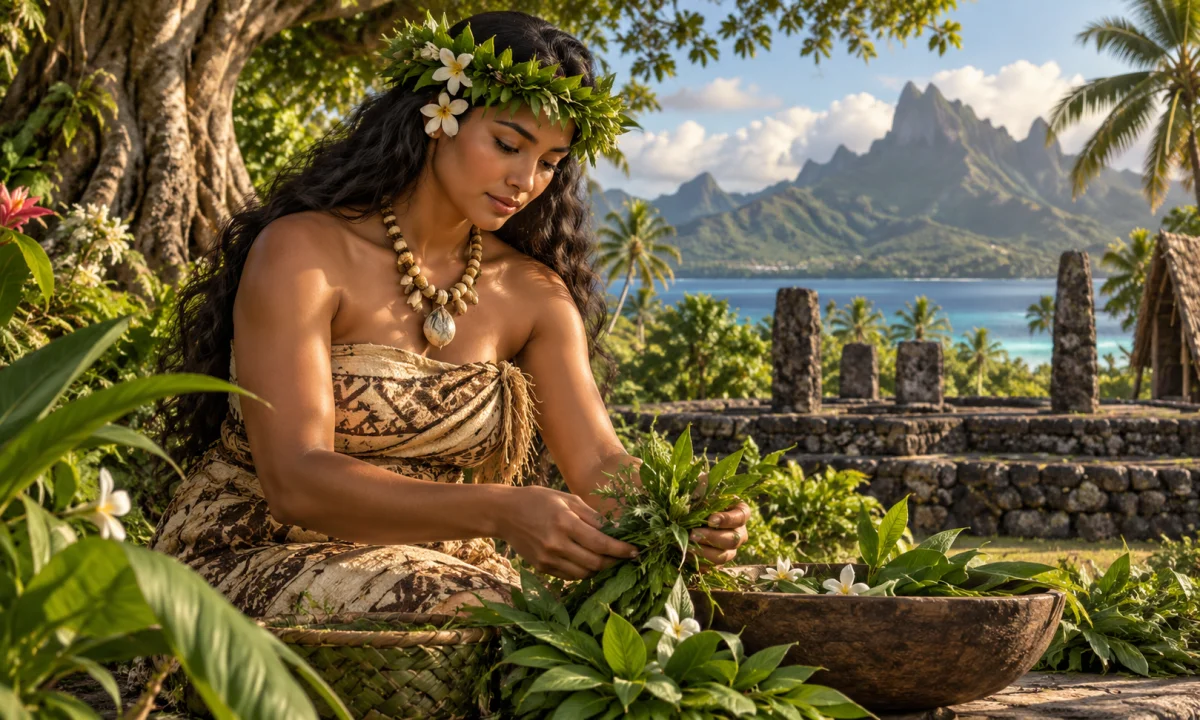
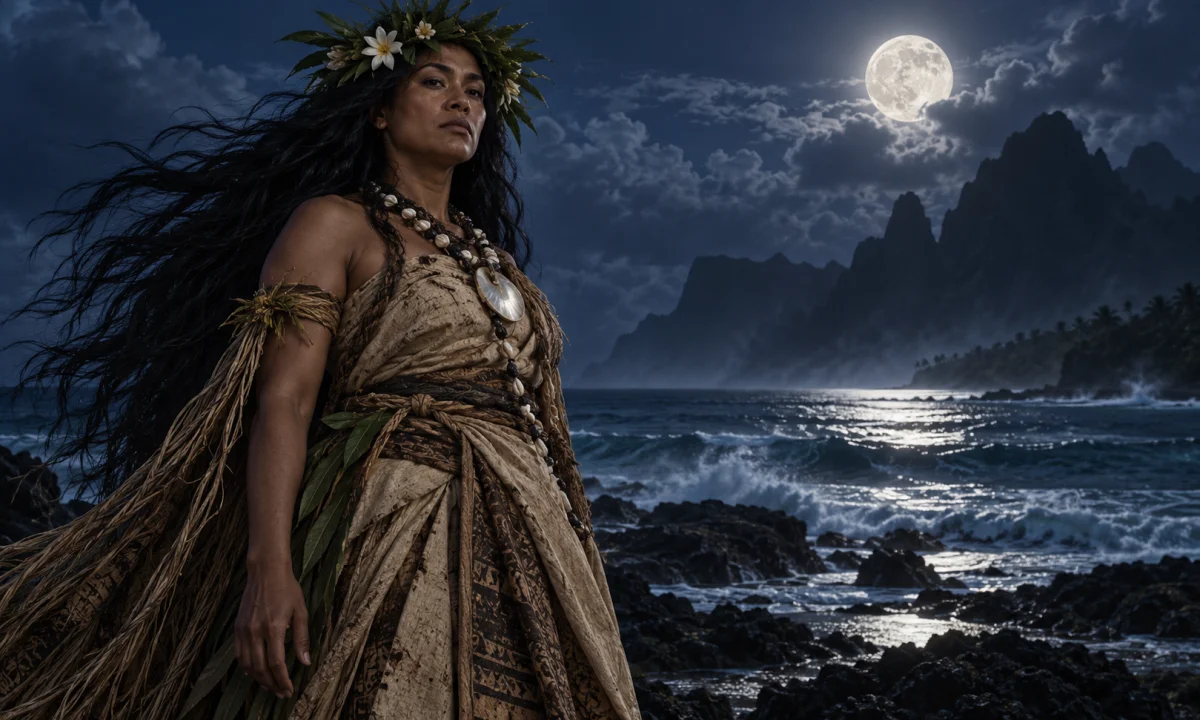
Nor is there strong evidence for a single emblem that would have identified Fa’ahotu throughout Tahiti. Modern illustrations may depict her as an idealized Polynesian goddess, often alongside Atea or surrounded by stars, vegetation or oceanic imagery. Such visual details generally belong to modern artistic interpretation rather than to a documented traditional iconography.
Her symbolism is consequently best approached through her role. She represents generative ancestry, the maternal side of a primordial divine pairing and the continuity between cosmic beings and later gods. This does not mean that traditional Tahitian worship necessarily treated her as an abstract “mother earth” figure. That interpretation can be tempting because of her gender and reproductive role, but it should not be presented as a proven ancient doctrine unless a particular source clearly supports it.
Creation traditions and variation
Tahitian creation narratives commonly involve a movement from enclosure, darkness or undifferentiated existence toward an ordered cosmos. In some versions associated with Ta’aroa, the creator’s activity involves breaking or opening a shell-like enclosure and producing beings who participate in the formation of the world. Atea and Fa’ahotu belong to this broad creative sequence in accounts that place them among the first divine generations.
The narratives are not equivalent to a single canonical scripture. Tahitian religious traditions were preserved in chants, genealogies and oral performances rather than in one authoritative written book. Missionary observers, colonial officials and later ethnographers recorded fragments after major religious and social changes had already taken place. Their records can be valuable, but they may simplify local distinctions, reorganize genealogies or use European categories such as “god,” “goddess” and “myth.”
For this reason, claims that Fa’ahotu was definitively the earth, the moon, a particular star or the universal mother of all Polynesian gods should be treated cautiously. Some may reflect an interpretation of her position in a particular genealogy rather than a feature consistently found across Tahitian traditions. A name shared with, or resembling, one from the Marquesas, Tuamotus, Hawaiʻi, New Zealand or other Polynesian regions does not prove that the figures are the same.
Religious and cultural significance
Fa’ahotu illustrates the importance of genealogy in Polynesian religious thought. Genealogies were not merely family records. They could establish rank, ritual authority, political legitimacy and relationships between human communities and the sacred world. Divine genealogy offered a way to explain the origins of powers that shaped everyday life, while also linking living people to remote ancestral beings.
The pairing of Fa’ahotu and Atea also reflects a recurring Polynesian interest in complementary relationships. Creation may be expressed through the union of male and female, the interaction of complementary forces, or the succession of generations. These patterns do not form one pan-Polynesian doctrine, but related structures appear often enough to show the importance of kinship and reproduction as models for cosmic order.
Fa’ahotu’s relative obscurity in comparison with Ta’aroa, Tāne or Rongo should not be taken to mean that she was unimportant. Many traditional religious systems preserve more extensive narratives about active culture heroes or powerful gods than about primordial ancestors. A figure may remain essential to the structure of a genealogy even when few independent episodes about that figure survive.
Distinguishing Fa’ahotu from similar figures
Fa’ahotu should not be automatically identified with Hina, a name shared by numerous Polynesian female figures associated in different traditions with the moon, weaving, women’s work, sexuality, ancestors or culture-hero narratives. Hina is not simply another name for Fa’ahotu in the Tahitian creation genealogy.
She should also be distinguished from Papa, or Earth Mother figures found in several Polynesian cosmologies. In Māori traditions, for example, Papatūānuku is the earth mother paired with Rangi, while other island groups preserve related but distinct ancestral pairs. The fact that Fa’ahotu is a female primordial being does not establish that she is the Tahitian equivalent of every earth goddess elsewhere in Polynesia.
Likewise, Fa’ahotu is not interchangeable with Fa’a, Hotu or similarly spelled names found in unrelated genealogies, and she should not be merged with every figure called Atea. Polynesian names often have related forms across languages, but individual identities depend on their local narratives, relationships and ritual context.
Sources and modern understanding
Knowledge of Fa’ahotu comes through the preservation and recording of Tahitian traditions rather than through a surviving ancient written scripture devoted to her. Oral traditions were affected by the arrival of Christianity, the suppression or decline of older ritual institutions, changing political structures and the methods of nineteenth- and twentieth-century collectors. Modern scholarship therefore compares versions, language, genealogy and historical context instead of assuming that any one transcription is complete.
Contemporary references sometimes present Fa’ahotu as though she belonged to a neatly organized pantheon with a fixed biography and clearly defined powers. That format makes the material easy to read but can conceal the fragmentary nature of the evidence. A more accurate description treats her as a Tahitian primordial goddess or ancestral divine figure whose clearest traditional identity is her place beside Atea and within the ancestry of other gods.
Fa’ahotu has not become a major figure in globally distributed popular culture. When she appears in modern fantasy art, online mythology lists or invented pantheons, those treatments may give her elaborate powers, costumes or adventures not supported by Tahitian tradition. Such creative reinterpretations can be distinguished from the surviving cultural material: the traditional evidence centers on her genealogical and generative role, not on a large cycle of independent heroic stories.