WORLD
WORLD
Ta’aroa
Ta’aroa is a major creator deity in the traditional religion of Tahiti and the Society Islands, in eastern Polynesia. He is often described as a primordial god who existed before the ordered world and brought the heavens, earth, gods and living beings into being. Ta’aroa is also associated with the ocean, but reducing him to a simple sea god can obscure his more important role in Tahitian cosmology: he is presented in several traditions as the source or maker of the entire universe.
The surviving accounts of Ta’aroa do not form a single, universally fixed mythology. Tahitian religious knowledge was transmitted orally, and versions recorded after European contact differ in names, genealogies, sequences of creation and the functions assigned to individual gods. Some accounts portray Ta’aroa as the highest creator; others place him within a more complex genealogy of divine beings. The name and figure are also related to other Polynesian traditions, although related names should not automatically be treated as identical gods.
Ta’aroa in Tahitian religious tradition
Ta’aroa belongs primarily to the religious world of ancient Tahiti and the Society Islands. Before the conversion of Tahiti to Christianity in the nineteenth century, religious life involved hereditary priests, sacred places, ritual specialists, offerings and powerful temple complexes known as marae. Gods were connected with particular communities, chiefs, professions, places and natural forces, but the boundaries between these areas were not always rigid.
Within this setting, Ta’aroa was understood as a being of exceptional rank. Tahitian traditions often describe him as older than, or responsible for, other gods. His importance is therefore theological as well as mythological. Stories about him do not merely explain one feature of nature; they describe the emergence of a structured cosmos from a condition of darkness, enclosure or undifferentiated space.
European missionaries and later observers recorded Tahitian traditions in writing, but these records were produced in circumstances of major cultural change. Missionary interpretations, translation choices and the assumptions of outside writers influenced how the material was presented. Oral traditions also naturally vary between informants and islands. As a result, no single written account should be treated as the definitive version of Ta’aroa’s mythology.
The name Ta’aroa
The name is commonly written Ta’aroa or Taaroa. The apostrophe represents a glottal stop in Tahitian spelling, and spelling conventions vary between older and modern publications. The name is widely considered related to the Polynesian forms Tangaroa, Tagaloa and Tangaloa, which occur in different island traditions. Historical linguistics connects these forms with a reconstructed ancestral Polynesian name, although the ultimate meaning and earliest religious significance of that name remain debated.
Related names do not prove that every Polynesian community worshipped exactly the same deity. Polynesian societies shared languages and inherited religious concepts, but each island group developed its own genealogies, rituals and divine relationships. Ta’aroa in Tahiti must therefore be understood in its local context, even when comparisons with Tangaroa or Tagaloa are useful.
The creator in the shell
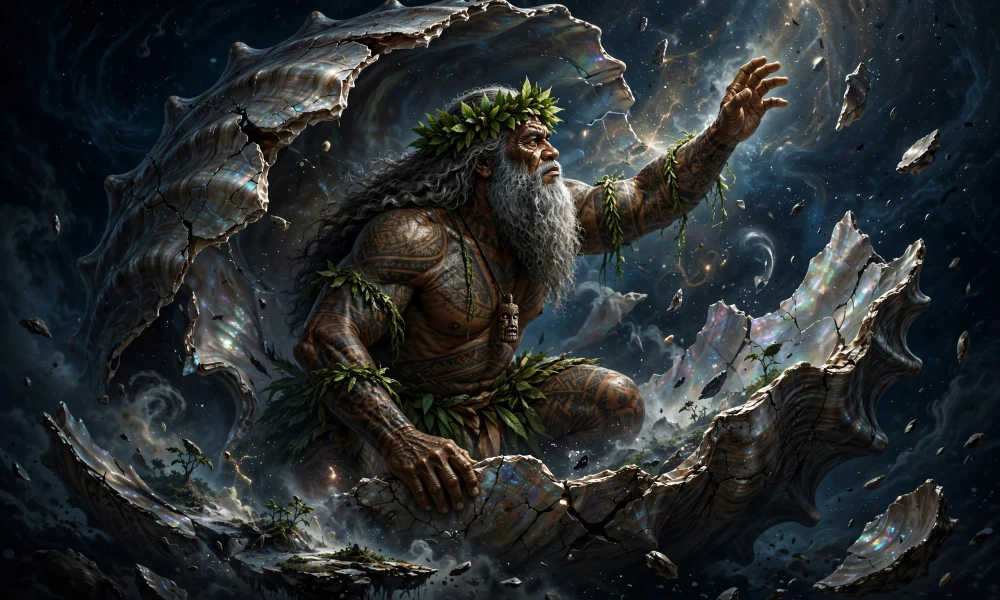
The best-known Ta’aroa narrative begins before the world had taken its familiar form. Ta’aroa is said to exist alone or enclosed within a shell, surrounded by darkness and emptiness. The shell functions as both a physical container and an image of a universe that has not yet opened. In some retellings, Ta’aroa moves within it, tests its limits or causes it to split apart.
When the shell breaks, creation begins. Accounts differ about what happens to the shell and in what order the parts of the cosmos appear. In some versions, the shell or its fragments become parts of the heavens and the earth. In others, Ta’aroa produces or arranges the basic layers of the universe and then brings forth additional divine beings who help shape it. The central idea remains consistent: the ordered world emerges from Ta’aroa’s solitary, enclosed existence.
The darkness surrounding the shell is not necessarily equivalent to absolute non-existence in the modern philosophical sense. Polynesian creation narratives often describe successive states, layers or generations of being. Darkness may represent an early cosmic condition rather than a complete absence of life or potential. The transition from enclosure to openness expresses the movement from an unformed state toward a world with sky, land, sea, gods and living creatures.
Creation of gods and the ordering of the universe
After emerging from the shell, Ta’aroa is described in some traditions as creating other gods or assigning them their places in the cosmos. The precise list varies. Tahitian religious traditions included important deities such as Tane, Tu, Rahi and Ru, while Oro became especially prominent in later Tahitian political and religious history. Not every genealogy gives these figures the same relationship to Ta’aroa, and the presence of a god in one account does not guarantee the same position in another.
Some narratives treat Ta’aroa as a divine ancestor who generates the layers of creation. Others present him as an artisan or sovereign who fashions the world and appoints other gods to govern aspects of it. He may be imagined as creating the sky, earth, winds, waters and living things, though the exact sequence differs. These variations are not simply errors in transmission. Oral myth can preserve several meaningful versions, each connected to a particular ritual, community or explanatory tradition.
Creation in this context is not necessarily a single event completed in the distant past. The world is made intelligible through relationships among divine powers, ancestors, places and living beings. Ta’aroa’s role is therefore associated with establishing the framework in which these relationships can exist. He stands at the beginning of a cosmic genealogy and represents the power that gives shape to what was previously enclosed or unformed.
Appearance and form
Ta’aroa does not have one fixed appearance across all representations. The shell narrative gives him a strongly symbolic form: before the world opens, the creator is contained within a cosmic shell. Once outside it, he may be described in human-like or divine terms, but traditional accounts do not establish a single standard visual image comparable to the familiar statues of some Mediterranean gods.
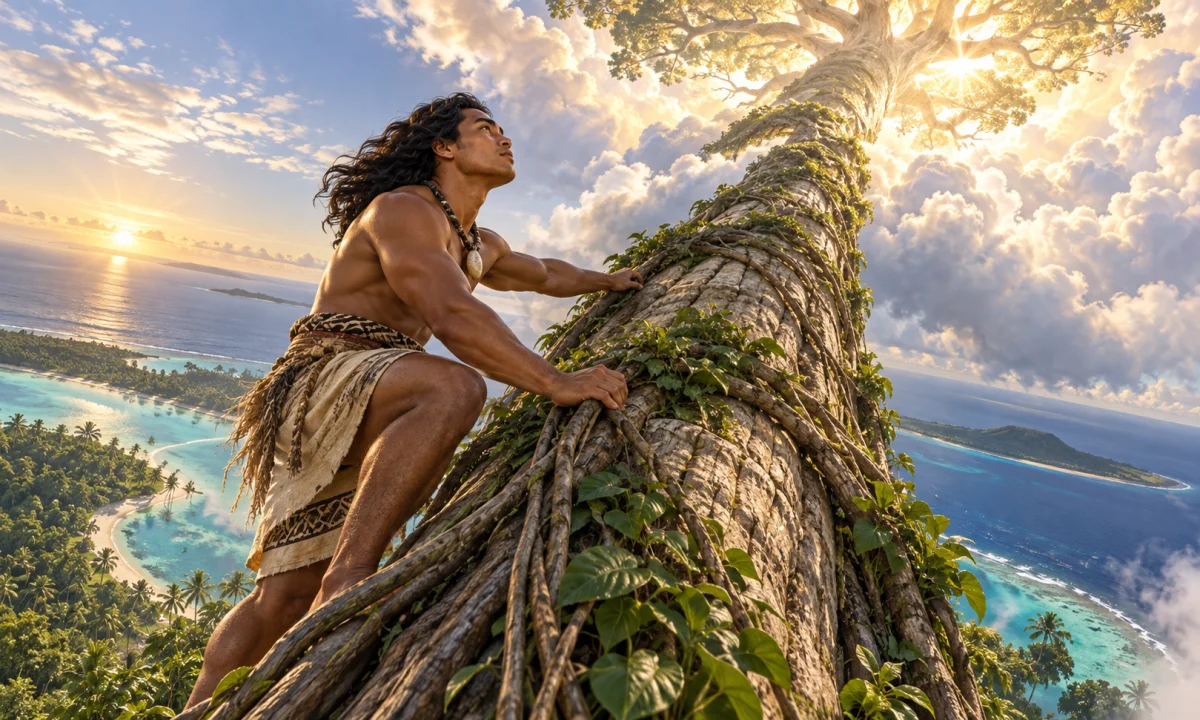
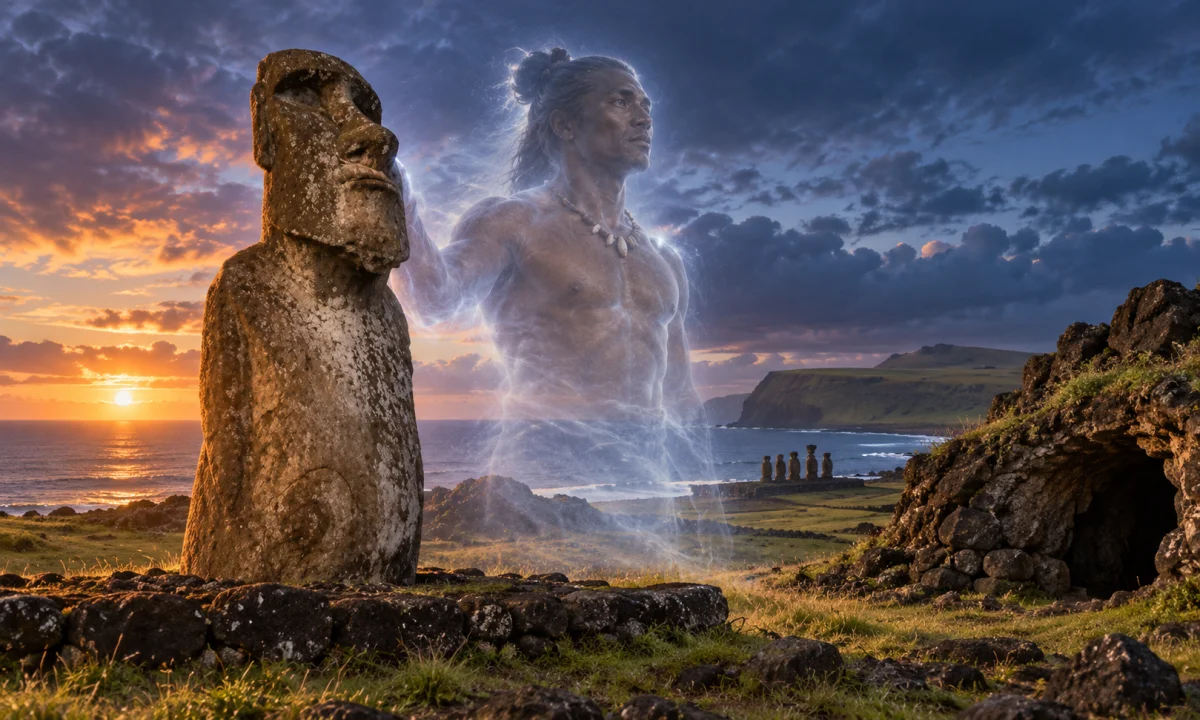
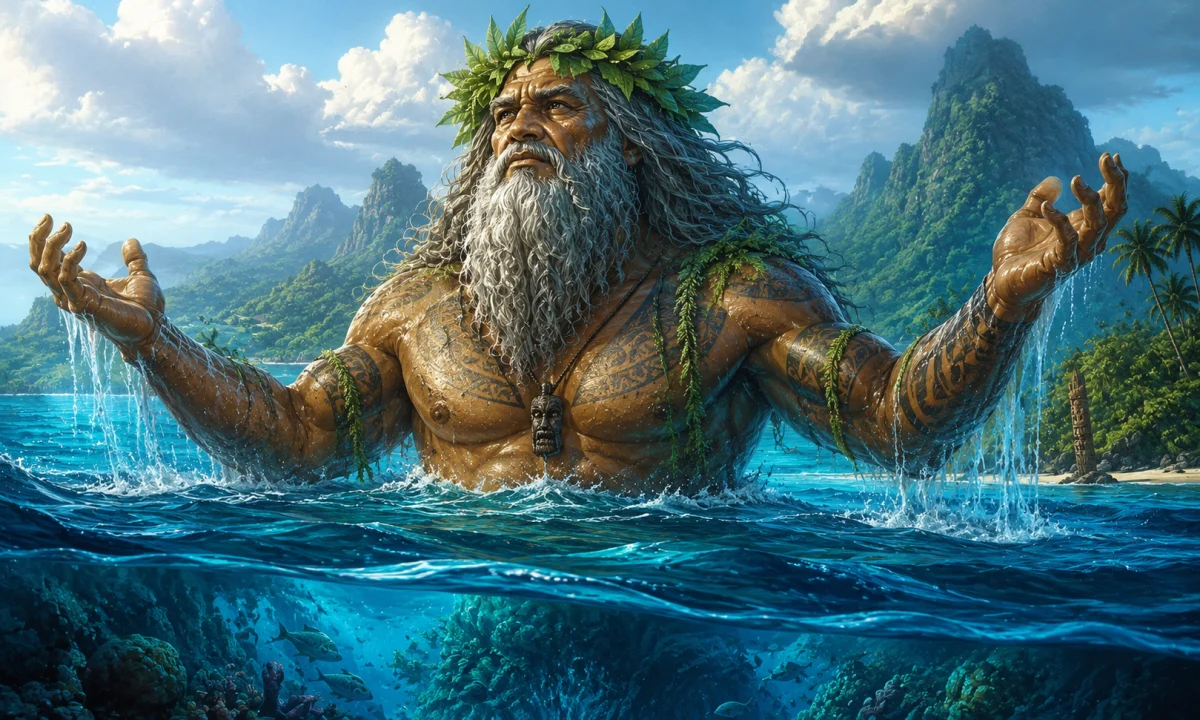
Modern illustrations sometimes portray Ta’aroa as a gigantic man, a radiant sky deity or a figure rising from the sea. Such images can communicate his importance, but they are artistic interpretations rather than evidence of a universally accepted traditional appearance. The shell, darkness and ocean are often more significant symbols of his identity than any particular bodily form.
Ta’aroa and the ocean
Because Ta’aroa’s name is closely related to the names of sea-associated gods elsewhere in Polynesia, he is frequently described as a god of the ocean. Tahiti’s maritime environment made the sea central to travel, fishing, exchange, danger and spiritual experience. Ta’aroa could consequently be connected with the waters and the forces that sustain or threaten human communities.
His creator status, however, is especially important in Tahitian accounts. He is not merely one divine specialist among others, responsible only for fishing or storms. The sea can be one part of a wider cosmic domain that includes the sky, earth, gods and human life. Descriptions that label Ta’aroa only as a “sea god” often reflect comparison with other Polynesian traditions rather than the full range of his Tahitian role.
Relationships with other Polynesian gods
Ta’aroa is sometimes compared with the following figures:
- Tangaroa in Māori tradition is chiefly associated with the sea and is commonly described as a child of Ranginui, the sky father, and Papatūānuku, the earth mother. His place in Māori mythology is not the same as Ta’aroa’s position in Tahitian creator narratives.
- Tagaloa in Samoan tradition is a high-ranking or creator deity in accounts that vary by source and locality. Samoan Tagaloa should not simply be substituted for Tahitian Ta’aroa.
- Tangaloa in Tongan and other western Polynesian traditions can refer to one or more important gods, sometimes connected with creation, the heavens, craftsmanship or the sea. These traditions have their own genealogies and histories.
- Tangaroa in parts of the Cook Islands may be a creator or an important god, but island traditions differ substantially in their stories and divine classifications.
These figures may share an ancient linguistic and cultural inheritance. Similar names can reveal historical connections among Polynesian societies, but they do not erase local distinctions. A comparative approach is most accurate when it recognizes both the shared background and the independent development of each tradition.
Religious significance in Tahiti
Ta’aroa’s significance lies partly in the way his mythology addresses origin and order. A creator who begins enclosed in a shell presents a striking image of potential held within boundaries. The opening of the shell transforms a solitary existence into a cosmos filled with differentiated beings and places. The story can therefore be read as an account of emergence, separation and the establishment of relationships.
The narrative also reflects the importance of genealogy in Polynesian thought. Gods, ancestors, chiefs, lands and living communities could be understood through lines of descent and connection. A divine genealogy was not merely a list of supernatural family members; it helped explain authority, sacred status and the relationship between people and the world around them. Ta’aroa’s elevated position in creation accounts places him at the head of a cosmic order in much the same way that ancestral genealogies could establish social and political relationships.
It is important not to force a single abstract interpretation onto the tradition. Ta’aroa was not simply a symbol invented to represent “creation” in a detached philosophical system. He was part of a living religious environment involving ritual practice, sacred sites, priests, political authority and local traditions. The surviving narratives are fragments of that wider world rather than complete theological manuals.
Sources and variations
Knowledge of Ta’aroa comes from a combination of oral traditions, early written records and later ethnographic or cultural histories. The most detailed accounts were recorded after sustained European contact, when Christianity, colonial administration and new forms of literacy were already reshaping Tahitian society. This context affects the evidence in several ways.
First, a recorded story may represent one narrator’s version rather than a belief shared identically by all Tahitians. Second, translators may have selected familiar terms such as “god,” “creator” or “heaven” that do not correspond perfectly to the concepts of the original tradition. Third, observers sometimes arranged oral material into a systematic mythology with clear ranks and chronological sequences, even though the original tradition may have been more flexible.
For these reasons, descriptions of Ta’aroa should use careful language. It is reasonable to call him a creator deity in important Tahitian traditions, but it is misleading to claim that every account gives him the same parents, spouse, offspring or precise method of creation. Some popular summaries present a neat sequence from shell to sky, earth, gods and humans; the traditional record is more varied.
Ta’aroa and the effects of Christian conversion
Christian missionaries became active in Tahiti during the early nineteenth century, and conversion brought profound changes to religious institutions and public worship. Older temples, priestly authority and rituals were challenged or suppressed, while traditional stories were reinterpreted in a Christian cultural environment. Some accounts of Ta’aroa were preserved because missionaries, scholars or local writers recorded them; other knowledge may have been lost, transformed or removed from public practice.
The survival of the name and stories does not mean that Ta’aroa continued unchanged as a central object of public worship. Traditional religion and modern cultural memory are not identical. Contemporary Tahitians may encounter Ta’aroa through heritage, literature, education, art or discussions of pre-Christian religion, while holding a wide range of personal religious views.
Later representations
In modern popular culture, Ta’aroa occasionally appears in books, artworks, games and general treatments of Polynesian mythology. These representations often combine features from several Polynesian traditions, especially when they use the name Ta’aroa as a broad label for a sea or creator god. Such adaptations can introduce the figure to new audiences, but they should not be mistaken for direct records of Tahitian belief.
Contemporary artistic interpretations may emphasize the shell, the ocean, cosmic darkness or the act of creation. These motifs are grounded in traditional accounts, while details such as a standardized costume, weapon, personality or heroic plot may be modern additions. The most responsible representations acknowledge that Ta’aroa belongs to a varied Tahitian religious tradition rather than presenting him as a character with one universally canonical biography.