WORLD

Kultana
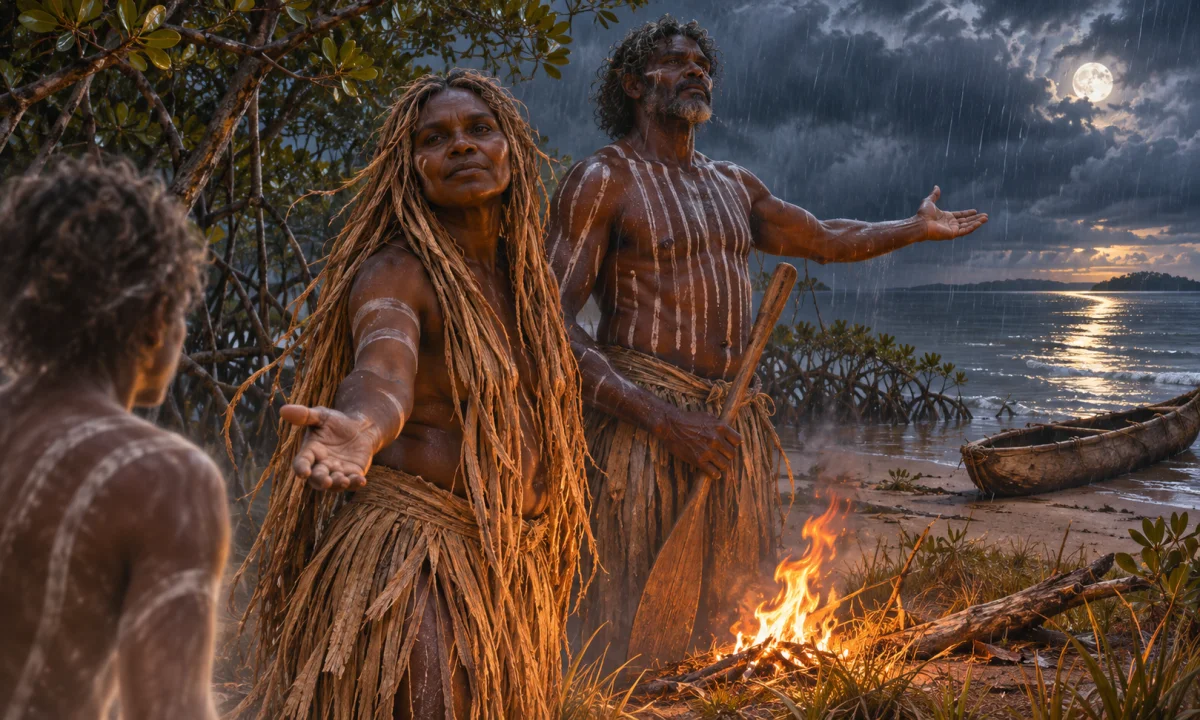
Kultana is a name associated in some modern listings with Australian Aboriginal mythology, but its traditional identity is uncertain. There is no clear evidence that Kultana was a universally recognised Aboriginal god or spirit, and surviving information does not securely connect the name with one particular Aboriginal nation, language group or body of sacred tradition. Descriptions of Kultana therefore need to be treated cautiously, especially when they present the figure as though Australian Aboriginal peoples shared a single mythology.
Cultural setting
Australian Aboriginal religious traditions belong to many distinct peoples and language groups across the continent and nearby islands. These traditions contain different ancestral beings, creator figures, animal ancestors, sky beings, spirits of particular places and laws governing relationships between people, animals, land and the ancestral past. Some stories are widely known across neighbouring communities, while others belong to a particular country and may be restricted by age, gender, initiation or ceremonial status.
The expression Australian Aboriginal mythology is therefore a broad modern category rather than the name of one unified religion. Aboriginal peoples have their own names for their traditions, laws, ceremonies and ancestral histories. The term “Dreaming”, often used in English-language writing, can be useful in some contexts, but it does not represent a single identical belief system throughout Australia. Depending on the community, ancestral events may be understood as continuing realities that shape land, kinship, ceremony, moral obligations and customary law, rather than as myths belonging only to a distant past.
This cultural setting matters in the case of Kultana because the name is often detached from the local context that would make its meaning intelligible. A traditional figure cannot be properly identified simply by assigning it a place in a general list of “Aboriginal gods”. The spelling of a name, its pronunciation, its relationship to a particular landscape and the circumstances in which it may be spoken can all be significant.
The name and the problem of identification
The available descriptions of Kultana are brief and inconsistent. In modern mythology databases and popular reference lists, Kultana is sometimes classified as an Aboriginal deity, occasionally with a connection to the sea or to creation. These summaries generally provide little information about the community from which the name comes, the language in which it was recorded, the storyteller or informant, or the traditional narrative in which Kultana appears.
That lack of provenance makes the identity difficult to establish. A name may have been transcribed incorrectly by an early observer, simplified for English readers, taken from a local word rather than a personal name, or separated from a longer expression. It may also have been repeated from one modern list to another without independent confirmation. Similar-looking names in Aboriginal languages cannot automatically be treated as forms of the same being, since Australian languages are numerous and unrelated in many cases.
It is consequently unsafe to state that Kultana has one fixed gender, appearance, genealogy or sphere of power. Nor is it safe to identify Kultana as a pan-Aboriginal equivalent of a creator god, sea god or sky god. Such labels may reflect the assumptions of modern catalogue writers more than the structure of the original tradition.
What can be said about Kultana?
Kultana is best treated as a poorly documented or uncertainly attributed figure. Some secondary accounts describe the name as belonging to a powerful supernatural being associated with the sea. Other listings use broader language and call Kultana a creator or deity without supplying a narrative. Because these descriptions are not accompanied by a securely identified cultural context, they should not be presented as established traditional facts.
No stable physical description is associated with Kultana in the commonly circulated material. There is no dependable account establishing whether the figure was imagined as human-shaped, animal-shaped, ancestral, gendered, formless or capable of changing shape. Nor is there a well-attested set of symbols, sacred objects, dwelling places or ritual practices that can confidently be assigned to Kultana.
The same caution applies to supposed powers. A modern source may describe a being as controlling the ocean, creating life or governing natural forces because such categories are familiar to readers of classical mythology. Aboriginal ancestral beings, however, do not always fit neatly into categories such as “god”, “spirit” or “hero”. A figure may be an ancestor of a clan, the source of a species, a landscape-forming being, a law-giving presence and a continuing spiritual reality at the same time. Reducing such a figure to a single supernatural function can distort the original meaning.
Possible association with the sea
The most frequently repeated modern association for Kultana is with the sea or marine forces. This claim should be distinguished from the well-documented maritime traditions of particular Aboriginal peoples. Coastal communities throughout Australia have rich knowledge of tides, reefs, currents, fish, whales, shellfish, storms and seaborne travel. Sea-related ancestral narratives may explain the formation of islands, bays and headlands, establish fishing laws, or describe the movements of ancestral beings across country.
Those traditions are not interchangeable. An ocean ancestor from one coastal nation cannot be used as evidence for Kultana, and a general statement that Kultana is a “sea god” does not identify a specific coastal tradition. Without a clearly documented community and narrative, the marine classification remains an attribution found in secondary summaries rather than a securely established description of Kultana’s traditional role.
It is also important not to assume that “sea god” has the same meaning in Aboriginal religion as it does in the mythologies of ancient Greece, Rome or the Norse world. Aboriginal ancestral beings are often connected to living places and continuing responsibilities. Their importance may concern the proper use of resources, obligations between generations and relationships with particular country, rather than dominion over an abstract element.
Sources, transmission and uncertainty
Much knowledge of Aboriginal tradition has been transmitted orally through families, custodians and ceremony. Oral transmission does not mean that the tradition lacks history or authority. It means that knowledge is preserved through social relationships, performance, place and customary practice rather than only through written documents. Some forms of knowledge are public, while other material is not intended for unrestricted publication.
Written records were often produced by missionaries, explorers, government officials, anthropologists and other outsiders. These records can preserve valuable information, but they may also contain misunderstandings. Observers sometimes translated Aboriginal ancestral beings as “gods”, treated sacred narratives as folktales, or combined accounts from different communities. Names could be recorded according to unfamiliar spelling systems, and details could be omitted because the observer did not understand their ceremonial significance.
Later popular books and websites have sometimes made the problem worse by extracting names from older works and presenting them in alphabetical lists. Once a short description has been repeated several times, it can appear authoritative even when its original attribution is unclear. A name such as Kultana may consequently acquire a detailed-looking profile that is not supported by a continuous, identifiable tradition.
Uncertainty should not be mistaken for proof that the name is meaningless. Kultana could preserve a genuine name, a local form, an imperfect transcription or a figure whose public documentation is very limited. The responsible position is to acknowledge the limits of the evidence rather than fill them with invented stories.
Role, symbolism and interpretation
If the marine association is retained, Kultana may be discussed cautiously as a figure connected in some modern accounts with the sea and its power. The sea can carry several kinds of significance in Aboriginal religious thought: it can be a source of food, a boundary between countries, a route travelled by ancestral beings, a dangerous force requiring respect, or part of a larger network linking human communities with animals and places.
Even so, symbolism should not be imposed from outside. The ocean does not have one universal meaning in Aboriginal cultures, just as the same animal or landscape feature may have different significance in different countries. Any interpretation of Kultana would need to begin with the local tradition in which the name appears, including the relevant language, custodians and ceremonial context.
Nor should Kultana be automatically described as a “creator” in the sense of making the entire universe from nothing. Many Aboriginal traditions tell of ancestral beings who shaped existing landscapes, established relationships between species, brought laws into being or transformed themselves into features of the country. These accounts express origins and continuing order, but they do not necessarily correspond to the theological categories used in European or Middle Eastern religions.
Distinguishing Kultana from other Aboriginal figures
Kultana should not be merged with better-documented figures simply because they are all placed under the broad label of Aboriginal mythology. Ngurunderi, for example, is a major ancestral figure in traditions of the Ngarrindjeri people of South Australia, with narratives connected to the lower Murray River, Lake Alexandrina, the Coorong and the sea. His stories belong to a specific cultural and geographical setting and should not be used to explain Kultana.
Likewise, Baiame, Bunjil, Daramulum, Gnowee, Tiddalik and other widely circulated names come from particular language groups and bodies of tradition. Their prominence in English-language writing does not make them representatives of all Aboriginal peoples. Some are ancestral beings, some are culture heroes, some are associated with initiation or the sky, and some are figures from stories that have become especially popular outside their original communities.
Kultana should also not be confused with similarly spelled words or names from unrelated Aboriginal languages. Australian languages may contain repeated sounds or syllables by coincidence, and an English transcription can conceal important distinctions. A resemblance in spelling is not enough to establish a relationship.
Modern reception
Kultana has had a limited presence in modern popular culture compared with figures such as Tiddalik or the Rainbow Serpent. The name is more often encountered in online mythology directories, encyclopaedic lists and generalized writing about Aboriginal gods than in widely known novels, films or games. These modern presentations may give Kultana a definite appearance, gender, domain or set of powers, but such additions should not be confused with documented Aboriginal tradition.
Contemporary retellings of Aboriginal stories require particular care because cultural knowledge can belong to specific communities and may not be available for unrestricted adaptation. A fictional work can use the name Kultana as an invented character, but it should identify that treatment as creative rather than presenting it as an authentic account. It should also avoid using an uncertain name as a placeholder for Aboriginal spirituality in general.
For WorldMythos, Kultana is most accurately described as a name of uncertain attribution within the broad field of Australian Aboriginal mythology. The occasional association with the sea can be reported as a modern classification, but a precise origin, narrative, appearance and religious function cannot be established confidently from the surviving general descriptions. Any fuller account would depend on identifying the specific Aboriginal community, language and tradition connected with the name.