WORLD
WORLD
Eagle Warrior
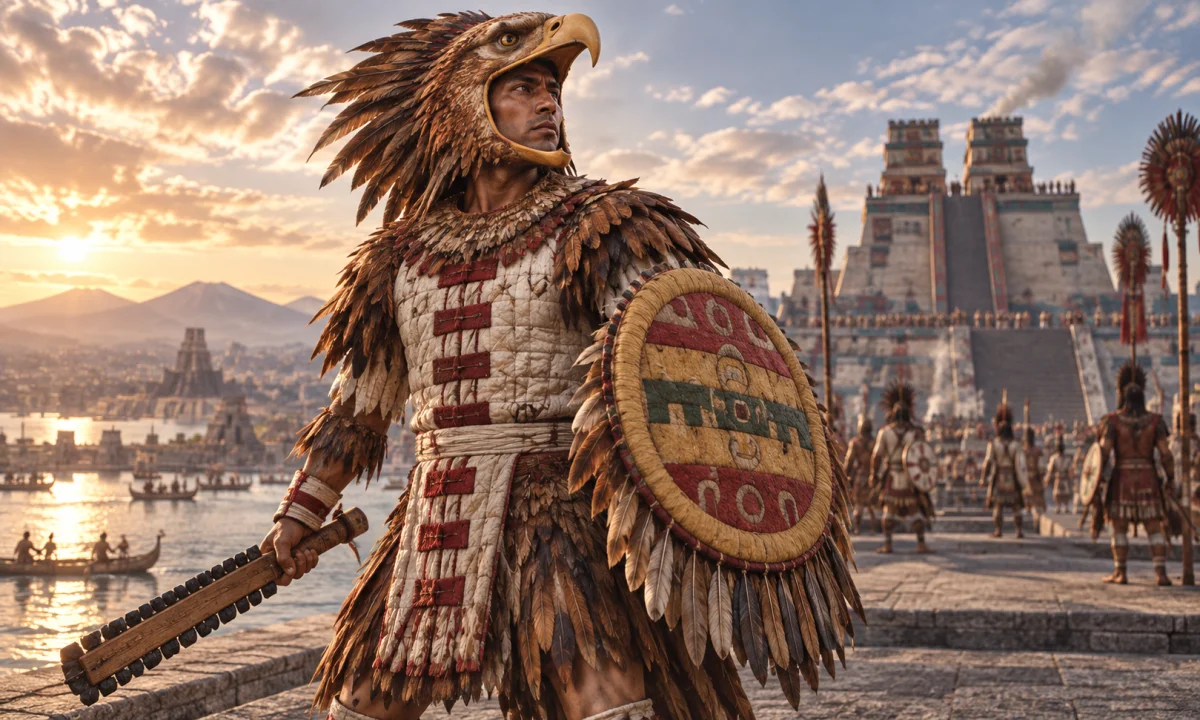
Eagle Warrior is the common English name for a member of an elite military order of the Mexica, often called the Aztecs, who ruled a powerful state in central Mexico before the Spanish conquest. The term does not usually refer to one individual supernatural being. Rather, it describes a class of highly accomplished warriors associated with eagle imagery, military prestige, and the religious world of Mexica warfare.
In Classical Nahuatl, the language of the Mexica, the eagle was called cuāuhtli. The plural term cuāuhpipiltin is commonly translated as “eagle nobles” or “eagle warriors,” while cuāuhpilli can refer to an individual member. Other titles and spellings appear in modern publications because Nahuatl words may be written with different systems of diacritics. “Eagle warrior” is therefore a useful English description, but it should not be treated as the name of a single god, hero, or monster.
Origins and cultural setting
The Eagle Warriors belonged to the military and social institutions of the Mexica capital, Tenochtitlan, and the wider political world of central Mexico. Their society was organized through rulers, nobles, priests, merchants, farmers, artisans, and several kinds of military specialists. Warfare was essential to the growth of the Mexica state, both for territorial expansion and for obtaining tribute, political authority, and captives used in religious ceremonies.
Military achievement could transform a person's social position. A warrior's reputation depended especially on success in taking enemy captives, although the exact relationship between individual accomplishments, rank, and privilege was shaped by circumstance and political recognition. Men who demonstrated exceptional ability could enter prestigious military orders and receive honors, distinctive clothing, and access to privileges not available to ordinary soldiers. Elite warriors were not simply professional fighters separated from religion: warfare, rulership, sacrifice, and divine service were closely connected in Mexica thought.
The Eagle Warriors are most often discussed together with the Jaguar Warriors. These were not two species of supernatural warrior, but elite military groupings represented through animal imagery. The distinction between them is not always described identically in modern accounts, and surviving evidence does not support every popular claim about a rigid hierarchy between the two. Both groups occupied an important place in Mexica military culture and were connected with status, courage, and the taking of captives.
Surviving evidence and traditions
Knowledge of Eagle Warriors comes from several kinds of evidence rather than from one complete mythological narrative. Indigenous pictorial manuscripts, colonial descriptions written in or translated from Nahuatl, archaeological remains, sculptures, and representations of military clothing all contribute to the picture. Important information was recorded after the Spanish invasion, often by Indigenous informants working with Spanish missionaries. These records preserve valuable traditions, but they also reflect translation, Christian interpretation, colonial conditions, and differences among communities.
Images of eagle and jaguar warriors occur in manuscripts and artworks associated with Mexica military and ceremonial life. Some sculptures and surviving objects show warriors wearing animal forms or animal-inspired equipment. Archaeological evidence can confirm the importance of military orders and their imagery, but it cannot always establish exactly how every costume was worn or what each emblem meant to its original owner.
There is no single surviving “Eagle Warrior myth” comparable to a long narrative about a god or culture hero. The figure is better understood as a historical-religious institution that existed within a mythic universe. Later writers and popular media sometimes turn the Eagle Warrior into a solitary legendary champion, but that presentation combines a collective military identity with the conventions of modern heroic fiction.
Name and classification
The English expression “Eagle Warrior” can conceal several related but distinct Nahuatl terms. Cuāuhpipiltin refers to eagle nobles or eagle warriors as a group. The word pilli means a noble or person of elevated status, and its plural form appears in cuāuhpipiltin. A related title, cuāuhtēuctli, is often translated as “eagle lord” or “eagle ruler.” Such titles should not automatically be treated as interchangeable with the name of every eagle warrior.
Modern authors also use “Aztec” broadly for the culture and empire centered on Tenochtitlan, although “Mexica” is more precise when referring to the people of Tenochtitlan and their political tradition. The Eagle Warriors were Mexica military figures within a broader Mesoamerican world that included other Nahua-speaking and non-Nahua societies. Comparable animal-based military symbolism existed elsewhere in Mesoamerica, but the Mexica Eagle Warriors should not be merged with every later or unrelated warrior tradition.
Appearance and equipment
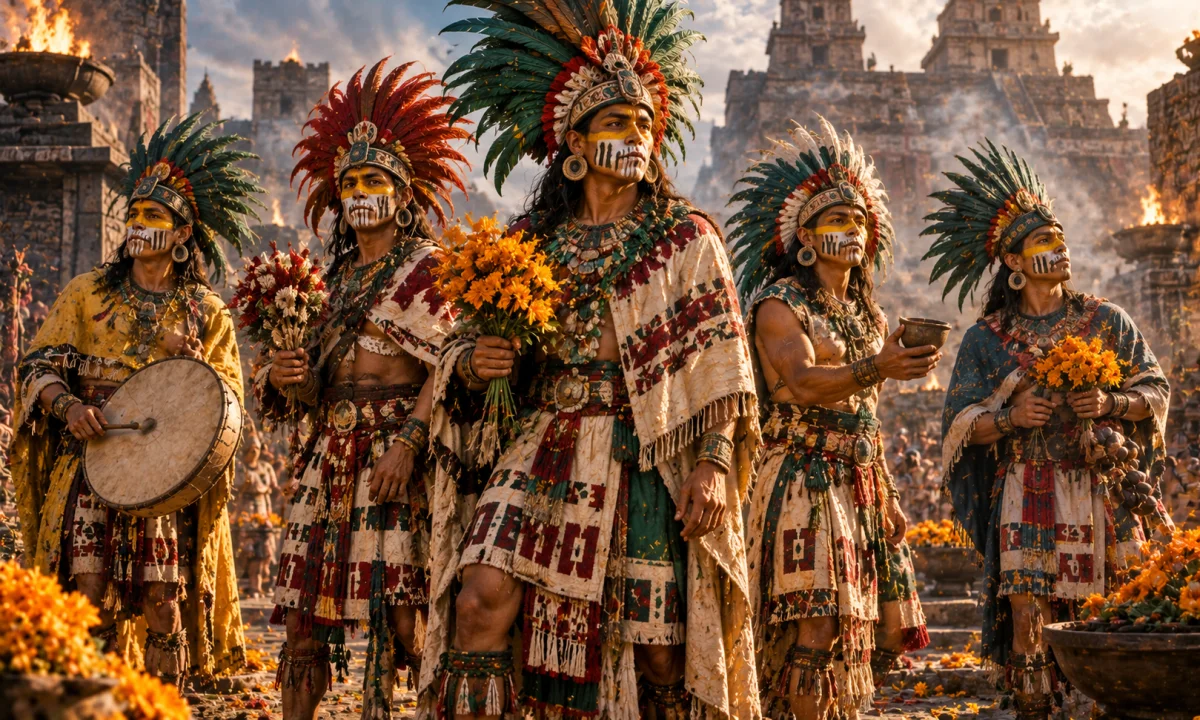
Eagle Warriors were represented through clothing and equipment designed to evoke an eagle. Artistic depictions commonly show a helmet or headpiece shaped like an eagle's head, sometimes with an open beak around the warrior's face. Other representations suggest feathered garments or eagle-like coverings. The precise appearance of these outfits probably varied according to period, rank, ceremony, and the materials available.
Feathers had great value in Mesoamerica. They were used in elite garments, shields, headdresses, and ceremonial objects because of their color, rarity, and visual connection with birds that moved between earth and sky. An eagle costume was therefore not merely camouflage or decoration. It announced rank and connected the wearer with a powerful animal image associated with height, force, vision, and the heavens.
Elite warriors carried the same general categories of weapons used by other Mexica fighters, including the mācuahuitl, a wooden-edged weapon fitted with sharp volcanic-glass blades, as well as spears, darts, and shields. The animal costume did not give a warrior magical claws, flight, or supernatural invulnerability. Descriptions of exceptional skill should be understood within the ideals of military courage and religious service, not as evidence that these warriors literally transformed into eagles.
Military role and social prestige
The route into an elite military order depended on demonstrated service rather than on costume alone. Successful warriors gained recognition through battlefield achievement, especially the capture of opponents. Capturing a living enemy was highly valued because it displayed control and courage and could contribute to the religious and political purposes of the state. The rewards for distinction could include better clothing, weapons, public honors, exemption from some ordinary obligations, and a higher social position.
Descriptions of Mexica society often portray Eagle and Jaguar Warriors as members of powerful military fraternities or orders with their own meeting places and ceremonial associations. Their status did not make them independent kings, nor did it necessarily mean that every member belonged to the hereditary nobility from birth. Military success could provide a path to advancement, while elite institutions also operated within the broader system of noble privilege and royal authority.
These warriors played a practical role in imperial warfare, but their importance was also symbolic. They embodied the ideal of the disciplined, courageous fighter who served the ruler and the gods. Their public presence demonstrated the strength of Tenochtitlan and helped give military expansion a sacred meaning.
Religious associations
Mexica religion connected warfare with the maintenance of cosmic order. The god Huitzilopochtli, patron deity of the Mexica, was associated with war, the sun, and the Mexica migration and foundation traditions. Warriors could therefore be described through imagery that resonated with solar and martial ideas. An Eagle Warrior was not, however, simply an incarnation of Huitzilopochtli, and the entire order should not be identified with the god.
Eagles occupied an important place in Mexica symbolism because they were powerful birds of prey and moved high above the earth. The sun itself could be imagined through bird and warrior imagery, especially in accounts of the cosmic struggle between forces of light and darkness. These associations help explain the prestige of eagle symbols, but they do not produce one universally fixed interpretation. The meaning of an eagle image could change according to whether it appeared on a warrior's costume, a shield, a monument, a manuscript, or a foundation narrative.
The tonalpōhualli, a 260-day ritual calendar, included Cuāuhtli, or Eagle, among its twenty day signs. This calendar sign belonged to the system used for divination and the interpretation of birth days. Its presence in the calendar demonstrates the wider religious importance of eagle imagery, but a person born under the Eagle sign was not automatically an Eagle Warrior. Calendar symbolism and military rank were related parts of Mexica culture, not identical categories.
The eagle and the founding of Tenochtitlan
The eagle is also famous in Mexica foundation traditions. In accounts recorded after the conquest, the Mexica were guided to a place where they saw an eagle perched on a prickly pear cactus, often described as growing from a stone or island. This sign identified the location where Tenochtitlan would be established. The image became one of the most enduring emblems of Mexico.
The founding story should not be confused with the origin of the Eagle Warriors. The eagle in the foundation narrative is a sign in a migration and settlement tradition, while Eagle Warriors were an elite military group. The surviving versions of the foundation story differ in wording and detail, and their colonial recording means that they must be read as historical documents shaped by transmission rather than as an untouched ancient text. Nevertheless, the eagle's role in the story helps explain why eagle imagery carried such strong political significance for the Mexica.
Relationships with Jaguar Warriors
Jaguar Warriors, commonly linked with the Nahuatl term ocēlōpipiltin, formed the other best-known animal-associated military order. Jaguars were admired for strength, stealth, and dominance on the ground, while eagles suggested height, speed, and the sky. This contrast is useful as a broad symbolic pattern, but it should not be simplified into a universal rule that eagles always represented one social class and jaguars another.
Both orders were associated with military excellence and social advancement. Modern illustrations often present them as exact opposites, with standardized costumes and clearly separate duties. The evidence is more varied. Depictions differ, terminology is not always consistent, and military organization changed over time. The two groups should be distinguished, but not turned into rigid fantasy factions with powers and rules that are unsupported by Mexica evidence.
Historical context and the Spanish invasion
Elite Mexica warriors participated in the conflicts that accompanied the Spanish invasion and the Indigenous alliances formed against Tenochtitlan. Spanish accounts and Indigenous records describe battles in which Mexica military forces confronted unfamiliar weapons, cavalry, firearms, epidemic disease, and large numbers of Indigenous enemies opposed to Mexica rule. These records do not provide a complete, neutral account of the Eagle Warriors, and they should not be read as a simple story of European soldiers defeating isolated warriors.
The fall of Tenochtitlan in 1521 ended the Mexica imperial state, but it did not erase the cultural importance of eagle imagery. Indigenous communities continued to preserve historical memory, visual symbols, and elements of pre-Hispanic tradition under changing colonial conditions. The eagle later became central to the national emblem of Mexico, although the modern emblem belongs to a different political and historical context from the military order of the Mexica.
Modern representations
In modern popular culture, Eagle Warriors appear in novels, games, films, comics, historical fiction, and fantasy settings. They are often presented as masked champions with superhuman agility, feathered armor, or a direct mystical connection to the sun. Such portrayals may draw inspiration from genuine Mexica imagery, but they frequently combine it with invented weapons, fictional ranks, or generalized “Aztec” aesthetics.
A historically grounded representation keeps several distinctions in view: an Eagle Warrior was generally a member of a military order rather than a single mythological creature; eagle costume did not grant literal flight or transformation; Huitzilopochtli was a god, not the personal identity of every warrior; and Mexica traditions belonged to a complex Mesoamerican society rather than to an undifferentiated fantasy culture. These distinctions allow the eagle warrior to be understood both as a powerful symbol and as a real institution within Mexica history.