WORLD
WORLD
Cassandra
Cassandra is a Trojan princess and prophetess in Greek mythology, best known for foreseeing catastrophe while being unable to persuade anyone to believe her. Daughter of King Priam of Troy, she belongs to the cycle of stories surrounding the Trojan War and the fall of the city. Her tragedy does not arise from a failure to know the future, but from the separation between truth and credibility: Cassandra sees what is coming, yet her family, her people and her enemies repeatedly dismiss her warnings.
Origins and cultural setting
Cassandra’s story developed within the wider mythology of Troy, a legendary city traditionally located in north-western Anatolia. The Trojan War brought together Greek heroic traditions concerning figures such as Achilles, Odysseus, Agamemnon and Helen, while Trojan traditions centred on Priam, Hecuba, Hector, Paris and their descendants. These stories were preserved in different poems, plays and later mythographic works rather than in a single authoritative account.
The oldest surviving literary references to Cassandra occur in Homeric epic. In the Iliad, she is identified as one of Priam’s daughters and is described as exceptionally beautiful. She sees Priam returning with Hector’s body and leads the mourning for her dead brother. The poem does not present a full account of her prophetic powers or explain a curse that prevents people from believing her. In the Odyssey, Agamemnon recounts the destruction of his household after returning from Troy and mentions Cassandra’s murder. These brief references suggest that important parts of Cassandra’s legend existed before the later tragedies, while also showing that her story changed and expanded over time.
Greek drama gave Cassandra the form that became most influential. Aeschylus’s tragedy Agamemnon, first performed in the fifth century BCE, presents her as a captive Trojan princess brought to Mycenae by Agamemnon. Euripides’s The Trojan Women also explores her fate after Troy’s defeat. Later writers, including mythographers and Roman poets, added or developed episodes concerning the Trojan Horse, Apollo’s curse and Cassandra’s death.
Name and identity
The origin and meaning of the name Cassandra are uncertain. It does not have a securely established Greek etymology, and scholars have proposed that it may preserve a pre-Greek name or a form adapted into Greek. The exact meaning should therefore not be treated as settled.
Some ancient traditions call Cassandra Alexandra. In the poem Alexandra, attributed to the Hellenistic poet Lycophron, the name is used for a prophetic Trojan woman whose obscure speeches recount the future sufferings of Troy and the Greek heroes. Alexandra may have functioned as an alternative name, an epithet or a cult title associated with Cassandra. Its precise relationship to the more familiar name is not entirely clear in every source.
Cassandra is generally described as the daughter of Priam and Hecuba, the royal couple of Troy. Her brothers and sisters include Hector, Paris, Helenus, Polyxena and other children whose number and names vary between traditions. She is especially connected with her twin brother Helenus, who is also a prophet. Some accounts give both twins exceptional prophetic abilities, although their stories develop in different directions. Helenus eventually aids the Greeks and survives the war, whereas Cassandra remains loyal to Troy and dies after its destruction.
Prophecy and the curse of disbelief
The best-known explanation of Cassandra’s powers appears in Aeschylus’s Agamemnon. Apollo grants her the gift of prophecy, but Cassandra refuses the sexual relationship he expects in return. In response, Apollo ensures that her prophecies will never be believed. The play presents the curse through Cassandra’s own fragmented recollection of her relationship with the god.
Later retellings often simplify this episode into a familiar formula: Apollo gives Cassandra prophetic power, and when she rejects him, he causes everyone to doubt her predictions. Some versions add that Apollo spits into her mouth or kisses her before imposing the curse. These details are not equally ancient or consistently reported. The core idea of a prophetic gift joined to social disbelief is especially prominent in later interpretations, while the earliest surviving accounts do not all include the same origin story.
The curse does not necessarily mean that Cassandra is always ignored in every version. Rather, it establishes a tragic pattern in which her statements are treated as madness, exaggeration or blasphemy even when events later prove them correct. Aeschylus uses this pattern dramatically: Cassandra understands the crime committed at Troy, the danger awaiting her in Agamemnon’s palace and the murder that is about to take place, but she cannot prevent any of it.
Her speech in Agamemnon is deliberately difficult and visionary. She moves between memories of the House of Atreus, images of blood and predictions of murder. The chorus initially struggles to understand her, and even after recognising that her visions may be genuine, it cannot rescue her. Her prophetic knowledge is therefore both a power and a form of isolation.
Cassandra and the fall of Troy
Cassandra is associated with several important episodes in the destruction of Troy, although their details differ among sources.
The Trojan Horse
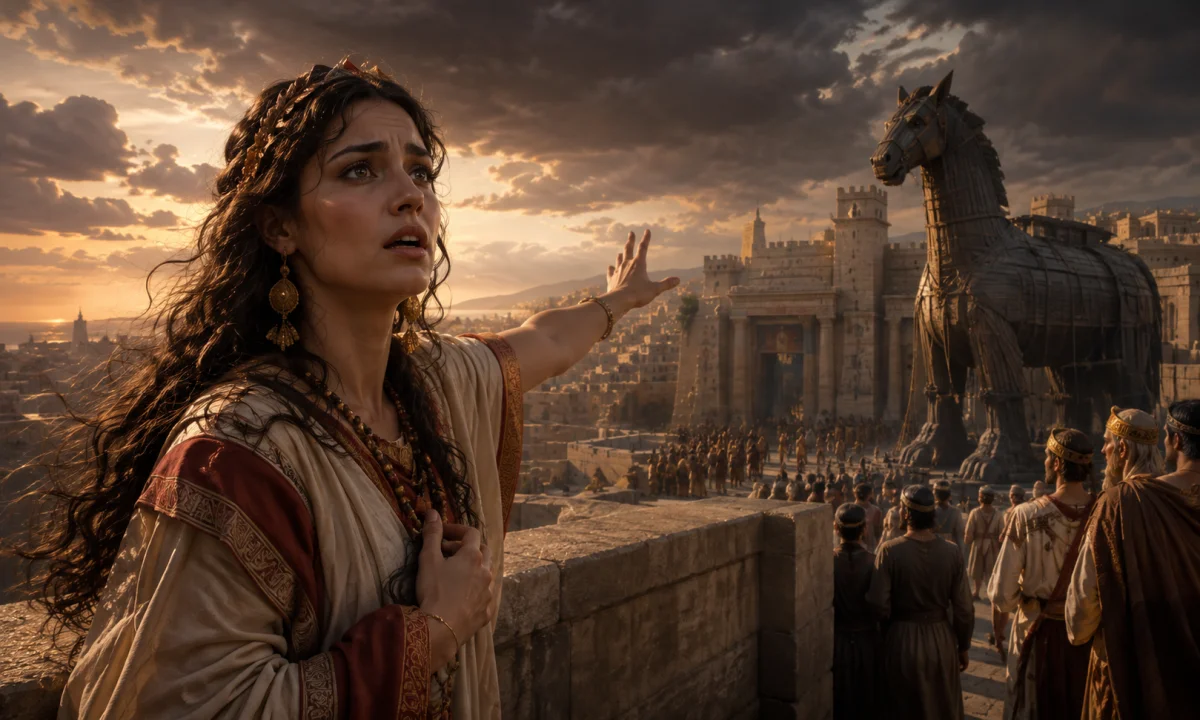
In later epic and dramatic traditions, Cassandra warns the Trojans that the wooden horse brought by the Greeks is a trap. Her warning is rejected. Some accounts connect her with the Trojan priest Laocoon, who also opposes bringing the horse inside the city. The two figures should not be confused: Laocoon is a male priest whose own warning is punished or discredited through a separate episode, while Cassandra is the Trojan princess whose prophetic speech is habitually ignored.
Virgil’s Aeneid refers to Cassandra as a prophetess whose warnings were not believed during the fall of Troy. Roman poetry helped establish the image of Cassandra as the voice that correctly identifies danger when an entire society prefers reassurance. The detailed story of her warning is not presented in exactly the same way by every Greek source, and the surviving Homeric poems do not provide a complete account of the Horse episode.
Her capture by Agamemnon
After the Greeks sack Troy, Cassandra is assigned to Agamemnon as a war captive and concubine. In Euripides’ The Trojan Women, she describes this forced union in disturbing, ironic terms. She presents herself as a bride for Agamemnon, but the supposed wedding is actually enslavement, and she knows that it will lead to his death and her own.
Her speech also gives a controversial interpretation of the war. Cassandra argues that the Greeks suffered heavily in the conflict and that Troy’s defeat will bring ruin upon the victors. This does not make the destruction of Troy a blessing or erase the suffering of its inhabitants. Instead, it shows how prophecy can rearrange the meaning of victory: the Greeks win the city, but their expedition produces further violence, exile and death.
Death at Mycenae
Cassandra reaches Mycenae with Agamemnon. In Aeschylus’s tragedy, she foresees that Clytemnestra, Agamemnon’s wife, will murder them both. Cassandra also sees the older crimes of the House of Atreus, including the inherited violence that surrounds Agamemnon’s family. She knows that she is walking towards death, yet she enters the palace because escape is impossible or because the course of events has already become fixed.
Clytemnestra kills Cassandra after murdering Agamemnon. The Odyssey also remembers Cassandra’s death, although the presentation is briefer than in Aeschylus. In some later accounts, Cassandra’s children by Agamemnon are killed as well. The names and circumstances of these children vary, and not every source includes the same genealogy.
Some traditions place Cassandra’s burial or cult near Mycenae, while others connect her with Amyclae in the Peloponnese. Pausanias records local traditions in which Alexandra, identified with Cassandra, received honours at Amyclae. These reports belong to later Greek religious and local memory rather than providing proof that a single, uniform cult existed everywhere in the ancient Greek world.
Appearance and attributes
Cassandra has no universally fixed physical appearance. Homer describes her beauty, and later artists and writers often portray her as a young woman with long hair, a veil, royal clothing or the attributes of a seer. These are conventional representations rather than details established by all ancient sources.
Her central attribute is prophetic sight. Cassandra does not usually function like a priestess who delivers an orderly public oracle at a sanctuary. Her visions emerge in emotionally charged speeches, laments and warnings. She may see several layers of time at once: the past crimes of a family, the immediate danger facing her and the future deaths that will follow.
In ancient Greek religion, prophecy could take several forms, including dreams, omens, inspired speech and formal consultation of an oracle. Cassandra should not be automatically identified with the Pythia of Delphi. The Pythia served as the inspired speaker of Apollo’s oracle at Delphi within a recognised religious institution. Cassandra is a mythic royal prophetess whose relationship with Apollo is personal and antagonistic in the most influential version of her story.
Meaning and interpretation
Cassandra’s legend explores the vulnerability of knowledge when it lacks authority. She is a princess, but her royal status does not make her credible. She is a woman in societies where political and military decisions are largely controlled by men, and her insight is repeatedly subordinated to male power, pride and desire. Her experience is not simply a general story about being ignored: Greek authors place it within the violence of war, enslavement and patriarchal control.
Her curse also raises questions about whether prophecy changes the future or merely reveals it. Cassandra sees events that appear inevitable, but her warnings are part of the dramatic process by which the audience understands those events. Her knowledge does not grant practical freedom. She can name disaster without possessing the power to stop it.
Aeschylus gives special weight to the relationship between speech and interpretation. Cassandra speaks truth, but her language is difficult because it expresses visions rather than ordinary explanation. The chorus is neither wholly hostile nor fully capable of responding. The tragedy therefore concerns not only deliberate disbelief but also the difficulty of recognising truth when it arrives in unfamiliar, frightening or politically inconvenient forms.
Her story is also tied to the fate of Troy’s royal women. Hecuba becomes a captive, Andromache loses Hector and is taken away, Polyxena is sacrificed in some traditions, and Cassandra is sexually enslaved before being murdered. Their stories reflect the consequences of conquest from the perspective of those who lose their home and status. Cassandra’s prophetic power does not place her outside this suffering; it makes her more conscious of what is happening.
Figures commonly confused with Cassandra
- Cassandra and the Sibyl: The Sibyl is a separate type of prophetic woman in Greek and Roman tradition. Some later writers connect Cassandra with broader ideas of inspired prophecy, but she is not simply another name for the Sibyl.
- Cassandra and the Pythia: The Pythia was the institutional prophetess of Apollo at Delphi. Cassandra is a Trojan princess whose prophetic gift is represented through myth and tragedy rather than through the Delphic oracle.
- Cassandra and Helenus: Helenus is Cassandra’s twin brother in several traditions and is also prophetic. He is not another form of Cassandra, and his later alliance with the Greeks gives his story a different political and moral direction.
- Cassandra and Laocoon: Both may warn against the Trojan Horse, but Laocoon is a priest involved in a separate punishment narrative. Their warnings should not be merged into one character.
- Cassandra and Alexandra: Alexandra can be an alternative name or title for Cassandra in some ancient contexts, especially in connection with Lycophron and later local traditions. Its exact status varies by source.
Later reception
In modern English, a Cassandra often means someone who makes accurate warnings that others refuse to accept. The expression comes from the myth but usually removes much of its religious and political setting. It can be used for warnings about war, environmental danger, public health or political crisis. “Cassandra complex” and similar expressions are modern metaphors, not categories from ancient Greek religion and not, by themselves, formal medical diagnoses.
Modern novels, plays, poems and films have frequently retold Cassandra’s story from her own perspective. These adaptations may emphasise sexual violence, the experience of conquered women, the psychology of trauma, political silencing or the burden of foreknowledge. Such interpretations can illuminate aspects of the ancient material, but they are modern readings rather than evidence that every ancient source understood Cassandra in the same way.
Cassandra remains powerful because her myth joins private suffering to public catastrophe. She is not merely a prophet whose predictions come true. She is a royal woman deprived of her homeland, a captive forced into a relationship with a victorious king, and a witness to the collapse of a political order. Her voice survives in the literature precisely because the world within the story refuses to hear it.