WORLD
WORLD
Calva
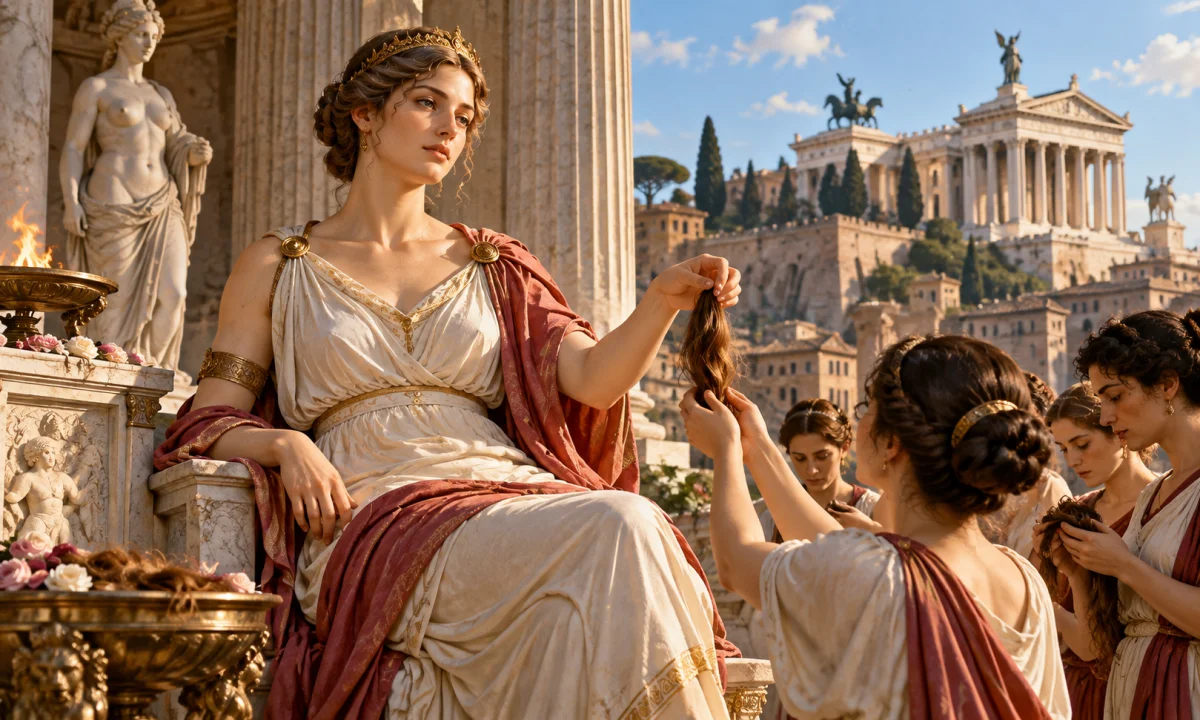
Calva is an obscure figure associated with Roman religious tradition and with the symbolism of hair, baldness and personal sacrifice. The name is usually understood as the feminine form of the Latin adjective calvus, meaning “bald” or “bare.” In surviving references, Calva is more securely known as an epithet of Venus—Venus Calva, or “Bald Venus”—than as a fully independent goddess with a separate mythology.
Very little evidence survives for a distinct cult of Calva. Ancient Roman writers mention the name in connection with a story about Roman women cutting off their hair during a military crisis. The episode has been interpreted as a foundation legend for the title Venus Calva, but the details vary and the religious significance is not entirely clear. Calva therefore belongs among the many minor, localised or highly specialised divine names of Roman religion, where an epithet could preserve a particular event, ritual, physical condition or aspect of a better-known deity.
Origins and cultural setting
Roman religion did not always treat gods as fixed characters with one standard appearance and one universally agreed biography. A deity could possess numerous titles, each highlighting a particular power, place, ritual function or relationship with the Roman community. Venus, for example, was associated with love, sexuality, fertility, beauty, prosperity and the protection of the Roman people, but her cult titles could also reflect political events or unusual local traditions.
Calva appears to belong to this system of specialised naming. The title may have commemorated a dramatic act performed by Roman women, rather than describing a goddess who was traditionally imagined as bald. The word could have carried a symbolic meaning: hair, normally associated with beauty, femininity and social identity, had been voluntarily removed for the defence of the city. A goddess called “Bald Venus” could therefore represent a form of beauty transformed by public duty, or a sacrifice that placed the survival of Rome above personal appearance.
The tradition is usually connected with a period when Rome was threatened by enemies, especially the Gallic attack traditionally dated to the early fourth century BCE. Roman historical narratives describe the city as facing severe danger and emphasise the extraordinary efforts made by its inhabitants. In the story associated with Venus Calva, Roman women cut their hair so that it could be used in the manufacture of bowstrings or other military materials.
The historical accuracy of this episode cannot be established. Roman accounts of the early Republic were written or shaped long after the events they describe, and foundation legends often explain the origin of a place-name, cult title or ritual through a memorable moral story. The account may preserve a genuine local tradition, but it may also be a later explanation devised to make the name Calva intelligible.
The name Calva
Calva is not a mysterious personal name whose original meaning has been lost. It is readily connected with Latin calvus, “bald,” “bare” or “without hair.” In a religious context, however, a descriptive adjective could function as an official divine title. Roman worshippers regularly addressed gods through epithets that narrowed or reshaped their powers.
The feminine form suggests a goddess or feminine divine figure, but grammar alone does not prove that Calva was an independent deity. The most cautious interpretation is that Calva was an epithet of Venus. Some modern lists of Roman gods present Calva as though she were a separate goddess of baldness or hair loss. That description may be convenient, but it gives a stronger impression of independence than the surviving evidence supports.
“Bald Venus” should also not automatically be understood as a goddess who caused baldness, protected people from hair loss or governed the medical condition of alopecia. Those functions are sometimes assigned to Calva in modern summaries, but ancient evidence for such a specialised power is slight. The title is better connected with the legendary removal of hair by Roman women than with a general Roman theology of baldness.
The story of the women’s hair
The best-known tradition places the origin of Venus Calva during a crisis in which Rome needed additional military resources. The women of the city are said to have cut off their hair and offered it for practical use, especially for making bowstrings. Since hair was valuable as a sign of feminine beauty and social presentation, the sacrifice represented a striking rejection of ordinary concerns in favour of collective survival.
In some retellings, the women’s act was connected directly with Venus. The goddess was honoured under the title Calva because her worshippers had become “bald” through their patriotic offering. Other versions treat the event as the reason for a shrine or cult observance. The exact sequence—whether the temple or title came before the story, or whether the story was created to explain an existing title—is uncertain.
The legend has several features common to Roman foundation narratives:
- A military emergency: the city faces a threat that demands unusual action.
- A civic sacrifice: a group that is not normally depicted as fighting directly contributes essential resources.
- A gendered offering: women surrender hair, an important marker of beauty, dignity and identity.
- A divine memorial: a religious title preserves the memory of the act.
Such stories should not be read as straightforward reports of military practice. Hair may have had practical uses, but the narrative’s emphasis is symbolic. The removal of hair makes the women visibly altered and temporarily deprived of a feature closely associated with their social role. Their appearance becomes a public sign of devotion to Rome.
Calva and Venus
Venus was one of Rome’s most important goddesses. Her older associations with sexuality and fertility were joined by specifically Roman claims about ancestry and national destiny. The Julian family later connected itself with Venus through the mythical descent of the Roman people from her son Aeneas. Venus could therefore function both as a goddess of personal attraction and as a protector of Roman identity.
Venus Calva fits the broader Roman habit of giving a major deity unusual and sometimes startling forms. A goddess normally associated with beauty could be honoured through an image or title that referred to the absence of hair. The apparent contrast may have been intentional. It could express the idea that Venus remained present even when ordinary beauty was sacrificed, or that devotion could transform an embarrassing or abnormal condition into a sacred sign.
It is not known whether a cult statue of Venus Calva actually showed a bald woman. The title does not by itself establish an iconographic type. Ancient divine epithets were often more flexible than modern character descriptions, and an epithet could be used in ritual without requiring a distinctive image. Claims that Calva had a standard bald form, particular clothing or a fixed set of attributes go beyond what the evidence securely permits.
Hair in Roman religious and social life
Hair carried considerable social and religious meaning in Roman culture. Hairstyles helped communicate age, gender, status, fashion and marital respectability. Hair could be arranged carefully for ceremonies, offered to a deity or cut as part of mourning, punishment, initiation or a vow. The significance of an act involving hair depended on who performed it and under what circumstances.
For Roman women, the deliberate cutting of hair could be especially dramatic because elaborate hairstyles were connected with femininity, beauty and public presentation. A collective cutting of hair during a crisis would have produced a visible community of women marked by sacrifice. In the Calva story, the body itself becomes part of the defence of the city: the women give up something personal so that Rome can continue to resist its enemies.
This symbolism does not mean that Roman women universally shaved their heads in wartime, nor that baldness was generally sacred. It describes an extraordinary action preserved in a particular legend. The story’s power comes precisely from the fact that the act is unusual.
Sources and uncertainty
Calva is not the subject of a surviving Roman epic, hymn or extended myth. Knowledge of the figure comes from brief antiquarian and mythographic notices, together with later summaries of Roman religious tradition. These references are too limited to reconstruct a complete cult, priesthood, festival calendar or theology.
The ancient evidence also does not provide a single uncontested explanation. The association with women’s hair and a military crisis is widely repeated, but the details can vary between accounts. Some versions connect the event with the Gallic threat; others have been reported in relation to different episodes or generalised as a story about Roman women making a patriotic offering. It is therefore safer to speak of a tradition associated with Venus Calva than of a fully stable myth.
There is likewise no firm evidence that Calva was worshipped throughout the Roman world. The name may have belonged to a local Roman cult, a commemorative title or an antiquarian explanation known to educated writers. A brief appearance in a literary source does not automatically demonstrate a large or long-lasting popular religion.
Interpretation and cultural significance
The story of Calva is significant because it expands the usual picture of Venus. Instead of presenting beauty as something merely ornamental or private, it makes beauty available for sacrifice. The women’s hair is valuable precisely because it represents something they are willing to surrender. The resulting baldness is not celebrated as an ideal appearance; it is remembered as evidence of loyalty.
The episode also reflects Roman ideas about collective virtue. Roman historical writing frequently praised acts in which individuals placed the safety of the state above comfort, wealth or status. The women in the Calva tradition do not necessarily become warriors, but they support the military community through a bodily offering. Their action fits the Roman ideal of pietas, understood broadly as dutiful loyalty to family, gods and community.
At the same time, the story should not be treated as uncomplicated proof of women’s political equality in ancient Rome. Its surviving form was shaped by male-dominated literary and religious institutions, and the women are praised mainly for supporting the defence of the city. The legend gives them collective agency, but it places that agency within conventional expectations of service to Rome.
Calva may also illustrate how Romans could sacralise states of vulnerability or imperfection. Baldness could be associated with age, illness, shame or loss, yet the title Venus Calva turns the bare head into a reminder of devotion. This does not amount to a general Roman celebration of baldness. Rather, it shows how a physical condition could acquire a positive religious meaning when connected with a memorable act.
Distinguishing Calva from similar figures
Calva should not be confused with a separate Roman goddess of disease, old age or bodily decay. There is no secure evidence that she ruled over all forms of hair loss or over the appearance of the human body. Nor should she be identified with every Roman deity whose worship involved hair offerings.
She is also distinct from Venus Verticordia, an epithet of Venus associated with turning women’s hearts toward sexual morality. Both titles belong to the wide range of Venus’s Roman forms, but they refer to different traditions. Calva is linked with baldness and the legendary cutting of hair, whereas Verticordia concerns moral transformation and chastity.
Calva should not be confused with a skull goddess or a personification of death. The Latin connection with baldness and bare surfaces can encourage modern visual associations with a skull, but the ancient tradition does not establish Calva as an underworld deity, a skeleton or a ruler of the dead. Similarly, she is not the same as later European figures whose names or images happen to involve baldness, bare heads or skulls.
Later reception
Calva has had little influence on major modern fiction, film or popular mythology. When the name appears today, it is often in lists of “forgotten” or “minor” Roman goddesses. Such lists sometimes expand the figure into a patroness of bald people, hair growth or hair loss without distinguishing ancient evidence from modern reconstruction.
Modern artists may reasonably use Venus Calva as a symbol of beauty surrendered for a greater cause, bodily difference, communal sacrifice or the instability of appearance. Those are creative interpretations rather than securely documented Roman doctrines. A historically responsible depiction should make clear that Calva’s surviving identity is brief, uncertain and closely tied to an epithet of Venus rather than to a fully developed independent mythology.