WORLD
WORLD
Caca

Caca is an obscure female figure in Roman mythology, best known as the sister of the monstrous Cacus and as a figure connected with the story of Hercules and the cattle of Geryon. Her tradition survives mainly in ancient Roman and Greek accounts of early Rome, where she appears in different roles: sometimes as the betrayer of Cacus, sometimes as a cult figure associated with fire, and possibly as an independent archaic goddess. The evidence is limited and inconsistent, so Caca’s identity cannot be reconstructed with the same confidence as that of better-known Roman deities.
Origins and cultural setting
Caca belongs to the legendary prehistory of Rome. Her story is linked with the Forum Boarium, the cattle market beside the Tiber, and with the cult of Hercules established in that area. Roman tradition treated the district as a place where Greek and Italian religious elements met. Hercules was worshipped there as a protector of trade, livestock and wealth, while the story of Cacus explained the supposed origin of his cult and the name of a local landmark, the Scalae Caci, or “Stairs of Cacus.”
The principal narrative concerns Hercules’ return from the western edge of the world with the cattle of Geryon. During the journey, Hercules rested near the future site of Rome. Cacus, a dangerous inhabitant of a cave on the Aventine Hill, stole some of the cattle and hid them. In the best-known versions, he dragged the animals backward by their tails so that their tracks would not lead to his dwelling. Their lowing eventually revealed the theft, and Hercules attacked and killed him.
Caca is not equally prominent in every account of this episode. The fullest ancient versions are found in Livy’s History of Rome, Dionysius of Halicarnassus’ Roman Antiquities, Virgil’s Aeneid, and later mythographical and antiquarian writings. Virgil gives Cacus a major poetic role but does not make Caca central to the narrative. Other authors and commentators preserve a version in which Caca helps Hercules discover the truth about her brother.
Name and identity
The name is usually written Caca in Latin. It should not automatically be treated as a simple feminine form of Cacus, although the close resemblance between the names encouraged ancient and modern interpreters to connect the two figures. The origin of both names is uncertain. Ancient writers sometimes explained mythological names through wordplay or popular etymology, and the relationship between Caca and Cacus may partly reflect such a process.
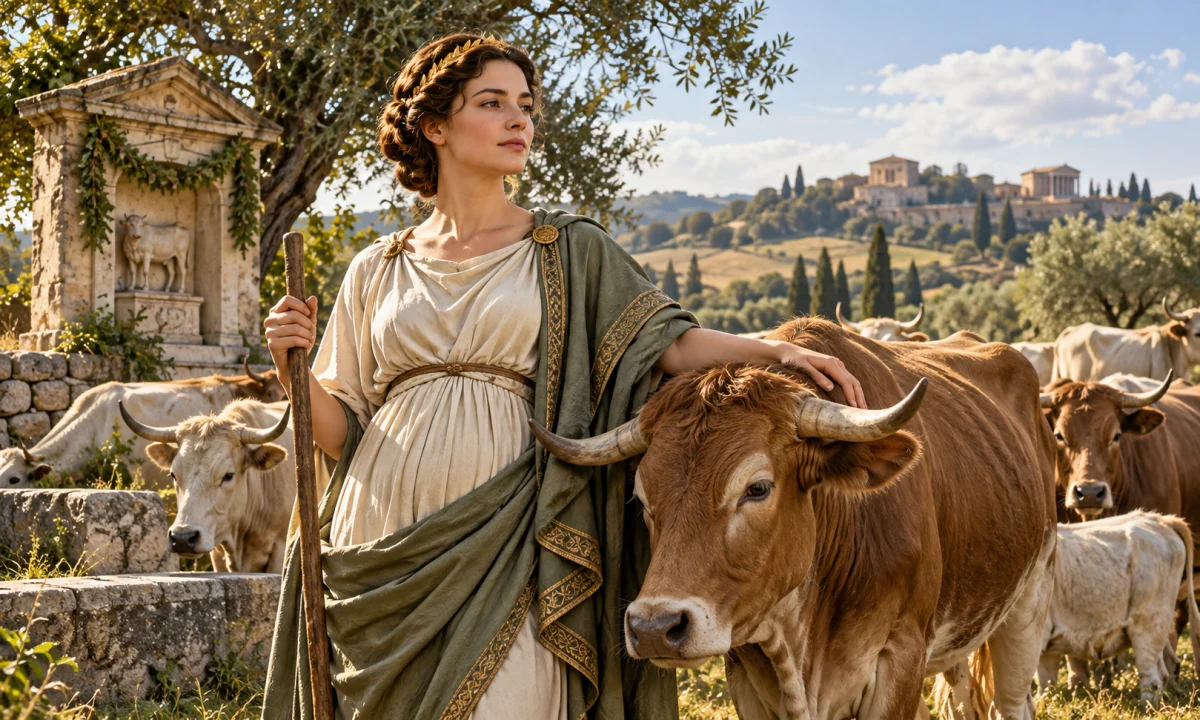
Caca is commonly described as Cacus’s sister. In some accounts she is a human or semi-human woman who lives near him; in others she has a more distinctly divine or ritual character. The sources do not provide a stable genealogy, biography or physical description. There is no well-established ancient image of Caca, and she does not possess a developed mythology comparable with that of Juno, Venus, Minerva or Vesta.
Her classification is therefore uncertain. She may be understood as a legendary woman attached to the Cacus story, a local cult figure later incorporated into that story, or an archaic goddess whose identity was reinterpreted through the Hercules legend. Ancient authors themselves did not always agree on how to understand her.
Caca and the theft of Hercules’ cattle
In one important tradition, Caca reveals Cacus’s crime to Hercules. Cacus has hidden the stolen cattle in his cave, but Caca either tells Hercules where they are or provides the information that enables him to locate the cave. Hercules then confronts Cacus and kills him. This makes Caca an essential agent in the hero’s victory, even though the surviving narratives differ in the details of her action.
Her motive is also unclear. She may have opposed her brother because of his violence, feared Hercules, or acted from a sense of justice. The ancient material does not consistently portray her as heroic in a broad moral sense. Her importance lies in the decisive information she supplies rather than in combat or supernatural power.
The episode creates an interesting contrast between the two siblings. Cacus is associated with concealment, predation and the dangerous wilderness. He steals the cattle and hides them in a cave, using deception to frustrate Hercules. Caca, by contrast, is associated with disclosure. Her intervention brings hidden wrongdoing into the open. This opposition may be one reason later interpreters connected her with fire or the hearth, both of which can be imagined as sources of light within darkness.
Not all versions include her betrayal. Virgil’s account in Book 8 of the Aeneid focuses on Cacus as a fire-breathing or fire-associated monster, his cave, his theft and his battle with Hercules. In Virgil’s highly dramatic presentation, Caca is absent. This absence is significant: the familiar literary form of the Cacus myth did not require her, and her role belongs to a different layer of the tradition.
A possible goddess of fire
Several ancient testimonies connect Caca with a cult or altar, and some associate her with fire. This has led scholars to describe her as a possible archaic fire goddess or hearth deity. The evidence, however, does not establish a complete theology for her.
Ancient Roman religion included many local and specialized divine figures whose cults were later overshadowed by the major state gods. A deity could be known through a small shrine, a ritual formula or a place-name without acquiring an extensive mythology. Caca may have belonged to this older layer of Roman religious tradition. Her story was then attached to the already popular legend of Hercules and Cacus.
Some ancient writers and later commentators compare Caca with Vesta, the Roman goddess of the hearth. This does not mean that Caca and Vesta were universally regarded as the same deity. The comparison probably arises from Caca’s alleged connection with fire and from the tendency of Roman antiquarians to explain obscure local gods by relating them to better-known divine figures. The identification remains interpretive rather than secure.
The proposed fire symbolism should therefore be treated cautiously. Caca is not described in a consistent body of myths as a goddess who controls flames, teaches humans to use fire or presides over domestic life. Those are attributes of other figures or later reconstructions. The surviving evidence supports, at most, a possible association with a local fire cult.
The connection with Hercules’ cult
Caca’s story is inseparable from the early Roman cult of Hercules at the Ara Maxima, the “Greatest Altar,” in the Forum Boarium. Roman tradition regarded Hercules as the founder or beneficiary of the altar after his victory over Cacus. The cult was unusually prominent in a commercial district associated with cattle and trade.
Later Roman writers preserved traditions about the hereditary priestly families who served Hercules, especially the Potitii and Pinarii. They also described ritual rules surrounding the Ara Maxima, including restrictions on women in some ceremonies. These details belong to the cult of Hercules rather than specifically to Caca, and they should not be used to create a fixed ritual system for her.
Some reports of a separate altar or shrine for Caca have encouraged the idea that she possessed an independent cult near the Hercules sanctuary. The exact location, date and character of such a shrine are not securely known. The evidence is too fragmentary to determine whether her worship was genuinely old, whether it represented a local tradition later recorded by antiquarians, or whether her divine status developed from the narrative of Cacus.
Attributes and symbolic role
Caca has no standard appearance in Roman art. Unlike Cacus, who is often imagined as a huge, monstrous or fire-breathing being in literary descriptions, Caca is not given a recognized physical form. She is generally represented in interpretation as a woman, but this is based on her name and narrative role rather than on surviving ancient iconography.
Her most consistent attribute is knowledge of what has been hidden. She knows where Cacus has taken the cattle and makes that knowledge available to Hercules. In this respect, she functions as an informant and intermediary. Her act also helps establish the moral structure of the story: Cacus’s secrecy fails, and the stolen animals are recovered.
If the association with fire is accepted, Caca may also represent a small, local expression of the hearth or sacred flame. Fire in Roman religious thought could signify protection, continuity and communication between humans and the gods. Yet it could also be destructive, as in the flames and smoke associated with Cacus. Caca’s possible connection with fire therefore does not automatically make her benevolent or domestic. It may reflect an older ritual meaning that the surviving literary sources no longer explain.
Relationship with Cacus
Caca and Cacus are related in tradition but sharply different in character. Cacus is a predatory cave-dweller who attacks or steals livestock and resists the civilizing power represented by Hercules. He is associated with the Aventine, a dark cave and uncontrolled violence. Caca is associated with the disclosure of his wrongdoing and, in some interpretations, with a sacred flame or local altar.
Their relationship may have served several purposes in Roman storytelling. A female relative who knows the monster’s secret gives the tale a narrative opening: Hercules cannot defeat an enemy he cannot find. At the same time, Caca’s presence may preserve traces of a separate local tradition that was later subordinated to the more dramatic story of the male monster and the Greek hero.
It is not safe to assume that Caca was originally invented only as a female counterpart to Cacus. Nor is it certain that she was originally an independent goddess. The surviving evidence allows both possibilities, as well as the possibility that different traditions were combined over time.
Ancient interpretations and later reception
Roman antiquarians often tried to explain old religious names and customs by connecting them with famous legends. Caca is a good example of how this process can preserve information while also reshaping it. A local goddess, a ritual name and a heroic story may have been interpreted together, even if they had not begun as parts of one tradition.
Christian authors who discussed Roman religion sometimes mentioned obscure gods such as Caca in order to criticize the multiplicity of pagan divine figures. Their references are valuable evidence that her name remained known in learned literature, but they do not necessarily preserve the original meaning of her cult. They often present Roman religion polemically rather than descriptively.
In modern scholarship, Caca is usually treated as a minor and uncertain figure rather than as a fully documented goddess. Discussions often focus on the relationship between local Latin religion and imported or adapted Greek heroic traditions, especially the Roman reception of Hercules. Her possible connection with fire, her relationship with Vesta and the nature of her shrine remain matters of interpretation.
Modern popular culture has shown little sustained interest in Caca. She may appear briefly in encyclopedic treatments of Roman mythology, retellings of the Hercules and Cacus story, or speculative reconstructions of archaic Roman religion. Such presentations sometimes expand her into a powerful fire goddess or a supernatural heroine. Those developments are modern embellishments unless they are clearly identified as creative reinterpretation. The ancient evidence supports a more limited figure: Cacus’s sister, a possible informant in the cattle-theft story, and perhaps a local cult personality associated with fire.
Distinguishing Caca from similar names
Caca should not be confused with Cacus, her male relative and the principal monster of the Hercules legend. She is also distinct from Vesta, even though ancient and modern interpreters sometimes compare the two because of a possible fire connection. Nor should she be merged with other obscure Italian goddesses merely because they are associated with the hearth, women’s religious activity or household protection.
The form of her name can also look unfamiliar or comic to modern readers because it resembles words in several modern languages. That resemblance has no secure bearing on the Roman religious tradition. Caca is an ancient Latin name preserved in a narrow and complicated body of evidence, and her significance depends on that historical context rather than on modern associations with the spelling.