WORLD
WORLD
Balam
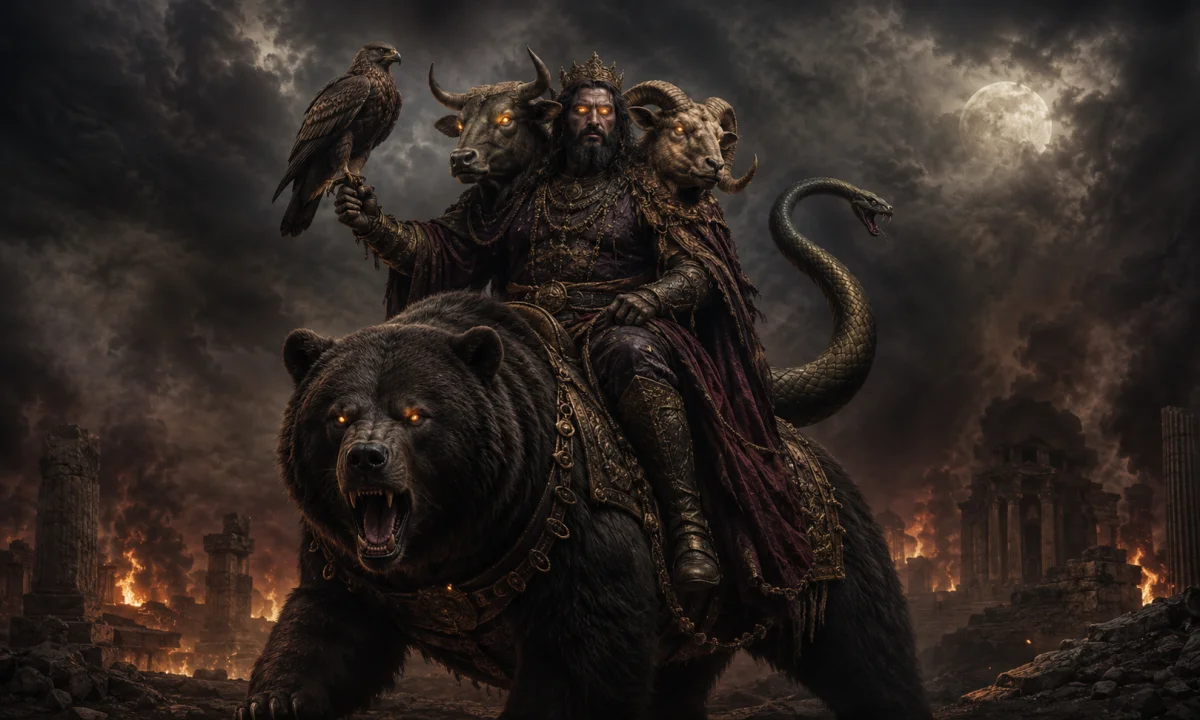
Balam is a demon in early modern European ceremonial demonology, best known from the Ars Goetia, the first section of the Lesser Key of Solomon. In that tradition, Balam is presented as a powerful king who appears as a composite creature with three heads, a serpent’s tail, fiery eyes, and animal companions. The name is also associated with several unrelated figures and terms, especially the biblical Balaam and the Maya word and spirit-name balam. These identities should not be treated as a single being.
Balam in Western demonology
The demon Balam belongs to the cataloguing tradition commonly called the Goetic or Solomonic tradition. “Goetia” refers to the practice of ritual magic concerned with the summoning and commanding of spirits. In the best-known catalogue, Balam is listed as the Fifty-first spirit and is described as a king of Hell.
The account presents Balam as “great and terrible” in character. He is said to answer questions about the past, present, and future, and to possess the power to make people invisible. The same description assigns him command over forty legions of spirits. These numbers and offices are features of the literary system used by the Goetic catalogue; they are not supported by evidence for an independent ancient cult devoted to Balam.
The Ars Goetia survives in manuscripts and printed editions connected with the Lesser Key of Solomon, a compilation whose surviving form belongs mainly to the seventeenth century. Its material draws on earlier European traditions of demonological lists, magical handbooks, and spirit catalogues. A related description appears in Johann Weyer’s Pseudomonarchia Daemonum, published in 1577, although names, numbering, wording, and details vary among manuscripts and editions.
Name and identity
Balam’s name appears in variant forms, including Balan and forms resembling Balaam. Spelling was not completely fixed in early magical manuscripts, and copyists sometimes altered names as they transmitted lists of spirits. Because of this, a particular edition may not use exactly the same spelling or numbering as another.
The connection between the Goetic Balam and the biblical Balaam is uncertain. In the Book of Numbers, Balaam is a human diviner from whom the Moabite king Balak seeks a curse against the Israelites. Balaam ultimately blesses Israel instead, after receiving divine instructions. He is not described in the Bible as a demon with three heads, a serpent’s tail, or command over infernal legions.
Later Christian writers sometimes treated biblical figures associated with magic, idolatry, or false prophecy as possible sources for demonological names. The similarity between “Balam” and “Balaam” may therefore have encouraged association, but the Goetic texts do not establish a clear historical line from the biblical narrative to the later demon. The two figures are best distinguished rather than automatically identified.
Appearance and attributes
The most familiar description of Balam gives him a striking composite form. He has:
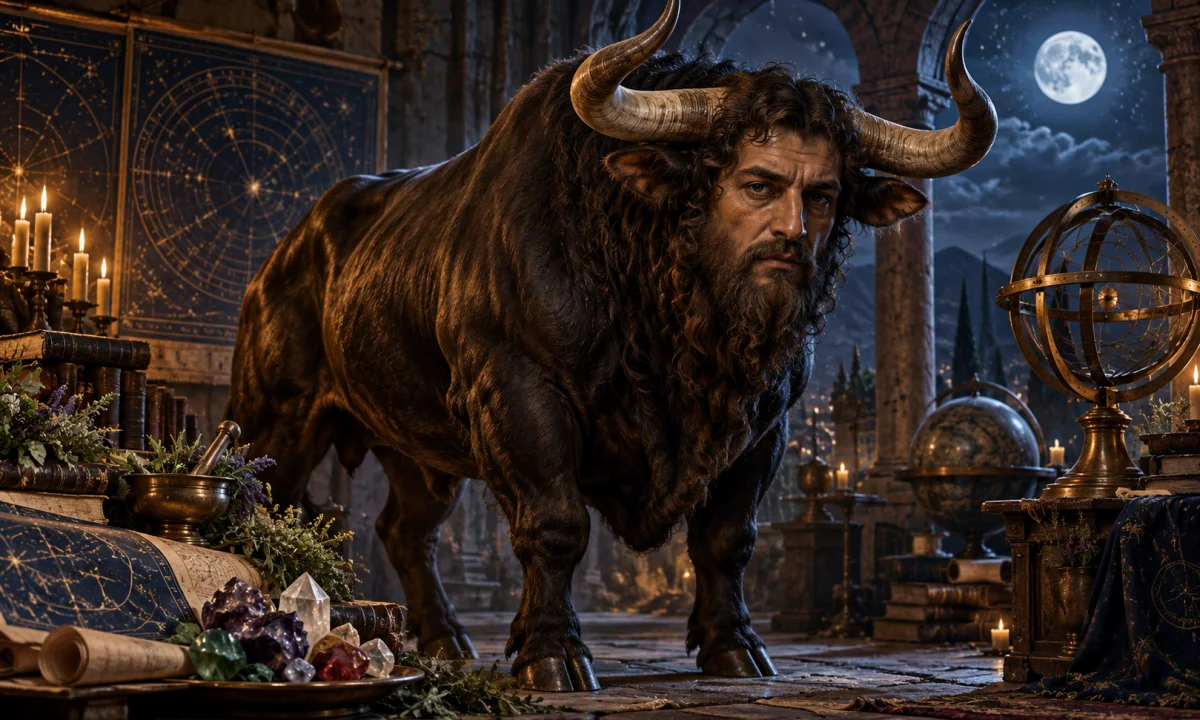
- three heads, described as those of a bull, a man, and a ram;
- a serpent’s tail;
- eyes that burn or flash with fire;
- a furious bear as a mount; and
- a goshawk or similar bird of prey carried on his hand.
The exact wording differs between versions. Some translations use “hawk” rather than “goshawk,” and punctuation or phrasing can affect how the three heads are understood. The standard image, however, is that of a royal and dangerous spirit combining human, domesticated, wild, and serpentine features.
These details fit a broader pattern in European demonological literature. Spirits are often given bodies assembled from several animals, especially when the description is intended to communicate power, strangeness, violence, or moral disorder. The bull and ram may suggest strength and aggression; the serpent commonly carries associations of cunning, danger, or forbidden knowledge; and the bear emphasizes physical force. The texts themselves do not provide a fixed symbolic interpretation for each feature, so these meanings belong to later interpretation rather than an explicit explanation by the original compilers.
The flaming eyes and hoarse voice reinforce Balam’s threatening presence. His animal companions also contribute to the image of a spirit that is not merely human or ghostly. He appears as a commanding supernatural monarch surrounded by signs of wilderness and predation, while his title of king places him within the hierarchical structure shared by many Goetic spirits.
Powers and ritual role
Balam’s principal stated powers are divination and invisibility. He is said to reveal things past, present, and future, making him one of the spirits in the catalogue associated with knowledge of hidden or distant matters. The power of invisibility can be understood literally within the magical text, although historical readers may also have treated it as a metaphor for concealment, secrecy, evasion, or freedom from notice.
The Goetic descriptions are brief catalogues rather than extended myths. They usually identify a spirit’s rank, appearance, abilities, and number of legions, but they do not tell a continuous life story. Balam therefore has no substantial cycle of legends comparable to the myths of a god or the narrative traditions surrounding a hero. His identity is defined primarily by his entry in a ritual classification system.
In ceremonial magic, a spirit’s listed rank and abilities function as practical information. The operator is expected to identify the spirit, use an appropriate seal or character, and perform a ritual of conjuration and control. Different manuscripts and modern editions arrange these materials differently, and historical practitioners did not necessarily follow one universally fixed procedure. The presence of Balam in a magical catalogue demonstrates his place in learned occult literature, but it does not prove that the rituals were historically successful or widely practiced.
The seal and the Goetic catalogue
Modern editions of the Ars Goetia commonly assign Balam a seal, as they do to the other spirits in the catalogue. These seals are abstract diagrams made from lines, circles, letters, and other signs. They function as identifying emblems within the ritual system. Their exact form can vary between editions, and the existence of a printed seal does not necessarily mean that one unaltered design was used throughout the history of European magic.
Balam’s position as the fifty-first spirit is also a feature of a particular ordering system. Numbering helps organize the catalogue, but it should not be confused with a universally recognized rank in all forms of demonology. The hierarchy of kings, princes, dukes, marquises, presidents, and other titles differs across demonological books.
Historical and religious context
Balam should be understood within the context of Christian Europe’s attempts to classify and regulate supernatural beings. Demonological writers inherited ideas from biblical interpretation, late antique and medieval discussions of demons, magical handbooks, and folklore about spirits. They combined these materials into lists that treated demons as members of an infernal bureaucracy.
This system was not the equivalent of a single, ancient religion with a stable pantheon. It was a literary and ritual tradition built from several sources and reshaped over time. A demon’s title, appearance, or number of legions could change as a text was copied, translated, edited, or incorporated into a new magical collection.
The Ars Goetia also presents spirits through a framework of command. The magician does not ordinarily approach Balam as a deity worthy of worship. Instead, the spirit is summoned, questioned, constrained, and dismissed according to the ritual’s assumptions. This distinction is important: Balam’s role in the catalogue is that of a dangerous spirit subject to ceremonial authority, not a god belonging to a public temple cult.
Distinction from Maya balam traditions
The name balam also occurs in Maya languages and traditions, particularly among Yucatec Maya communities. This Maya material is not the same tradition as the European demon Balam. In Yucatec Maya, balam is associated with the jaguar, and balamo’ob can refer to supernatural guardian beings. Descriptions vary by community, period, and source.
Maya balames are often portrayed in ethnographic and colonial accounts as protectors of settlements, fields, boundaries, or the wider landscape. Some traditions speak of multiple guardian beings connected with directions, mountains, caves, rain, crops, and the defence of human communities against harmful forces. They may be imagined as ancient, powerful, or difficult to see, but their exact appearance and duties are not uniform across all Maya traditions.
The protective role of these beings differs sharply from the Goetic portrayal of Balam as a king of Hell. A shared spelling in English does not establish a shared identity or origin. Similarities may arise through transcription, translation, or coincidence, while the cultural settings, languages, religious concepts, and histories are different.
The name in the Books of Chilam Balam
Confusion also sometimes arises because of the Books of Chilam Balam, a group of colonial-era Yucatec Maya manuscripts. These books contain historical material, calendrical knowledge, prophecies, Christian teachings, medical information, and other traditions recorded after the Spanish conquest. “Chilam Balam” is generally understood as a title and personal name associated with a prophetic figure, although the precise interpretation of the components and the history of the manuscripts are subjects of scholarly discussion.
The Balam in “Chilam Balam” should not be identified with the Goetic demon. Nor should the Maya prophetic tradition be read as evidence that the European demon catalogue borrowed directly from Maya religion. The relevant texts belong to different continents, languages, and historical periods.
Variants and uncertainty
Several features of Balam’s identity remain dependent on the version consulted. The spelling may be Balam or Balan; the bird in his hand may be translated as a goshawk or hawk; and the arrangement of his heads and animals can differ in illustrations. Some modern occult books add interpretations or ritual instructions that are not present in the earliest accessible wording of the catalogue.
There is also no single ancient mythology that supplies a complete biography for Balam. Claims that he was originally a pre-Christian god, a historical monarch, or a demon worshipped in a documented ancient cult go beyond the evidence normally provided by the Goetic texts. Such ideas may appear in modern occult speculation, fiction, or esoteric reinterpretation, but they should be labelled as later interpretations.
Later reception
Balam’s unusual appearance has made him attractive to modern occult writers, artists, role-playing games, encyclopaedias of demons, and horror fiction. Contemporary depictions often emphasize the three heads, the bear, the serpent’s tail, or the fiery eyes, sometimes turning the brief catalogue entry into a detailed personality or mythology.
These creative treatments may use Balam as a symbol of prophecy, concealment, animal power, or infernal kingship. They are modern adaptations rather than evidence for additional historical traditions. In traditional Goetic material, Balam remains a comparatively concise catalogue figure: a kingly demon associated with hidden knowledge, invisibility, and a formidable composite form.