WORLD

Stolas
Stolas, also called Stolos in some versions, is a spirit of early modern European demonology. He is best known from the Ars Goetia, the first section of the Lesser Key of Solomon, where he is listed as the thirty-sixth spirit and described as a great prince of Hell. His stated areas of knowledge are astronomy, herbs and precious stones. Unlike figures with long-standing worship traditions or extensive mythological cycles, Stolas is primarily a literary and ritual figure preserved in learned occult catalogues.
Origins in Christian demonology
Stolas belongs to the tradition of European grimoires: books that presented systems of ritual magic, spirit catalogues, prayers, seals and instructions for commanding supernatural beings. These works were usually written within a Christian cultural environment, even when they incorporated material from Jewish, classical, Arabic and medieval magical traditions. Their descriptions of demons do not necessarily represent popular religious belief. They often reflect attempts by learned authors and copyists to organise many different supernatural names into a hierarchy governed by kings, princes, dukes, marquises and other ranks.
The most important surviving source for Stolas is the Ars Goetia. It survives in manuscripts associated with the broader Lesser Key of Solomon, a collection that took shape in the seventeenth century, although many of its individual names, formulas and ideas are older. The Ars Goetia presents seventy-two spirits, each with a title, a number of subordinate legions, a description of appearance and a stated function. The work claims a connection with Solomon, but the collection is not an ancient text written by the biblical king. Its Solomonic attribution is part of the authority and legendary framework used by early modern magical authors.
Stolas also appears in related demonological traditions, including catalogues connected with the Pseudomonarchia Daemonum, a sixteenth-century work associated with Johann Weyer. The wording, spelling and order of names vary among manuscripts and later editions. These variations are important because they show that Stolas was transmitted through copying and editorial reshaping rather than through a single, fixed canonical mythology.
Name and identity
The forms Stolas and Stolos are both encountered in discussions of the demon. The spelling “Stolas” is now the more familiar form, especially in English-language occult writing and popular culture. The precise origin and meaning of the name are uncertain. It should not automatically be derived from a Greek, Latin, Hebrew or other ancient word merely because a suggested resemblance exists. The surviving demonological texts do not provide a reliable etymology.
Stolas is sometimes treated as a distinct demon from similarly named figures, but the major descriptions associated with “Stolas” and “Stolos” generally refer to the same grimoire spirit. The name should not be confused with unrelated personal names, place names or modern fictional characters that happen to use the same spelling.
In the hierarchy of the Ars Goetia, Stolas is called a great prince. The text states that he governs twenty-six legions of spirits. This number belongs to the internal bureaucratic structure of the grimoire. It is not evidence for an independently attested ancient religion, nor does it indicate that historical Christian churches recognised Stolas as a demon with a universally agreed rank.
Appearance in the grimoires
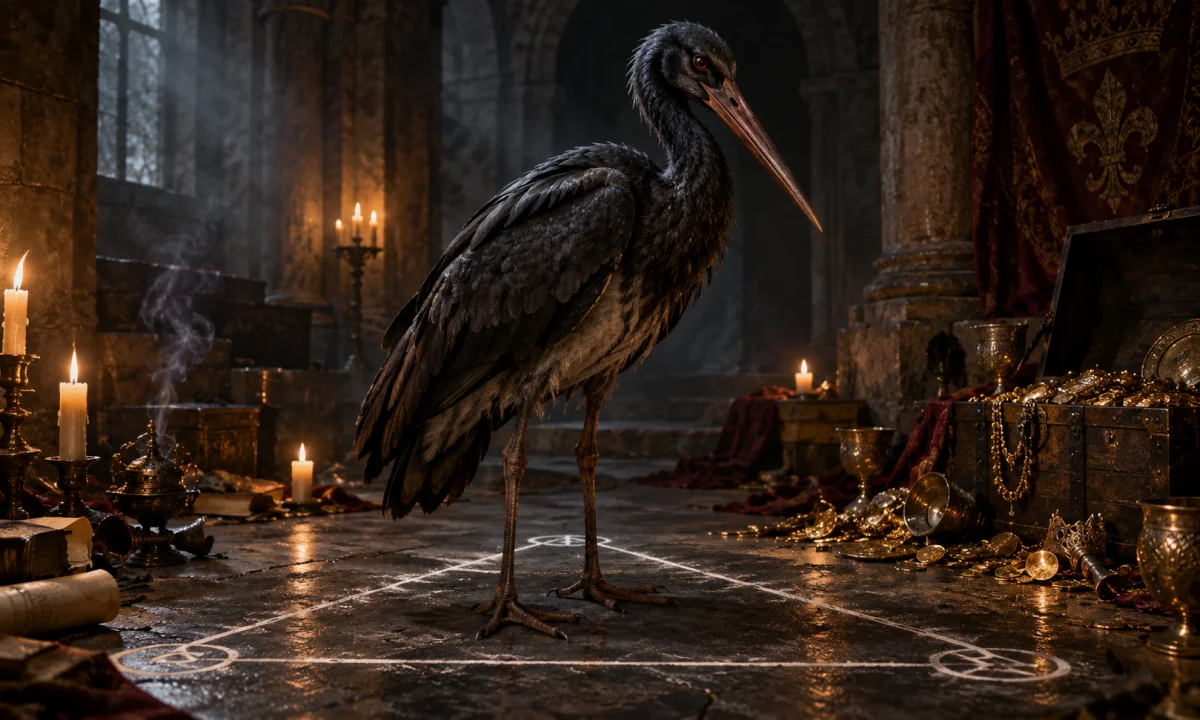
The central description of Stolas in the Ars Goetia is distinctive. He is said to appear first as a mighty raven and then to take the shape of a human being. The raven form connects him with a familiar symbol of omen, intelligence, wilderness and contact with hidden knowledge, although the grimoire does not explain the symbolism in those terms. Its primary purpose is to tell the ritual practitioner how the spirit is expected to manifest.
Later illustrations and popular summaries often portray Stolas as an owl rather than a raven. This image is particularly associated with nineteenth-century demonological art and with later occult and fantasy representations. The owl is a fitting visual choice for a spirit linked to learning, observation and the night sky, but it should not replace the older textual description without qualification. In the Ars Goetia, the explicit animal form is a raven.
Many modern depictions also show Stolas as an anthropomorphic owl, a crowned bird or a scholarly figure surrounded by stars, books, plants and gems. These images combine the original raven-and-human description with later artistic conventions. They may be visually recognisable, but they are interpretations rather than details supplied by the earliest surviving descriptions.
Knowledge and powers
The Ars Goetia assigns Stolas three principal areas of instruction:
- Astronomy, meaning knowledge of the stars, planets and structure of the heavens as understood by the text’s early modern readers.
- The virtues of herbs, referring to the properties or powers attributed to plants in traditional herbal, medical and magical lore.
- The virtues of precious stones, referring to the symbolic, medicinal or occult qualities assigned to gems and minerals.
The term “astronomy” should be retained carefully. Modern writers sometimes describe Stolas simply as a demon of astrology, but astronomy and astrology were not always sharply separated in early modern intellectual culture. The grimoire’s wording concerns knowledge of the heavens; it does not provide a detailed astrological doctrine belonging uniquely to Stolas.
Likewise, the text does not give a botanical catalogue, a list of stones or a set of specific teachings attributed to him. Stolas is presented as a possessor or instructor of knowledge, not as the author of a surviving treatise on plants, minerals or celestial movements. Claims that he governs particular herbs, gemstones or constellations generally come from later occult elaboration rather than from the core description.
His powers therefore have an intellectual and encyclopedic character. He is not primarily portrayed as a tempter, destroyer, warrior or ruler of a particular earthly territory. His role is closer to that of a supernatural instructor in occult natural philosophy. The classification reflects the early modern tendency to imagine demons as repositories of forbidden, secret or difficult knowledge.
Seal and ritual context
Like most of the spirits in the Ars Goetia, Stolas is associated with a distinctive seal or sigil. In the ritual structure of the grimoire, such a sign functions as an identifying emblem used by the magician during an attempted evocation. The text also places the spirit within a broader ceremonial system involving divine names, protective boundaries, conjurations and commands.
The presence of a seal does not mean that the emblem has an ancient history independent of the grimoire. The sigil belongs to the manuscript and magical tradition in which the spirit is catalogued. Modern occult practitioners may reproduce or reinterpret it, but there is no reliable evidence that the sign was used in antiquity or in a continuous pre-Christian cult of Stolas.
The ritual setting also matters for understanding the language of rank and obedience. The demons of the Ars Goetia are not described as free-standing gods with temples, priesthoods or communities of worshippers. They are presented as spirits who can be compelled, constrained or questioned through a ceremonial system. This is a feature of grimoire magic and should not be confused with ordinary devotional religion.
Stories, relationships and variants
Stolas has no substantial mythological biography in the surviving goetic material. The texts do not give him a birth, family, kingdom, marriage, rivalry or sequence of adventures. His main “story” is the ritual encounter: he appears in a prescribed form, assumes another form, and provides knowledge in the fields assigned to him.
Nor is there a stable set of relationships between Stolas and other named spirits. The statement that he commands twenty-six legions places him in a hierarchy, but the individual members of those legions are not normally identified. He is also not consistently described as a subordinate or companion of one particular demon. Later writers sometimes invent elaborate infernal genealogies or connections, but these should be recognised as modern additions unless they can be traced to an older text.
Manuscript and editorial differences affect the details. The name may be written as Stolas or Stolos, and the order or wording of the catalogue can vary. The animal form is generally given as a raven in the principal goetic description, while later presentations frequently substitute an owl. The number of legions and the title of prince are among the more stable elements of the standard account, though even these belong to a textual tradition with variant copies.
Symbolism and interpretation
Stolas can be interpreted as an example of how early modern demonology transformed areas of natural knowledge into supernatural expertise. Herbs and stones were important in medicine, agriculture, trade, alchemy and magic. Astronomy was central to calendars, navigation, astrology and theories of the universe. By placing these subjects under the authority of a demon, the grimoire frames them as knowledge that is powerful, hidden or potentially dangerous.
The raven form reinforces this impression. Ravens appear in many cultural traditions as intelligent birds associated with prophecy, death, battlefields, wilderness or messages from the unseen world. Those associations do not establish a direct ancient origin for Stolas. The grimoire does not claim that Stolas is a surviving raven deity, and there is no sound basis for identifying him with a particular god from Norse, Celtic, Greek or other pre-Christian mythology.
The later owl image creates a different emphasis. Owls are widely connected with wisdom, night vision and the ability to perceive what others cannot see. Their use in Stolas’s modern iconography reflects the demon’s scholarly and nocturnal character, but it appears to be a later visual development rather than a secure feature of the earliest account.
From a historical perspective, Stolas is best understood as a grimoire demon: a named supernatural figure shaped by manuscript culture, Christian demonological categories and ritual magic. That classification is more precise than calling him an ancient god or a universally recognised demon of all religious traditions.
Distinction from other figures
Stolas should not be identified with every raven-, owl- or star-associated supernatural being. Birds of omen and wisdom occur throughout world mythology, but resemblance in symbolism does not prove a shared identity. In particular, Stolas is not established as a form of Odin’s ravens, the Greek goddess Athena’s owl, the Roman Minerva’s owl or any single spirit from Celtic or Near Eastern tradition.
He should also be distinguished from demons in theological writings that have more developed biblical or patristic backgrounds. Figures such as Satan, Beelzebub and Asmodeus have histories extending across religious texts, commentaries and traditions that are substantially broader than Stolas’s grimoire profile. Stolas’s title and infernal rank come from a later catalogue system, not from a comparable body of ancient scripture.
Modern reception
Stolas has become increasingly visible in contemporary occult publishing, fantasy art, games and online discussions of demonology. Modern writers often expand his role into that of an astral scholar, keeper of forbidden libraries, teacher of herbal magic or patron of gemstone lore. Such portrayals can draw inspiration from the traditional description, but the additional biographies, personalities and powers are creative interpretations.
A particularly prominent modern use of the name appears in Helluva Boss, an animated series that presents a fictional character called Stolas. That character is an owl-like aristocratic demon with a developed personality, family situation and narrative role. The series borrows the name, princely status and bird imagery associated with goetic demonology, but its characterisation is not a historical account of the grimoire spirit. Details from the show should therefore not be projected backward onto the early modern texts.
In historical and religious terms, Stolas remains a comparatively concise figure: a prince in a catalogue of spirits, initially shown as a raven and then as a human, associated with astronomy and with the properties attributed to herbs and precious stones. Much of the elaborate image now surrounding him comes from later illustration, occult reinterpretation and modern fiction rather than from an ancient mythological tradition.