WORLD

Sorath
Sorath is an esoteric demon or adversarial spirit associated especially with the Sun, the number 666 and apocalyptic opposition to divine or Christ-centred revelation. The name belongs chiefly to later Western occultism and modern spiritual movements rather than to the Bible or to a single, continuous ancient demonological tradition. Its identity, spelling and meaning vary considerably between sources.
Origins and cultural setting
Sorath is most often encountered in European occult literature, Christian esotericism, ceremonial magic and, later, Anthroposophy. The figure developed within a symbolic world that combined biblical apocalyptic imagery with astrology, medieval and Renaissance magic, angelology, demonology and forms of Christian Cabala. These traditions frequently assigned spiritual beings to planets, zodiacal forces, numbers and regions of the cosmos.
The name does not appear in the biblical Book of Revelation. Revelation does, however, famously associate the number 666 with the “number of the beast”. In its original religious setting, that number is part of a cryptic apocalyptic passage about a beast that exercises oppressive authority. The text does not name the beast Sorath, identify it with a solar demon or provide the later occult correspondences attached to the name.
Later interpreters connected 666 with a powerful anti-divine force. Within some occult systems, this force was given the name Sorath or Sorat and was placed in opposition to the spiritual intelligence of the Sun. The result was not a universally accepted doctrine, but a developing esoteric interpretation in which biblical symbolism, planetary magic and numerology were brought together.
The surviving history of the name is difficult to trace with precision. Sorath is sometimes presented as an old Kabbalistic demon, but that description can be misleading. Jewish religious tradition contains extensive discussions of angels, demons, impurity and cosmic opposition, yet the specific figure called Sorath is not a standard, universally recognised being of classical Jewish demonology. Much of what is now said about Sorath comes from Christian or post-Christian occult reinterpretation rather than from ancient Jewish sources.
Name, spelling and identity
The figure appears under several forms, including Sorath, Sorat and occasionally other transliterations. Differences in spelling can reflect language, printing practice or the transmission of occult material between authors. They do not always indicate separate beings, although it is unsafe to assume that every similarly named figure has exactly the same meaning.
The name’s etymology is uncertain. Proposed explanations have connected it with Hebrew letters, numerical symbolism or occult attempts to construct a counterpart to a solar angel. None of these explanations has established the name as an ancient, independently attested demon. Claims that Sorath has a simple and securely known linguistic origin should therefore be treated cautiously.
In many occult classifications, Sorath is described as the spirit or demon of the Sun. This wording can be confusing because solar symbolism was not inherently demonic. The Sun could signify illumination, life, kingship, intellect, revelation and divine glory. In a dualistic or adversarial scheme, however, the same force could be represented in a distorted form: excessive selfhood, tyranny, pride, false illumination or destructive power.
Some sources distinguish between the benevolent or orderly spiritual intelligence of the Sun and its hostile or corrupted counterpart. Other sources simply treat Sorath as a demonic ruler connected with solar energy. There is no single standard hierarchy governing all these descriptions.
The number 666
The strongest recurring association of Sorath is with 666. In occult numerology, this number was sometimes treated as the numerical signature of the solar demon. The connection reflects an interpretation of Revelation rather than a statement made by the biblical text itself.
In the ancient context of Revelation, many scholars understand 666 as a coded reference to a historical ruler, commonly associated with Nero Caesar through a system of letter-number calculation. Other interpretations have treated it as a symbol of human imperfection, political oppression or organised opposition to God. These readings belong to biblical interpretation and early Christian apocalyptic thought, not specifically to the later identity of Sorath.
Occult writers reworked the number within systems of planetary magic. The Sun was traditionally linked with numerical and geometric patterns, including the so-called magic square of the Sun. The numbers in that square add to 666 when counted in the standard arrangement. This mathematical feature helped strengthen the association between the Sun, 666 and a demonic solar power in some Western magical traditions.
The connection is therefore layered. Revelation supplied the number of the beast; astrology supplied the symbolic role of the Sun; magical numerology supplied a planetary framework; and later demonological writers combined these elements under the name Sorath. This history explains why Sorath is often called the “demon of 666”, while also showing why the title should not be projected back into ancient scripture.
Attributes and symbolism
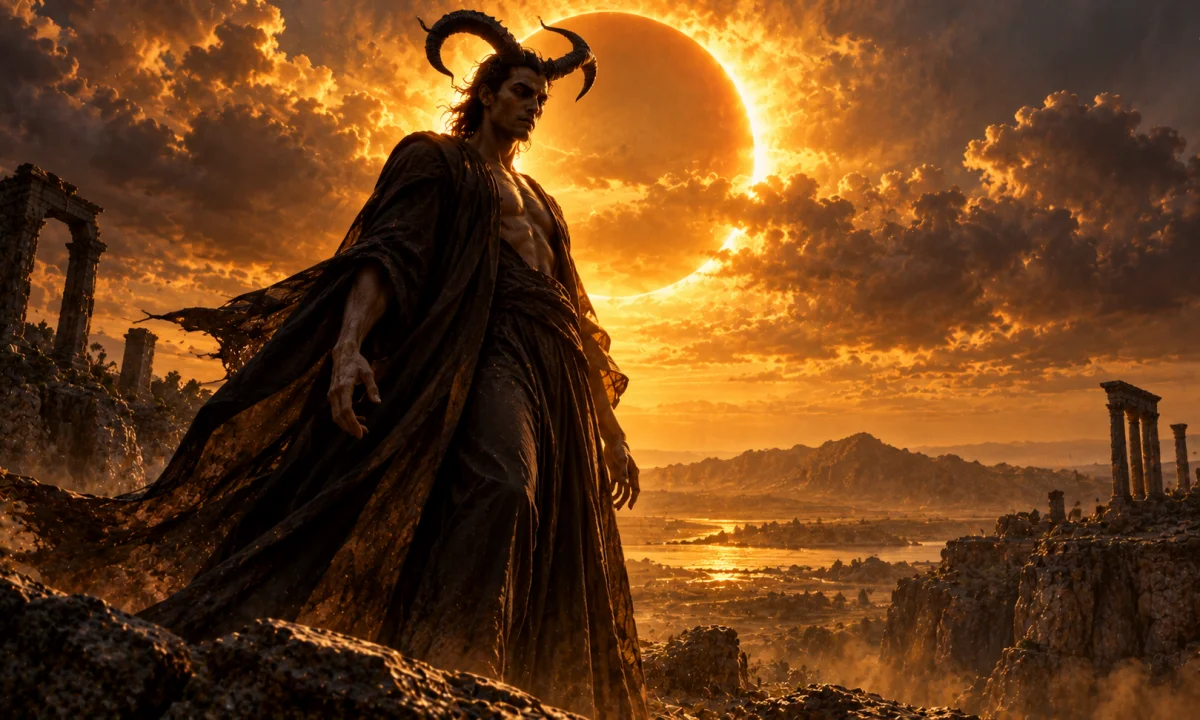
Sorath generally has no stable physical appearance. Unlike demons with well-known forms in medieval legends or grimoire descriptions, Sorath is more often presented as a cosmic principle than as a narrative monster. Images of a black sun, an eclipsed light, a crowned beast or a radiant but destructive figure are modern symbolic possibilities, not a consistent traditional description.
The symbolism commonly associated with Sorath includes:
- the Sun understood in its hostile, excessive or corrupted aspect;
- 666 and related forms of occult numerology;
- pride, domination and the inflation of the individual will;
- false illumination or knowledge separated from moral responsibility;
- apocalyptic rebellion against divine order;
- the destructive side of fire, radiance and concentrated power.
These attributes are interpretive rather than fixed. Solar demons in occult writing could represent different dangers depending on the author’s religious outlook. One writer might emphasise political tyranny, another spiritual pride, another materialism or the misuse of intellectual and magical power.
In some esoteric schemes, Sorath is not merely a personal tempter. The figure represents an anti-cosmic or anti-spiritual force working through historical events, collective movements or crises in human consciousness. This larger role becomes especially important in Anthroposophy, where Sorat is treated as an adversary connected with the evolution of humanity and the appearance of the Antichrist.
Sorath in Anthroposophy
The most developed modern religious interpretation of Sorath appears in Anthroposophy, the spiritual movement founded by Rudolf Steiner in the early twentieth century. Anthroposophy describes spiritual beings and stages of human development through a distinctive Christian-esoteric cosmology. Its use of Sorat or Sorath should not be confused with mainstream Christian demonology or with the original context of Revelation.
In Anthroposophical writings and later interpretations, Sorat is portrayed as an especially significant adversary of Christ. The figure is connected with the number 666 and with a future or recurring manifestation of anti-Christian power. Sorat is sometimes described as a solar demon because the Sun has a central place in Anthroposophical spiritual history and because the adversarial force is understood as a dark or distorted counterpart to the Christ impulse.
Anthroposophy often presents spiritual development as a conflict between forces that support human freedom and moral consciousness and forces that pull humanity toward hardening, fragmentation or destructive materialism. Within that framework, Sorat can symbolise an extreme form of opposition: the attempt to sever human beings from spiritual purpose while exploiting their intelligence, will and technological or social power.
Terms such as Antichrist, Beast and 666 may therefore occur near the name Sorat in Anthroposophical discussions. These terms retain biblical associations but are interpreted through Steiner’s particular cosmology. They should not be treated as evidence that the biblical authors knew a demon named Sorath.
Anthroposophical accounts also tend to give Sorat a historical and future dimension. The being may be discussed in relation to major stages of human evolution, the emergence of materialistic worldviews or anticipated spiritual crises. Such claims are matters of religious belief and esoteric interpretation, not conclusions established by conventional historical research.
Relationship to astrology and ceremonial magic
Sorath’s solar character reflects a widespread feature of Western occultism: planets were treated not only as physical bodies but also as signs of spiritual powers. The Sun could be associated with royal authority, vitality, courage, identity, illumination and the higher self. A demonic counterpart might embody these qualities in an imbalanced form, turning authority into domination and illumination into deceptive brilliance.
In ceremonial magic, a planetary spirit was not necessarily “evil” in the same way as a monster in popular demon folklore. Magical systems often contained complicated hierarchies of intelligences, spirits, angels and demons, with classifications differing from one author to another. A spirit might be described as hostile because it was dangerous, impure, rebellious or opposed to a particular religious order.
Sorath is consequently better understood as a symbolic occult classification than as a universally recognised demon with a standard biography. There is no broadly accepted traditional story explaining Sorath’s birth, family, fall from heaven, dwelling place or encounters with named saints. Accounts that supply such details are usually later inventions, adaptations or extrapolations.
Distinction from similar figures
The Beast of Revelation
Sorath is not simply another name found in the Book of Revelation for the Beast. The biblical Beast is an apocalyptic symbol or figure within a complex vision, and its number is 666. The name Sorath was attached to that symbolism later by occult interpreters.
Satan and the Devil
Sorath is also not automatically identical with Satan or the Devil. Some writers may place the figure within a broad hierarchy of demonic opposition, while others treat Sorath as a distinct solar adversary. The identification depends on the author’s system and should not be assumed as a universal doctrine.
Lucifer
Lucifer is another figure frequently associated with light, pride, solar imagery and rebellion in later Western culture. Nevertheless, Lucifer and Sorath have different histories. Lucifer’s development draws on the Latin word for “light-bearer”, the interpretation of Isaiah 14 in Christian tradition and later stories of the fallen angel. Sorath’s main associations arise from occult numerology, solar demonology and interpretations of 666. Similar symbolism does not make them the same being.
Surya and other solar deities
Sorath should not be confused with benevolent or ambivalent solar gods such as the Hindu deity Surya, the Egyptian Ra, the Greek Helios or the Roman Sol. These figures belong to distinct religious traditions with their own myths, rituals and theological meanings. A later occult writer may compare solar beings across cultures, but such comparisons do not establish that they are versions of Sorath.
Interpretation and cultural significance
Sorath is significant less as a character in a large body of traditional myths than as an example of how religious symbols are transformed across time. A number from an early Christian apocalypse, planetary correspondences from astrology and magical numerology, and modern concerns about spiritual or technological power were combined into a new demonic image.
The figure can be read psychologically as a warning about power without wisdom. Solar language makes the symbolism especially pointed: light may reveal truth, but excessive brightness can blind; authority can protect, but it can also become tyranny; individuality can support moral freedom, but it can also expand into narcissism and domination.
For believers in Anthroposophy and related esoteric movements, Sorath may be a real spiritual intelligence. For historians of religion, the name is better examined as a later construction within Western occult and Christian-esoteric thought. Both perspectives can be described without treating theological claims as independently verified historical facts.
Later reception
Sorath has appeared mainly in occult, esoteric and religious subcultures rather than in widely known folklore. Modern writers may use the name in discussions of the Antichrist, dark solar symbolism, ritual magic, numerology or cosmic dualism. Some fictional works also employ Sorath as the name of a demon, cosmic entity or apocalyptic villain.
These modern appearances often expand the figure with horns, wings, armour, a monstrous body or elaborate supernatural powers. Such depictions belong to popular culture or individual occult creativity, not to a stable ancient tradition. The historically grounded core is narrower: Sorath is a variable later name for a demonic or adversarial solar force, strongly associated in some systems with 666 and with opposition to spiritual or Christ-centred order.