WORLD
WORLD
Aroteh
Aroteh is an uncertain name associated in some modern mythology lists with South American tradition. Its identity, cultural origin and meaning are not securely established in the surviving historical and ethnographic record. There is no widely agreed description of Aroteh as a god, spirit, monster or culture hero, and the name should not be presented as a firmly documented figure without qualification.
The problem of identifying Aroteh
South America contains hundreds of Indigenous peoples and many distinct religious traditions. Names for spiritual beings were recorded in numerous languages, often by missionaries, travellers, colonial officials or later folklorists. Such records can vary greatly in spelling because unfamiliar sounds were adapted to European writing systems. A single being may consequently appear under several forms, while similar-looking names may refer to entirely unrelated figures.
Aroteh is especially difficult to identify because the name is not accompanied by a stable body of traditional material. Accounts that circulate in unspecialised mythology catalogues may label it a deity, spirit or supernatural being, but they do not consistently agree about its people, function, appearance or stories. Some entries repeat one another without providing an identifiable oral tradition, historical text or linguistic explanation. Repetition in online lists is therefore not proof that Aroteh was a widely recognised figure.
The safest classification is an obscure or uncertain mythological name, rather than a clearly defined South American deity. The absence of secure information does not prove that no community ever used the name. It means that the available evidence is not sufficient to reconstruct its original meaning responsibly.
Cultural setting
Indigenous South American religions do not form a single mythology. Traditions from the Andes, Amazonia, the Guianas, the southern cone, the Caribbean coast and the tropical lowlands developed in different linguistic and social environments. Religious beings may be connected with ancestors, animals, rivers, weather, illness, warfare, hunting, fertility, the land or relations between human and non-human persons.
Many traditions also do not divide supernatural beings into categories that correspond neatly to European terms such as “god,” “demon” or “mythological creature.” A being may be an ancestor in one context, a powerful spirit in another, and a dangerous presence in a particular story. Names can also be personal, descriptive, secret or restricted to ritual use. Translating such a name simply as a “god” can therefore distort the original belief system.
This context matters when considering Aroteh. Assigning the figure to a specific South American people without a reliable cultural record would create a false impression of certainty. Nor is it safe to infer a role from the sound of the name. Aroteh does not by itself demonstrate an origin in any particular language family or region.
Name, spelling and proposed identity
The spelling Aroteh may represent a transcription, an altered spelling or a modern editorial form. Without an attested source in the original language, its pronunciation and meaning cannot be established. The final “h,” for example, might reflect an attempt to represent a sound that does not exist in ordinary English spelling, or it might simply have been added during transmission. That possibility remains speculative.
No consistent traditional genealogy, sacred narrative or set of ritual practices can be securely attached to the name. It is therefore not possible to state with confidence that Aroteh was male or female, human or animal-like, benevolent or hostile, or associated with a particular natural force. Descriptions sometimes found in general-interest lists should be treated as unverified unless they can be traced to a specific Indigenous tradition and an identifiable record.
Aroteh should also not be treated as a generic name for South American supernatural beings. The region’s traditions include many well-documented figures, but their existence does not supply evidence for an unrelated name. Similarity in spelling is not enough to establish identity or relationship.
Attributes and powers
There is no dependable traditional description of Aroteh’s appearance. Claims that the figure had horns, wings, animal features, unusual size or a monstrous body cannot be confirmed as part of an established Aroteh tradition. The same caution applies to supposed powers such as controlling storms, causing disease, guarding the dead, creating the world or protecting warriors.
In well-attested South American traditions, supernatural attributes usually have a cultural setting. An animal form may express a relationship between a community and a particular species; control over rain may be tied to agricultural ritual; and a dangerous forest being may embody rules governing hunting, sexual conduct or respect for other-than-human persons. Removing a figure from that setting and listing isolated powers can make a complex religious concept look like a character from a fantasy catalogue.
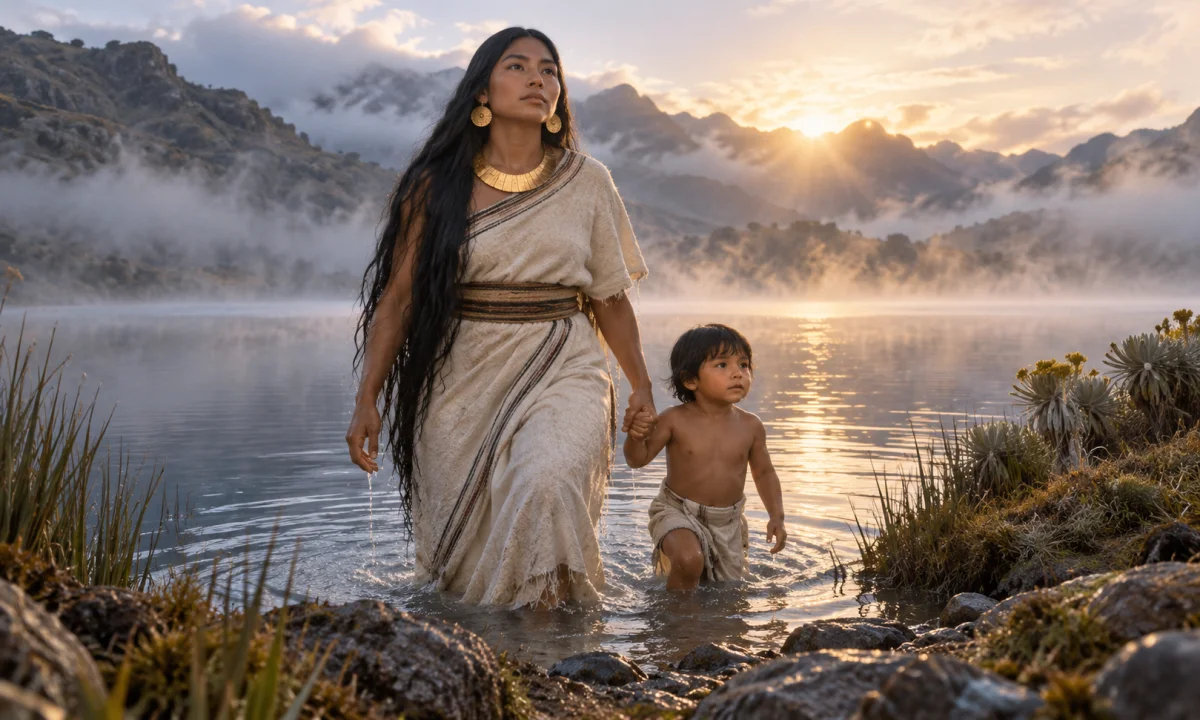
Because no stable set of attributes is associated with Aroteh, illustrations or character profiles that give the figure a definite appearance should be understood as modern invention or artistic interpretation unless they are accompanied by verifiable traditional evidence.
Stories and relationships
No widely recognised cycle of myths about Aroteh has been securely preserved in translation. There is no established account of the figure’s birth, family, enemies, marriage, death or role in the creation of the world. Likewise, no particular sacred place, festival or ritual can responsibly be identified as belonging to Aroteh.
This lack of narrative should not be filled by borrowing episodes from better-known traditions. South American mythologies contain powerful creator figures, culture heroes, ancestral beings, tricksters and adversaries, but stories belonging to one people cannot be transferred to Aroteh merely because the themes appear similar. A creator, serpent, sky being or underworld guardian in one tradition is not evidence for an equivalent figure bearing this name.
Oral traditions can change through performance and may exist in more than one version. Even when variation is expected, however, a figure usually has some recognisable connection to a community, language, story corpus or ritual context. That supporting framework is currently unclear for Aroteh.
Possible confusion with other names
Confusion is likely because Indigenous names from South America are often represented inconsistently in English-language publications. Aroteh may have been copied from an earlier list, misread during transcription or confused with another name. It should not automatically be equated with any figure whose name merely resembles it.
In particular, Aroteh should not be casually merged with Arutam, a term associated with powerful spiritual experience and ancestral force in some Jivaroan or Shuar-related contexts. The resemblance between the two spellings does not establish that they refer to the same concept. Arutam belongs to a documented cultural and religious setting of its own, and it should be discussed under that tradition rather than used to explain Aroteh.
Nor should Aroteh be identified with figures from Mapuche, Guaraní, Andean, Amazonian or Caribbean traditions without direct evidence. Names from these regions can look alike after being written in Spanish, Portuguese or English, even when their original pronunciations and meanings are unrelated.
Historical and scholarly interpretation
The limited information surrounding Aroteh illustrates a broader problem in the study of mythology. Older compilations often arranged traditions from many peoples into lists of “gods” and “monsters,” sometimes without distinguishing an Indigenous account from a traveller’s interpretation. Later websites may reproduce those lists, giving an uncertain name the appearance of antiquity and authority.
Scholarly interpretation requires more than a repeated label. Researchers normally consider the language in which a name was recorded, the identity of the community concerned, the date and circumstances of the record, related words, variant spellings and the role the being plays in ritual or narrative. They also ask whether a description comes from community tradition or from an outsider’s attempt to classify it.
For Aroteh, those questions remain unresolved. There is no secure basis for assigning a precise date, geographical homeland or religious function. A responsible account must therefore distinguish between the existence of the name in modern circulation and evidence for an ancient or traditional figure. These are not the same thing.
Modern reception
Aroteh occasionally appears in internet-based lists of obscure mythological beings and in informal reference material. Such appearances may encourage artists, writers or game designers to develop a character around the name. If that happens, the resulting version belongs to modern creative culture, not automatically to Indigenous South American religion.
A fictional interpretation can give Aroteh a body, powers, enemies or a dramatic origin story, but those additions should be labelled as invention. Presenting them as recovered traditional material risks attributing fabricated beliefs to an Indigenous community. It can also obscure the diversity of South American religions by turning an uncertain name into a generic fantasy monster or deity.
Until a reliable cultural and linguistic context is established, Aroteh is best treated as an unverified or poorly documented mythological name. Further identification would require an attested source, information about the language and community involved, and a clear distinction between traditional testimony, colonial recording, later interpretation and modern invention.