WORLD
WORLD
Angita
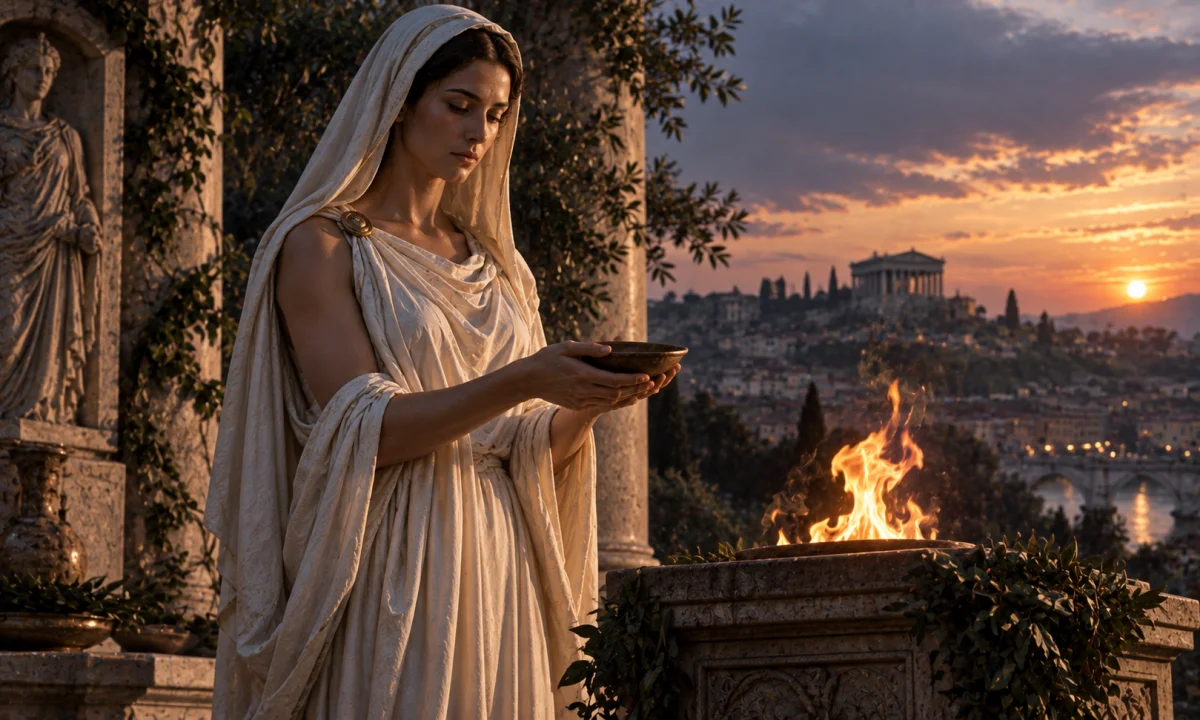
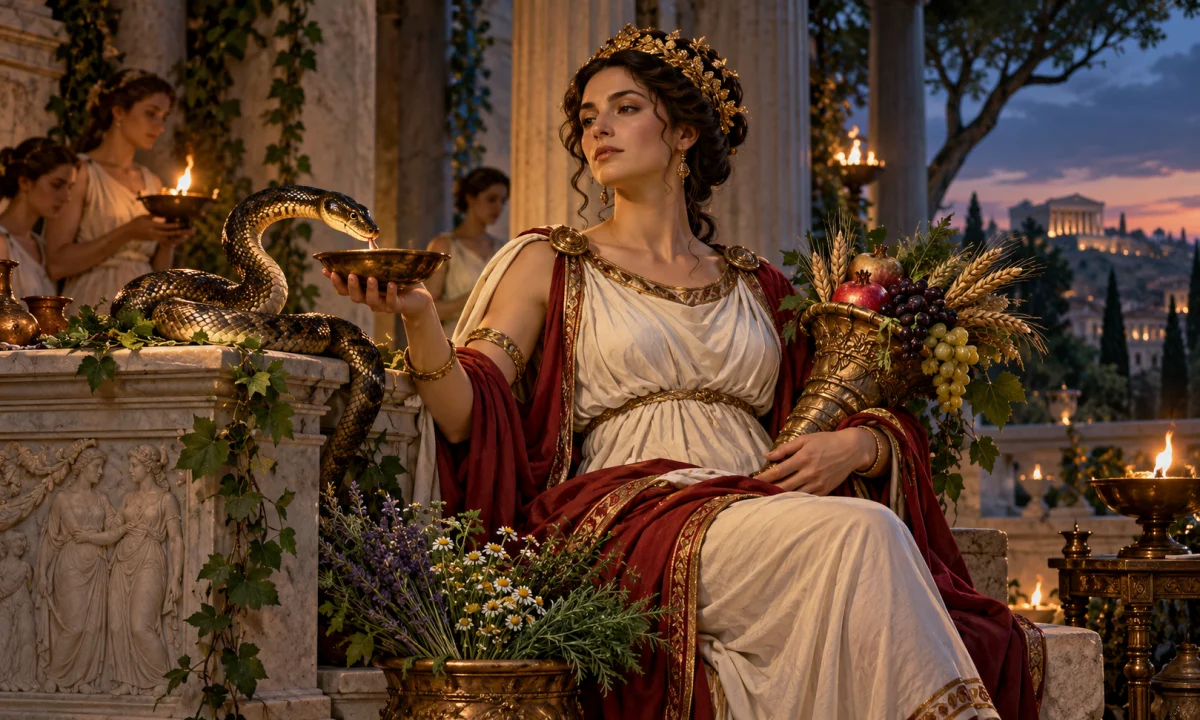
Angita, also written Angitia, is a goddess or sacred female figure associated with the Marsi, an ancient people of central Italy. Her tradition belongs to the religious landscape of the Apennines, where local Italic cults existed alongside, and were later interpreted through, Roman mythology. Angita was especially connected with snakes, healing, herbs and the control of poisons. Ancient writers also linked her with the Marsi’s reputation as healers and snake-charmers.
Although she is often called a Roman goddess, Angita was probably rooted in a local Italic tradition rather than originating in the city of Rome. Much of what is known about her comes from Roman authors who described the beliefs of peoples incorporated into the Roman world. Her identity is therefore partly historical and partly shaped by later literary interpretation. The surviving evidence does not provide a complete mythological biography, and several details commonly repeated about her remain uncertain.
Origins in central Italy
Angita’s principal cult centre was in the territory of the Marsi, around Lake Fucinus in the central Apennines. The lake, called Fucinus or Fucine Lake in antiquity, lay in what is now the Abruzzo region. It was surrounded by mountains, forests and settlements whose religious traditions were distinct from those of Latium and the Greek colonies of southern Italy.
Her sanctuary was associated with a grove near the lake. Ancient references place the sacred site at or near a settlement known as Lucus Angitiae, a name that can be understood as “the sacred grove of Angitia.” The exact development of the place over time is not entirely clear, but the name indicates that Angitia was not merely a literary invention. She was connected with a real cult landscape in which worship, healing practices and local identity were closely related.
Inscriptions and place-names provide important evidence for her worship, while literary sources preserve stories about her powers. The inscriptions are limited and do not outline a full theology. They show that a female divine name resembling Angitia or Angita was used in a religious context, but they do not settle every question about her origin, character or relationship to other goddesses.
The name Angita and the form Angitia
The name appears in more than one form. Angitia is the most familiar Latin form, while Angita is also used, particularly in modern discussions of the figure. Ancient spelling could vary, and the evidence does not justify treating every form as a separate goddess. In most contexts, Angita and Angitia refer to the same Marsian religious figure.
The meaning of the name is uncertain. It has sometimes been connected with words relating to snakes, constriction or magical knowledge, but these explanations are not securely established. A resemblance between a divine name and a later Latin word is not, by itself, proof of an ancient etymology. The safest description is that the name is Italic or local in origin, later written into Latin literary and epigraphic traditions.
Angitia should not automatically be treated as a purely Roman version of a Greek goddess. Roman authors frequently explained unfamiliar Italian deities by comparing them with figures from Greek myth. Such comparisons may preserve genuine associations, but they can also reshape a local goddess according to literary expectations familiar to educated Roman readers.
Snakes, healing and magical knowledge
Angitia’s most consistent associations are with snakes, herbal remedies and the protection or treatment of illness. The Marsi were famous in ancient literature for their ability to handle snakes and cure venomous bites. Their reputation may have arisen from practical knowledge of local plants, ritual healing, professional snake-handling or a combination of these elements.
In a religious setting, snakes could represent both danger and healing. Their venom made them threatening, while their ability to shed their skin made them symbols of renewal and vitality. A goddess who controlled serpents could therefore be understood as one who mastered poisonous forces rather than as a spirit of evil. Angitia’s sphere was not necessarily limited to snakes themselves; it included the wider knowledge needed to confront disease, poison and the dangers of the natural world.
Ancient descriptions associate her with incantations and the use of herbs. These references should not be read as evidence for a single standardized system of “witchcraft.” In ancient Mediterranean cultures, the boundaries between medicine, ritual, prayer and magic were not always sharply drawn. A healer might use plants, spoken formulas, inherited expertise and divine assistance at the same time.
Her powers are therefore best understood as protective and curative. Angitia could be invoked in connection with venom, illness and the control of harmful creatures. The surviving evidence does not establish a detailed list of spells, rituals or medical practices belonging specifically to her cult.
Angitia in ancient literary tradition
The most influential literary account connects Angitia with the family of the legendary king Aeetes. In this version, she is presented as a sister of Circe and Medea, the famous enchantresses of Greek mythology. She is said to have come to Italy and settled among the Marsi, where she taught them the use of herbs and the means of dealing with snakes.
This genealogy appears in Roman poetic and explanatory traditions, but it should not be mistaken for an uncontested feature of an older Marsian religion. The relationship to Circe and Medea may represent an attempt to place a local Italian goddess within a well-known Greek mythological family. Greek myth already supplied a convenient language for discussing women associated with herbs, poisons, transformation and supernatural knowledge.
The association is nevertheless significant. It shows how Roman writers interpreted local religious traditions through a network of Mediterranean stories. By making Angitia a sister of Circe and Medea, they emphasized her expertise in plants, enchantment and the management of dangerous forces. At the same time, the tradition preserved her distinctive connection with the Marsi rather than simply replacing her with one of the better-known Greek figures.
Some accounts say that Angitia taught the Marsi to cure snakebite or to neutralize venom. Other references focus on her power over snakes. The ancient material is brief, and there is no surviving epic narrative describing a complete series of adventures involving her. Claims that she possessed a particular magical object, ruled a specific kingdom or carried out elaborate transformations generally go beyond what the ancient evidence securely supports.
Relationship to Circe and Medea
Angitia’s connection with Circe and Medea must be handled carefully. They belong to different layers of tradition. Circe and Medea are major figures in Greek myth, each with extensive literary development. Angitia is a comparatively localized Italian divine figure whose surviving evidence is much more limited.
The three figures share themes of plant lore, poison, transformation and supernatural knowledge. This similarity encouraged ancient authors to connect them genealogically. Yet shared attributes do not prove that Angitia was originally a local form of Circe or Medea. Nor is there strong evidence that her cult involved the same stories, rituals or moral characterization found in Greek literature.
Circe is especially associated with the island of Aeaea, transformations and the encounters of Odysseus. Medea is associated with Colchis, Jason and a tragic sequence of magical and violent actions. Angitia, by contrast, is linked primarily with the Marsi, Lake Fucinus and practical or sacred control of snakes and disease. The three should be compared, but not merged.
The Marsi and the religious setting
The Marsi occupied a mountainous region east of Rome and maintained their own political and religious identity before and during their incorporation into Roman power. Their territory was not culturally isolated. Italic peoples interacted with Rome, Greek traditions and neighbouring communities, producing a complex religious environment in which local gods could acquire Latin names and new interpretations.
Angitia’s importance appears to have been closely tied to this regional identity. The goddess embodied knowledge that was especially valuable in a landscape where people encountered wild animals, venomous creatures and difficult medical conditions. Her cult may also have helped express the distinctiveness of the Marsi, whose reputation for healing and snake-handling was widely repeated by Roman writers.
Roman authors sometimes treated such abilities with a mixture of respect, curiosity and suspicion. A community known for curing bites could be praised as exceptionally skilled, while the same skills could be described as magic. This tension affected the way Angitia’s religious role was represented. She could appear as a benevolent healer, a mistress of secret knowledge or a local figure assimilated to the literary image of the enchantress.
Angitia’s sanctuary and sacred landscape
The grove associated with Angitia was an important part of her identity. In ancient Italian religion, a sacred grove was not simply a building surrounded by trees. It was a consecrated landscape in which divine presence was marked through boundaries, offerings, paths, springs or other natural features. Such places could serve as locations for prayer, healing and community observance.
The name Lucus Angitiae preserves the connection between the goddess and this wooded sanctuary. The exact form and architecture of the cult site are not fully known, and it is unsafe to reconstruct a large temple complex without firm evidence. The significance of the grove lies precisely in its relationship to the local environment: Angitia’s religious presence was connected to the living landscape around the lake and mountains.
Later Roman development altered the region, and the ancient lake itself was eventually drained in the nineteenth century. Modern archaeological work has identified remains and inscriptions connected with the area, but the surviving evidence is fragmentary. It can establish the existence of a cult and its geographical setting more securely than it can reveal the precise rituals performed there.
Angita as a healer and protective goddess
Angita can be interpreted as a goddess of specialized protection. Her sphere was not general good fortune but the dangerous boundary between harm and recovery. Snake venom, poisonous plants and serious illness all represented forces that could not be managed through ordinary strength alone. The person who knew which plant to use, how to handle a snake or which words to speak occupied a socially important position.
Her symbolism therefore combines the natural and supernatural. Plants belong to the observable world, while incantations invoke powers beyond ordinary human control. Snakes are physical animals, yet in religious thought they may also represent hidden knowledge, death, renewal and the earth. Angitia stands at the meeting point of these meanings.
It is also possible that her cult involved more than emergency cures. Healing deities could receive offerings from people seeking protection, recovery or continued health. However, the available evidence does not identify particular offerings, festivals or priestly offices with certainty. Descriptions of her worship should remain general unless supported by direct evidence.
Distinguishing Angita from similar figures
Angita is sometimes confused with other female figures whose names or attributes involve danger, magic or protection. She should not be identified with Angerona, a Roman goddess whose name and functions are associated with secrecy, silence or the relief of distress in certain Roman traditions. The resemblance between Angita and Angerona is mainly superficial.
She is also not simply another name for Circe or Medea. The familial relationship found in some Roman accounts is a literary genealogy, not proof that all three were worshipped as the same deity. Circe and Medea belong primarily to Greek mythic traditions, whereas Angitia’s cult is anchored in the central Italian world of the Marsi.
Nor should Angita be confused with generic ideas of a Roman “snake goddess.” Rome and Italy had many divine figures associated with health, fertility, animals or the earth, but the evidence for Angitia is specifically regional. Her identity depends on the combination of Marsian geography, snake lore, healing and the sanctuary near Lake Fucinus.
Later interpretation and modern representation
Angita has received far less attention in modern popular culture than Circe, Medea or other classical enchantresses. When she appears in modern writing, historical fiction, fantasy or online mythology collections, she is often expanded into a fully developed witch-goddess with detailed powers and a dramatic family history. Such portrayals may be imaginative adaptations rather than recoveries of ancient tradition.
Modern summaries sometimes describe her as the “goddess of snakes,” a “witch goddess” or the Roman equivalent of Medea. These labels capture parts of her surviving image but can oversimplify it. “Witch goddess” reflects the language of later interpretation more than a precise ancient category, while “Roman equivalent” obscures her local Italic background. The most historically cautious description is a Marsian-associated goddess or sacred female figure connected with snakes, healing and herbal knowledge, later interpreted through Greek and Roman myth.
Angita’s limited evidence is not a weakness in the tradition. It illustrates how much ancient religion was local, practical and embedded in particular landscapes. Many divine figures known to Roman writers did not possess extensive myths or standardized personalities. Their importance could lie in a sanctuary, a community’s inherited expertise and the protection sought by worshippers facing specific dangers.
For Angita, the strongest traditional image is therefore not that of a universal goddess with a long sequence of adventures. It is the image of a local power rooted in the Marsian country: a guardian of healing knowledge, a mistress of venomous creatures and a figure whose grove stood near the waters and mountains of Lake Fucinus.