WORLD
WORLD
Amy

Amy, also written Ami or Avnas in some versions, is a spirit described in the Ars Goetia, the first section of the early modern grimoire commonly known as the Lesser Key of Solomon. In that text, Amy is ranked as a President and is listed as the fifty-eighth spirit. The work presents him as a powerful supernatural being who can reveal knowledge, disclose hidden treasures and teach certain intellectual arts.
Amy does not belong to a clearly documented demon cult from the ancient Near East, Greece, Rome or the medieval Christian world. His identity comes primarily from the learned tradition of European ceremonial magic, especially the catalogues of spirits that circulated in manuscripts and printed grimoires from the seventeenth century onward. The Ars Goetia gives him a formal place within a hierarchy of spirits, but the history of the name and the figure before its appearance in those texts is uncertain.
Origins in the Solomonic grimoire tradition
The Lesser Key of Solomon is not a single ancient book written by the biblical King Solomon. It is a compilation assembled from older magical writings, lists of spirits and ritual traditions. Its surviving forms date from the early modern period, although some of the material used by its compilers is older. The attribution to Solomon reflects a longstanding European belief that Solomon possessed exceptional wisdom and authority over spirits, rather than providing evidence that the king authored the work.
Within the Ars Goetia, spirits are arranged according to titles drawn from European ideas of monarchy and administration. These ranks include kings, dukes, marquises, earls, knights, presidents and princes. Such titles should not be treated as evidence of a universally recognized demonic government. They are part of the grimoire's symbolic and ritual system, in which a magician commands or summons spirits under divine names and prescribed authority.
Amy is therefore best understood as a grimoire spirit. Calling him a demon reflects the classification used by later occult and popular traditions, but it should not imply that Amy was a prominent figure in ancient or mainstream religious belief. There is no broad, independent body of traditional mythology about him comparable to the legends of figures such as Lucifer, Lilith or the demons named in ancient Mesopotamian sources.
Name and identity
The name appears in more than one form. Amy is common in English-language editions of the Ars Goetia, while Ami and Avnas occur in variant readings, editions and discussions of the text. Differences in spelling are partly the result of manuscript transmission, transliteration and editorial choices. The exact original form and meaning of the name are not securely established.
Some occult writers have attempted to connect Amy's name with older Hebrew, Latin or other linguistic roots, but such proposals are speculative unless supported by strong textual evidence. The name should not be confidently equated with a word from a particular ancient language merely because the spelling resembles it. Nor should Amy be automatically identified with another spirit whose name sounds similar.
The Ars Goetia describes Amy as a male spirit, using masculine pronouns and presenting him as a president. These grammatical and administrative features belong to the text's own framework. They do not establish an ancient personal history, family, place of origin or independent mythology for the being.
Rank as a President
In the hierarchy of the Ars Goetia, a President is one of the official titles assigned to a spirit. The title may suggest authority, governance or command, but the grimoire does not provide a consistent political structure that explains how every rank relates to every other one. Different spirits with the same title can have entirely different appearances, abilities and functions.
Amy's position as the fifty-eighth entry is significant within the catalogue, but the number itself should not be treated as a sacred or ancient classification. The sequence reflects the arrangement of the grimoire tradition and can vary in small details between manuscripts and editions. The description associated with Amy is more important for his identity than the number alone.
Appearance
The standard description says that Amy first appears in the form of a flaming fire. After a period of manifestation, he is said to take on a human form. This two-stage appearance distinguishes Amy from spirits whose primary forms are animals, hybrid creatures or human figures carrying specific objects.
The fire imagery can be read in several ways. Within ceremonial magic, fire may signal spiritual power, dangerous presence, transformation or a manifestation that is difficult to perceive in ordinary human terms. It may also reflect the broader symbolism of fire as illumination and knowledge. The text itself does not offer a detailed theological explanation of why Amy appears as flame, so interpretations should remain tentative.
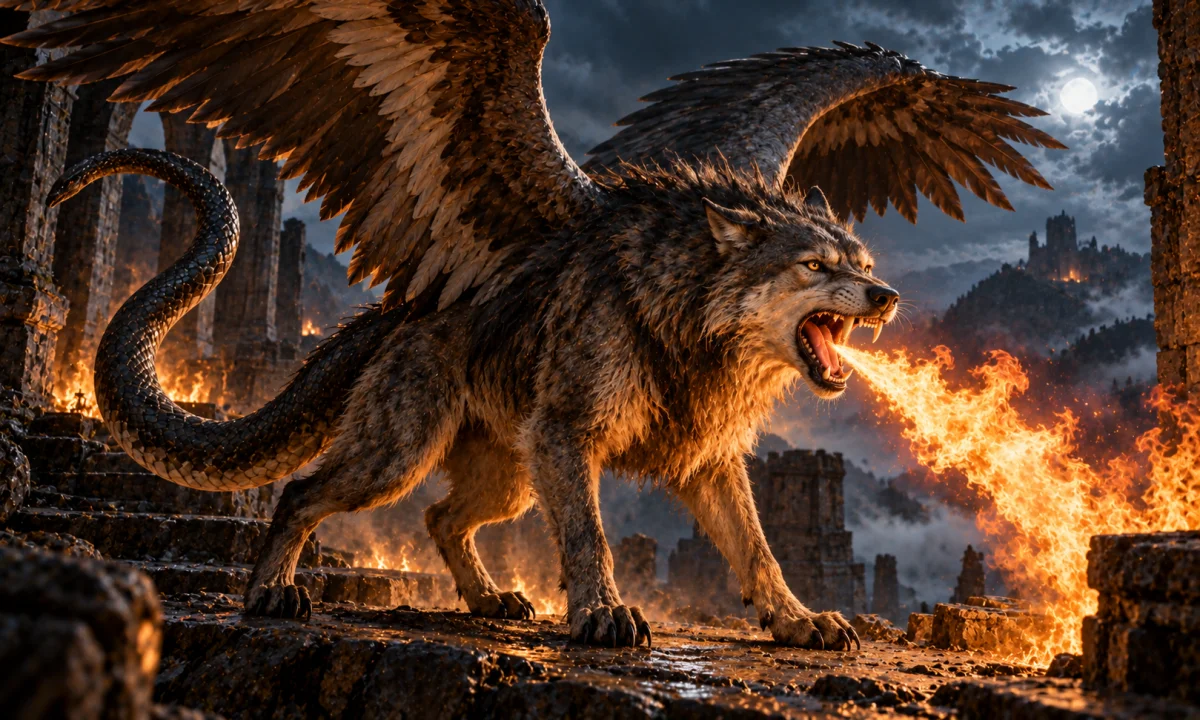
Some modern illustrations give Amy elaborate demonic features, horns, wings or armour. These details are artistic additions rather than elements consistently supplied by the original description. The traditional account is comparatively brief: it emphasizes a fiery initial manifestation and a later human shape, not a fixed monstrous anatomy.
Powers and functions
Amy is chiefly associated with knowledge and revelation. The Ars Goetia states that he can make a person knowledgeable in astrology and the liberal sciences. In the educational culture of early modern Europe, the liberal arts referred to established fields of learning rather than to “liberal” politics in the modern sense. They traditionally included grammar, rhetoric, logic, arithmetic, geometry, music and astronomy; in magical contexts, astrology and related forms of celestial knowledge were often treated as important intellectual disciplines.
The description also assigns Amy the ability to reveal treasures guarded by spirits. This reflects a common theme in European magical literature: hidden wealth is imagined as being protected by supernatural beings and accessible through specialized ritual knowledge. The claim belongs to the grimoire's occult worldview. It is not evidence for a historical tradition of treasure guardianship associated with Amy outside that literary setting.
Another function attributed to Amy is the provision of good familiars. A familiar, in the language of witchcraft and ceremonial magic, is a supernatural attendant or helper believed to serve a practitioner. The term has several meanings across different sources. In witch-trial records, folklore and grimoires, familiars may be described as animal companions, spirits or assistants. The Ars Goetia does not develop a detailed narrative about Amy's familiars; it simply lists this capacity among his powers.
Some versions or translations also associate Amy with knowledge of past and future events. The wording varies, and the exact scope of this ability is not always presented identically. It is safest to describe this as a recurring feature of the Amy entry in the grimoire tradition rather than as a universally fixed attribute. Divination and the disclosure of hidden information are common powers in spirit catalogues, so the motif is not unique to Amy.
The claim about a return to heaven
One of the more unusual details connected with Amy is a statement that he hopes to return to the seventh throne. The wording is obscure and varies among editions and translations. It has sometimes been interpreted as suggesting that Amy was once an angelic being or that he seeks restoration to a former heavenly rank.
That interpretation should be treated cautiously. The text does not provide a clear account of Amy's fall, former identity, relationship with God or place in a Christian angelology. The phrase may reflect scribal corruption, translation difficulty or the influence of older ideas about fallen spirits. It does not by itself prove that Amy was originally a named angel in a separate religious tradition.
Christian demonological writing frequently describes demons as fallen angels, but the Ars Goetia does not apply that idea with complete consistency to every spirit in its catalogue. Some entries resemble angels, classical gods, folkloric beings or literary inventions more than they resemble figures from biblical tradition. Amy's alleged connection with a heavenly throne is therefore an interpretive clue, not a complete biography.
Place within demonology
Amy belongs to a form of demonology shaped by Christian vocabulary, Renaissance occult philosophy and the practical structure of ritual magic. The spirits of the Ars Goetia are presented as entities that can be summoned, questioned and compelled through ceremonies involving divine names, seals, timing and formal commands. This makes the text different from theological demonology, which generally discusses demons in relation to sin, temptation, possession and the problem of evil.
It is also different from folklore. Folkloric beings are often preserved through oral narratives, local customs and regional beliefs, whereas Amy is known mainly through a written catalogue. There is little evidence of a broad popular tradition in which ordinary communities told stories about Amy independently of occult books.
The figure should therefore not be treated as proof of a single, unified “demon religion.” The Ars Goetia is a constructed magical system that draws on several intellectual and religious currents. Its hierarchy gives spirits names, ranks and capabilities, but those features arise within the literature rather than from a universally accepted supernatural taxonomy.
Possible confusion with similar names
Amy should not automatically be identified with Aamon, a separate spirit in the same grimoire tradition. Aamon is commonly listed as a marquis and has a different description and set of powers. Similar spellings in modern books, websites and games can make the two names appear interchangeable, but they are distinct entries in the standard catalogue.
Nor should Amy be confused with Amycus, a name associated with figures in Greek mythology, or with unrelated personal names such as Amy or Ami in European and Asian languages. Similar sound does not establish a shared origin. The demonological Amy is defined by his place in the early modern grimoire tradition, not by every occurrence of the same or a similar name elsewhere.
Interpretations of Amy's symbolism
Amy's combination of fire, learning and hidden treasure has encouraged symbolic interpretations. Fire can represent illumination, the transformation of raw material into knowledge, or the danger involved in seeking forbidden power. Astrology and the liberal sciences suggest the desire to master an ordered universe through calculation, observation and esoteric learning. Hidden treasures guarded by spirits evoke the belief that valuable knowledge and wealth lie behind invisible barriers.
These interpretations help explain why Amy has remained interesting to occultists and writers, but they are not doctrines explicitly developed by the Ars Goetia. The text lists practical abilities in a concise formula rather than explaining Amy's psychological meaning or symbolic role. Any broader interpretation belongs to later readers, artists and occult practitioners.
The name also illustrates the way early modern demonological catalogues turned uncertain supernatural material into organized entries. A short description, a rank and a seal could give a spirit the appearance of a stable identity even when its history was obscure. Amy's apparent precision—his number, title and powers—should not conceal the fragmentary nature of the evidence.
Later occult and popular reception
Amy has continued to appear in modern editions of the Ars Goetia, occult reference works and discussions of Western ceremonial magic. Contemporary practitioners may interpret him as a symbolic intelligence, an independent spirit, a psychological figure or a literary construction. These interpretations differ significantly, and none should be presented as the single traditional meaning of Amy.
Modern fantasy fiction, role-playing games, comics, music and digital media sometimes adapt the names of Goetic spirits. When Amy appears in such settings, his fire, scholarly abilities or treasure-related powers may be expanded into a dramatic character with a new personality and history. Those portrayals are modern inventions or adaptations unless they directly reproduce the brief grimoire description.
The historically identifiable Amy remains a relatively narrow figure: a president in the Ars Goetia, associated with a fiery manifestation, human appearance, astrology, the liberal sciences, hidden treasures and familiars. Beyond that short entry, his origins and development are uncertain. Treating the uncertainties as part of his history is more accurate than supplying him with a detailed mythology that the surviving tradition does not preserve.