WORLD
WORLD
Alemonia
Alemonia is a name associated with a minor Roman divine power believed to protect or nourish a developing child in the womb. The figure belongs to the broad category of specialised Roman religious names sometimes connected with the indigitamenta, a term used for lists or formulas naming gods invoked for particular actions and stages of life. Alemonia is not a major goddess with an established mythology, temple cult, or surviving body of stories. Much of what is said about her comes from later summaries of obscure Roman religious traditions, and the evidence is limited.
Identity and name
Alemonia is also found in the forms Alemona and, less commonly, forms related to Alimona. The spelling is not entirely stable, and the different forms should not automatically be treated as separate goddesses. In modern reference works, “Alemonia” is often presented as a Roman goddess of prenatal nourishment, while “Alemona” is closer to the form more often used in discussions of obscure Roman deities.
The name is generally connected with the Latin verb alere, meaning “to nourish,” “to feed,” or “to sustain.” This proposed derivation fits the traditional description of Alemonia as a power who nourished the fetus before birth. It remains an interpretation of the name rather than proof of a fully documented cult. Ancient Roman divine names could be explained through wordplay, ritual function, or later scholarly reconstruction, and the surviving evidence does not provide a complete account of how worshippers understood Alemonia.
The descriptions attached to Alemonia therefore need to be treated cautiously. She is best understood as a specialised divine function in Roman religious thought, not as a goddess about whom a substantial independent tradition survives.
Roman religious setting
Roman religion often represented divine power through highly specific names. A god or goddess might be associated with a city, a household, a natural force, a military action, a farming task, or a particular stage in human life. Some divine names belonged to major public cults, while others appeared mainly in priestly language, ritual formulas, antiquarian discussions, or lists of protective powers.
Birth and early childhood were surrounded by many religious concerns. Pregnancy, delivery, the infant’s first cries, feeding, sleeping, illness, naming, and protection from danger could all be understood as stages requiring divine assistance. Roman families did not necessarily imagine these powers as a family of gods with personalities and adventures. A divine name could instead identify the sacred agency operating in a particular process.
This background explains why a figure such as Alemonia could exist without the mythology normally associated with a major deity. Her importance, if the name was used in ritual or religious explanation, would have rested in the function attributed to her: sustaining life before birth. She would not have needed a dramatic genealogy, a famous weapon, or a distinctive cycle of legends.
Connection with the indigitamenta
The term indigitamenta is commonly used by modern scholars and historians of Roman religion for lists of divine names connected with specific ritual actions or needs. Ancient discussions associate such lists with Roman priestly knowledge, especially the pontiffs, although the surviving evidence is fragmentary and later writers do not always present the material in the same way.
Many names linked with childbirth and infancy have been grouped with these specialised divine powers. They include figures associated with pregnancy, labour, the protection of the newborn, nourishment, movement, fear, sleep, and the infant’s transition into family and community life. Alemonia is often placed within this context because her attributed role concerns nourishment in the womb.
It is important not to assume that every name in a later list had an independent temple cult or a separate popular following. A divine name may have been used in a ritual formula, preserved by an antiquarian writer, inferred from a religious explanation, or transmitted through a later compilation. The surviving information about Alemonia does not establish the exact form of her worship, the people who invoked her, or the ceremonies in which her name was used.
Role before birth
Alemonia’s traditional role is usually described as the nourishment or sustaining of the unborn child. In this interpretation, she represents the divine assistance that allowed a fetus to grow within the mother’s womb. Her sphere begins before the infant’s birth and is therefore distinct from powers concerned specifically with labour, the first breath, or the care of a child after delivery.
This function reflects a Roman tendency to regard biological processes as religiously significant. Pregnancy was not treated merely as a private medical condition. It involved the continuity of the household, the production of descendants, the legitimacy of inheritance, and the survival of the family line. A power associated with prenatal nourishment could therefore have significance at both the bodily and social levels.
Alemonia should not be described as a universal “goddess of motherhood” without qualification. The surviving tradition gives her a narrower attributed function. Nor is there reliable evidence that she personally controlled conception, determined the sex of a child, protected every aspect of pregnancy, or ruled over childbirth as a whole. Those broader claims go beyond what can be securely inferred from the name and its usual description.
Attributes and appearance
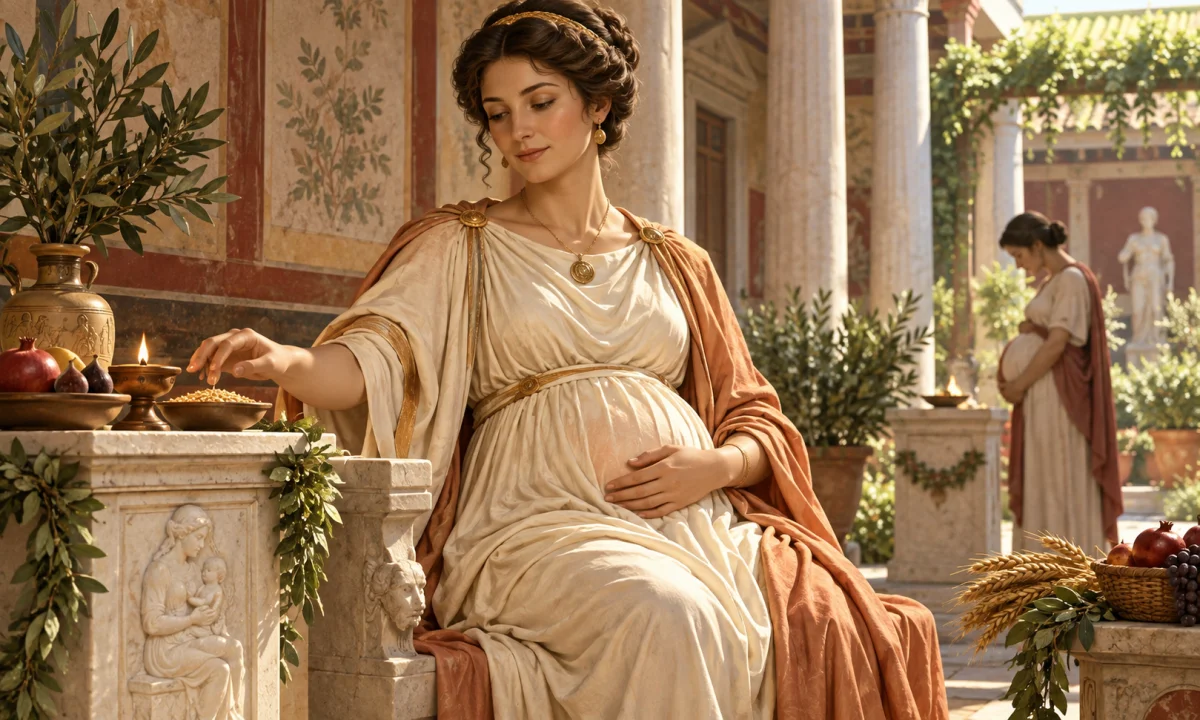
No securely documented ancient image of Alemonia is known. There is no established description of her clothing, physical form, sacred animal, plant, weapon, or emblem. Artistic representations sometimes assigned to her in modern illustrations should not be mistaken for evidence of Roman iconography.
Likewise, there is no reliable basis for giving Alemonia a fixed personality. She is not preserved through myths in which she acts as a mother, nurse, midwife, or divine ancestor. Her traditional identity is functional rather than narrative. If the name was used as part of a ritual vocabulary, her “attribute” would have been the power of nourishment and growth before birth, not an object carried in a statue or a visual symbol used across Roman art.
Some modern descriptions portray her as a kindly female spirit watching over pregnant women. This is a reasonable imaginative interpretation of her supposed function, but it should be distinguished from ancient evidence. The Roman material does not provide a detailed character portrait or demonstrate that worshippers pictured her in this particular way.
Related powers of pregnancy and infancy
Alemonia is often discussed alongside other minor Roman divine names connected with reproduction and childhood. Some lists mention powers associated with the months of pregnancy, the protection of the mother, the opening of the womb, the birth itself, or the child’s first stages of life. Other names are linked with feeding, carrying, sleeping, fear, speech, movement, or the infant’s place in the household.
These groupings are useful for understanding the religious environment, but the relationships among the figures are not always securely ancient. A list that places several names together does not necessarily prove that Roman worshippers conceived them as a coordinated group. Nor does a shared subject mean that the figures were interchangeable.
Alemonia should therefore be kept distinct from better-known childbirth deities. Juno Lucina had a much more substantial and recognisable association with childbirth and the delivery of infants. Lucina could function as an epithet or title connected with bringing a child into the light, and her cult is better documented than that of Alemonia. Alemonia, by contrast, is usually assigned to the earlier and more specific process of nourishment in the womb.
She is also distinct from Cunina, a protective power associated in later accounts with the infant’s cradle, and from Rumina, who is traditionally connected with suckling and the feeding of infants after birth. These comparisons show how Roman religious language could divide a single human experience into several stages. They do not prove that all such figures were worshipped in the same manner or during the same period.
Surviving evidence and uncertainty
The evidence for Alemonia is considerably weaker than the evidence for major Roman goddesses. She does not have a well-preserved myth, a known sanctuary, a securely identified festival, or a large body of inscriptions. Her name and function are mainly known through later discussions of obscure Roman religious names and through the broader pattern of specialised divine powers associated with birth and childhood.
Christian authors and late antique writers sometimes referred to minor Roman gods while criticising traditional Roman religion. Their purpose was often argumentative rather than descriptive. They might emphasise the large number of divine names involved in ordinary human activities in order to question whether such powers deserved the status of gods. As a result, their accounts can preserve valuable information while also presenting the material selectively or satirically.
Later antiquarian and mythographical traditions further shaped the modern picture. Writers attempting to reconstruct Roman religion sometimes gathered together names from different kinds of evidence and supplied concise functions for them. A short statement such as “the goddess who nourishes the fetus” can therefore represent a genuine ancient association, a later interpretation of an ancient name, or a combination of both. The available evidence does not allow every stage of transmission to be reconstructed with confidence.
For this reason, the most responsible description is that Alemonia is a poorly documented Roman divine name traditionally associated with prenatal nourishment. It is safer than presenting her as a fully developed goddess with a known cult and mythology.
Religious significance
Even in fragmentary form, Alemonia illustrates an important feature of Roman religious thought: divine protection could be imagined as present within ordinary physical processes. Growth in the womb, like the germination of a seed or the ripening of a crop, could be understood as a process that required both natural conditions and divine support.
Her attributed role also highlights the connection between religion and the Roman household. The birth of a child affected inheritance, family continuity, ancestral identity, and social status. Protecting pregnancy was therefore not only a matter of personal wellbeing. It concerned the future of the household and its place within the wider community.
The specialised nature of Alemonia’s function should not be dismissed simply as an example of Roman superstition or excessive multiplication of gods. Roman religion frequently expressed relationships between human life and divine power through precise names. At the same time, the existence of a divine name does not by itself prove that a separate cult was widespread. Alemonia is significant precisely because she shows the difference between a religious concept preserved in learned tradition and a major deity supported by temples, images, inscriptions, and public festivals.
Alemonia in modern reference works
Modern encyclopaedias, mythology websites, and lists of Roman deities often present Alemonia in a single sentence as the goddess who nourished an unborn child. This concise description captures the central tradition but can create a misleading impression of certainty. It may suggest that Alemonia had a clearly defined mythology comparable to that of Venus, Minerva, or Diana, when the surviving evidence does not support such a comparison.
Modern fantasy, games, novels, and visual media may freely develop obscure Roman names into characters with appearances, powers, relationships, and dramatic stories. Such adaptations can use Alemonia as a symbol of pregnancy, hidden growth, maternal protection, or the mystery of life before birth. These creative portrayals belong to modern imagination, not to a securely preserved ancient narrative.
In traditional Roman material, Alemonia remains a limited and uncertain figure: a name associated with the sustaining of the unborn child, situated within a wider religious vocabulary of pregnancy, birth, and infancy.