WORLD
WORLD
Albunea
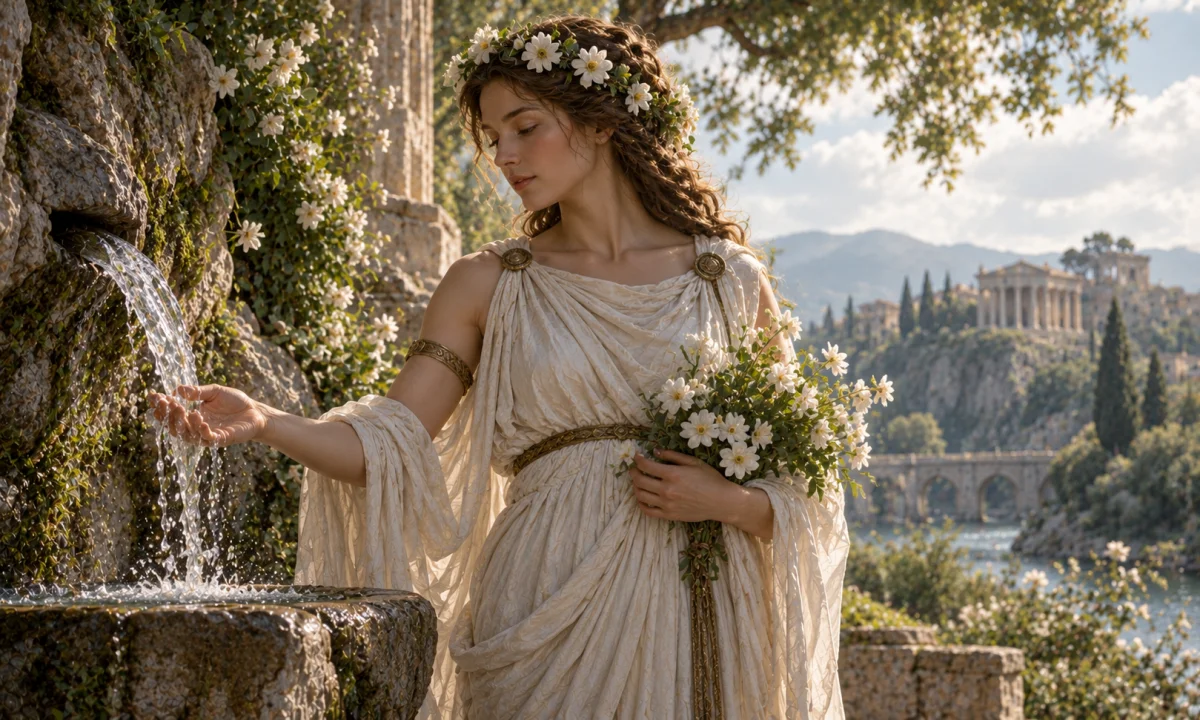
Albunea is a prophetic female figure associated with Roman Italy, the waters of the Anio River and the ancient town of Tibur, now Tivoli. She is described in different traditions as a nymph of a sacred spring, a local goddess or a Sibyl—the last of these being a woman believed to possess divine knowledge and deliver oracles. Because the surviving evidence is brief and sometimes ambiguous, Albunea cannot be given a single completely certain identity. Her importance lies precisely in the way Roman religious tradition connected natural water, local cult and prophetic inspiration.
Origins and cultural setting
Albunea belongs to the religious landscape of Latium, the central Italian region surrounding Rome. Before and alongside the development of Roman state religion, many communities revered springs, rivers, groves and hills as places where divine power was especially present. Water sources could provide practical benefits, but they were also treated as sacred thresholds between the human world and the supernatural realm. A spring that spoke through sound, unusual movement or the words of an inspired woman could become a centre of prophecy.
Tibur, situated east of Rome beside the Anio, was particularly rich in sacred places. Its religious traditions included the local worship of Hercules, the goddess of childbirth and motherhood known as Mefitis or related water deities, and the celebrated grove and spring of the goddess Albunea. The Tiburtine landscape was later incorporated into Roman literary and religious imagination, but its traditions probably developed from local Italian practices rather than from a single literary invention.
The name Albunea is most closely connected with a spring or body of water near Tibur. Ancient writers describe the water as remarkable for its coldness, clarity or sound, and the site appears to have been associated with a temple or shrine. The exact location and archaeological character of the sanctuary are not completely certain. Several springs and ancient waterworks existed in the area, and later identification of the sacred site has depended on interpreting literary references alongside the changing landscape.
Albunea in ancient sources
Albunea is mentioned in Roman literature, but she does not possess a large surviving mythology. The most influential literary reference occurs in Virgil’s Aeneid, where the poet evokes Albunea among the sacred places of Latium during the events leading to the war between the Trojans and the Italian peoples. The passage associates her with a resonant or echoing spring and with the surrounding woods. Virgil’s description presents the place as ancient, holy and capable of inspiring fear or wonder.
Virgil does not provide a full biography of Albunea. He does not clearly state whether she is a nymph, a goddess or a prophetess, and the poem gives no extended account of her genealogy. Her presence functions primarily as part of the religious atmosphere of Latium. The spring is a place where divine signs may be heard, and its mention helps establish that the Italian landscape is already filled with powers and traditions before the arrival of Aeneas.
Another important witness is the Christian writer Lactantius, who preserves a catalogue traditionally attributed to the Roman scholar Varro. This catalogue lists ten Sibyls, including a Tiburtine Sibyl named Albunea. According to the account, she was worshipped at Tibur and was associated with a statue or image found in the waters of the Anio holding a book. The details are reported through a later Christian source, not through an intact work by Varro, so they must be treated with care. They nevertheless show that Albunea could be understood within the Roman classification of prophetic women.
Other ancient references connect the name with the Tiburtine spring or with a divine presence in the region. The evidence does not establish whether the water goddess and the Sibyl were originally the same figure. It is possible that a local spring deity gradually became associated with a prophetic woman, or that later writers identified two related traditions because both belonged to the same sacred site. The name may therefore refer to a complex tradition rather than to one consistently defined being.
Name and identity
The meaning of the name Albunea is uncertain. It may be related to Latin words connected with whiteness or brightness, such as albus, perhaps referring to pale water, foaming rapids, a bright spring or a light-coloured landscape. This explanation is plausible but not securely demonstrated. Ancient names for places and deities often preserve older Italic or pre-Roman elements whose original meanings were no longer understood by classical authors.
The spelling also appears in forms related to Albunea and Albuneus. These variations may reflect differences of grammatical gender, manuscript transmission or the distinction between a deity and a place-name. They should not automatically be treated as separate gods. At the same time, the evidence is not strong enough to claim that every ancient use of the name refers to precisely the same figure.
Albunea is sometimes called a Sibyl without qualification, but this classification belongs mainly to the learned tradition that organised famous prophetic women into a list. In Roman usage, a Sibyl was generally an inspired prophetess whose utterances were delivered in a state of divine possession. The word did not necessarily describe a goddess. A local spring spirit could acquire a Sibylline identity when Roman scholars or later religious writers connected her with the wider tradition of famous oracles.
Attributes and sacred setting
Albunea’s principal attribute is the sacred spring. Unlike goddesses who are known through weapons, animals or distinctive clothing, she is identified primarily through place. The spring, its waters and the sounds of the surrounding landscape form the centre of her religious character.
Descriptions of the site emphasise resonance. Water flowing through rock, a cavern or a wooded valley could produce voices and echoes that encouraged people to interpret natural sounds as divine communication. In this setting, prophecy did not need to come from a visible anthropomorphic deity. The landscape itself could seem to speak, while the inspired prophetess served as its human interpreter.
The association with a book or prophetic writings belongs especially to the Sibylline interpretation of Albunea. A book in the hand of her image would symbolise preserved revelation, although the surviving account does not provide a complete description of the text. It is important not to confuse this tradition with the official Sibylline Books of Rome, which were a separate collection of prophetic verses kept under state supervision and consulted on matters of public religious importance. The Roman state’s Sibylline Books were linked by tradition to the Cumaean Sibyl and should not be treated as Albunea’s personal book.
Albunea’s likely symbolism includes water, hidden knowledge, the fertility of the land and the boundary between the visible and invisible worlds. Springs were sources of life, but their caves, depths and unpredictable sounds also made them suitable places for encounters with the unknown. Her character therefore combines a nurturing natural power with the unsettling authority of prophecy.
Stories and relationships
No substantial myth about Albunea survives. There is no securely preserved story of her birth, marriage, children or conflict with another god. She is not presented as a participant in the major mythic cycles of Jupiter, Mars, Venus or the Roman foundation legends. Her narrative role is tied to the sacred location rather than to a sequence of adventures.
Her strongest literary relationship is with the land of Latium and, more specifically, Tibur. In Virgil’s epic, places such as Tibur, Albunea and the Anio help create a religious geography for the Italian setting. The poet presents the region as a land already marked by ancient rites and prophetic forces. This is significant for the poem’s larger purpose: the conflict surrounding Aeneas is not simply a struggle between foreign newcomers and an empty wilderness. It takes place within a landscape inhabited by local gods, sanctuaries and long-established traditions.
Albunea’s connection with the Tiburtine Sibyl also brings her into contact with the later Christian history of Sibylline prophecy. Christian authors treated selected Sibyls as pagan witnesses who had, in mysterious form, foretold aspects of Christian revelation. The Tiburtine Sibyl became especially important in medieval and Renaissance religious culture, but this later interpretation should not be projected backward as though it were the original meaning of the Roman spring cult.
Albunea and the Tiburtine Sibyl
The terms Albunea and Tiburtine Sibyl are often used as if they were exact equivalents. They are closely related in literary tradition, but the identification is not entirely straightforward. The Tiburtine Sibyl is the name given to a prophetic woman associated with Tibur; Albunea is the name associated with the sacred spring and, in one important catalogue, with that Sibyl. The two traditions may have merged over time.
There may originally have been a local water deity known as Albunea and a separate prophetic figure attached to her sanctuary. Ancient religious sites often employed priests, priestesses or inspired specialists who acted on behalf of a deity. Later writers could then describe the sanctuary’s prophetic woman by the name of the goddess, or reinterpret the goddess herself as a Sibyl.
Conversely, it is possible that Albunea was already understood as a prophetic nymph or goddess, and that Roman scholars simply placed her within the established category of Sibyls. The surviving evidence does not allow a decisive answer. The safest description is that Albunea was a Tiburtine sacred figure associated with a prophetic spring and later identified with the Tiburtine Sibyl.
Distinction from similar figures
Albunea should not be confused with Albunea’s spring as a physical location. Ancient texts can use a divine name and a place-name so closely together that it becomes unclear whether the writer is referring to the goddess, the water or the sanctuary. Modern summaries sometimes treat all such references as evidence for a fully developed goddess, although the texts themselves may be describing the site rather than narrating a personal myth.
She should also be distinguished from the Cumaean Sibyl. The Cumaean Sibyl was associated with Cumae in Campania and became the most famous Sibyl in Roman epic, particularly through Virgil’s account of Aeneas’s journey to the underworld. The Tiburtine Sibyl belonged to Tibur in Latium. Both were prophetic women, but they were connected with different locations and traditions.
Albunea is not the same as Egeria, the prophetic or advising water nymph associated with Numa Pompilius. Egeria was linked to a sacred grove and spring near Rome and played a role in stories about the religious formation of the Roman king. The two figures share associations with water, inspiration and female supernatural wisdom, which can lead to confusion, but their cult locations and legends are different.
Nor should Albunea be merged with Albuneus wherever that form appears in ancient or modern discussions. The forms may be grammatically or textually related, but the precise referent varies. Careful interpretation is necessary because ancient manuscripts and later editions do not always preserve names consistently.
Religious and cultural significance
Albunea illustrates how Roman religion could preserve several layers of meaning at once. A spring might be a natural feature, a local sanctuary, the dwelling place of a nymph, a site of healing or fertility, and a source of prophecy. None of these interpretations had to exclude the others. Roman religious practice was often cumulative: local traditions were retained while scholars, poets and state institutions gave them new classifications.
Her example also shows the difference between cultic importance and mythological visibility. Albunea has little surviving narrative mythology, yet the site associated with her was sufficiently notable to appear in major literature and learned catalogues. A deity did not need a long cycle of stories to be meaningful to the people who approached a spring, made offerings or sought an omen there.
The figure is especially valuable for understanding the relationship between landscape and authority in Roman culture. Prophecy at Albunea was not detached from geography. It belonged to a particular body of water, a particular community and a particular regional memory. Even when later writers turned Albunea into a member of a pan-Mediterranean list of Sibyls, her identity remained rooted in Tibur and the waters of the Anio.
Later reception
In late antique and medieval Christian writing, the Tiburtine Sibyl was increasingly interpreted as a pagan prophet who anticipated Christian truths. Medieval and Renaissance artists sometimes represented Sibyls alongside biblical prophets, especially in decorative programmes that treated them as witnesses to the coming of Christ. These representations belong to Christian reception rather than to the original Roman cult of Albunea.
Later traditions also produced expanded writings attributed to the Tiburtine Sibyl. Such texts should not be assumed to preserve direct records of an ancient woman or of the original spring sanctuary. They reflect the religious concerns and literary practices of the periods in which they were composed or transmitted.
Albunea has never been as prominent in modern popular culture as figures such as the Cumaean Sibyl, Medusa or the major Olympian gods. When she appears in modern fantasy, historical fiction or treatments of Roman mythology, she is usually presented as an oracle, water spirit or mysterious prophetess. These portrayals draw on genuine ancient associations, but a detailed personality, appearance or supernatural power set is generally a modern development rather than something securely recorded in Roman tradition.