WORLD
WORLD
Agnostos-theos
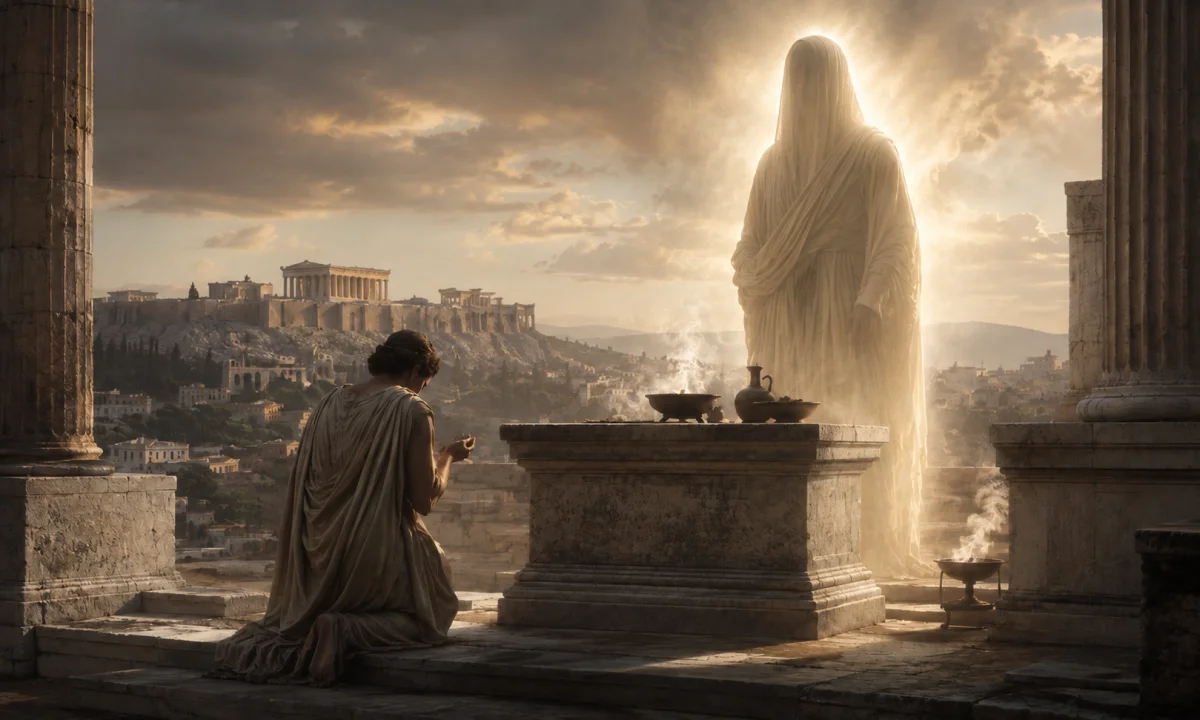
Agnostos-theos is the Greek expression for “the unknown god” or “an unknown god.” It is associated chiefly with ancient Athens and with the religious and intellectual world of the Greek-speaking Mediterranean under Roman rule. Despite its use as a name, Agnostos-theos was not a clearly defined god with an established mythology, genealogy, appearance or set of powers. The expression refers instead to a deity whose identity was unknown, undisclosed or deliberately left unspecified.
The subject is sometimes placed under Roman mythology because one of its best-known references appears in the New Testament, a Roman-period text, and because Athens was part of the Roman Empire when that reference was written. Its original setting, however, was Greek religious culture. Agnostos-theos should therefore be understood as a feature of ancient Greek and Roman-era religious practice rather than as a standard member of the Roman pantheon.
The meaning of the name
The Greek words agnostos theos mean “unknown god.” The adjective agnostos means unknown, unrecognised or not known, while theos means god or deity. The phrase is not equivalent to the modern philosophical word “agnostic,” which describes a position concerning whether knowledge of divine reality is possible. In its ancient setting, “unknown” could mean that worshippers did not know a deity’s name, nature or preferred form of worship. It did not necessarily mean that the god was considered unreal.
The phrase can be understood in either a singular or plural context. Agnostos theos is singular, “unknown god,” while agnostoi theoi means “unknown gods.” Ancient evidence refers to both a singular altar inscription and plural altars or cult places. This variation is important because it shows that the expression did not always designate one particular divine personality.
Religious setting in ancient Greece
Greek religion included many named gods, heroes and local divine powers, but it did not require every sacred power to be identified in the same way. Worship could be directed towards a god whose name was known throughout the Greek world, a local divinity known only in one community, a hero associated with a specific place, or a power invoked under a functional title such as a protector, healer or giver of victory.
There were practical reasons for leaving a deity unnamed. A community might fear neglecting a divine power that had not been recognised. A ritual might be intended for whichever god was responsible for a particular event. Worshippers might also acknowledge that divine knowledge was limited and that the gods could not always be classified confidently. An altar to an unknown god could therefore function as a respectful act of religious caution.
This practice should not automatically be interpreted as evidence of a hidden universal god or of a secret monotheistic cult. The polytheistic religious systems of Greece and Rome could accommodate unnamed or uncertain divine powers alongside well-known gods such as Zeus, Athena, Apollo and Artemis. The unknown god was not necessarily superior to those gods, nor was it necessarily understood as the only true deity.
Ancient literary evidence
The most important evidence comes from several ancient literary references, although they do not all describe exactly the same tradition.
Pausanias and the Athenian altars
The second-century Greek writer Pausanias described Athens in his account of Greece. Near the entrance to the city, he reported the presence of altars to gods called unknown. His wording indicates that the Athenians maintained a religious place associated with divine powers whose identities were not specified.
Pausanias did not provide a detailed myth about a single Agnostos-theos. He did not describe the deity’s family, form, symbols or deeds. His evidence is therefore especially valuable for showing that “unknown gods” could be treated as a recognised category within Athenian religious life. It does not prove that Athens possessed a single cult devoted to a god with the personal name Agnostos.
The story of Epimenides
A related account appears in the work of Diogenes Laertius, who preserved a story about the Cretan religious specialist Epimenides. According to this tradition, Athens suffered from a plague or another serious affliction. Epimenides advised the Athenians to release sheep and observe where they lay down. At the places selected by the animals, sacrifices were to be offered to the appropriate deity, even though the deity’s identity was not known.
Altars were then said to have been erected to unknown gods. The story explains the altars as a response to a crisis: the Athenians believed that some divine power had been offended or had the ability to end the disaster, but they did not know which god should receive the sacrifice.
The historicity of this story is uncertain. It is a later literary account rather than a securely documented record of the original event, and its details may have been shaped to explain an existing religious custom. It nevertheless illustrates an important ancient idea: a ritual could be directed towards a divine recipient without a known name, provided that the worshippers acted with respect.
Paul’s speech in Athens
The most famous reference to an unknown god occurs in the Acts of the Apostles. In the narrative, the apostle Paul visits Athens and observes the city’s religious monuments. He tells the Athenians that he has found an altar bearing an inscription that can be translated as “to an unknown god.” Paul then presents his own teaching as an explanation of the deity whom the Athenians worship without knowing.
The passage is a Christian interpretation of Athenian religion, not a neutral catalogue of local cults. Its purpose is rhetorical and theological: Paul uses an existing or reported religious idea as a point of contact for preaching about the God of Christianity. The speech does not establish that Athenians as a whole believed in one universal unknown god. Nor does it demonstrate that the altar was dedicated specifically to the Christian God before Paul’s arrival.
No surviving archaeological monument can be identified with certainty as the altar described in Acts. Several altars and inscriptions from the ancient Mediterranean have been connected with unknown deities, but none provides an uncontested match for the biblical account. The wording of Acts may reflect an actual inscription, a remembered Athenian tradition, or a literary presentation of Greek religious openness. Scholars have debated these possibilities.
Identity and classification
Agnostos-theos is best classified as a religious designation rather than as a fully developed mythological figure. The name identifies a condition of divine uncertainty. It does not tell us whether the deity was male or female, Olympian or local, benevolent or dangerous, singular or one among many.
The expression could refer to several different situations:
- A deity whose proper name had been forgotten or was known only to specialists.
- A local divine power not identified with one of the famous gods.
- A god believed to be responsible for a crisis when the worshippers did not know which god had been offended.
- A general category covering any divine beings not named in a particular ritual.
- A respectful acknowledgement that human beings might fail to recognise every power active in the world.
Because the surviving sources are brief, it is not possible to determine which of these meanings applied in every case. The singular phrase in Acts should not be treated as proof that all references to unknown gods concerned the same being.
Attributes, appearance and powers
No traditional physical description of Agnostos-theos survives. There are no reliable ancient accounts assigning the figure a human shape, animal form, garment, weapon, sacred animal or distinctive emblem. Modern illustrations that portray the unknown god as a veiled man, a shadowy spirit or a divine figure without a face are imaginative interpretations rather than reconstructions based on ancient evidence.
Likewise, Agnostos-theos has no securely recorded mythology. The figure is not known to have been born from a divine parent, fought a monster, ruled a particular region or entered into a recognised relationship with another god. The stories connected with the expression concern the circumstances of uncertain worship, especially the Athenian crisis associated with Epimenides and Paul’s later interpretation of the altar.
Any power attributed to the unknown god must therefore be stated cautiously. In the Epimenides tradition, the unknown divine recipient is connected indirectly with the ability to respond to a plague or affliction. That does not establish a permanent role as a healing god. The altar’s purpose was to honour the relevant deity, whoever that deity might be, rather than to define a god with a fixed sphere of influence.
Ritual and symbolism
An altar to an unknown god symbolised religious humility as much as it represented a particular cult. It acknowledged that human knowledge was incomplete and that a community could owe duties to divine powers it had not successfully identified. Such a practice could also protect worshippers from accidentally omitting a god who might deserve honour.
The idea reflects a broader characteristic of ancient polytheism. Greek and Roman religious practice was often concerned with maintaining correct relationships with divine powers through sacrifice, prayer and ritual observance. Knowing a god’s name could be important, but the absence of a known name did not necessarily prevent worship. A community could perform a rite using a general title when certainty was unavailable.
At the same time, an unknown god was not simply a symbol of abstract mystery. The altar was part of a concrete religious environment involving offerings, sacred space and communal memory. The practice belonged to lived religion, not only to philosophical speculation.
Relationship to Greek and Roman religion
The expression belongs linguistically and culturally to Greek religion, but its surviving references come from periods in which Greek cities existed under Roman power. Athens retained its Greek institutions, traditions and religious vocabulary during the Roman imperial period. This mixture explains why Agnostos-theos may appear in discussions of Roman mythology even though it is not a Roman god in the usual sense.
There is no evidence that Agnostos-theos was adopted as a regular Roman deity with an official place among gods such as Jupiter, Juno, Minerva, Mars or Venus. Nor should the phrase be confused with Roman practices of invoking a god under a title when the exact divine identity was uncertain. Roman religion also recognised many local, functional and obscure divine powers, but those traditions are not automatically references to the Athenian unknown god.
Greek religious language continued to be used in many parts of the Roman Mediterranean. Consequently, the Roman setting of Acts does not transform Agnostos-theos into a distinct Roman character. It demonstrates instead how Greek religious ideas could be discussed, reinterpreted and contested within the Roman world.
Distinctions from similar ideas
Agnostos-theos should be distinguished from several figures and concepts that may appear similar.
- Deus incertus: This Latin phrase can mean an uncertain or unidentified god, but it is not simply the Latin personal name of the Athenian unknown god. Similar wording may describe a general religious situation rather than one specific deity.
- Chaos or the primordial gods: In Greek mythology, primordial beings represent the beginnings of the cosmos. They are not “unknown gods” merely because their myths are ancient or incomplete.
- The supreme God of philosophical theology: Greek philosophers sometimes discussed a highest or transcendent divine principle. That philosophical subject is not identical with the unnamed recipient of an altar.
- The Christian God in Acts: Paul interprets the unknown-god inscription in relation to Christian teaching, but this is a theological claim made within the narrative. It does not establish the original identity of the altar’s deity.
- Gnostic or esoteric beings: Later religious and occult systems sometimes describe an unknowable divine source. Such ideas belong to different historical traditions and should not be merged with ancient Athenian altars.
Historical significance
The importance of Agnostos-theos lies less in a body of mythology than in what the expression reveals about ancient religious practice. It shows that the boundaries of a pantheon could remain open. Communities could recognise divine agency without possessing a definite name or image, and they could create a ritual response to uncertainty without abandoning the normal forms of sacrifice.
The tradition also illustrates how religious language can change meaning when it enters a new setting. In Athenian practice, an unknown god or gods could represent an unidentified recipient of worship. In Acts, the phrase becomes the starting point for a Christian argument about revelation and knowledge of God. Later readers have often treated the expression as evidence of a universal religious instinct, but the ancient sources support more limited and varied interpretations.
For that reason, Agnostos-theos is best approached not as a lost Olympian or a hidden Roman deity, but as a name for the unknown within ancient Mediterranean religion. Its significance comes from the space it leaves open: the possibility that divine powers existed beyond the names, images and traditions known to a particular community.
Later reception
The phrase has continued to attract interest in discussions of comparative religion, classical studies and the relationship between paganism and Christianity. Its appearance in Acts has made it especially familiar in Christian interpretation, where it is often presented as an example of incomplete knowledge awaiting revelation. Classical scholarship, by contrast, generally stresses the variety of ancient practices involving unnamed or uncertain deities.
In modern fiction, games and occult-themed writing, “the Unknown God” may be used as a title for a secret cosmic being or a hidden antagonist. These portrayals usually expand the phrase into a fictional character with powers and motives. They should not be confused with the ancient evidence, which supplies no fixed appearance, personality or mythology for Agnostos-theos.