WORLD
WORLD
Agla

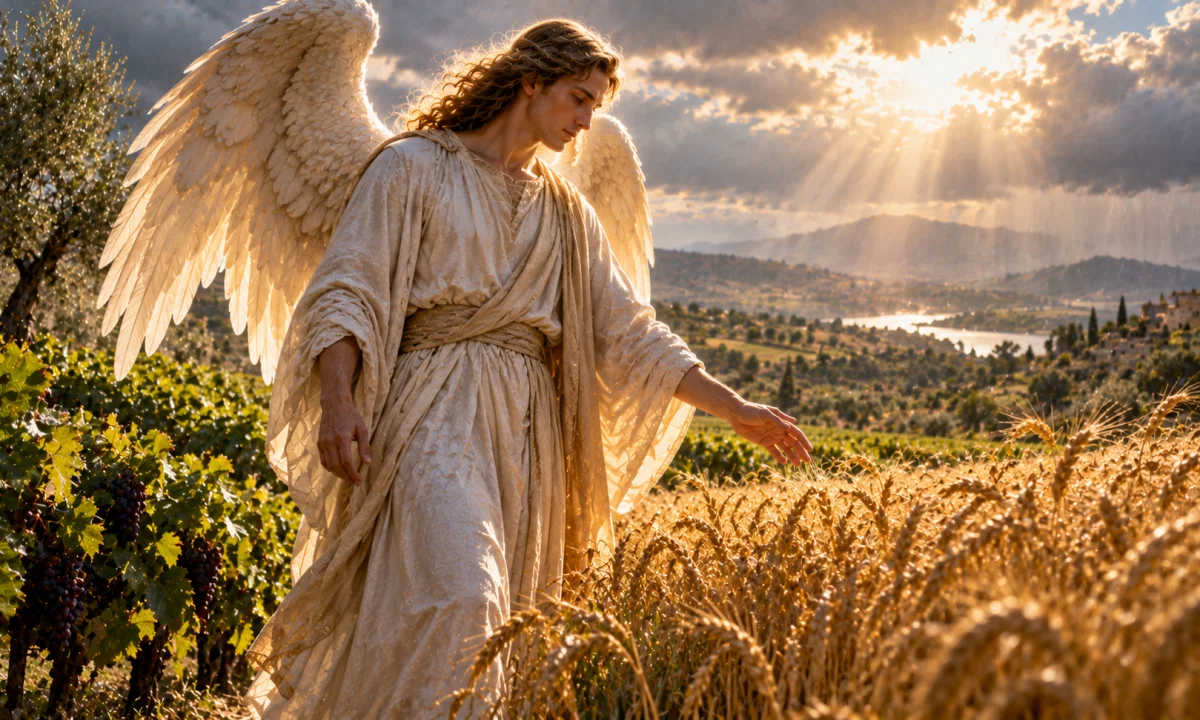
Agla is a figure associated with Jewish and Christian angelological traditions, though the name is not among the best-known angels of scripture. In most surviving references, Agla appears not as a fully developed archangel with a detailed biography, but as a sacred name, formula, or angelic designation preserved in magical, devotional, and esoteric contexts. Because the tradition surrounding Agla is scattered and sometimes ambiguous, its identity varies by source: in some settings Agla is treated as an angelic being, while in others the word functions as a holy invocation rather than the personal name of a distinct angel.
Origins and cultural setting
The name Agla belongs to the wider world of late antique and medieval religious traditions in which angelic names, divine epithets, and sacred words were used for prayer, protection, healing, and ritual. It is most often encountered in Jewish, Christian, and later magical texts rather than in the canonical Hebrew Bible or the New Testament. As a result, Agla stands on the boundary between formal religious tradition and practical devotional usage.
One important reason for the uncertainty around Agla is that the term is frequently explained as an acronym or sacred formula. In Jewish and Christian contexts, it is often associated with the Hebrew phrase “Atah Gibbor Le-olam Adonai”, meaning “You are mighty forever, Lord,” or a closely related wording. In such interpretations, Agla is not originally a personal name at all, but a condensed liturgical expression of divine power. Over time, however, the formula could be understood as angelic in nature or linked with angelic mediation.
This kind of development is common in the history of angel lore. Names that began as divine titles, liturgical abbreviations, or ritual formulas were sometimes reinterpreted as the names of angels or spiritual powers. Agla is one of the clearest examples of this process.
Name, spelling, and identity
Agla is usually spelled AGLA in transliteration, though the underlying language and exact derivation are matters of scholarly discussion. The term is not firmly established as a single, universally recognized angelic individual in the way that Michael, Gabriel, or Raphael are. Instead, the name appears in different traditions with overlapping but not identical meanings.
In some sources, Agla is treated as a sacred name of God rather than an angel. In others, it is included among angelic or protective names. This ambiguity is significant and should not be ignored. A responsible reading of the tradition must distinguish between:
- a divine acclamation or acrostic,
- a protective sacred word, and
- a putative angelic name used in later devotional or magical practice.
Because of these multiple functions, Agla is best understood as a figure or formula that moves across categories rather than belonging neatly to only one of them.
Appearance in religious and ritual traditions
Agla appears most often in texts and practices concerned with protection. It is found in amuletic inscriptions, prayers, blessing formulas, and other contexts where sacred names were believed to carry spiritual efficacy. In medieval and early modern Europe, especially within Christian magical and devotional traditions influenced by Jewish angelology, names such as Agla could be written on objects, recited in prayers, or combined with other holy words for safeguarding a person or place.
In such settings, the power of Agla was not tied to a visual image or a mythic story. Instead, the word itself was believed to hold authority because of its connection with divine majesty. This reflects a broader religious principle in which naming is powerful: to invoke a sacred name is to call upon the presence, power, or protection associated with it.
Some traditions place Agla among lists of angelic names used in healing or exorcistic contexts. However, the historical record is not uniform. In many cases, later occult or magical compilations preserved names without clear explanation of their original meaning, making it difficult to determine whether the compiler understood Agla as an angel, an angelic title, or a divine formula.
Attributes and symbolism
Because Agla is not a narrative angel with a well-defined iconographic tradition, its attributes are symbolic rather than physical. The main qualities associated with Agla are:
- Protection — especially in prayers, charms, or inscriptions intended to ward off harm.
- Divine power — arising from its probable connection with praise of God’s strength and eternity.
- Sacred speech — the idea that holy words themselves can mediate blessing or defense.
- Ambiguous angelic status — a reminder that angel names and divine names were sometimes used in overlapping ways.
In religious symbolism, Agla often represents the efficacy of sacred language. The name’s importance lies less in a detailed mythic personality than in what it does: it invokes holiness, power, and protection. This makes Agla a typical example of the way angelic and divine names functioned in practical piety.
Roles in prayer, protection, and esoteric practice
Agla’s role is most visible in traditions of protection and ritual invocation. In Jewish and Christian settings, sacred names were sometimes employed to guard against illness, danger, demons, or misfortune. Agla belongs to this broader tradition of holy nomenclature, alongside divine epithets and angelic names used in amulets and prayers.
In later esoteric literature, Agla could be grouped with other names of power and treated as part of a ceremonial vocabulary. Such uses do not necessarily reflect mainstream theology. They belong instead to the history of popular religion, practical devotion, and esoteric speculation. That distinction matters, because the presence of Agla in a magical text does not mean that it was universally accepted as an angel by all communities sharing the tradition.
In some Christian contexts, especially in medieval and early modern Europe, angelic and divine names were frequently combined in protective formulas. Agla might be written alongside names such as Michael or Emmanuel, reinforcing the sense that sacred language formed a spiritual shield. Yet the exact use varied widely from region to region and from text to text.
Relationship to Jewish tradition
Agla is often discussed in relation to Jewish sacred language and angelology, but caution is necessary. It is not a central figure of classical rabbinic literature, nor is it a major named angel in the Hebrew Bible. Its likely origin in a Hebrew acrostic gives it a strong Jewish linguistic background, but its later life in amulets and mystical or magical usage crossed confessional boundaries.
The blending of divine names and angelic names is especially significant in the history of Jewish mysticism and protective practice. In some Jewish traditions, the utterance or inscription of holy names was believed to have real spiritual effect, though legitimate use was carefully regulated. Agla fits into this broader environment, where names could be treated as concentrated forms of sacred meaning and power.
At the same time, the use of Agla in later Christian materials should not be mistaken for evidence that it originated as a standard Christian angel. Much of the terminology of Christian angelology was shaped through contact with Jewish and late antique sources, and Agla appears to have entered Christian usage through that wider channel.
Relationship to Christian tradition
In Christian tradition, Agla is usually encountered outside the canonical scriptures, often in devotional, magical, or symbolic materials. Medieval Christianity had a strong interest in angels as servants and messengers of God, and that interest encouraged the circulation of many names beyond the few explicitly named in the Bible.
Agla sometimes appears in lists or formulas that aim to protect the faithful or invoke divine help. In such contexts, the name’s authority derives from its perceived holiness and from its association with the power of God. However, it is important not to overstate its status: Agla is not one of the universally recognized archangels of mainstream Christian doctrine.
The figure therefore occupies a marginal but revealing place in Christian angelology. It shows how devotional practice could extend beyond formal doctrine, preserving sacred words that were meaningful in prayer, healing, and protection even when their precise theological classification remained uncertain.
Distinction from similar names and figures
Agla is sometimes confused with other names that sound similar or appear in comparable ritual contexts. This confusion can arise because medieval and early modern compilations frequently list angelic names together without consistent explanation.
Agla should be distinguished from:
- Aglaia, a figure from Greek mythology, who is one of the Graces and has no relation to Agla’s angelic or sacred-name tradition.
- Agiel and similar angelic names from esoteric or occult sources, which are separate entities and should not be merged with Agla.
- The archangels of canonical scripture, such as Michael and Gabriel, who have far clearer biblical and liturgical identities.
It is also important not to assume that every occurrence of AGLA in a text refers to an angelic being. In many cases, it is more accurate to read it as a sacred formula with a theological meaning of its own. Treating it automatically as an angel can obscure the tradition’s original complexity.
Historical evidence and scholarly interpretation
Scholars generally approach Agla as a term whose history is layered and not fully transparent. The strongest evidence suggests a Hebrew liturgical or acclamatory origin, followed by later reinterpretation in devotional and magical settings. This does not diminish its importance; rather, it places Agla within a common pattern in the history of religion, where sacred language shifts meaning across time.
There is no single universally accepted account of Agla’s origin, and that uncertainty should be stated plainly. Some interpreters emphasize the acrostic explanation. Others focus on the word’s later angelic use in amulets and prayer traditions. Both perspectives can be valid, depending on the text under discussion. What cannot be responsibly claimed is that Agla has a stable, singular biography supported by a broad canonical tradition.
From a historical perspective, Agla is valuable precisely because it demonstrates how fluid the boundaries were between name, title, invocation, and angelic identity. It also reveals the practical side of religious life, where sacred words were deployed for immediate spiritual need.
Symbolic meaning in religious culture
Agla’s enduring significance lies in the idea that sacred language is powerful. Whether understood as a divine acrostic or as an angelic name, Agla expresses trust in a world structured by holy speech, protection, and divine sovereignty. The word belongs to the same broad religious imagination that gave rise to amulets, blessing formulas, and invocations of heavenly assistance.
In that sense, Agla is not merely a label. It functions as a compressed theological statement: God is mighty, divine authority endures, and sacred words can participate in that authority. Such meanings help explain why the term persisted across communities and centuries even when its precise status was debated.
The figure also illustrates how angels can inhabit a spectrum between doctrine and popular devotion. Some angels are named in scripture and doctrine; others emerge from prayer practice, mystical interpretation, or ritual usage. Agla belongs to this second, more fluid category, where religious experience and textual transmission shape identity together.
Modern reception
Modern interest in Agla is generally limited to discussions of angelology, Jewish mysticism, ceremonial magic, and the history of sacred names. It is occasionally mentioned in popular esoteric literature, sometimes without adequate distinction between its possible meanings. In such settings, Agla may be presented simply as an angel, but that treatment is often too neat for the historical record.
In contemporary religious practice, the word may still appear in devotional or protective contexts, though usage is far from universal and is usually shaped by inherited tradition rather than by a single authoritative source. In popular culture, Agla has not become a major angelic character comparable to Michael or Gabriel. When it does appear, it is more often in occult or fantasy-inspired settings than in mainstream religious storytelling.
That relative obscurity does not lessen its importance. Agla remains a notable example of how sacred words can move through liturgy, mysticism, and folklore, gathering new meanings while retaining traces of their original religious power.
Key points of tradition
- Agla is most often linked to Jewish and Christian sacred-name traditions.
- The term may originally be an acrostic or divine formula rather than a personal angelic name.
- Its main associations are protection, invocation, and the power of holy speech.
- It appears more often in amulets, prayers, and esoteric texts than in canonical scripture.
- Its identity is not fully fixed, and sources vary in whether they treat it as an angel, a name of God, or a ritual word.
Understanding Agla requires attention to that uncertainty. The figure belongs to the living intersection of theology, ritual language, and popular devotion, where a sacred word can be at once a prayer, a sign of power, and, in some traditions, an angelic presence.