WORLD
WORLD
Acca-larentia

Acca Larentia, also called Acca Larentina, is a figure of Roman mythology associated with the childhood of Romulus and Remus, the founding legends of Rome, and the annual festival known as the Larentalia. Her identity is not consistent across surviving Roman traditions. In one important version, she is the human wife of the shepherd Faustulus and the foster mother of the abandoned twins. In another, she is a wealthy courtesan whose property eventually passed to the Roman people. These stories may preserve different attempts to explain an older religious observance rather than a single, unified biography.
Origins and Roman religious setting
Acca Larentia belongs to a layer of Roman tradition in which legendary history, family mythology, and religious ritual overlap. She is connected both with the story of Rome’s first king and with the Larentalia, a funeral or commemorative rite held on 23 December. During this observance, a sacrifice was performed at a tomb traditionally identified with hers near the Velabrum, an area between the Roman Forum, the Capitoline Hill and the Tiber.
The festival was an established part of the Roman religious calendar, but its original meaning is uncertain. Ancient authors preserved several explanations for it, and those explanations do not fit together perfectly. Some accounts treat Acca Larentia as a mortal woman honoured after death. Others give her an unusually generous fortune, a connection with fertility, or an almost divine importance. Modern interpretations likewise differ: some scholars have viewed her as a transformed ancestral figure, an earth or fertility power, or a local protectress whose cult was later explained through stories about Rome’s foundation. None of these interpretations can be treated as certain.
The Roman state traditionally maintained a formal relationship with the festival. Ancient descriptions associate the rite with the pontifex maximus, the chief priest of Roman religion, who performed or supervised the sacrifice at Acca Larentia’s tomb. This public observance indicates that she was more than a minor character in a popular tale. At the same time, the surviving evidence does not show that Romans worshipped her in exactly the same way as Jupiter, Mars or Venus. It is safer to describe her as a legendary and cult figure whose commemoration occupied an unusual place between ancestor ritual, civic religion and mythology.
Acca Larentia in the story of Romulus and Remus
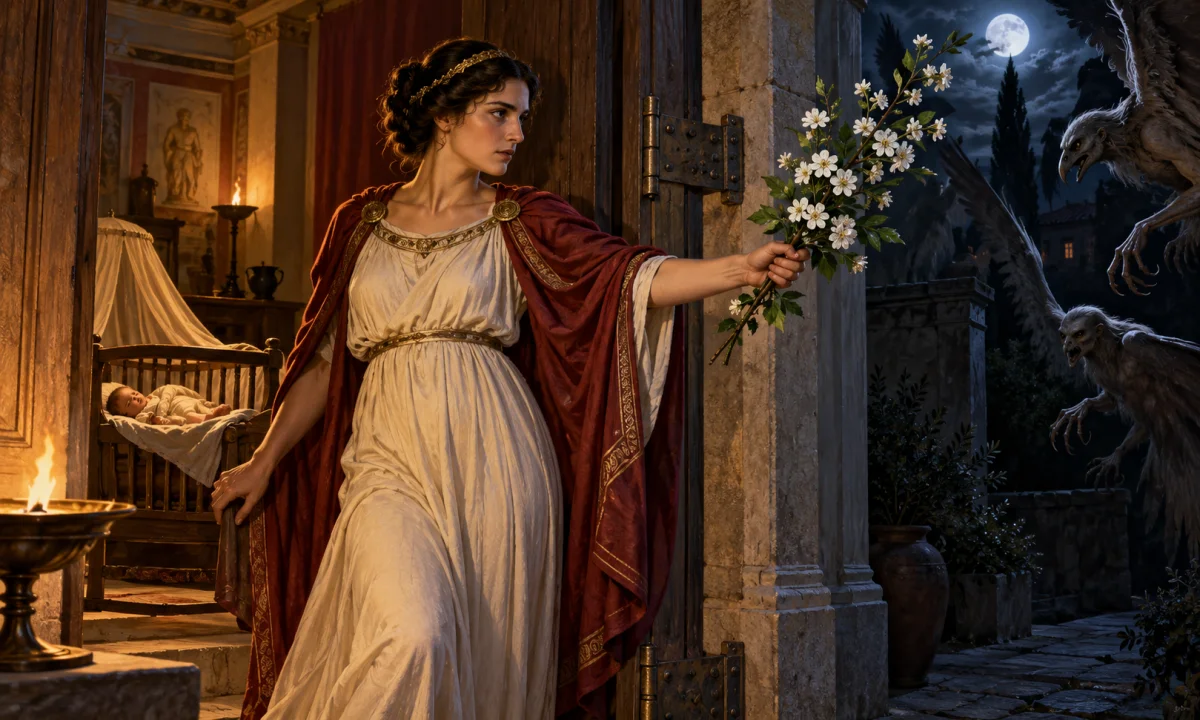
The best-known version of Acca Larentia’s story appears in accounts of the infancy of Romulus and Remus. According to the Roman foundation legend, the twins were born to Rhea Silvia and the god Mars. Their uncle Amulius, who had seized power at Alba Longa, ordered them to be abandoned because he feared that they might one day challenge his rule.
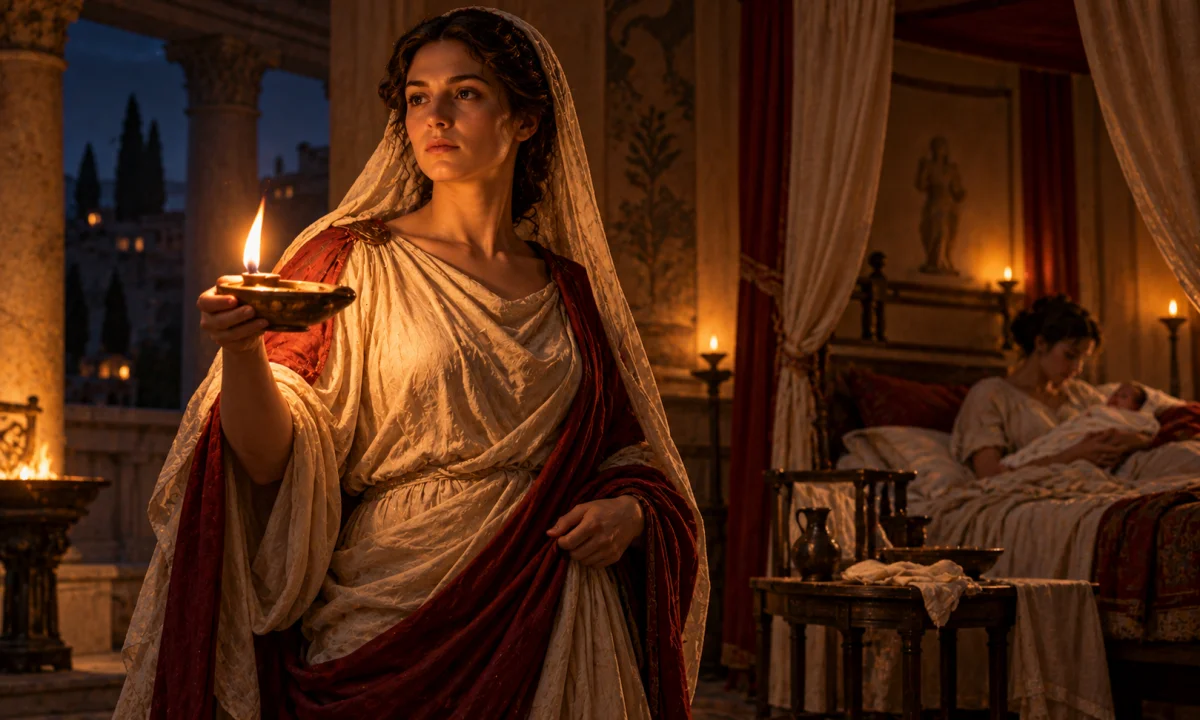
The infants were exposed beside the Tiber. A she-wolf found and suckled them, after which the shepherd Faustulus discovered them and brought them to his home. Acca Larentia was Faustulus’s wife in this version. She helped raise the boys, providing the human care that follows the more miraculous episode with the wolf. As they grew older, Romulus and Remus became strong young men, learned of their royal ancestry and eventually overthrew Amulius.
Ancient writers did not always tell this sequence in exactly the same way. Livy presents Acca as the wife of Faustulus and a foster mother of the twins. Plutarch also preserves this familiar account, while noting that other explanations existed for her name and character. Dionysius of Halicarnassus similarly places the twins within the household of Faustulus. The presence of Acca in several Roman foundation narratives shows that she was part of the established tradition, even though her precise role could be interpreted differently.
In this domestic role, Acca represents the hidden household that protects the future founders of Rome. The twins are royal by birth and favoured by divine or animal intervention, but they survive because ordinary people shelter them. Faustulus and Acca therefore connect the heroic foundation story with the world of shepherds, rural labour and family life. Their home is a bridge between the wilderness of the riverbank and the political destiny of the city.
The courtesan and the inheritance tradition
A second major tradition makes Acca Larentia a woman of a very different social identity. In this account, she was a lupa, a word that could mean either “she-wolf” or, in Roman usage, a prostitute or courtesan. Ancient authors used this double meaning to explain how the story of the animal that nursed the twins might have arisen. According to the alternative interpretation, “the she-wolf” was originally a human woman who cared for or encountered the children.
The term should not be treated as proof that every Roman version understood Acca as a prostitute. Rather, it reflects an ancient argument about the origin of the wolf story. Some writers accepted the miraculous she-wolf as a literal part of the foundation myth; others suggested that a human woman called a lupa had been transformed by storytelling into an animal.
In the inheritance story, Acca Larentia became wealthy through her relationship with a rich man named Tarutius, sometimes described as her husband. The details vary, but the important point is that she eventually controlled considerable property. She then left her wealth to the Roman people, or to the community associated with Romulus. Her generosity was given as the reason for her continuing commemoration.
Plutarch reports versions in which her beauty, sexual relationships and wealth form part of the explanation for the cult. The story also connects her with Hercules in a setting involving the Ara Maxima, the great altar of Hercules in the Forum Boarium. These details belong to a complicated group of Roman legends surrounding Hercules, sexuality, gambling, ritual exclusion and public benefaction. They should not be combined uncritically with the simpler account in which Acca is merely Faustulus’s wife.
The inheritance motif may reflect a Roman interest in the relationship between private wealth and the civic community. A woman who transfers her property to Rome becomes an idealized benefactor, even if the story uses a socially ambiguous figure. The tradition may also have helped explain why a woman remembered in a public religious festival was associated with a tomb and a state-sponsored rite.
Name and identity
The name appears in several forms, including Acca Larentia, Acca Larentina and Larentia. Ancient spelling was not always fixed, and modern books may choose different forms. “Acca” is generally treated as her personal name, while “Larentia” or “Larentina” may be a family name, a cult name or part of an older religious designation. The evidence does not establish one universally accepted meaning.
Some interpretations connect Larentia with the Lares, the Roman household and local spirits. On that reading, she might once have been understood as a maternal or ancestral figure associated with the land, the household or the community. Other explanations derive the name from a personal or place-name tradition rather than from the Lares. The similarity between the words is suggestive, but it does not prove that Acca Larentia was originally the mother of the Lares or that she was simply another name for a known goddess.
Her classification is therefore difficult. She is often called a Roman goddess in modern reference works because she possessed a cult and a festival. Yet the surviving ancient evidence more often presents her as a legendary woman, nurse, benefactor or deceased ancestor than as a fully described goddess with a stable mythology. Calling her a cult figure of uncertain status is more precise than assigning her a definite divine identity.
The Larentalia
The Larentalia took place late in the Roman year, on 23 December. The date placed the rite close to the winter solstice and within a season when Roman religious practice frequently focused on ancestors, the dead, renewal and the protection of households. The ceremony at Acca Larentia’s tomb was not simply a retelling of the Romulus and Remus story. It was a formal act of remembrance connected with the Roman state.
The tomb was traditionally located in the Velabrum, a low-lying district near the Tiber. This location is meaningful within Roman geography: the river, the Forum and the Palatine were all central to stories about Rome’s earliest settlement. The placement of a venerable tomb in this landscape allowed the city’s foundation legends and its ritual topography to reinforce one another.
Later Roman writers sometimes related the Larentalia to the Lares because of the similarity between the names. They also associated Acca with fertility, the land and the prosperity of the Roman people. These associations may preserve genuine features of an older cult, but they may equally represent later attempts to interpret an obscure ceremony. No surviving account provides a complete original liturgy or a secure explanation of how the festival first developed.
Acca and the twelve Arval Brothers
Another tradition links Acca Larentia with the Fratres Arvales, or Arval Brothers, an ancient priestly college concerned with agricultural fertility and the well-being of the Roman community. According to one foundation story, Acca had twelve sons. When one of them died, Romulus took his place, making him the twelfth member of the group. The brothers then continued as a sacred association.
This story explains the name and membership of the priesthood through a family relationship with Rome’s founder. It also gives Acca a maternal connection to a ritual institution concerned with fields and crops. The Arval Brothers were an actual Roman priesthood, but the account of Romulus joining Acca’s sons is legendary. It should not be confused with documentary evidence about the college’s historical development.
The agricultural association has encouraged interpretations of Acca as a fertility mother or personification of the cultivated land. Such readings are possible, particularly because her festival, her name and the Arval tradition all touch on land, ancestry and communal prosperity. Nevertheless, the ancient sources do not offer a single theological system explaining her as a grain goddess. Her agricultural significance remains an interpretation rather than a settled fact.
Symbolism and cultural significance
Acca Larentia’s different stories revolve around several recurring themes. She is connected with nurture, because she raises children who will establish Rome. She is linked with social transformation, because the story turns a woman of uncertain reputation into a public benefactor. She also belongs to the boundary between life and death: she protects the living in the foundation myth, yet receives an annual rite at her tomb.
Her legends also show how Roman myth could preserve competing explanations without resolving them. Acca may be a shepherd’s wife, a prostitute, a wealthy widow, a foster mother, an ancestor or a figure with divine associations. These identities were not necessarily part of one coherent character in the modern sense. They were separate narrative and religious traditions attached to a name that had become important in Roman memory.
The connection with the word lupa is especially revealing. Roman storytellers could move between animal symbolism and human biography, treating the wolf as a literal creature in one account and as a metaphor for a woman in another. This was not merely a disagreement about zoology. It reflected different ways of making the foundation of Rome intelligible: as a miracle of the wilderness, as a human act of charity or as a combination of both.
Distinction from similar figures
Acca Larentia should not be confused with the she-wolf itself. In the most familiar foundation story, the wolf and Acca have separate roles: the animal suckles the infants, while Acca later helps raise them in the household of Faustulus. Some ancient explanations merge or reinterpret these roles through the double meaning of lupa, but the human foster mother is not automatically identical with the animal.
She is also distinct from Lara or Larunda, a nymph in Roman mythology who was punished by Jupiter after revealing his secrets and who became associated with the Lares. The similar names have encouraged comparison and occasional confusion, but Lara’s myth is different. Acca Larentia is likewise not simply another name for a generic household spirit or for the goddess of the earth.
Finally, Acca Larentia should not be treated as a Roman equivalent of a single Greek goddess. Her stories draw on themes found widely in ancient mythology, including abandoned children, foster parents, sacred animals and generous benefactors. Those similarities do not establish that she was borrowed directly from one Greek figure. Her surviving cult and legends belong specifically to Roman religious and civic traditions.
Later reception
Acca Larentia has had a much smaller presence in modern popular culture than the wolf, Romulus and Remus, or the god Mars. When she appears in retellings of Rome’s foundation, she is usually presented as the wife of Faustulus and the compassionate human guardian of the twins. The more complicated traditions about the courtesan, the inheritance and the Larentalia are often omitted.
Modern portrayals may also use her as a symbol of the overlooked women behind heroic or political history. That is a legitimate contemporary interpretation, but it should be distinguished from the ancient evidence. Roman tradition itself did not preserve one definitive image of Acca Larentia. Her importance lies partly in that uncertainty: she is one of the figures through whom Romans connected the city’s legendary beginnings with household care, civic wealth, ancestral ritual and the mysterious origins of religious custom.