WORLD
WORLD
Abaddon
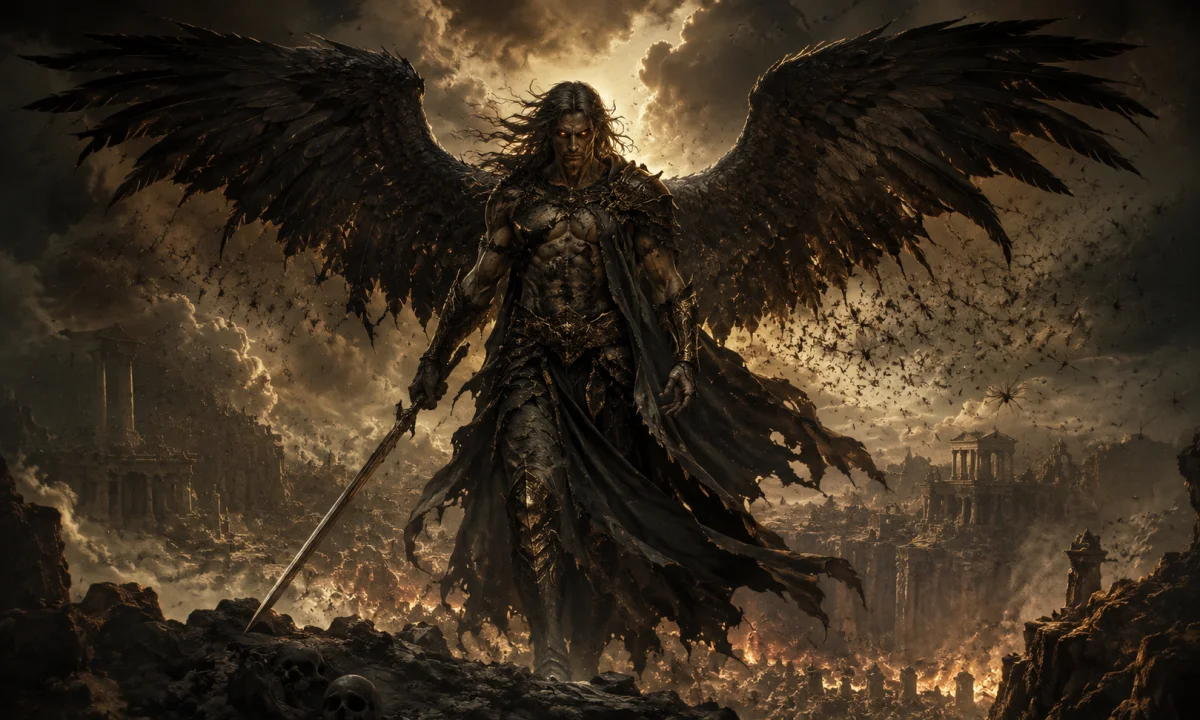
Abaddon is a figure from Jewish and Christian traditions whose meaning has shifted over time. In the Hebrew Bible, the word abaddon most often refers to “destruction” or the realm of destruction, not a personal being. In later Jewish interpretation and in the New Testament, especially the Book of Revelation, the name is associated with an angelic ruler of the abyss, and in Christian tradition it was often read as a destructive or demonic power. Because the sources differ, Abaddon is best understood as a name with layered meanings rather than a single fixed character.
Origins and scriptural background
The earliest occurrences of the term appear in the Hebrew Bible. There, abaddon is usually not a proper name but a noun connected with ruin, death, or the underworld. It is paired with terms such as Sheol, the realm of the dead, and appears in poetic and wisdom literature as a place associated with loss and oblivion. In these texts, the word functions as a vivid expression for the depth of destruction rather than as the name of a being.
One of the most important passages is in the Book of Job, where Abaddon is linked with the hidden regions known only to God. Similar language appears in Psalms and Proverbs, where death and destruction are spoken of as powers or places beyond human control. In these settings, the term belongs to Hebrew poetic vocabulary and reflects ancient Israelite ideas about mortality, the grave, and divine sovereignty.
The transformation of Abaddon into a personal figure is most clearly seen in the New Testament Book of Revelation. There, Abaddon is named as the angel of the abyss. The passage is brief but significant: the abyss is opened, locusts emerge in a plague-like vision, and their king is called Abaddon in Hebrew and Apollyon in Greek. This is one of the few places where the term is unmistakably treated as a proper name for a supernatural ruler.
Name, spelling, and meaning
The Hebrew form is usually transliterated as Abaddon. The word is related to a root meaning “to perish” or “to destroy,” which explains why it can signify both “destruction” and the place of destruction. In Greek, the corresponding name in Revelation is Apollyon, meaning “Destroyer.” The text itself makes the connection explicit by giving both Hebrew and Greek forms.
This dual naming is important because it shows how the figure moved across languages and interpretive traditions. In Jewish scripture, the term is primarily conceptual and poetic. In Christian apocalyptic tradition, it becomes personified. Later readers sometimes treated Abaddon as an angel, a demon, or even a title rather than a unique individual. The evidence does not support a single uniform identity across all traditions.
Some later religious and literary works spell or interpret the name differently, but the standard forms Abaddon and Apollyon are the most widely recognized in the traditional sources. It is important not to confuse this figure with similar-sounding names from unrelated traditions.
Abaddon in the Hebrew Bible
In the Hebrew Bible, Abaddon belongs to the language of death, ruin, and the hidden world beneath life. It appears alongside Sheol and other terms that describe the fate awaiting the dead. Rather than describing a ruler with a biography, these texts use Abaddon as a theological image: destruction is real, but it remains subordinate to God. Human beings may enter the realm of Abaddon, but they do not govern it.
The poetic force of the term is part of its significance. Ancient biblical writers often used parallelism, pairing related words to deepen meaning. Abaddon could stand beside death, the grave, or Sheol to emphasize finality and loss. In this sense, it belongs to a broader ancient Near Eastern and biblical vocabulary of the underworld, though the biblical text presents that world within its own theological framework.
Because the Hebrew Bible uses the word in this way, some modern readers who encounter Abaddon first in Revelation may assume it was always a personal evil being. That is not the case. The traditional material is more complex, and the name’s meaning developed over time.
Abaddon in Revelation
The most famous personal depiction of Abaddon is in Revelation 9. In the apocalyptic vision, the abyss is opened and a swarm of locust-like beings is released. They are not ordinary locusts, but monstrous agents of torment. Their king is described as the angel of the abyss, with the name Abaddon in Hebrew and Apollyon in Greek.
This scene is highly symbolic. Revelation uses vivid imagery to express divine judgment, imperial threat, spiritual conflict, and the terror of chaos unleashed. Abaddon in this context is not a comforting guardian or a neutral force. He is associated with devastation and the abyss, and he presides over destructive powers that torment humanity.
Scholarly interpretation varies on how to understand this figure. Some readers see Abaddon as an evil angel, others as a symbolic personification of destruction, and others as a demonic ruler framed within the book’s apocalyptic imagination. The text itself leaves room for debate, since Revelation often uses symbolic beings in ways that are both literal and figurative within its own visionary world.
It is also worth noting that Revelation’s use of Abaddon belongs to a broader apocalyptic pattern in which cosmic forces are named and dramatized. The book frequently presents evil in angelic, monstrous, or imperial forms. Abaddon fits that pattern as a named destructive power linked to the abyss.
Classification in religious tradition
In later Jewish and Christian tradition, Abaddon was often grouped among the powers of the underworld, the destroyer figures, or the fallen angels. However, that classification is not equally explicit in all sources. In the Hebrew Bible, the term is not a fallen angel at all. In Revelation, it is an angel of the abyss, but the text does not call him “fallen” in the same direct way later demonology does.
As a result, Abaddon occupies a somewhat ambiguous position. He can be read as:
- a poetic term for destruction or the realm of the dead,
- an angelic ruler of the abyss in apocalyptic vision,
- a destructive or demonic force in later interpretation.
This ambiguity is one reason Abaddon has remained influential. He is not a simple character with a fixed biography but a name through which traditions explored death, ruin, divine judgment, and cosmic disorder.
Appearance, powers, and symbolism
Traditional sources do not provide a detailed physical description of Abaddon. Revelation gives imagery associated with his domain rather than a portrait of his body. The central symbols are the abyss, destructive locusts, and torment. His power is therefore understood through function rather than appearance.
The main symbolic associations are:
- Destruction, reflected in the meaning of the name;
- The abyss, as his place of authority in Revelation;
- Death and ruin, from the older Hebrew usage of the term;
- Judgment, in the apocalyptic context where his actions form part of a larger divine scheme.
In Christian interpretation, especially in later centuries, Abaddon could be treated as a terrifying supernatural officer of destruction. In some traditions, he became one of several named demonic powers. Yet that later demonological status should not be projected back onto the Hebrew Bible, where the term is not a demon’s name.
Abaddon and the abyss
The connection between Abaddon and the abyss is one of the defining features of the Revelation passage. The abyss in biblical and apocalyptic literature is a deep, chaotic, or imprisoned space associated with forces kept under restraint until the time of judgment. It is not simply “hell” in a later doctrinal sense, though popular usage sometimes conflates the terms.
Abaddon as the angel of the abyss suggests command over that destructive realm. The vision presents him as an authority within a temporary, divinely permitted outbreak of judgment. That does not necessarily mean he is sovereign in an ultimate sense. In apocalyptic literature, even hostile beings often operate only within limits allowed by God’s larger purpose.
This distinction matters because some later retellings turn Abaddon into a fully autonomous demon of chaos. The traditional text is more restrained and more ambiguous. Its emphasis is on the terrifying opening of the abyss, not on a complete mythology of Abaddon’s origins or rebellion.
Relationship to Apollyon
Revelation’s pairing of Hebrew and Greek names is one of the clearest interpretive clues in the text. Abaddon and Apollyon are presented as equivalent names meaning “Destroyer.” The Greek term does not indicate a different figure; it is the translation of the Hebrew name.
This equivalence has sometimes caused confusion in later tradition, where Apollyon and Abaddon may be treated as separate names in demonology or fiction. In the scriptural source, however, they refer to the same being or same symbolic identity. The text’s bilingual naming underscores its audience’s mixed linguistic world and the universality of the destructive power being described.
Later Jewish and Christian interpretation
In post-biblical Jewish literature, the term could continue to denote the realm of destruction or death. In some interpretive traditions, it was expanded into a more personified figure, but such developments were not uniform and should not be overstated. The available evidence suggests that the original scriptural usage remained important even where later imagination added new layers.
Christian readers, especially in apocalyptic and devotional traditions, often treated Abaddon as a name for a fallen angel or demon. Medieval and early modern interpretations sometimes incorporated him into broader hierarchies of evil beings. These later systems were shaped by theology, folklore, and literary imagination, and they often drew on Revelation more than on the Hebrew Bible.
Because Christian demonology developed across many centuries and regions, there is no single universal traditional portrait of Abaddon outside scripture. Different communities emphasized different aspects: the abyss, destruction, infernal rank, or symbolic opposition to divine order. That variation should be expected in a figure whose scriptural basis is brief but powerful.
Distinction from similar figures
Abaddon is sometimes confused with other destroyer-type beings because the name itself suggests an almost archetypal role. It is important to distinguish him from unrelated figures who share thematic similarities.
He should not be conflated with:
- Apollyon as a separate being, since the two names are equivalents in Revelation;
- Azazel, a distinct figure from other Jewish traditions with different textual and ritual associations;
- generic satanic figures, since Abaddon’s scriptural profile is specific and not identical to Satan;
- later invented demons who borrow his name but have no basis in the biblical sources.
Such distinctions matter because modern occult literature, fantasy fiction, and some popular religious writing often blend these figures together. Traditional sources do not support collapsing them into one another.
Cultural significance
Abaddon’s significance lies partly in the way the name bridges concept and person. As a word, it expresses the nearness of destruction, death, and the limits of human life. As a being in Revelation, it gives destruction a face and a rank within an apocalyptic cosmos. That shift makes the name especially potent in theological and literary imagination.
The figure also reflects an important biblical pattern: destructive power is real, but it is never ultimately outside divine control. Even in the frightening visions of Revelation, the abyss is opened by a higher order of judgment. Abaddon embodies danger, but not final victory. For readers and believers, that combination made him an effective symbol of fear, order, and divine sovereignty.
In cultural history, Abaddon has been used to evoke ruin, desolation, and infernal authority. Writers and artists have drawn on the name because it carries a heavy emotional and symbolic charge. Its long afterlife shows how a brief scriptural term can become a major emblem of catastrophe.
Abaddon in modern popular culture
Modern popular culture uses Abaddon far more freely than the traditional sources do. Novels, comics, games, television series, and role-playing settings often present Abaddon as a demon lord, a fallen angel, a warlike monster, or a cosmic destroyer. These portrayals may borrow the name, the association with the abyss, or the idea of destruction, but they are not the same as the scriptural figure.
Some modern works amplify Abaddon into a fully developed character with motives, hierarchy, and history. Others use the name as a generic marker of apocalyptic evil. These creative adaptations are imaginative retellings, not traditional doctrine. They are best understood as modern cultural receptions of an ancient term whose original meaning was broader and more uncertain than later fiction suggests.
Where modern usage is concerned, the strongest continuity with tradition is the link to destruction and abyssal imagery. Beyond that, many details are inventions of later storytelling. That does not make them uninteresting, but they should be kept separate from the textual evidence.
Why Abaddon remains difficult to define
Abaddon resists simple categorization because the name belongs to more than one layer of tradition. In one layer, it is a Hebrew word for destruction or the realm of the dead. In another, it becomes the named angel of the abyss in Revelation. In still later layers, it is treated as a demon, a fallen angel, or a title for infernal power.
This range is not a flaw in the tradition; it is part of how religious language develops. Words that begin as metaphors or poetic expressions can become personified. Scriptural images can become theological figures. Later readers can turn symbolic language into mythic biography. Abaddon illustrates that process especially well.
For that reason, the most accurate way to speak of Abaddon is to keep the contexts distinct: Hebrew Bible, New Testament apocalyptic vision, later interpretive tradition, and modern imaginative adaptation. Each layer adds something, but none should be treated as if it exhausts the whole meaning of the name.