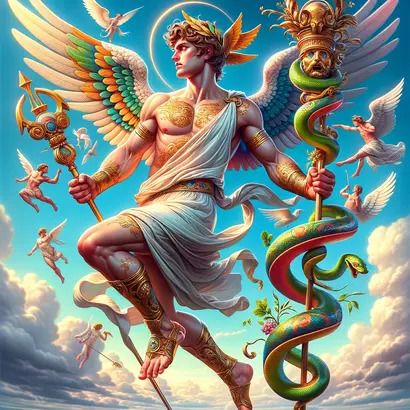
In Greek mythology, Hermes is one of the most fascinating and multifaceted deities. Known as the messenger of the gods, he plays a crucial role in various myths and legends. Hermes is often depicted with winged sandals and a winged helmet, symbolizing his speed and agility. He is not only the messenger but also the god of trade, thieves, travelers, and sports. His ability to move freely between the mortal and divine realms sets him apart from other gods. This article will delve into the different aspects of Hermes, exploring his origins, attributes, and significance in Greek mythology.
Origins of Hermes
Hermes was born to Zeus, the king of the gods, and Maia, one of the Pleiades. According to myth, his birth took place in a cave on Mount Cyllene. From the very beginning, Hermes exhibited remarkable qualities. He was born in the early hours of the day and, even as an infant, displayed an unusual cunning and intelligence. On the day of his birth, he is said to have stolen cattle from Apollo, showcasing his mischievous nature. This act of thievery would later define his character as the god of thieves.
 Hespera
The story of Hermes’ birth is rich with symbolism. His mother, Maia, was known for her beauty and grace, traits that Hermes inherited. His father, Zeus, represented power and authority. This combination of lineage gave Hermes a unique position among the gods. He was not only a messenger but also a bridge between the divine and mortal worlds. His dual nature allowed him to traverse both realms with ease, making him an essential figure in many myths.
Attributes of Hermes
Hermes is often depicted with specific attributes that highlight his various roles. One of his most recognizable symbols is the caduceus, a staff entwined with two serpents. This staff represents peace and commerce and is often mistaken for a symbol of medicine. Hermes is also portrayed wearing winged sandals, known as talaria, which grant him the ability to fly swiftly. Additionally, he wears a winged helmet, further emphasizing his speed and agility.
His attire often includes a traveler’s cloak, symbolizing his role as the god of travelers. Hermes is also associated with herms, stone pillars that were erected as boundary markers. These pillars served not only as physical markers but also as protective symbols for travelers. The presence of herms is a testament to Hermes’ guardianship over those who journey from one place to another.
 Hesperides
Hermes in Mythology
Hermes appears in numerous myths, each showcasing different aspects of his character. One of the most famous stories is his role in the abduction of Persephone. In this myth, Hermes is tasked with guiding Persephone to the Underworld after she is taken by Hades. His role as a messenger is crucial, as he must navigate the realms of the living and the dead. This story highlights his ability to move freely between worlds, reinforcing his significance in Greek mythology.
Another important myth involving Hermes is the story of his theft of Apollo’s cattle. As a newborn, Hermes devised a clever plan to steal Apollo’s herd. He crafted sandals to disguise his tracks and used a tortoise to create the first lyre. When Apollo discovered the theft, he was furious. However, Hermes charmed him with the lyre, and the two gods eventually formed a bond. This myth illustrates Hermes’ cunning nature and his ability to use his intelligence to resolve conflicts.
Hermes and the Underworld
Hermes’ connection to the Underworld is another significant aspect of his mythology. He is known as Hermes Psychopompos, the guide of souls. In this role, he escorts the souls of the deceased to the afterlife. This duty underscores his importance in the cycle of life and death. Hermes ensures that souls reach their final destination, providing a sense of closure for the living.
 Hesperus
The role of Hermes as a psychopomp is often depicted in art and literature. He is portrayed as a compassionate guide, leading souls through the treacherous journey to the Underworld. This aspect of Hermes highlights his duality; while he is a trickster and a thief, he is also a protector and guide. His ability to navigate both realms allows him to fulfill this important role effectively.
Hermes in Art and Literature
Hermes has been a popular figure in ancient art and literature. Many classical sculptures depict him in various poses, often showcasing his winged sandals and caduceus. Artists have portrayed Hermes as a youthful figure, embodying both beauty and intelligence. The Hermes of Praxiteles is one of the most famous sculptures, depicting him as a graceful young man holding the infant Dionysus.
In literature, Hermes appears in many ancient texts, including Homer’s Iliad and Odyssey. In these epic poems, Hermes plays vital roles, often acting as a messenger for the gods. His cleverness and resourcefulness are highlighted throughout these stories, making him a beloved character in Greek mythology. Additionally, many later works, including those of the Roman poet Ovid, feature Hermes, further solidifying his place in the literary canon.
Hermes and Modern Culture
The influence of Hermes extends beyond ancient mythology and into modern culture. His image and attributes have been adopted in various contexts, from literature to branding. The caduceus is widely recognized today, often associated with medicine and healthcare, despite its origins in commerce and trade. This misunderstanding highlights how ancient symbols can evolve over time, taking on new meanings.
In literature, Hermes continues to inspire contemporary authors and creators. Many modern retellings of Greek myths feature Hermes as a central character, showcasing his charm and wit. Additionally, Hermes appears in popular media, such as films and video games, where he is often portrayed as a mischievous but helpful figure. This ongoing fascination with Hermes demonstrates his enduring appeal and relevance in modern storytelling.
Hermes and Philosophy
Hermes also holds a significant place in philosophy, particularly in the context of Hermeticism. This philosophical system, based on the teachings attributed to Hermes Trismegistus, combines elements of Greek and Egyptian thought. Hermeticism emphasizes the pursuit of knowledge and the understanding of the cosmos. Hermes is seen as a symbol of wisdom and enlightenment, guiding seekers on their spiritual journeys.
The writings associated with Hermeticism explore themes of alchemy, astrology, and the nature of the divine. These texts have influenced various philosophical and spiritual movements throughout history. The figure of Hermes as a teacher and guide resonates with those seeking deeper understanding and connection to the universe. This aspect of Hermes’ legacy continues to inspire individuals interested in mysticism and philosophy.
Hermes is a complex and multifaceted figure in Greek mythology. His roles as a messenger, guide, and protector highlight his significance in various myths and legends. From his cunning nature to his connection with the Underworld, Hermes embodies the duality of existence. His influence extends into modern culture, art, and philosophy, making him a timeless character that continues to captivate audiences. Whether as a trickster or a wise guide, Hermes remains an essential part of the rich tapestry of Greek mythology.