WORLD
WORLD
Yingarna
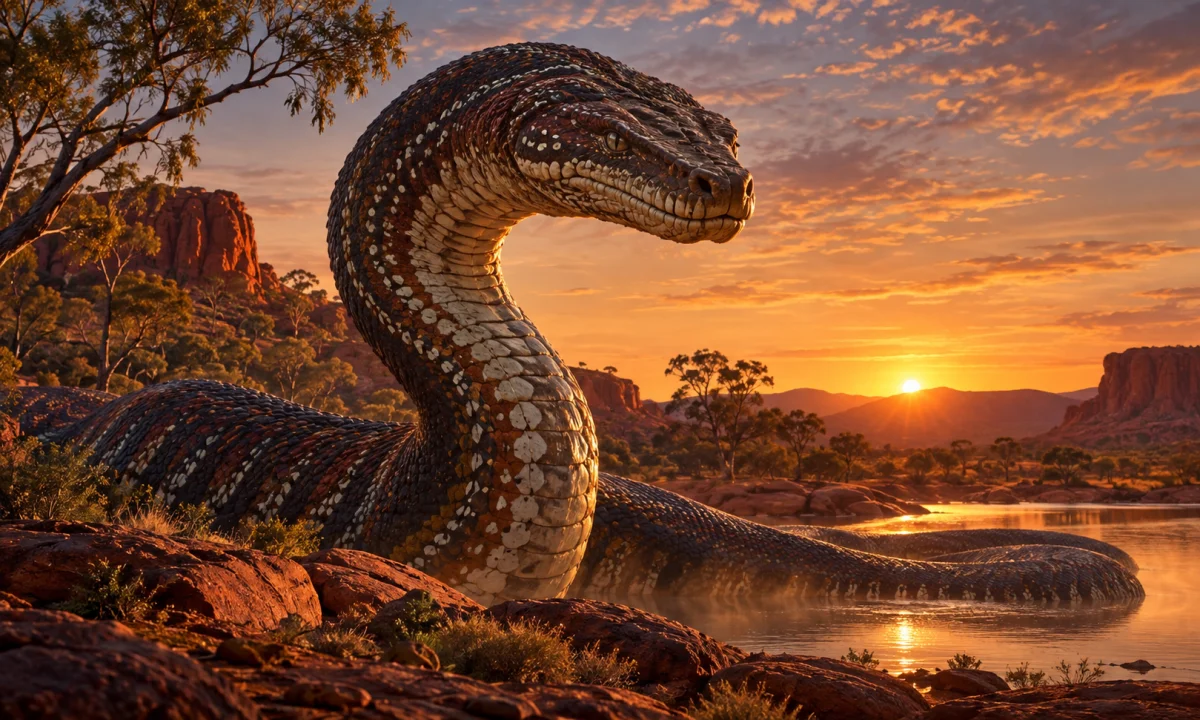
Yingarna is an ancestral creator being in the traditions of the Kunwinjku people of western Arnhem Land in northern Australia. She is commonly described as a powerful female Rainbow Serpent and as an ancestral mother associated with the creation of people, waterways and important places. Like other ancestral beings of Aboriginal Australian traditions, Yingarna belongs to a living religious and cultural system rather than to a single set of ancient stories separated from present-day life.
Accounts of Yingarna are connected especially with Kunwinjku-speaking communities around western Arnhem Land, including the region near Gunbalanya and the stone country of Kakadu and western Arnhem Land. The details available to wider audiences come from a combination of oral transmission, Indigenous explanations, ethnographic records and contemporary artistic practice. These accounts do not form one universally fixed narrative. Knowledge may vary between communities, families and custodians, and some aspects may be restricted or unsuitable for public discussion.
Cultural setting
Yingarna is understood through the religious framework often called the Dreaming in English. “Dreaming” is a useful but imperfect translation for a range of Aboriginal concepts concerning ancestral beings, creation, law, country, ceremony and continuing spiritual presence. It does not refer only to dreams or to a remote mythical age. The actions of ancestral beings are understood to remain present in the landscape and to establish obligations for people living there.
In this worldview, country is not merely physical territory. Waterholes, rivers, hills, rock formations, plants and animals may all be connected with ancestral actions. Stories explain how places came into being, but they also convey law and responsibilities. Knowledge of a particular site can include rules about behaviour, ceremony, kinship, resource use and the protection of sacred information.
Yingarna therefore should not be treated simply as an Australian equivalent of a dragon or as a general “rainbow goddess”. Her significance depends on the relationships between ancestral beings, named places, clans, ceremonies and the living custodians of country. Descriptions made for a broad audience necessarily leave out knowledge that is private, ceremonial or restricted.
Name and identity
The spelling Yingarna is widely used in English-language descriptions of Kunwinjku traditions, but spelling can vary when Aboriginal names are written in English. Forms such as Yingana may appear in older records or in accounts using different orthographic conventions. Such variation does not necessarily indicate a different being, although names must always be checked against the community and tradition in which they are used.
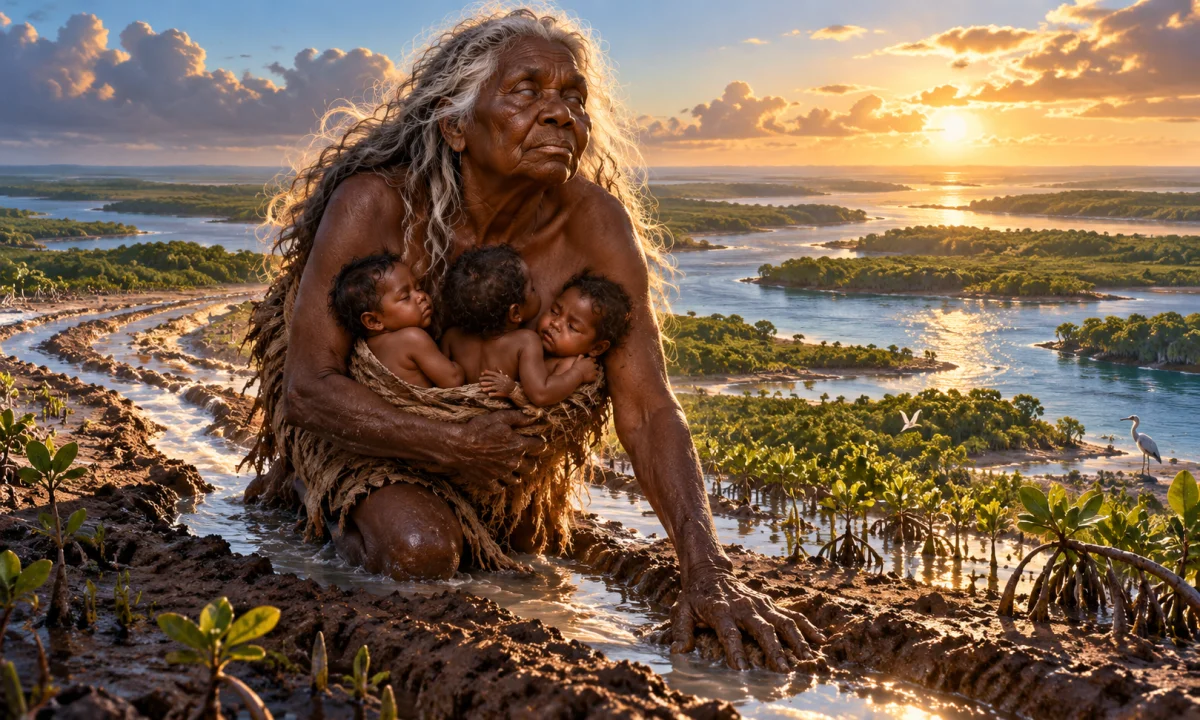
Yingarna is often identified as a female Rainbow Serpent or as a great ancestral mother associated with the Rainbow Serpent tradition. In some Kunwinjku accounts she is described as the mother of people or as an ancestral source from which human life and other beings emerged. She is also linked with the creation and animation of water sources. These descriptions are related, but not every public account presents her role in exactly the same way.
The term “Rainbow Serpent” itself is a broad English label. Aboriginal peoples across Australia have many different serpent beings, and their names, genders, powers and stories differ greatly. Some are associated with rain, storms, rivers or fertility; others are guardians of sacred places, agents of punishment or creators of particular landscapes. Yingarna belongs to the cultural traditions of western Arnhem Land and should not be presented as a single pan-Aboriginal deity shared identically by all Aboriginal peoples.
Form and attributes
Yingarna is generally imagined in serpent form, particularly as a vast and powerful snake connected with water and the rainbow. Her serpent body expresses movement through the landscape and the capacity to travel between different kinds of country. The rainbow is an important visual association because it can appear after rain, linking the sky with the water that sustains life below.
Her appearance is not limited to a zoological description. In Aboriginal art and religious thought, an ancestral being may be represented through patterns, tracks, colours and signs that refer to its presence rather than provide a literal portrait. A depiction of a serpent may therefore communicate country, ancestral power, ceremony or a particular story as much as physical appearance.
Yingarna’s major attributes include:
- ancestral motherhood: she is associated in public accounts with the origin or birth of people and other ancestral beings;
- water and life: her movements are connected with freshwater places, rain and the availability of water in a demanding environment;
- creation of country: she is linked with the formation or spiritual animation of places across western Arnhem Land;
- law and responsibility: her story belongs to a system in which ancestral actions establish obligations for descendants and custodians;
- danger and power: like many Rainbow Serpent beings, she is not merely benevolent and may be approached with respect and caution.
The balance between nurturing and dangerous qualities is significant. A serpent that creates water and life can also represent forces that must not be disturbed. Flooding, storms, deep water and violations of sacred law may all be associated with the power of Rainbow Serpent beings. Public summaries should not turn this complexity into a simple opposition between a friendly creator and an evil monster.
Creation journeys and the landscape
Public versions of Yingarna’s story commonly describe her as travelling through country during the ancestral era. As she moved, places were created, marked or given spiritual significance. Waterholes and other water sources are particularly important in accounts of her journey. Her movement may explain why a place exists, how it received its character and why it must be treated according to particular rules.
Some accounts describe Yingarna as emerging from or travelling from the sea before moving inland. Other versions focus on her passage through freshwater country and on the birth of people or ancestral beings along the route. These differences reflect the fact that Aboriginal traditions are transmitted through many forms, including local oral histories, song, ceremony, painting and knowledge of named places. They should not automatically be harmonised into one continuous story.
The phrase “creation story” can also be misleading if it suggests that the events happened only once in a distant past. For custodians, ancestral journeys may remain active through ceremony, language, kinship and the continuing existence of the places shaped by them. A waterhole connected with Yingarna is not simply evidence of an old event; it can be part of a living relationship between people and country.
Yingarna and other Rainbow Serpent beings
Confusion often arises because western Arnhem Land has several important serpent traditions and because the English phrase “Rainbow Serpent” is used broadly. In Kunwinjku contexts, Ngalyod is a major Rainbow Serpent figure frequently discussed in relation to rock art, ceremony and contemporary Kunwinjku painting. Yingarna and Ngalyod should not automatically be treated as interchangeable names.
Accounts differ concerning the relationship between them. Some describe Yingarna as an ancestral mother or progenitor associated with other Rainbow Serpents, including Ngalyod. Other presentations focus on Yingarna as a particular female Rainbow Serpent and do not set out a detailed genealogy. The relationship may also depend on the community, story cycle or level of knowledge being discussed. It is more accurate to acknowledge these variations than to assert a single family tree as universal.
Nor should Yingarna be merged with serpent beings from other regions. The Wagyl of south-western Australia, the Rainbow Serpent traditions of central Australia and the many water-serpent figures of northern Queensland belong to different cultural settings. Similar themes—water, fertility, rain, danger and landscape creation—do not prove that all these beings are one deity.
Gender and the figure of the ancestral mother
Yingarna’s feminine identity is an important feature of many public accounts. She is associated with motherhood, birth and the continuation of human life, but these associations should not be reduced to a simple fertility symbol. Her maternal role is also connected with country, law and collective identity. To speak of Yingarna as a mother can refer to the origin of people, the provision of water and the ancestral foundations of social relationships.
Gender in Aboriginal religious traditions does not always operate in the same way as gender categories in European mythology. An ancestral being may have several manifestations, relationships or ceremonial aspects. English descriptions can also simplify local terms and distinctions. For that reason, Yingarna’s identification as female should be retained while recognising that her religious role is broader than a modern category such as “mother goddess”.
Relationship to people and country
Yingarna’s importance lies partly in the relationship she creates between human beings and their home country. If people are descended from or brought forth by an ancestral mother, their connection to country is not merely historical or economic. It is inherited, spiritual and practical. People may have responsibilities to protect places, observe ceremonial rules, care for water and maintain the knowledge associated with their ancestral estates.
This relationship also helps explain why a story about Yingarna cannot be separated entirely from questions of cultural authority. A public account may name the being and describe her general role, while more detailed knowledge remains with the relevant custodians. The right to tell a story, paint a design or speak about a sacred place may depend on kinship, initiation, gender, community permission or other forms of cultural authority.
Descriptions of Yingarna should therefore avoid treating Indigenous stories as free-floating material available for unlimited reinterpretation. The tradition is not only a collection of images or plot elements. It is part of the continuing intellectual, religious and legal life of Aboriginal communities.
Sources and transmission
There is no single ancient book that preserves a definitive account of Yingarna. As with many Aboriginal Australian traditions, knowledge has been transmitted primarily through oral teaching, performance, ceremony, language and relationships to country. Paintings, recorded interviews, museum descriptions and scholarly studies provide valuable evidence, but each represents a particular context and may preserve only part of the relevant tradition.
Older colonial records must be read carefully. They often used inconsistent spellings, imposed European categories and recorded information without fully understanding local languages or cultural restrictions. Modern community-led explanations and Indigenous artistic statements are especially important for understanding how Kunwinjku people represent and interpret their own ancestral beings. Even then, a public statement should not be assumed to disclose every aspect of the tradition.
Contemporary Aboriginal art has helped make figures such as Yingarna and Ngalyod known beyond Arnhem Land. Artists may use ancestral imagery to communicate connections to country, law and identity while also engaging with galleries, museums and a national art market. A painting of a Rainbow Serpent is not necessarily an illustration of a complete public myth. It may refer to a particular site, inherited story, ceremonial responsibility or artistic lineage.
Modern representation
Yingarna has not become as widespread in global popular culture as some figures from Greek, Norse or Egyptian mythology. She is more often encountered through exhibitions of Aboriginal art, cultural education, writing about Arnhem Land and discussions of Australian Indigenous traditions. In these settings, she should be presented as a living cultural figure rather than as a character belonging only to a vanished prehistoric religion.
Modern retellings sometimes use Yingarna as a generic symbol of the “Rainbow Serpent” or as an all-purpose earth mother. Such adaptations can obscure her specific Kunwinjku context and may incorrectly combine her with unrelated beings. A responsible representation identifies the tradition in which the name is used, distinguishes public knowledge from restricted knowledge and avoids claiming that one version explains every Aboriginal serpent tradition.
Yingarna is best understood as a powerful ancestral mother and Rainbow Serpent of western Arnhem Land, whose significance is inseparable from water, country, kinship and law. Her stories are not only accounts of how the world began. They express continuing relationships between people, ancestral presence and the places through which those relationships are lived.