WORLD
WORLD
Wati-kutjara
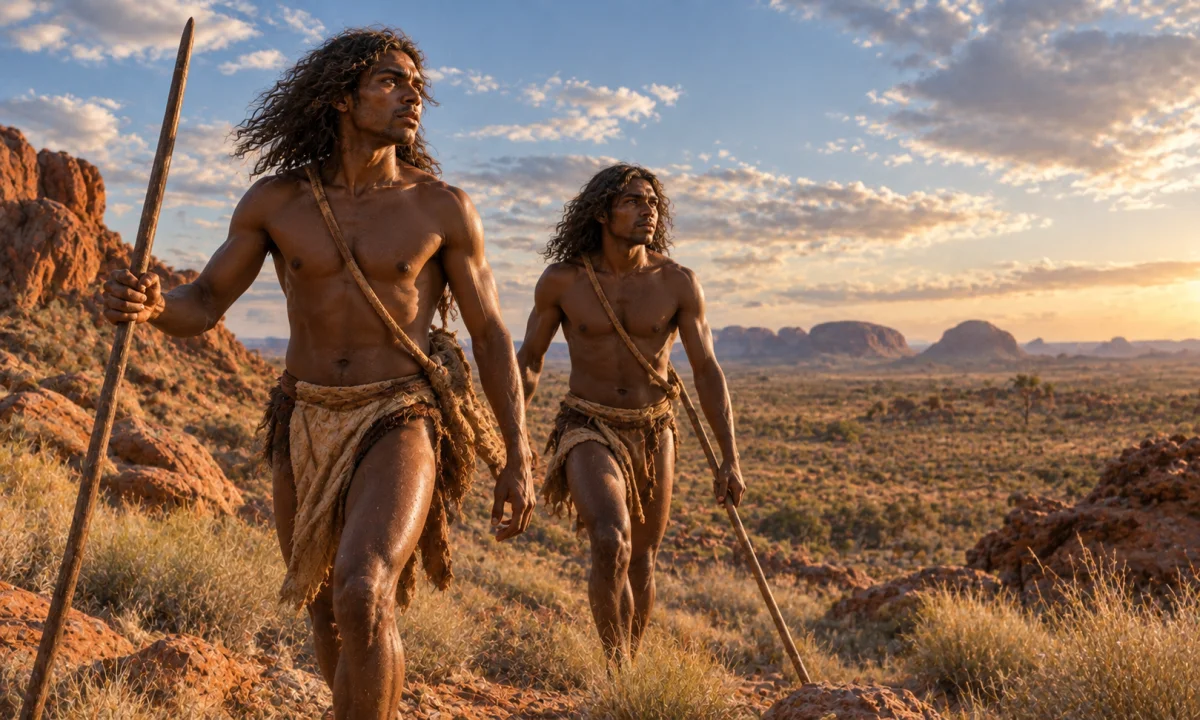
Wati-kutjara, also written Wati Kutjara or Wati-kutjara Tjukurpa, is the name commonly translated as “Two Men” in several Western Desert Aboriginal traditions of Australia. The name generally refers not to one individual creature, but to a pair of ancestral men whose travels, encounters and actions belong to a wider body of Tjukurpa—often translated into English as the Dreaming or Dreamtime. Their story is especially associated with Western Desert peoples, including Pintupi communities, although the details, names and emphasis vary between language groups and custodians.
Wati-kutjara is best understood as a ancestral narrative cycle rather than a single, fixed myth. In these traditions, ancestral beings move through a country that is both physical and spiritually significant. Their journeys explain features of the landscape, establish relationships between people and places, and connect living communities with inherited law, ceremony, song and visual designs. The Two Men are therefore not simply characters in an old story. They belong to a continuing cultural framework in which ancestral events remain relevant to country and to the responsibilities of its custodians.
Cultural setting
Western Desert cultures encompass a large region of central and western Australia. It includes areas now associated with Western Australia, the Northern Territory and South Australia, and contains many distinct Aboriginal language groups and communities. The term “Western Desert” is useful for discussing related traditions, but it should not be taken to mean that all communities share one identical religious system or one uniform version of every ancestral story.
In many Western Desert traditions, Tjukurpa concerns the actions of ancestral beings during the foundational era. English words such as “myth,” “legend” and “religion” only partly convey its meaning. Tjukurpa can include accounts of ancestral journeys, rules for social conduct, ceremonial knowledge, relationships to land, obligations to kin and explanations of natural features. It is not merely a distant past. The ancestral order continues to inform present-day life.
Knowledge of such traditions is often transmitted through several forms at once. These may include spoken narratives, ceremonial performance, songs, dances, designs, paintings, sacred places and detailed knowledge of routes across country. A single public name may therefore refer to a much larger body of knowledge than can be represented in a short written account. Some parts of Wati-kutjara traditions are restricted, and versions intended for public discussion do not necessarily disclose all ceremonial or local meanings.
The name and identity of the Two Men
Wati is commonly translated in Western Desert languages as “man,” “male person” or, depending on context and language, “young man.” Kutjara is widely glossed as “two.” The compound is consequently rendered as “Two Men” or sometimes “Two Young Men.” Spellings differ because Western Desert languages have different orthographies and because English-language publications represent sounds in varying ways.
The expression does not always indicate exactly the same figures in every community. In some accounts the pair are described as brothers, while other public representations simply call them two ancestral men. It is safer to speak of them as a paired set of ancestral beings than to impose a single family relationship across all versions. Descriptions of their age, character and precise identity can also differ according to local tradition and the context in which the story is being told.
Wati-kutjara should not automatically be classified as “gods” in the sense used for the deities of ancient Mediterranean or Near Eastern religions. They are ancestral beings within Aboriginal religious traditions. Their authority comes from their place in Tjukurpa and their relationship to country, law and ceremony. They may possess extraordinary abilities, but the central issue is not a hierarchy of omnipotent gods. It is the continuing force of ancestral action and inherited obligation.
Their journeys through country
Public accounts commonly describe the Two Men as travelling through the Western Desert. Like many ancestral travel narratives, these journeys are linked to particular places, tracks, water sources, hills, rock formations and other features of country. As they move, events associated with them help explain how the land acquired its present form or why a place has particular ceremonial significance.
The journey may also involve encounters with animals, other ancestral beings and human communities. Hunting, searching for water, pursuing an enemy, responding to danger or dealing with social relationships can all form part of the narrative cycle. Such episodes are not simply adventures. They can communicate principles concerning proper behaviour, kinship, marriage, sexuality, ritual authority, the use of resources and obligations to particular places.
Because the stories are attached to routes across country, they are sometimes described as songlines. That term is useful but should be used carefully. A songline is not merely a song that tells a story; it may encompass a network of sung place-names, remembered routes, ceremonies, ecological knowledge and ancestral law. The Wati-kutjara cycle, where held by particular custodians, can therefore function as a map of cultural knowledge as well as a narrative of ancestral events.
Different locations in the cycle may be represented by distinctive designs or motifs in Western Desert art. A painting labelled “Wati Kutjara” may not illustrate one scene in the manner of a European history painting. It may encode a route, a set of sites, a ceremonial association or a section of inherited knowledge. The meaning of dots, lines, concentric forms and other visual elements depends on the artist’s community, artistic conventions and the knowledge being communicated.
Attributes and powers
The Two Men are generally presented as human-like ancestral figures rather than as monsters or animal spirits. Their significance lies in what they do and what they establish. They travel over great distances, survive in a demanding environment, interact with other beings and leave enduring marks upon the country. Their actions can be creative, dangerous, instructive or transformative.
As ancestral beings, they may not be subject to ordinary human limitations. However, descriptions of supernatural “powers” can be misleading if they make Wati-kutjara resemble a fantasy character. The important feature is their participation in the ancestral order. A landscape feature associated with their passage is not simply the result of magic; it is part of a living relationship between land, story, ceremony and community.
Some public discussions describe the pair as hunters or travellers, but these labels do not exhaust their role. The same ancestral figures can be understood through several connected dimensions: as protagonists in a narrative, as founders or transmitters of law, as presences associated with specific places and as subjects of contemporary artistic practice. The balance between these aspects depends on the tradition and on what may appropriately be made public.
Stories, relationships and local variations
There is no single universally authoritative written version of the Wati-kutjara cycle. Aboriginal religious knowledge was maintained primarily through oral, ceremonial and artistic traditions, and many versions were recorded by outsiders only after sustained contact with communities. Written records may preserve valuable information, but they are selective and shaped by the circumstances of recording, translation and publication.
For this reason, broad statements about the Two Men should not be expanded into invented details. The pair are sometimes called brothers in English-language descriptions, but that relationship should not be assumed in every local account. Likewise, claims that they always begin their journey in one particular place, follow one fixed route or possess one consistent set of enemies may reflect a specific community’s version rather than the entire Western Desert tradition.
There can also be differences in the level of detail that is publicly available. Certain stories may be suitable for children or general education, while other knowledge is connected with initiation, gender-specific instruction or restricted ceremony. An apparently simple narrative may have deeper meanings that are not disclosed outside the relevant community. Respect for custodial authority is essential when interpreting these traditions.
Religious and social significance
Wati-kutjara illustrates the close relationship between ancestral narrative and geography in Aboriginal Australia. The country is not treated as an empty setting for supernatural events. Places have histories, names, moral associations and responsibilities. Knowledge of an ancestral route can involve knowledge of where to find water, how to move through a region, which sites are dangerous or sacred, and which people hold authority for particular traditions.
The Two Men’s cycle can also help express the connection between individual communities and a much larger cultural landscape. Ancestral tracks cross areas occupied by different language groups, but this does not erase local distinction. Instead, shared or related narratives may be held in different forms, with each community maintaining its own rights, interpretations and ceremonial responsibilities.
In this setting, “belief” is an incomplete description. Wati-kutjara traditions are not merely propositions about supernatural characters. They can shape conduct, identity, art, education, ritual life and relationships to land. The stories help explain why certain places matter and why particular people have duties toward them. Their authority is practical as well as spiritual.
Wati-kutjara in Western Desert art
The Two Men are prominent in discussions of Western Desert painting and related forms of Aboriginal art. Artists may represent their travels through abstract or semi-abstract arrangements of lines, circles, tracks and other signs. These works are often described in museum and gallery settings as “Dreaming paintings,” but the label should not suggest that the works are merely imaginative illustrations.
A painting associated with Wati-kutjara may communicate ancestral geography and cultural ownership. Its imagery may be deliberately simplified or coded, and an artist may choose to reveal only the level of information appropriate for a public audience. The title gives an important clue, but it does not provide a complete interpretation. The artist, community and cultural context remain central.
Contemporary artists have also adapted inherited visual languages to changing materials and markets. This does not make the underlying tradition a modern invention. At the same time, not every artwork carrying the words “Two Men” should be treated as a complete or universally representative account of Wati-kutjara Tjukurpa. Museum labels and commercial descriptions can compress complex local knowledge into a short English title.
Distinguishing Wati-kutjara from similar figures
Wati-kutjara is sometimes confused with other Aboriginal ancestral pairs or with generic “two brothers” stories. Australia contains hundreds of Aboriginal nations and many distinct traditions involving brothers, male ancestors, creator beings and travelling heroes. A shared narrative pattern does not prove that the figures are the same.
The name should also not be confused with every use of the words wati or kutjara in Australian languages. Western Desert languages are related but not identical, and the meaning or spelling of a word can vary between languages and orthographies. A translation such as “two men” identifies the broad sense of the name, not necessarily the full cultural identity of the figures.
Nor should Wati-kutjara be treated as an Aboriginal equivalent of a pair of twins from Greek, Norse or other mythologies. Comparisons may be useful when carefully framed, but they can obscure the particular relationship between Tjukurpa, country, ceremony and custodianship. The Two Men belong to the cultural worlds of the communities who hold their traditions, not to a universal category of “twin heroes.”
Modern reception
Wati-kutjara is relevant in contemporary Australia chiefly through Aboriginal cultural practice, visual art, community education, museums and discussions of land and heritage. The figures may appear in exhibitions, catalogues and educational material, but these modern presentations are not separate “adaptations” in the same sense as a film or fantasy novel. They are often part of continuing cultural transmission, even when the medium is contemporary.
Popular culture sometimes reduces Aboriginal ancestral beings to exotic characters or treats the Dreaming as a collection of interchangeable legends. Such portrayals can remove the figures from their language groups, landscapes and custodial relationships. A responsible account keeps those contexts visible, acknowledges variation, and avoids presenting restricted or locally held knowledge as universally available.
Wati-kutjara therefore remains best approached as a living and regionally grounded tradition: a pair of ancestral men whose journeys are connected with Western Desert country, Tjukurpa, law, ceremony and art. The English translation “Two Men” is useful as an introduction, but it does not replace the local languages, custodians and cultural settings that give the name its full meaning.