WORLD
WORLD
Waramurunggundji
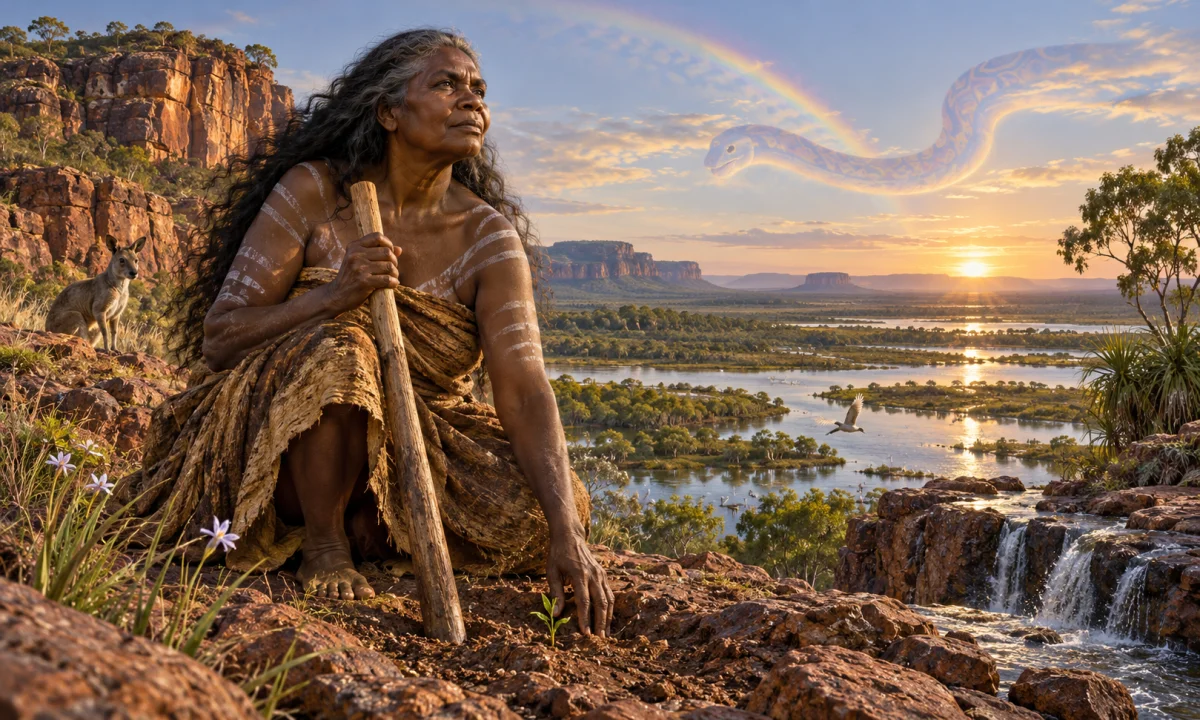
Waramurunggundji is an ancestral creator figure associated particularly with Aboriginal traditions of western Arnhem Land in the Northern Territory. Her name is also written as Warramurrungundji, Waramurrungundji and in several other forms. In accounts connected with Kunwinjku-speaking communities—formerly often identified in older writing by the spelling “Gunwinggu”—she is described as a powerful female ancestral being who helped establish the land, human life, language and social order.
Waramurunggundji belongs to the religious world often called the Dreaming in English. The Dreaming is not simply a collection of stories about a distant mythical past. It refers to enduring ancestral realities that explain the formation of country, the origins of living beings, correct social relationships, ceremonial responsibilities and connections between people and particular places. Consequently, descriptions of Waramurunggundji should not be treated as a single fixed legend with one universally accepted plot. Different communities, families, storytellers and researchers have recorded versions that vary in detail.
Cultural setting
Waramurunggundji is most often associated with Arnhem Land, a large region of northern Australia whose Aboriginal peoples have maintained rich and distinct religious traditions. Western Arnhem Land contains many language groups and cultural communities. Although neighbouring peoples may share ancestral themes, a name, story or ceremonial interpretation cannot automatically be transferred from one community to another.
The traditions connected with Waramurunggundji are especially linked in published descriptions with the Kunwinjku people and related communities. Older ethnographic and popular writings frequently used “Gunwinggu” or similar spellings. Contemporary usage often prefers Kunwinjku, although the relationship between historical labels, language names and community identities is not always simple. The spelling of the ancestral name also changes because it has been written by people using different systems to represent Aboriginal languages.
Knowledge about Waramurunggundji has been preserved through oral teaching, ceremonial practice, visual art, place-based traditions and the work of Aboriginal artists and cultural custodians. Written accounts are generally records made by outsiders or by later researchers, rather than ancient texts composed in the European sense. Such records may be incomplete, may reflect the questions asked by the researcher and may not include knowledge restricted by age, gender, initiation or ceremonial authority.
Name and identity
The form Waramurunggundji is one of several English spellings used for the same or a closely related ancestral name. Warramurrungundji is another widely encountered form. Differences such as doubled consonants, the use of w or omission of sounds can reflect different orthographies, dialects or attempts to represent sounds that are not easily rendered in English.
She is commonly described as a female ancestral creator, but the English word “goddess” can be misleading. In many Aboriginal religious traditions, ancestral beings are not distant supernatural rulers who merely govern the world. They are connected to identifiable places, species, laws, ceremonies and living communities. Their actions continue to shape the present, and their stories often function as statements of responsibility rather than as entertainment alone.
Nor should Waramurunggundji be assumed to be a universal Aboriginal creator. Aboriginal Australia contains hundreds of language groups and many distinct religious systems. A creator figure known in western Arnhem Land does not automatically have an equivalent role among peoples elsewhere on the continent.
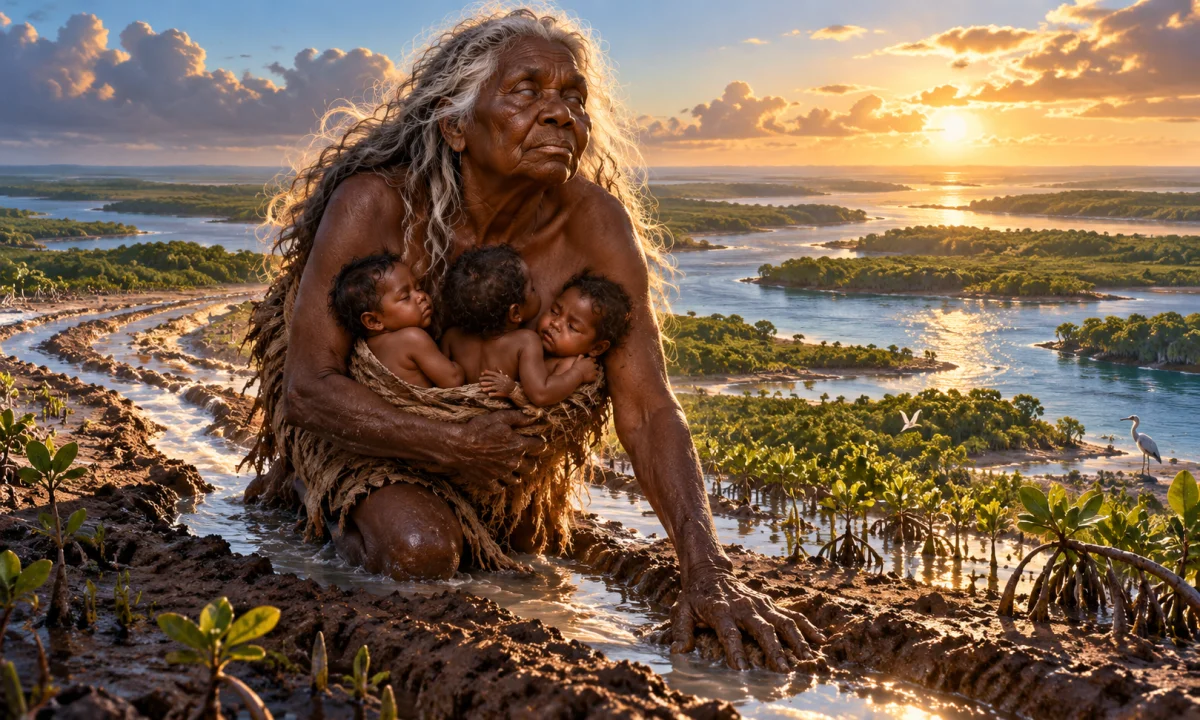
The creator and mother of life
In the accounts most often associated with her, Waramurunggundji is a generative ancestral presence. She is linked with the arrival or establishment of human beings and with the ordering of the world in which they live. Some tellings portray her as travelling through country, bringing life into existence or placing living beings in their proper environments. Others emphasise her role as a mother and teacher who gave people language, customs and knowledge necessary for communal life.
Her creative work is therefore broader than the manufacture of physical objects. The world she helps establish includes social rules, kinship obligations, ceremonial practices and the relationships between people and country. Creation in this setting is an ongoing moral and ecological arrangement. A story about where a person, animal, waterhole or hill came from may also explain who has the right to care for that place and what conduct is required there.
Some accounts describe Waramurunggundji as emerging from or arriving from the sea before moving through the land. This marine association is significant in a region where coastal waters, islands, estuaries, rivers and inland country are closely connected. However, the precise sequence of her movements and the places associated with her are not identical in every account. A general description of her as a creator who travelled through country is safer than treating one recorded itinerary as the definitive version.
She is also associated with the origin or distribution of languages. In many Aboriginal traditions, language is inseparable from country and ancestral identity. Different groups may be understood to have received distinct languages as part of the ordering of the world. Waramurunggundji’s role as a source of language thus presents her not merely as a mother of biological life, but as an ancestor of cultural identity and social knowledge.
Travels, country and transformation
Dreaming narratives frequently connect ancestral journeys with visible features of the landscape. An ancestral being may leave behind a hill, rock, spring, watercourse, island or other significant site. These places are not only reminders of an event in the past; they can be living centres of law, ceremony and custodianship.
In stories associated with Waramurunggundji, her movements through the world are understood in this kind of place-based way. She is connected with the shaping of country and with the establishment of the conditions in which people, animals and plants can live. The surviving summaries do not always identify the same sites or provide the same sequence of events, so individual geographic claims need to be treated as belonging to particular local tellings rather than to an all-purpose account.
Like many ancestral beings in Australian Aboriginal traditions, Waramurunggundji may be described as undergoing a transformation or entering a lasting relationship with the land. Such transformations are not necessarily a disappearance or death in the ordinary human sense. They express the continuing presence of the ancestor in country. Ancestral power may remain in a rock, spring, cave, hill or stretch of coastline, where it is approached through appropriate cultural knowledge and ceremony.
Relationships with other ancestral beings
Some written accounts place Waramurunggundji alongside a male ancestral figure called Wuragag, or describe the two as connected within creation traditions from western Arnhem Land. Their precise relationship varies in the literature. In some presentations, Wuragag has a complementary creative role; in others, the focus is more strongly on Waramurunggundji as the originator or mother of human life.
These figures should not be combined simply because they appear in the same summaries. Nor should a relationship recorded in one community be assumed to apply everywhere that the names are known. Aboriginal religious knowledge can be held by particular custodians and may be presented differently according to ceremonial context. Information made public in an ethnographic account may also be only one part of a much larger body of tradition.
Waramurunggundji should likewise be distinguished from other important ancestral figures of Arnhem Land, including beings associated with storms, lightning, fire, animals or particular ceremonial systems. Similar functions—such as creating land or teaching people—do not prove that two figures are versions of one another. Names and roles must be considered within their own language and community contexts.
Attributes and symbolism
Descriptions of Waramurunggundji often emphasise her maternal and life-giving character. She represents the capacity of the ancestral world to bring forth people and to place them within an ordered environment. This does not reduce her significance to fertility in a narrow biological sense. Her motherhood is connected with teaching, social continuity, language, law and responsibility to country.
Her significance can also be understood through the relationship between body, land and community. In Aboriginal Australian religious thought, country is frequently understood as alive, storied and socially meaningful. The ancestral creator’s actions may explain why a certain group belongs to a particular place, why a species has a particular habitat or why a ceremony must be performed in a particular manner.
Representations of ancestral beings in western Arnhem Land art are not always straightforward portraits. An image may refer to a story, a site, a ceremonial association or a body of restricted knowledge. The presence of a female figure in rock art, bark painting or contemporary artwork cannot by itself establish that the figure is Waramurunggundji. Identification depends on the artist, the community, the story and the context in which the work is made.
Religious meaning
Waramurunggundji’s importance lies in the way her story connects origins with obligations. The account of how people came into the world is also an account of how they should live in it. Language, kinship, ceremonial practice and care for country are not separate subjects added to a creation story; they are part of what creation means.
This perspective differs from the common European idea of a creator who completes the world and then withdraws from it. Ancestral beings can remain active through country, law and inherited responsibilities. A place associated with Waramurunggundji may therefore be treated with respect because it is part of a continuing ancestral relationship, not merely because it commemorates an old event.
The tradition also illustrates why translations such as “creator goddess” require care. The phrase may help a general audience recognise that Waramurunggundji is a powerful female sacred figure, but it can impose categories from classical or modern Western mythology. “Ancestral creator” or “creator ancestor” usually communicates more accurately that she belongs to a living network of country, law and community.
Sources and limits of knowledge
There is no single canonical scripture containing the complete story of Waramurunggundji. Knowledge has been transmitted through spoken narratives, instruction, ritual and relationships to country. Some information has been shared publicly, while other knowledge may remain restricted. Public summaries therefore cannot be assumed to represent the whole tradition.
Early written descriptions often simplified Aboriginal religious systems by assigning individual beings a fixed “role,” such as creator, mother or god. They could also standardise names that were pronounced or spelled differently by local speakers. Later popular works sometimes repeated these simplified versions without identifying the community from which the information came.
A responsible account should therefore distinguish between broadly repeated features and details that belong to particular versions. Waramurunggundji is widely associated with western Arnhem Land, creation, human origins and the establishment of cultural order. The exact geography of her travels, her relationship with other ancestors, the form of her transformations and the ceremonial meaning of particular sites may differ according to local tradition and the authority of the people sharing it.
Modern recognition
Waramurunggundji is encountered today mainly through educational writing, museum interpretation, cultural programs and Aboriginal art connected with Arnhem Land traditions. Contemporary Aboriginal artists and cultural organisations may present ancestral subjects in ways that address both inherited responsibilities and present-day concerns. A modern painting or public explanation should not automatically be treated as a literal illustration of every traditional version of the story.
Outside Australia, the name is sometimes presented in lists of “mythological goddesses” or “female creation deities.” Such classifications can make the figure more familiar to readers, but they flatten the cultural setting. Waramurunggundji is better understood as an ancestral being whose significance is grounded in particular Aboriginal communities, languages and places. Her story belongs to a continuing religious and cultural tradition rather than to a detached catalogue of world mythology.