WORLD
WORLD
Varima-te-takere
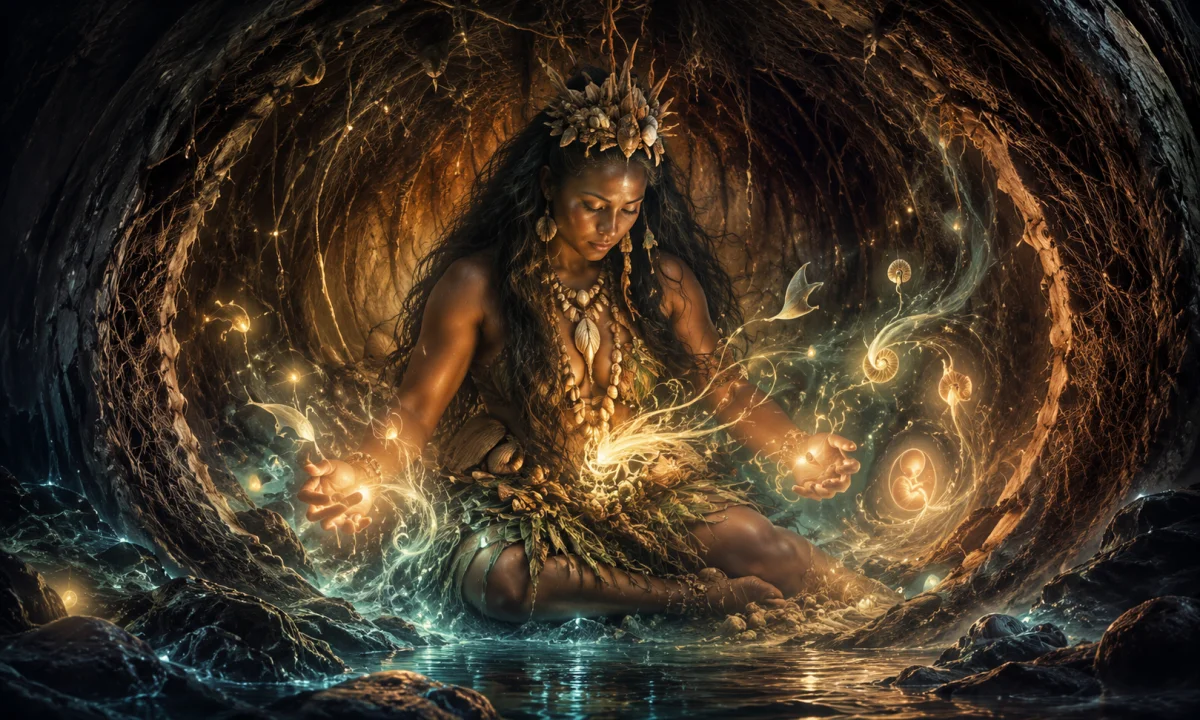
Varima-te-takere is a figure in Cook Islands mythology, especially in traditions from the island of Rarotonga, where she is remembered as a primal being associated with the beginning of the world and the emergence of the first gods and humans. In many retellings, she appears as the mother of important divine ancestors, including the culture hero Vātea and other offspring connected with the creation of the world. Her story belongs to the wider Polynesian pattern in which creation begins not with a single abstract deity but with an ancestral presence, a cosmic parent, or an original source from which later beings unfold.
The surviving knowledge of Varima-te-takere comes mainly through oral tradition and later recorded accounts of Cook Islands mythology. As with many Polynesian religious traditions, these narratives were preserved in more than one form and were shaped by local genealogy, chanting, and interpretation over time. The name and role of Varima-te-takere are therefore best understood as part of a living traditional complex rather than as a fixed figure with one universally agreed account. Some details vary between tellings, and the cosmological setting may differ according to island or recorder.
Origins and cultural setting
In Rarotongan cosmology, Varima-te-takere is often placed at the beginning of existence, before the familiar world has taken shape. The tradition presents her as emerging from or existing within an initial state sometimes described as darkness, stillness, or an underworld-like original domain. From this first condition, life, lineage, and divine power begin to separate and develop. The imagery is not merely physical but cosmological: Varima-te-takere belongs to the moment before the world is ordered, when creation is still intimate, maternal, and not yet divided into sky, land, sea, and human society.
Such accounts reflect a common Polynesian emphasis on genealogy. Origins are often explained through descent, parenthood, and successive generations of beings rather than through creation by command alone. Varima-te-takere is significant in this context because she stands at the head of a divine family tree. Her role is less that of a distant maker than that of an ancestral source from whom later powers are born. This makes her both a cosmological figure and a genealogical one.
Because the traditions were transmitted orally, the form of the story depends on performance and context. In some accounts, Varima-te-takere appears as a being in a primordial realm who gives birth to children in a sequence that establishes the divine order. In others, her place in the narrative is more compressed, serving as the first mother of gods associated with the heavens, the sea, and humanity. The broad pattern remains consistent even when individual details shift.
Name and identity
The name Varima-te-takere is sometimes interpreted in ways that point toward beginnings, foundations, or original sourcehood, though exact etymology can be difficult to state with certainty. As is common with names preserved across oral traditions and later transcription, spelling may vary. The hyphenated form is often used in modern writing, but older sources may present the name differently. Care should be taken not to force a single meaning onto the name when historical usage is not fully clear.
She is usually identified as female and as a primordial mother figure. In that role, she is not simply a goddess among others but a being whose fertility and generative power are central to the unfolding of the cosmos. The maternal quality of her identity matters symbolically: the world does not appear fully formed, but is instead born from a source that is itself alive, embodied, and generative. This distinguishes her from more remote creator figures in some other mythological systems.
Varima-te-takere is also important because she is tied to the origins of divine descent. In Polynesian traditions, the line between gods, ancestors, and legendary heroes can be fluid. A figure like Varima-te-takere helps explain how sacred authority travels through genealogy, linking the earliest cosmic moment to later tribal or chiefly lines. Her identity is therefore both mythic and ancestral.
Attributes and symbolic role
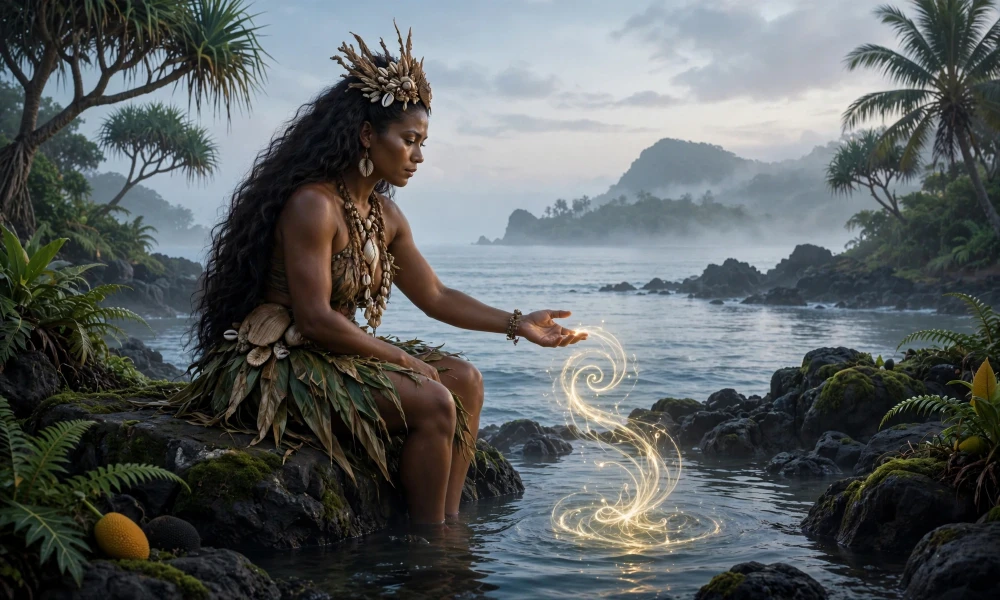
Varima-te-takere is not usually described in detailed physical terms in the surviving traditions. Unlike some mythological beings who have a stable iconography, she is better understood through function than appearance. What matters most is her place at the root of things. She embodies beginning, maternity, hiddenness, and the power of emergence.
Her symbolic importance can be understood in several ways:
- Primordial motherhood: she is the source from which divine life is born.
- Cosmic origin: she stands at the start of the world-order, before separation and naming.
- Genealogical authority: her descendants establish lines of divine and human descent.
- Fertility and generation: her power is expressed through birth and succession.
- Transition from chaos to order: she belongs to the moment when existence begins to differentiate itself.
These qualities make Varima-te-takere an important figure in understanding how Cook Islands myth presents creation. Rather than imagining creation as a purely external act, the tradition gives it a familial and embodied shape. The universe comes into being through relationship, birth, and the unfolding of ancestral power.
Stories and relationships
The best-known accounts place Varima-te-takere as the mother of Vātea, a major figure in Cook Islands cosmology. Vātea is often presented as a sky or ancestral being connected with the origin of the gods and the ordering of the world. In some versions, he becomes a central father figure in later divine genealogy. Through him, Varima-te-takere is linked to further generations that populate the mythic universe.
Different traditions may describe her children in different ways. Some tellings emphasize that she gave birth to more than one important being, each associated with a distinct domain or function. Because the narratives were transmitted orally and recorded at different times, the exact sequence and number of descendants may vary. It is safer to say that she is a foundational mother of divine lineages than to present a single rigid list as universally accepted.
One recurring theme is the notion that Varima-te-takere’s offspring are not arbitrary but structurally important. They help establish the division of the cosmos into areas of power and relationship. In Polynesian thought, such divisions may include the heavens, the sea, the underworld, and the human community. Her role in the myths is therefore not limited to biological motherhood; she helps organize the very architecture of reality.
In some interpretive traditions, Varima-te-takere’s position at the beginning of descent also suggests that sacred status passes through the maternal line as well as the paternal one. This is significant because Polynesian societies often give great importance to genealogy, chiefly rank, and ancestral legitimacy. Myths of origin can function as models for social order, and Varima-te-takere is part of that process.
Varima-te-takere in the wider Polynesian context
Varima-te-takere belongs specifically to Cook Islands tradition, but she can be discussed in relation to broader Polynesian patterns. Many Polynesian peoples preserve stories of an original parent or primal source from whom gods, lands, and people descend. These figures are not identical from one culture to another, and they should not be merged carelessly. Still, the recurrence of ancestral cosmogony across Polynesia helps explain why a figure like Varima-te-takere is so significant.
Her role also resembles, in broad function if not in exact identity, other Polynesian primordial figures associated with darkness, depth, or the first emergence of life. In each case, the mythic imagination tends to present the beginning of the world as something that grows out of an original condition rather than appearing from nothing in a purely abstract sense. Varima-te-takere embodies that original condition in a maternal form.
It is important not to confuse her with deities from other islands or oceanic traditions simply because they share features such as primacy, fertility, or darkness. Similar roles do not mean identical beings. The cultural meaning of Varima-te-takere is tied to Rarotongan and Cook Islands genealogy, oral history, and cosmology, and should be understood on its own terms.
Interpretation and cultural significance
Scholars of Polynesian religion often note that creation stories in the region tend to be genealogical rather than purely philosophical. Varima-te-takere is a good example of this pattern. She is not merely “the beginning” in an abstract sense; she is a mother whose descendants become active agents in the formation of the cosmos. This gives creation a personal and social structure.
Her figure can also be read as an expression of the value placed on fertility and continuity. In societies where descent lines matter deeply, the first ancestor or first mother is more than a mythic character. She represents continuity across generations, the legitimacy of chiefly authority, and the sacredness of kinship. The mythic past and social present are connected through her.
At the same time, Varima-te-takere belongs to a religious world in which divine beings are integrated into the landscape and history of a people. She is not simply a symbol invented for entertainment. She expresses a traditional understanding of how life, authority, and the cosmos began. That understanding may be held differently today by practitioners, cultural historians, and readers of mythology, but its religious and cultural significance remains rooted in the traditions that preserved her name.
Because the original stories were carried orally, there is room for variation in interpretation. Some modern readers may see Varima-te-takere primarily as a creation mother, while others may emphasize her role in genealogical sacred history. Both views are compatible with the way such figures often function in Polynesian tradition. The absence of a single standardized text does not make the figure less meaningful; it reflects the flexibility of oral myth.
Sources and transmission
Knowledge of Varima-te-takere survives through later written records of oral material, along with ongoing cultural memory in the Cook Islands. As with many Indigenous mythological traditions, colonial-era recording preserved some narratives while inevitably filtering them through the assumptions of outside collectors and translators. This means that modern readers should treat the written versions as valuable but incomplete witnesses to a broader traditional heritage.
Differences in spelling, sequencing, and emphasis may reflect local variation rather than contradiction. A name like Varima-te-takere can appear in forms shaped by missionary orthography, scholarly transcription, or later popular retelling. When discussing her, it is best to remain alert to the fact that the tradition is not frozen in a single canonical text.
Some published summaries of Cook Islands mythology present her in a concise way, usually as the first mother in a line leading to other divine figures. More detailed tellings expand the family structure and explain how different descendants relate to the sky, sea, and human world. The range of versions suggests that her myth served multiple purposes: cosmological explanation, genealogical legitimation, and the preservation of sacred ancestry.
Distinction from similar figures
Varima-te-takere is sometimes discussed alongside other Polynesian primordial beings, but she should not be conflated with them. Similarity in role does not equal identity. In particular, she should not be merged with deities from neighboring traditions merely because they also function as ancestral mothers or first beings.
Confusion can also arise because Polynesian myths often share themes of origin, descent, separation, and the emergence of light from darkness. These are widespread structural features, but the names, relationships, and cultural meanings differ. Varima-te-takere belongs specifically to Cook Islands tradition and is best interpreted within that setting.
It is also worth distinguishing her from later literary or popular adaptations that may simplify the traditional material. Modern retellings sometimes present her as a generalized “earth mother” or “goddess of creation,” but such labels can flatten the more specific ancestral and genealogical dimensions of the original tradition. She is more accurately understood as a primal mother in a particular mythic lineage.
Modern reception
Varima-te-takere is not widely known in global popular culture, and there is little evidence of major modern adaptation outside works that discuss Polynesian mythology, Cook Islands heritage, or comparative religion. Where she does appear in contemporary contexts, it is usually in educational, cultural, or literary settings rather than in mainstream film or entertainment.
In modern Pacific identity discourse, figures such as Varima-te-takere may be valued as part of the recovery and affirmation of Indigenous knowledge. Her story can serve as a reminder that Cook Islands traditions possess their own rich cosmology, not reducible to outside frameworks. At the same time, respectful modern use requires care: traditional beings should not be treated as decorative fantasy figures detached from the cultural world that gave them meaning.
For readers approaching Polynesian mythology, Varima-te-takere offers an important example of how origin stories can center maternal power, genealogy, and sacred descent. Her place at the beginning of the mythic order helps show how Cook Islands traditions understand creation as relational, ancestral, and alive.