WORLD
WORLD
Uluru
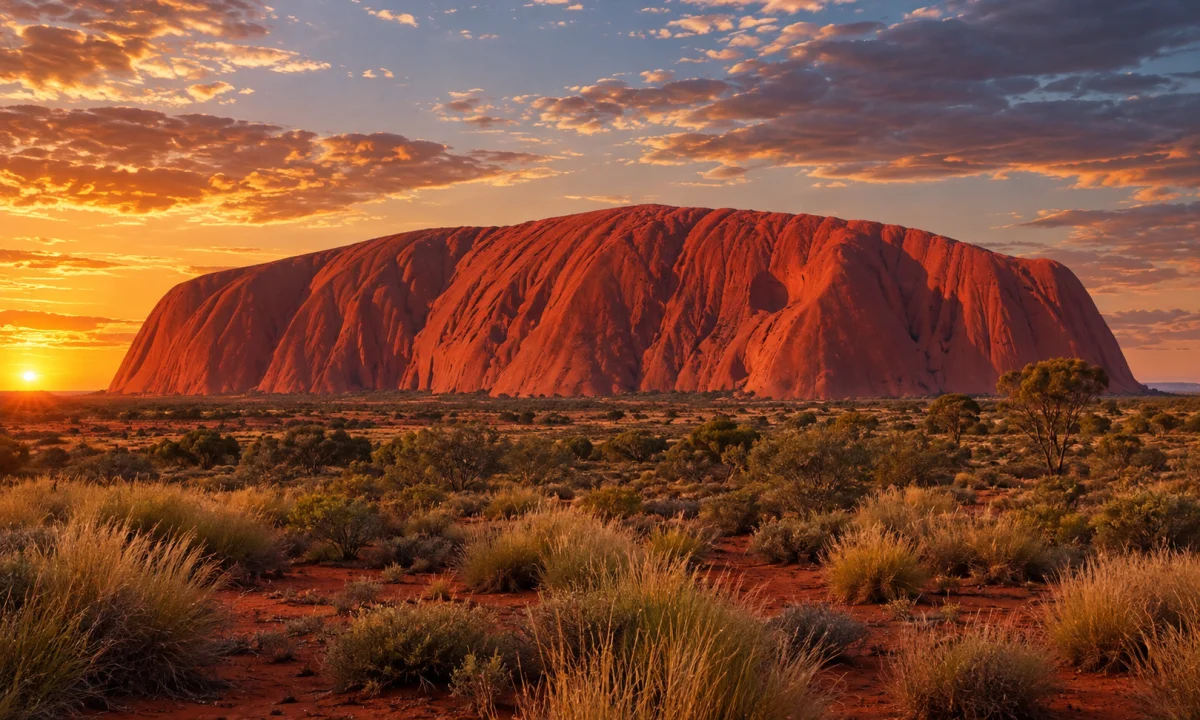
Uluru is a vast sandstone monolith in the centre of Australia and one of the most important sacred places in the living traditions of the Aṉangu peoples, including the Pitjantjatjara and Yankunytjatjara. It is often discussed under Australian Aboriginal mythology, although Uluru is not a god, monster or legendary hero. It is a real place whose landforms, waterholes, caves and paths are connected with ancestral beings, sacred law and continuing cultural responsibilities.
In English-language writing, Uluru has often been described through the idea of the “Dreamtime”. Many Aṉangu people prefer the term Tjukurpa, though spellings and translations vary. Tjukurpa is not simply a story about a distant mythological age. It includes accounts of ancestral creation, ethical law, ceremony, kinship, appropriate behaviour and obligations to country. The ancestors whose actions are remembered at Uluru are understood to have shaped the landscape while establishing ways for people to live within it.
Uluru and Aṉangu country
Uluru stands in the Northern Territory within Uluru-Kata Tjuta National Park. The surrounding region is Aṉangu country, a cultural landscape extending far beyond the rock itself. For its traditional custodians, country is not an empty natural setting. It has relationships, histories, responsibilities and spiritual significance. Particular sites may be associated with particular ancestral beings, ceremonies, family groups or stages of life.
The word Uluru is the established Aṉangu name for the site. Its precise linguistic origin and literal meaning are not consistently explained in public sources, and it should not be treated as though it were a simple translation such as “red rock”. The name is a proper name embedded in local language and tradition. English speakers may pronounce it approximately as “oo-loo-roo”, although English pronunciation does not reproduce every feature of the relevant Aboriginal languages.
The name “Ayers Rock” was applied by the European explorer William Gosse in 1873. He named the landmark after Sir Henry Ayers, who was then Chief Secretary of South Australia. “Uluru” became the official name in a dual naming arrangement in 1993, and Uluru is now the preferred name in most cultural and public contexts. The older colonial name remains visible in some historical records and informal usage, but it does not replace the Aṉangu name.
A living sacred landscape
Uluru is sometimes presented as though it were the setting for one single Aboriginal creation myth. That presentation is misleading. Aboriginal Australia contains many distinct peoples, languages and cultural traditions, and there is no single pan-Aboriginal mythology. The traditions connected with Uluru belong particularly to Aṉangu communities and are expressed through several interrelated Tjukurpa narratives.
Some knowledge is public, while other knowledge is restricted according to age, gender, initiation, kinship and ceremonial authority. Public accounts therefore provide only part of the cultural meaning of Uluru. A brief story told to visitors may be an introductory version rather than a complete account. Some sacred matters are not meant to be recorded, translated or discussed outside the appropriate cultural setting.
The rock itself is understood as evidence of ancestral activity. Its cliffs, caves, fissures, waterholes and unusual surfaces can mark events in the journeys of ancestral beings. These places are not merely symbols standing for invisible events. In Tjukurpa, the physical landscape and the ancestral story are joined: the shape of the country preserves the actions and presence of those who travelled through it.
Important ancestral traditions
Kuniya and Liru
One of the best-known public traditions concerns Kuniya, a woma python woman, and Liru, poisonous snake men. Public versions describe Kuniya travelling to Uluru from the north-east while carrying or guarding eggs. At the same time, Liru men approached from the south. The encounter culminated near Mutitjulu Waterhole, at the base of Uluru.
In commonly told versions, one of the Liru attacked or killed Kuniya’s nephew. Kuniya confronted the attacker and fought him with a digging stick. Her struggle with the Liru is associated with marks and formations on the rock near the waterhole. The details, names and emphasis of the narrative vary according to the teller and the level of knowledge considered appropriate for public explanation.
Kuniya is especially associated with Mutitjulu Waterhole, one of Uluru’s most significant public sites. The waterhole is important not only because it is a source of water in an arid environment, but also because its story connects a living place with ancestral law, protection and conflict. A visitor may see a rock surface, pool or indentation; Aṉangu understanding may also recognise the continuing presence of an ancestral event.
The Mala Tjukurpa
The Mala are hare-wallaby ancestors associated with Uluru. A public account of the Mala Tjukurpa tells of their arrival at Uluru from the north. They established a ceremonial camp and began preparations for ceremony. A conflict developed when some of the men chose to leave the gathering and travel elsewhere, while others remained. The consequences of this disagreement are linked with features and sites around the rock.
Some versions also describe the arrival of men from the west and a dispute involving ceremonial obligations. The story is not simply a fable about personal disagreement. It concerns proper conduct, the authority of ceremony and the consequences of failing to respect social and spiritual responsibilities. Certain parts of the Mala Tjukurpa are connected with restricted ceremonial knowledge and are not represented in public retellings.
The Mala story is often used to explain why particular places around Uluru are culturally important. It also shows why describing Uluru only as a geological wonder leaves out the relationships that make the place meaningful to its custodians.
Other ancestral beings and places
Many other Tjukurpa narratives are associated with Uluru and the surrounding country. These include ancestral people, animals and beings whose journeys are connected with particular tracks, caves, springs and rocky formations. Not all names or stories are appropriate for general publication, and public accounts do not constitute a complete map of Aṉangu sacred knowledge.
Uluru is also culturally connected with Kata Tjuta, the nearby group of large rock domes. The two formations are not the same geological structure and should not be treated as interchangeable mythological objects. They belong to a broader cultural landscape, but different sites have different stories, ceremonial associations and custodial relationships. Public information about Kata Tjuta is likewise limited in comparison with the full body of traditional knowledge.
Appearance and natural features
Uluru is composed mainly of arkose, a coarse-grained sandstone rich in feldspar. Its surface changes colour according to sunlight, cloud and moisture, appearing brown, violet, orange or deep red at different times. The red colour is largely produced by the weathering of iron-bearing minerals near the surface. The rock rises about 348 metres above the surrounding plain and extends several kilometres across, although its visible mass represents only part of a much larger geological formation beneath the ground.
These geological facts do not cancel the sacred interpretations of the site, and the sacred interpretations do not require geological explanations to be rejected. Aṉangu Tjukurpa and Western geology answer different kinds of questions. Geology describes the formation and physical properties of the rock; Tjukurpa expresses ancestral relationships, law and responsibility. Treating one system as a defective version of the other produces a false opposition.
Uluru contains sheltered caves, overhangs, water sources and areas with rock art. Some paintings and engravings are connected with long histories of human use, teaching and ceremony, but their meanings cannot always be inferred from their appearance. A shape that looks decorative to an uninitiated visitor may have cultural significance that is not publicly explained.
Meaning, law and responsibility
In Aṉangu tradition, stories are not separated from practical knowledge. Tjukurpa can teach where water may be found, how people should travel, which places require care and how obligations between people are maintained. The journeys of ancestral beings establish routes through the country, and those routes can be remembered through song, ceremony, visual design and oral teaching.
The traditions also express a moral order. Respect for elders, observance of ceremony, appropriate relationships between kin and care for country are not optional themes added to a myth. They are part of the law carried by the stories. Ancestral events explain why certain conduct is expected and why particular sites must be protected.
Uluru is therefore not best understood as an object believed to possess magical powers in the sense used by fantasy fiction. Its significance lies in the continuing relationship between people, ancestors, land and law. The site can be sacred without being personified as a single deity, and it can be a place of spiritual presence without belonging to a system of gods and heroes comparable to classical Greek or Norse mythology.
Uluru and the question of climbing
For many years, visitors were permitted to climb Uluru, while Aṉangu custodians repeatedly asked people not to do so. The request was connected with the sacred status of the climb, cultural law, the risk of accidents and the burden placed on custodians when visitors were injured or died. The path was permanently closed to climbing on 26 October 2019.
The closure is sometimes described merely as a tourism-management decision, but that description misses its cultural basis. The summit route is associated with a culturally significant ancestral track, and climbing it disregarded Aṉangu wishes about the treatment of the site. Visitors can still walk around designated parts of the base, subject to closures, weather conditions and cultural restrictions. Some areas are closed because they are sacred or because public access would be inappropriate.
Sources and transmission of tradition
Uluru’s traditions survive through oral teaching, ceremony, performance, art, language and custodianship of country. They have also been documented in varying ways by missionaries, anthropologists, government officers, artists and other outsiders. Such records can be useful, but they are not neutral replacements for Aṉangu authority. Colonial observers often translated complex concepts into inadequate English categories or recorded knowledge without fully understanding restrictions on its circulation.
Public interpretation at the national park is shaped by Aṉangu custodians and by joint management arrangements. Since the return of Uluru to its traditional owners in 1985, the site has been managed through a partnership between Aṉangu and the Australian government. This history matters because ownership, access and interpretation are part of the modern cultural context of Uluru, not separate administrative details.
Visitors are expected to follow instructions about photography, walking routes and restricted areas. Some places should not be photographed, and certain information should not be copied or distributed. Respectful treatment means recognising that not every story connected with Uluru is public property and that Indigenous custodians have the authority to decide how sacred knowledge is shared.
Uluru in modern culture
Uluru has become one of Australia’s most recognisable national images, appearing in tourism campaigns, documentaries, school materials, photographs and works of art. These representations often emphasise its colour, scale and isolation. They can also reduce it to a scenic landmark unless they acknowledge the continuing Aṉangu relationship with the place.
Modern spiritual and “New Age” interpretations sometimes describe Uluru as a universal energy centre, a lost extraterrestrial monument or a site whose meaning belongs equally to everyone. Such claims are not part of the publicly known Aṉangu Tjukurpa and should not be presented as traditional Aboriginal belief. They frequently appropriate the authority of Indigenous sacredness while ignoring Aṉangu restrictions and requests.
Uluru is best approached neither as a fictional character nor as a relic of a vanished mythology. It is a living cultural place, a geological formation and a continuing centre of Aṉangu law and identity. Its public stories offer an entry into a much larger body of tradition, while also making clear that some meanings remain held within the communities to whom Uluru belongs.