WORLD
WORLD
Tjinimin

Tjinimin is a name associated in some modern reference works with an Aboriginal Australian mythological figure, usually described as a trickster, culture hero or ancestral being. The identification is not as securely documented as that of better-known figures such as the Rainbow Serpent, Baiame or Tjilbruke. Accounts differ in spelling, community attribution and the details of the stories attached to the name. For that reason, Tjinimin should not be treated as a single, uniformly recognized “god” shared by all Aboriginal peoples of Australia.
Cultural setting
Australian Aboriginal religious traditions are not one mythology. They comprise many distinct systems of belief belonging to hundreds of cultural and language groups. Each community has its own ancestral beings, sacred places, laws, ceremonial knowledge and protocols concerning what may be told publicly. Stories that outsiders group together under labels such as “Dreamtime mythology” may therefore have very different meanings and origins.
The term Dreaming is often used in English to describe the continuing religious reality established by ancestral beings. It does not simply mean a distant period of “mythical time.” In many Aboriginal traditions, the actions of ancestral beings explain the shape of the land, the behaviour of animals, relationships between people, ceremonial obligations and rules for living. A figure described in a short written source as a “trickster” may therefore have a more serious role within the original tradition: the being may embody dangerous behaviour, establish a law through its actions or connect particular people with a place.
Information about Tjinimin is especially difficult to assess because the name is uncommon in general English-language writing and is not represented by one widely accepted narrative cycle. Some summaries associate the figure with northern Australia and with a culture-hero or trickster role. Other retellings provide little detail or use different spellings. The available material does not support a single definitive account of Tjinimin’s appearance, genealogy or domain.
The name and its identity
Tjinimin is an English transcription of a name from an Aboriginal language, but the spelling should not be assumed to be original or universal. Aboriginal languages were written using several different systems, and older publications often represented unfamiliar sounds inconsistently. A name recorded as Tjinimin in one work might appear differently in another source, while similar-looking forms can also belong to unrelated languages.
There is no reliable basis for treating the word as an Aboriginal-wide title. It should instead be approached as a locally situated name whose meaning depends on the language, community and story from which it comes. In particular, a resemblance between Tjinimin and another name is not enough to establish that the figures are the same.
Descriptions of Tjinimin as a trickster are also partly the result of English classification. “Trickster” is a comparative term used by scholars and popular writers for beings who deceive, break rules, behave arrogantly or bring about unexpected changes. Aboriginal traditions do contain powerful ancestral figures whose actions can be comic, disruptive or morally troubling, but they do not necessarily fit the European or academic category of the trickster. The label can obscure the religious importance of an ancestor whose story explains law and country.
Attributes and role
The most cautious description of Tjinimin is that the figure belongs to the broad class of ancestral or mythic beings who appear in Aboriginal storytelling and are sometimes interpreted as culture heroes. In this context, a culture hero is not necessarily a benevolent deity. The term may refer to a being whose actions introduce, reveal or model an important practice, custom or condition of human life.
Some secondary accounts present Tjinimin as a disruptive or mischievous character. Such accounts may emphasize cleverness, deceit or actions that produce consequences for human beings. However, the surviving general descriptions are not consistent enough to establish a fixed set of powers. There is no securely documented canonical list of Tjinimin’s symbols, sacred animals, weapons, family members or physical attributes.
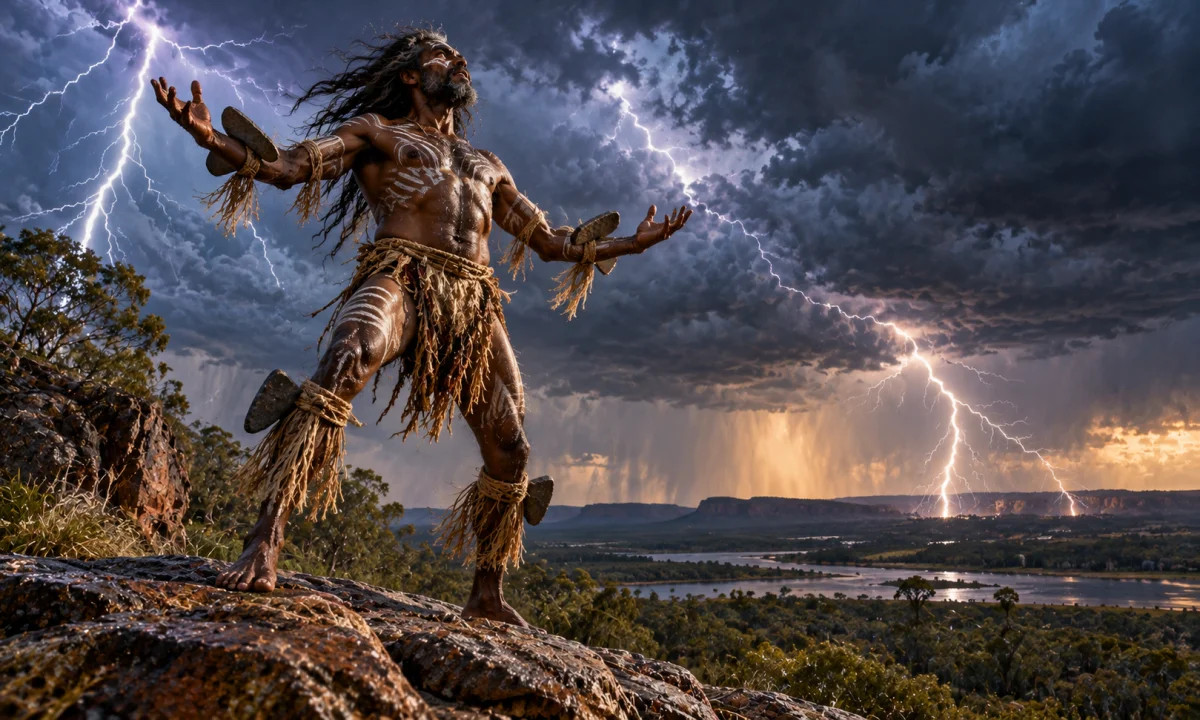
It is therefore unwise to portray Tjinimin as having one standard form. A figure in an Aboriginal story may change shape, appear as a human ancestor or be connected with animals and landscape features, but such details must come from a particular tradition rather than being added from general ideas about Dreaming beings. Likewise, a dramatic description such as “giant,” “spirit,” “god” or “monster” may reflect a translator’s choice rather than a traditional classification.
Stories and narrative patterns
Short accounts of Tjinimin tend to place the figure within the kind of narrative in which an ancestral being’s behaviour has lasting consequences. In Aboriginal storytelling, such narratives can explain why a place looks as it does, why a custom must be followed or why a particular animal behaves in a certain way. The story is not merely an entertaining episode about a supernatural character; it can be part of a larger body of knowledge tied to country and social responsibility.
Public retellings frequently reduce complex narratives to a few actions: a being makes a mistake, attempts to deceive another character, takes something important or is punished for breaking a rule. That condensed form can make Tjinimin appear simply comic or villainous. Without the wider ceremonial and geographic context, however, the significance of the story may be lost. An event that looks like mischief in an English summary may explain an origin, warn against dangerous conduct or dramatize the consequences of violating an obligation.
No single sequence of adventures can safely be presented as the definitive Tjinimin cycle. The lack of a stable, widely documented narrative means that claims about specific relationships, enemies, offspring or heroic deeds should be treated cautiously unless they are tied to a clearly identified community tradition. Different Aboriginal groups may tell stories with comparable patterns without sharing the same character.
Oral tradition and written records
Much Aboriginal religious knowledge has been transmitted orally, through teaching, performance, ceremony, art and close relationships with particular places. Written records are selective and often reflect the circumstances in which an outsider collected or translated a story. A publication may record only the portion considered appropriate for public telling, or it may omit names, ritual information and local explanations.
There are also ethical limits on what can be made public. Some stories are restricted by age, gender, initiation status, kinship or ceremonial authority. The absence of a detail from an English-language account does not prove that the detail never existed; it may indicate that it was not recorded or was not suitable for publication. Conversely, a colourful detail in a later retelling may have been added by an editor, translator or popular writer.
These issues are important in the case of Tjinimin. General mythology dictionaries often detach names from their linguistic and cultural settings, presenting a compact profile with a defined function, appearance and list of powers. Such profiles can create an impression of certainty that the underlying evidence does not support. A responsible account must distinguish between a name found in a particular tradition and a later summary that turns that name into a pan-Australian mythological “character.”
Religious and cultural significance
If Tjinimin is understood as an ancestral figure in the traditions where the name occurs, the most important question is not simply what supernatural abilities the being possesses. The more significant questions concern the relationship between the figure, people and country. Aboriginal ancestral beings are often inseparable from the landscapes through which they travelled or acted. Their stories can encode knowledge of waterholes, tracks, food sources, hazards, boundaries and ceremonial sites.
A disruptive ancestral figure can also express the tension between individual desire and collective law. Mischief, greed, deception or disobedience may be memorable because they show what happens when a being ignores responsibilities to others. At the same time, such figures can be more complex than moral examples. Their actions may create something useful, reveal a hidden truth or establish a condition that is neither wholly good nor wholly bad.
Calling Tjinimin a “god” can be misleading. The English word usually suggests a member of a universal pantheon with a defined sphere such as war, love or the sea. Aboriginal ancestral beings are more often understood through their connections to country, kinship, law and ceremony. Some may be powerful creators, some may be dangerous spirits, and some may be ancestors whose presence remains active in the landscape. The category “mythological being” is safer than assuming a European-style divine status.
Distinguishing Tjinimin from other figures
Tjinimin should not automatically be identified with the Rainbow Serpent. Rainbow Serpent traditions occur across many parts of Australia, but they involve numerous local names, stories and interpretations rather than one standardized character. A source that describes a serpent, creator or water-associated ancestor is not necessarily referring to Tjinimin.
Nor should Tjinimin be merged with prominent ancestral or creator figures from other regions, including Baiame, Bunjil, Daramulum or Tjilbruke. These beings belong to particular cultural traditions, and their names and roles cannot be treated as interchangeable Aboriginal equivalents. Similar narrative functions—creating land, teaching customs or punishing wrongdoing—do not demonstrate a shared identity.
Names that look or sound similar also require care. Aboriginal languages contain sound patterns that may be represented in several ways in English spelling. A variant spelling may refer to the same figure, but it may equally represent a different word or a being from another language group. Without a clear linguistic and cultural context, combining such forms risks creating a fictional composite.
Later reception
Tjinimin has not become a major figure in globally distributed popular culture. Where the name appears in modern mythology lists, fantasy databases or brief online profiles, it is often separated from the community and landscape that give the tradition its meaning. These presentations may describe Tjinimin as a generic Aboriginal god, demon or trickster, but those labels should be understood as modern classifications rather than established Aboriginal categories.
There is no well-established body of major films, novels, games or other popular adaptations devoted specifically to Tjinimin. Any contemporary fictional portrayal should therefore be distinguished from traditional material, especially when it invents a fixed appearance, supernatural powers or relationships. Creative works may use the name, but invention does not turn a modern characterization into evidence about the original tradition.
The most accurate approach is to preserve the uncertainty surrounding Tjinimin while recognizing the cultural setting in which Aboriginal ancestral figures are understood. The name may refer to a locally meaningful being whose stories were not fully represented in widely available English sources. Respect for that possibility is more reliable than supplying an artificial biography or treating a fragmentary description as a complete mythology.