WORLD
WORLD
St. Peter Chrysologus
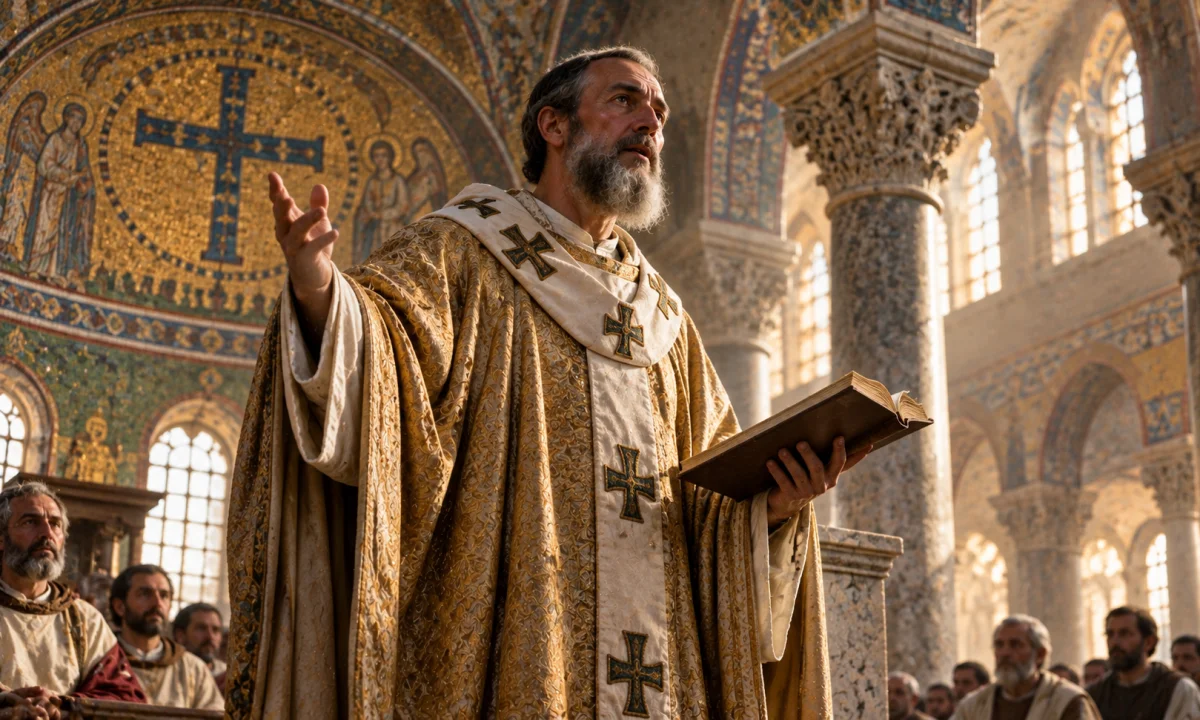
St. Peter Chrysologus was a fifth-century Christian bishop, preacher and theologian who served as bishop of Ravenna in northern Italy. Remembered especially for the clarity and brevity of his sermons, he is known by the Greek epithet Chrysologus, usually translated as “Golden-Worded” or “of the Golden Speech.” The title distinguishes his eloquence from that of St. John Chrysostom, whose name means “Golden-Mouthed.” Peter Chrysologus is honoured as a saint in the Catholic Church and was declared a Doctor of the Church in 1729.
Origins and historical setting
Peter was probably born around 380 in Forum Cornelii, the Roman town now known as Imola, in the region of Emilia-Romagna. The exact date and details of his early life are uncertain. Later tradition associates his upbringing with the church of Imola, where he is said to have studied under Bishop Cornelius. The surviving evidence does not provide a complete biography, and much of the information about his youth comes from later ecclesiastical tradition rather than contemporary records.
His adult life unfolded during a period of major political and religious change. Ravenna had become the residence of the western Roman emperors in 402, replacing Milan as the principal imperial centre in the West. It remained an important administrative, military and Christian city even as imperial authority weakened during the fifth century. Its churches, court connections and links with the eastern Roman Empire gave the bishop of Ravenna considerable influence.
Peter became bishop of Ravenna sometime in the early fifth century, traditionally around 425. A later account says that Bishop Cornelius of Imola presented him to Pope Celestine I, who selected him for the see after receiving a vision of the apostle Peter. That story helped explain the saint’s name and the prestige of his appointment, but it is a hagiographical tradition rather than a securely documented historical event. The surviving evidence does establish that Peter held the episcopal office at Ravenna and became one of the prominent preachers of his age.
Name and identity
The name Peter Chrysologus combines the personal name Peter with a descriptive title. “Peter” refers to the apostle and first traditional leader of the church at Rome, not to a claim that the bishop was the apostle reborn or directly related to him. “Chrysologus” comes from Greek words associated with gold and speech. It is generally understood as praise for the bishop’s eloquent preaching.
Peter Chrysologus should not be confused with St. John Chrysostom, the influential fourth-century archbishop of Constantinople. Both men were celebrated for their preaching, and their epithets are similar in meaning, but they were different historical figures. John Chrysostom was active mainly in the eastern Roman Empire and wrote extensively on Scripture and Christian ethics. Peter Chrysologus belonged to the Latin-speaking Christian world of Italy and is known primarily through his sermons.
He is also distinct from St. Peter the Apostle. Christian art may show both men as bishops or teachers, but Peter Chrysologus was a later historical bishop who lived several centuries after the apostolic period.
Surviving writings
Peter’s reputation rests chiefly on a large collection of homilies. Approximately 180 sermons have been transmitted under his name, with 176 commonly treated as authentic or substantially authentic by modern scholarship, although individual sermons and textual details remain subjects of discussion. These works are not a continuous theological treatise. They are short sermons designed for public worship, especially for the explanation of biblical readings and the celebration of major Christian feasts.
The sermons discuss the Nativity, Epiphany, Lent, Holy Week, Easter, the Ascension, Pentecost, the Virgin Mary, the apostles, Christian morality and the meaning of the sacraments. They reveal how a bishop in late Roman Italy presented Christian doctrine to a congregation that included educated urban Christians as well as ordinary worshippers. Peter often moves quickly between biblical interpretation, doctrinal teaching and practical exhortation.
His sermons are usually concise by the standards of ancient Christian preaching. He favoured strong contrasts, memorable phrases and carefully shaped transitions. He could explain a theological point through an image drawn from ordinary life, then return to the biblical passage being read in church. The epithet “Chrysologus” reflects this recognised skill, although it should not be taken to mean that every sermon is rhetorically elaborate. Many are direct, pastoral and closely focused on a single theme.
One of the most important non-homiletic texts associated with him is a letter addressed to Eutyches, a Constantinopolitan archimandrite whose teaching became involved in the controversy over the nature of Christ. Peter urged Eutyches to accept the authority of the bishop of Rome and to follow the developing consensus of the church. The letter is valuable because it places Peter within the Christological debates that preceded the Council of Chalcedon in 451.
Preaching and theology
Peter Chrysologus preached within the doctrinal framework that became associated with the Council of Chalcedon: Jesus Christ is one person in whom divine and human natures are truly united. His sermons repeatedly insist on both sides of Christian belief. Christ is genuinely divine, yet he also possesses a real human body, human birth, human suffering and human death.
The Incarnation is central to his preaching. Peter presents the birth of Christ not merely as a miraculous event but as the meeting of God and humanity. The humility of the manger reveals divine love, while the humanity of Jesus affirms that human nature has been taken up and restored. His treatment of the Virgin Mary often connects her motherhood with the mystery of the Incarnation, while preserving the theological conviction that the child born from her is also the eternal Son of God.
Peter frequently interprets biblical passages through symbolic relationships. Adam and Christ, Eve and Mary, death and resurrection, sin and grace are placed in parallel. Such contrasts were common in early Christian interpretation, but Peter presents them in a particularly compact and memorable manner. He does not treat the Bible merely as a collection of moral stories. For him, its events and images point toward the saving work of Christ, the life of the church and the transformation of believers.
His preaching also addresses Christian conduct. He condemns greed, violence, sexual immorality, drunkenness, abusive speech and indifference to the poor. Fasting, in his understanding, should be joined to generosity and reconciliation. A person who abstains from food while continuing to exploit or hate others has not properly observed the spiritual purpose of the season. Prayer, fasting and almsgiving belong together.
Peter’s sermons show a strong interest in the unity of the church. He presents the bishop as a guardian of teaching and worship, but he also stresses the responsibility of every Christian to live according to the faith professed in church. His language can be forceful, yet it is normally directed toward conversion rather than abstract speculation. The sermon is meant to change conduct as well as to communicate doctrine.
Role as bishop of Ravenna
As bishop, Peter served a prominent church in a city shaped by imperial politics and contact with different Christian traditions. Ravenna stood between the Latin West and the Greek-speaking East, and its clergy were connected to wider ecclesiastical networks. The city’s position made disputes about authority and doctrine especially significant.
Peter’s sermons suggest the responsibilities expected of a late antique bishop. He preached during the liturgy, instructed candidates and the wider congregation, interpreted Scripture, defended established doctrine and addressed social behaviour. Bishops also acted as public representatives of their communities and as patrons of charitable care. The sermons do not provide a complete administrative record, but they show a pastor concerned with worship, moral discipline and the spiritual formation of ordinary Christians.
His relationship with the imperial court should not be exaggerated. Ravenna’s political importance gave its bishop a public role, but the surviving writings do not portray Peter as a court politician in the detailed sense known from some other late Roman church leaders. His lasting reputation comes from his preaching and theological judgment rather than from documented political actions.
Involvement in the controversy surrounding Eutyches
During the 440s, Christians in the eastern Roman Empire argued intensely about how to describe the relationship between Christ’s divinity and humanity. Eutyches opposed the teaching of Nestorius and emphasised the unity of Christ, but his formulations were judged by many bishops to compromise the full reality of Christ’s human nature. The dispute eventually contributed to the Council of Chalcedon in 451.
Peter Chrysologus wrote to Eutyches after the controversy had become public. His letter appealed to the authority of Pope Leo I and urged Eutyches to accept a clearer confession of orthodox faith. Peter’s response is often remembered because it places him on the side of a Christology that affirmed the complete humanity and complete divinity of Christ.
Peter died around 450, probably at Imola, before the Council of Chalcedon met in 451. He therefore did not participate in the council itself. Claims that he personally helped formulate the council’s definition should be treated cautiously. His letter demonstrates that he was involved in the wider theological conflict, but it does not make him a direct participant in the council’s proceedings.
Death, relics and veneration
Tradition holds that Peter returned to Imola near the end of his life and died there. The details of his death are not firmly documented. His body has long been associated with Imola Cathedral, although the history of the relics and their movement from Ravenna to Imola is shaped by later tradition and ecclesiastical memory.
Peter was venerated locally before receiving wider recognition in the Latin Church. His sermons helped preserve his memory because they continued to be copied, read and used as evidence of early Christian teaching. In 1729, Pope Benedict XIII proclaimed him a Doctor of the Church. This title is given to saints whose teaching is considered to have particular importance for Christian doctrine and spiritual life. It does not mean that every statement attributed to the saint is treated as equally authoritative, nor does it remove the need to distinguish authentic works from later attributions.
His principal feast in the Roman Catholic calendar is observed on 30 July. Local calendars and traditions may commemorate him differently. He is especially associated with Ravenna, the city of his episcopal ministry, and with Imola, which is linked to his birth and burial.
Attributes and artistic representation
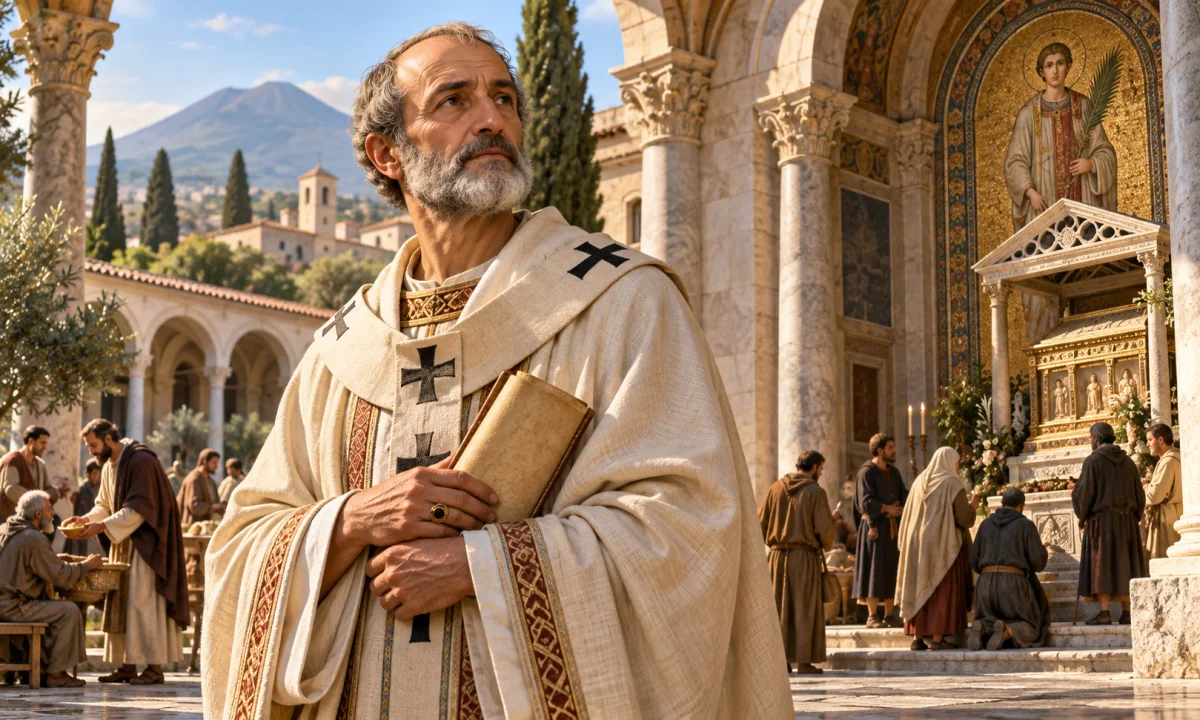
There is no reliable portrait from Peter’s lifetime, so images of him are devotional and symbolic rather than eyewitness representations. He is commonly shown as a bishop wearing liturgical vestments and holding a pastoral staff or a book. The book represents his preaching and theological instruction. A bishop’s mitre may appear in later Western art, although its use in representations of early bishops reflects later artistic convention rather than the clothing Peter necessarily wore.
Some depictions emphasise his eloquence through an open book, a raised hand or a gesture associated with preaching. The epithet “Golden-Worded” may also inspire decorative gold details, but there is no traditional supernatural object or magical attribute connected with him. He is a saint and teacher, not a legendary being with powers independent of Christian faith.
Cultural and religious significance
Peter Chrysologus is significant for the study of late antique Christianity because his sermons show how major theological ideas were communicated beyond councils and scholarly correspondence. Doctrines about the Incarnation, the Virgin Mary, sin, grace and resurrection were not confined to bishops debating in distant cities. They were explained to congregations through short homilies tied to the calendar of worship.
His works also illuminate the development of Christian preaching in the Latin West. The sermons combine biblical interpretation with rhetorical techniques inherited from Roman education. Yet their purpose is pastoral rather than ornamental. Peter uses memorable language to make doctrine intelligible, encourage moral reform and draw worshippers into the meaning of the liturgical season.
Modern readers should distinguish between Peter’s historical voice and the later legends surrounding his appointment, death and relics. The sermons and the letter connected with Eutyches provide the strongest evidence for his thought. Later biographies help explain how communities remembered him, but they may preserve devotional patterns rather than independently verifiable details.
Distinction from other “golden” preachers
The similarity between “Chrysologus” and “Chrysostom” has caused recurring confusion. John Chrysostom was born in Antioch, became bishop of Constantinople and died in exile in 407. Peter Chrysologus was an Italian bishop of Ravenna who died around 450. Both were honoured for eloquent preaching, but their lives, churches, languages and historical circumstances were different.
Peter should also be distinguished from other saints named Peter, including Peter the Apostle, Peter of Alexandria and Peter Damian. Shared names do not indicate a common biography or a single religious figure. In Christian calendars and artwork, identifying features such as the episcopal vestments, the connection with Ravenna and the title “Chrysologus” help specify which Peter is being commemorated.