WORLD

St. Oswald Of Northumbria
St. Oswald of Northumbria was a seventh-century Anglo-Saxon king, Christian convert, and martyr whose cult became one of the most important royal saint traditions in early medieval England. He ruled Northumbria from 634 until his death in battle in 642. Remembered especially for restoring Christianity in northern England, Oswald is associated with the monastery of Lindisfarne, the missionary bishop Aidan, and a series of miracles recorded after his death.
Historical setting
Oswald lived during a period when several Anglo-Saxon kingdoms competed for power while Christianity was spreading unevenly across Britain. Northumbria itself was formed from the northern kingdoms of Bernicia and Deira. Its rulers sometimes supported Christianity and sometimes followed older Germanic religious practices, and royal authority could change rapidly through warfare and dynastic rivalry.
Oswald was a son of Æthelfrith, king of Bernicia and later ruler of both Bernicia and Deira. Æthelfrith was a powerful pagan king who was killed in 616 by Edwin of Deira, a rival claimant supported by the East Anglian king Rædwald. After Edwin took control of Northumbria, Æthelfrith’s sons went into exile. Oswald and his brothers appear to have spent part of their exile in the Gaelic-speaking kingdom of Dál Riata, in what is now western Scotland.
This exile was decisive for Oswald’s religious identity. According to the later historical tradition, he encountered Christianity among the Irish monks and rulers who sheltered him. He was probably baptized during this period, although the exact circumstances are not recorded in a contemporary account. His religious formation linked him with the Christian tradition associated with the monastery of Iona, founded by Columba in the sixth century.
Name and identity
The name Oswald, written in Old English as Osweald or in related forms, is generally understood to contain elements meaning “god” and “ruler” or “power.” Such names belonged to the naming traditions of the Germanic-speaking peoples. The first element did not itself prove that a person was pagan or Christian; inherited royal names could retain older religious language after conversion.
Oswald is sometimes called Oswald of Bernicia, Oswald of Northumbria, or Oswald the Martyr. These descriptions refer to the same historical king. He should not be confused with other medieval saints named Oswald, including Oswald of Worcester, a tenth-century English archbishop, or later local figures whose names were shaped by devotion to the Northumbrian king.
Oswald’s classification as a saint rests on his posthumous cult and on the Christian interpretation of his death. He was not formally canonized through the centralized procedures used by the later medieval and modern Roman Catholic Church. His veneration developed locally and spread through churches, monasteries, relic traditions, liturgical commemorations, and written accounts of miracles.
Return to Northumbria and the battle of Heavenfield
In 633, King Edwin was defeated and killed at the Battle of Hatfield Chase by the forces of Cadwallon ap Cadfan of Gwynedd and Penda of Mercia. Northumbria then divided again. Cadwallon devastated parts of the kingdom, while Æthelfrith’s surviving son, Osric of Deira, briefly became king. Osric had been baptized but later abandoned Christianity, according to Bede, and was killed by Cadwallon.
Oswald returned from exile and challenged Cadwallon near Hexham in 634. Before the battle, Oswald reportedly ordered a large wooden cross to be raised. His army helped hold it upright while the earth was packed around it. Bede says that Oswald prayed before the cross and promised that, if victory came through divine mercy, he would establish the Christian faith in his kingdom.
The battle, known as the Battle of Heavenfield, ended in Oswald’s victory and Cadwallon’s death. The location became a place of Christian memory. A spring was said to have appeared where Oswald’s soldiers washed or drank, and later tradition attributed healing power to its water. Bede presents the victory as evidence of divine support rather than merely a successful military campaign.
The cross at Heavenfield became an important symbol of Oswald’s kingship. It also connected him with the Christian practice of using the cross as a visible sign of protection, prayer, and consecration. The story does not mean that the cross was treated as a magical object in the original account; its significance lies in Oswald’s prayer, his public profession of faith, and the interpretation of the battle as providential.
King and supporter of Christian mission
After taking power, Oswald became ruler of a large but politically unstable Northumbria. He sought religious assistance from Iona rather than from the Roman Christian mission then established in Kent. The first missionary sent to Northumbria was not successful, but the monk Aidan was then chosen. Oswald gave Aidan the island of Lindisfarne as the site of a monastery and episcopal centre.
Lindisfarne, later called Holy Island, became the principal base for the Christian mission in northern England. Aidan’s work included preaching, founding churches and monasteries, training clergy, and instructing local communities. Bede portrays Oswald as an active partner in this mission. Because Oswald knew the language used by Aidan and the Irish monks, he sometimes translated the bishop’s preaching for his own people.
This image of the king as interpreter is central to Oswald’s religious reputation. He was not presented simply as a ruler who permitted missionaries to operate. He used royal authority, personal knowledge, and public example to help establish Christianity among communities that included both converts and followers of older traditions.
Oswald’s reign also involved diplomatic links with other Christian rulers. Bede records that he was connected by marriage to the family of Cynegils, king of Wessex. The details are not entirely certain. Later tradition identifies Oswald’s wife as Cyneburh, a daughter of Cynegils, but the surviving evidence does not provide a full and undisputed account of the marriage. Oswald acted as godfather when Cynegils was baptized, a ceremony associated with the missionary work of Bishop Birinus.
Through this alliance, Oswald helped connect Northumbria with the developing Christian kingdom of Wessex. His religious importance therefore extended beyond northern England. He belonged to a generation of rulers who used baptism, marriage, patronage, and ecclesiastical foundations to create networks among newly Christian kingdoms.
Death at Maserfield
Oswald’s reign ended in 642 at the Battle of Maserfield, usually identified with a site near present-day Oswestry in Shropshire. His opponent was Penda of Mercia, one of the most powerful pagan rulers in Anglo-Saxon England. The political causes of the conflict are not fully known, and it is misleading to treat the battle as a simple war between Christianity and paganism. Early Anglo-Saxon warfare involved control of territory, dynastic rivalry, tribute, and alliances as well as religious differences.
Oswald was killed in the battle. Bede records that he died praying for the souls of his soldiers. This detail shaped his later image as a Christian king who combined military leadership with concern for the spiritual welfare of others. In Christian terms, his death was interpreted as martyrdom because he died while ruling a Christian kingdom and became the victim of a hostile ruler associated with paganism. The historical circumstances were more complex than the devotional interpretation, but both aspects belong to the tradition surrounding him.
According to Bede, Penda ordered Oswald’s body to be dismembered and displayed. Oswald’s brother Oswiu, who later became king, recovered some of the remains. The body was eventually associated with the monastery at Bardney in Lindsey, although the local community is said to have initially resisted receiving the remains because of Oswald’s Bernician origins. After miracles were reported, the relics were honoured there.
The head and hands were treated separately in the early tradition. The head was later associated with the church at Durham, while an arm and hand were connected with Bamburgh. These accounts reflect the medieval practice of dividing and redistributing relics. They also helped create multiple centres of devotion rather than concentrating Oswald’s memory in one location.
Miracles and sacred kingship
The main written source for Oswald’s life is the Ecclesiastical History of the English People by Bede, completed in the early eighth century. Bede presents Oswald as both a historical ruler and a model of Christian kingship. His account includes military events, missionary activity, royal relationships, and miracles attributed to Oswald’s relics or to places associated with him.
One of the most famous stories concerns a piece of wood from the cross raised at Heavenfield. A man suffering from illness was said to have been healed after applying wood from the cross to his body. Bede uses the story to show that the cross remained a channel of divine grace after Oswald’s death. The miracle belongs to Christian devotional literature and should not be treated as independently verified medical evidence.
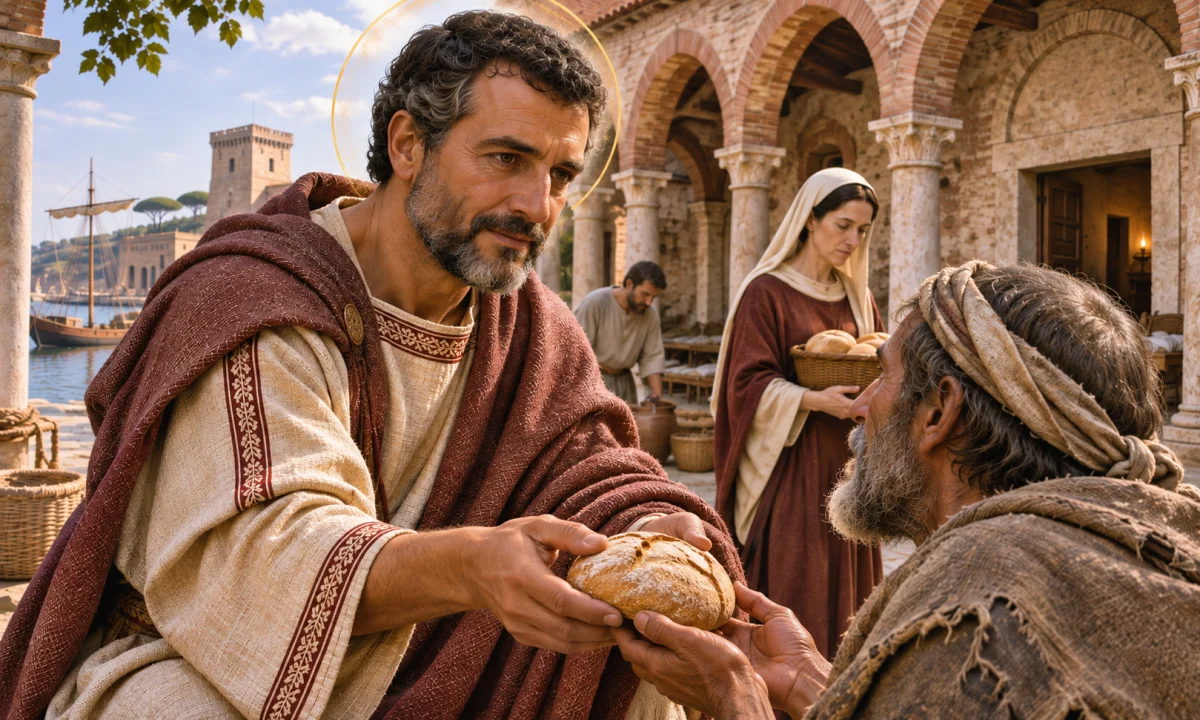
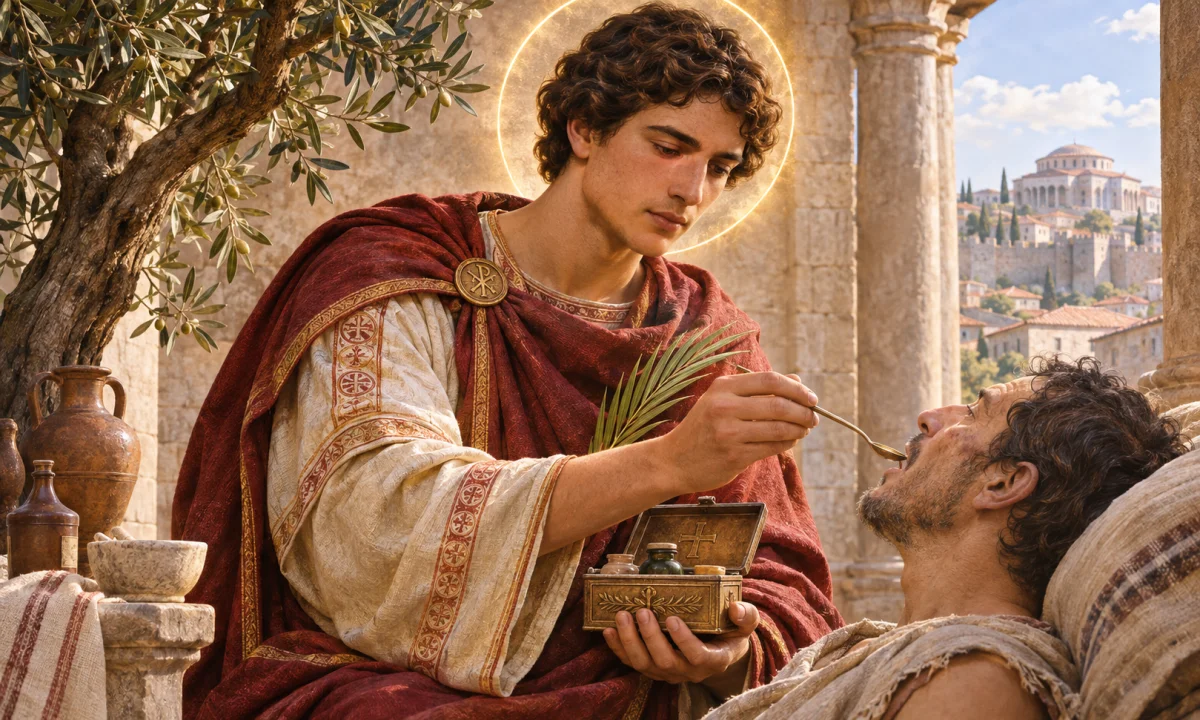
Another story tells of a poor man who approached Oswald while the king was dining with Bishop Aidan. Oswald ordered food to be given to the beggar and then had a silver dish divided among the poor. Aidan, impressed by this generosity, is said to have taken Oswald by the hand and declared that the king would not grow old. The story emphasizes almsgiving as a royal virtue and helps explain why Oswald became associated with charity and care for the poor.
These accounts express an ideal of sacred kingship. Oswald’s authority was shown not only through victory but also through humility, generosity, prayer, and support for the Church. His military power was considered legitimate when used in defence of his people and in the service of Christian order. This ideal was influential in later medieval portrayals of holy rulers.
Relics and the growth of his cult
Oswald’s cult expanded after the seventh century. His relics were connected with Bamburgh, Lindisfarne, Bardney, and later Durham. Different communities preserved different parts of the tradition, and the history of the relics became complicated by translation, theft, political disruption, and the destruction or movement of monasteries.
Churches dedicated to Oswald appeared in many parts of England. His cult also spread beyond England, especially through ecclesiastical and dynastic connections in continental Europe. Dedications and local traditions developed in regions including Germany, Austria, Switzerland, and Scandinavia. In some places, his name was transmitted through royal devotion; in others, it was carried by monks, relics, liturgical books, or English religious communities.
His feast is commonly observed on 5 August in Western Christian calendars, though local calendars and traditions may vary. Some churches remember him as a martyr, while others emphasize his role as a king and missionary patron. The date and form of observance should therefore be understood as part of later liturgical tradition rather than as a practice documented from Oswald’s own lifetime.
Symbols and artistic representation
Oswald is usually represented as a crowned king holding a cross, a sword, or both. The cross recalls Heavenfield and his Christian mission, while the sword represents his royal and military status. In some medieval and early modern images, he appears with a raven or with a severed arm. These details reflect later iconographic and legendary developments rather than a single uniform ancient tradition.
The story of the hand and arm has particular importance because the body parts were associated with Oswald’s charity and with the relic cult at Bamburgh. The raven appears in some later European traditions connected with the discovery or protection of his remains, but it is not the central symbol in Bede’s account. Images should therefore be interpreted according to the local tradition in which they were produced.
Oswald’s cult also encouraged the sanctification of places. Heavenfield became a memorial landscape because of the cross and the reported spring. Churches connected with his name often served as reminders of royal conversion, missionary activity, and the continuing presence of Christian memory in the region.
Interpretation and significance
Oswald occupies a transitional place between the older heroic model of the warrior king and the Christian model of the saintly ruler. He was expected to command armies, defend a kingdom, form alliances, and exercise political authority. At the same time, Christian writers praised him for prayer, generosity, humility, and support for monastic life.
His story also shows that the conversion of Anglo-Saxon England was not a single event. Christianity advanced through changing royal policies, missionary communities, marriage alliances, local preaching, and the personal commitments of rulers. Oswald’s support was important, but the work of conversion depended on Aidan, other clergy, monasteries, local leaders, and ordinary communities as well.
Bede’s account should be read as both history and religious interpretation. It preserves valuable information about rulers, battles, places, and ecclesiastical foundations, but it also arranges those events to present a moral vision of Christian history. Oswald’s victory is portrayed as providential, his generosity as exemplary, and his death as a form of martyrdom. Later writers and local traditions expanded these themes, sometimes adding details that cannot be securely traced to the seventh century.
For Christian communities, Oswald became a patron of royal responsibility, missionary work, charity, and steadfast faith under persecution. For historians, he offers evidence of how political power and religious change interacted in early medieval Britain. His importance lies not only in the legends surrounding his relics, but also in the historical role he played in connecting Northumbria with the Christian world of Iona, Wessex, and the wider European Church.