WORLD
WORLD
St. Peter Chanel
St. Peter Chanel was a nineteenth-century French Catholic priest and missionary who was killed on the Polynesian island of Futuna in 1841. Venerated as a Christian martyr, he is known in Catholic tradition as the first martyr of Oceania and as the patron saint of Oceania and the Marist missions. His life belongs to the period when newly established European religious congregations were sending missionaries across the Pacific, a movement closely connected with the wider history of European exploration, colonial power and cultural change.
Identity and historical setting
St. Peter Chanel was born Pierre-Louis-Marie Chanel on 12 July 1803 in the region of Bresse, in southeastern France. He grew up in a rural Catholic family and worked as a shepherd during his childhood. His early education and vocation led him to the diocesan seminary, and he was ordained a Catholic priest in 1827.
Chanel first served in parishes in the Diocese of Belley. He became known as a conscientious and compassionate parish priest, but he increasingly desired missionary work. In 1831 he joined the Society of Mary, commonly called the Marists, a recently formed Catholic congregation devoted to education, pastoral work and missionary activity. The Society of Mary received formal approval from the papacy in 1836, during a period of intensified Catholic missionary expansion.
The Pacific missions were shaped by several overlapping forces. Catholic missionaries sought to preach Christianity and establish local churches, while European governments and commercial interests were also extending their influence across the region. Catholic accounts traditionally describe Chanel as a gentle and self-sacrificing evangelist. A broader historical view also recognizes that missionaries entered societies with their own religious systems, political structures, social customs and rivalries. Conversion could therefore affect not only personal belief but also authority, law, ritual practice and relations between communities.
Mission to Futuna
In 1836, the Marists organized a mission to Western Oceania. Chanel was selected to take part in the expedition, together with Bishop Jean-Baptiste Pompallier and other missionaries. The group reached the western Pacific in 1837. Chanel was assigned to the island of Futuna, while other members of the mission went to different islands.
Futuna is a small Polynesian island, now part of the French collectivity of Wallis and Futuna. At the time of Chanel’s arrival, the island was divided between two principal political territories, commonly identified as Alo and Sigave. Authority rested with local rulers and chiefly families, and religious life was closely connected with community identity and political legitimacy.
Chanel landed in Futuna with the French Marist brother Marie-Nizier Delorme. They depended heavily on local hospitality and assistance. One important helper was Thomas Boag, a European or European-descended resident familiar with the island and its language. Chanel gradually learned the local language and tried to communicate Christian teaching through conversation, instruction and personal example.
The mission did not produce rapid conversions. Chanel faced language difficulties, unfamiliar customs and the limits of his material resources. Traditional religious practices remained influential, and the island’s political divisions affected how the missionaries were received. Catholic tradition emphasizes Chanel’s patience during this period: he continued caring for the sick, helping the poor and teaching those willing to listen, even when the mission seemed to make little visible progress.
Name, status and religious classification
In English, he is usually called St. Peter Chanel. His French name was Pierre Chanel, and Catholic references may also use Pierre-Louis-Marie Chanel. “Peter” is the English form of Pierre rather than the name of a separate figure. He should not be confused with Saint Peter the Apostle, the first-century disciple of Jesus, or with other Christian saints named Peter.
Chanel is classified as a martyr because he was killed in connection with his Christian mission. In Catholic usage, a martyr is a person who dies because of steadfast adherence to the faith or because of religious persecution. The Church does not treat every violent death of a missionary as martyrdom automatically; the circumstances and the relationship between the death and the person’s religious witness are examined during the canonization process.
He is also described as a missionary priest, a Marist and the protomartyr of Oceania. “Protomartyr” means the first recognized martyr of a particular region, mission or Christian community. It does not mean that Chanel was the first Christian ever to die in the Pacific in every possible historical sense. Rather, it is a title used by the Catholic Church to identify him as the first martyr officially associated with the Catholic evangelization of Oceania.
The killing of 1841
Chanel was killed on 28 April 1841 at Poi, in the territory of Alo on Futuna. The principal surviving accounts were produced within Catholic missionary circles and later hagiographical traditions. They agree that his death followed growing tension over the spread of Christianity and that men connected with the local ruling group attacked him.
Traditional accounts associate the attack with Musumusu, whose precise status and role are described somewhat differently in different retellings. He is often presented as an important man in the service of the ruler Niuliki, the chief of Alo. The accounts also connect the conflict with Niuliki’s son, usually named Meitala, who had accepted Christian teaching or shown strong interest in conversion.
Niuliki’s authority combined political and religious dimensions. A new religion could therefore appear threatening not simply because it introduced unfamiliar beliefs, but because it might challenge established ritual obligations, social relationships and the authority of the ruling family. Missionary traditions commonly explain the killing as a reaction to the perceived loss of influence caused by conversions. That interpretation is historically plausible, but the exact motives of every person involved cannot be recovered with certainty from the surviving accounts.
Chanel was attacked and killed after he refused to abandon his mission. Later Catholic narratives describe severe physical violence, sometimes specifying clubs or other weapons. Details vary between accounts, and devotional retellings may present the event in a more stylized form than a modern historical reconstruction would allow. His death is remembered in Catholic worship as a deliberate act of witness rather than as a military or political battle.
Conversion and the growth of Christianity on Futuna
Chanel’s death did not end the mission. In the Catholic tradition, the event became the turning point in Futuna’s conversion. Afterward, Niuliki’s son and other islanders continued to support Christianity. Meitala is especially important in Catholic accounts because his conversion is presented as one of the immediate causes of the ruler’s alarm and as a sign that the new faith had gained a lasting foothold.
Within a few years, Christianity spread widely on Futuna. This process involved local people as active participants, not merely passive recipients of European teaching. Islanders interpreted the new religion through their own language, relationships and cultural categories, and local converts became essential to the formation of Christian communities. The later dominance of Catholicism on Futuna should not be understood as the result of Chanel’s efforts alone; it developed through the work of subsequent missionaries and, above all, through the choices and influence of Futunans themselves.
Conversion also altered political and social life. Traditional religious institutions lost authority in many areas, while Christian leaders and communities gained importance. As elsewhere in the Pacific, the arrival of Christianity was connected with wider patterns of foreign contact, disease, trade and colonial administration. A religious history of Futuna therefore exists alongside a more complex history of cultural negotiation and external influence.
Relics, beatification and canonization
After Chanel’s death, his remains were preserved by the mission and later transferred through the Catholic networks operating in the Pacific. They eventually returned to Europe and were placed under the care of the Marists. In the twentieth century, some of his relics were brought back to Futuna, where he is especially venerated at Poi, the place associated with his martyrdom.
Chanel was beatified by Pope Leo XIII in 1889. Pope Pius XII canonized him on 12 June 1954. His liturgical feast is celebrated on 28 April, the anniversary of his death. Catholic churches and schools connected with the Marists have often commemorated him through Masses, processions, missionary celebrations and educational programs.
His title as patron of Oceania reflects his importance in Catholic missionary history, although it does not imply that he represents every religious tradition or cultural community in the Pacific. Oceania includes many peoples, languages and histories, and the region has never been religiously or culturally uniform.
Attributes and symbolism
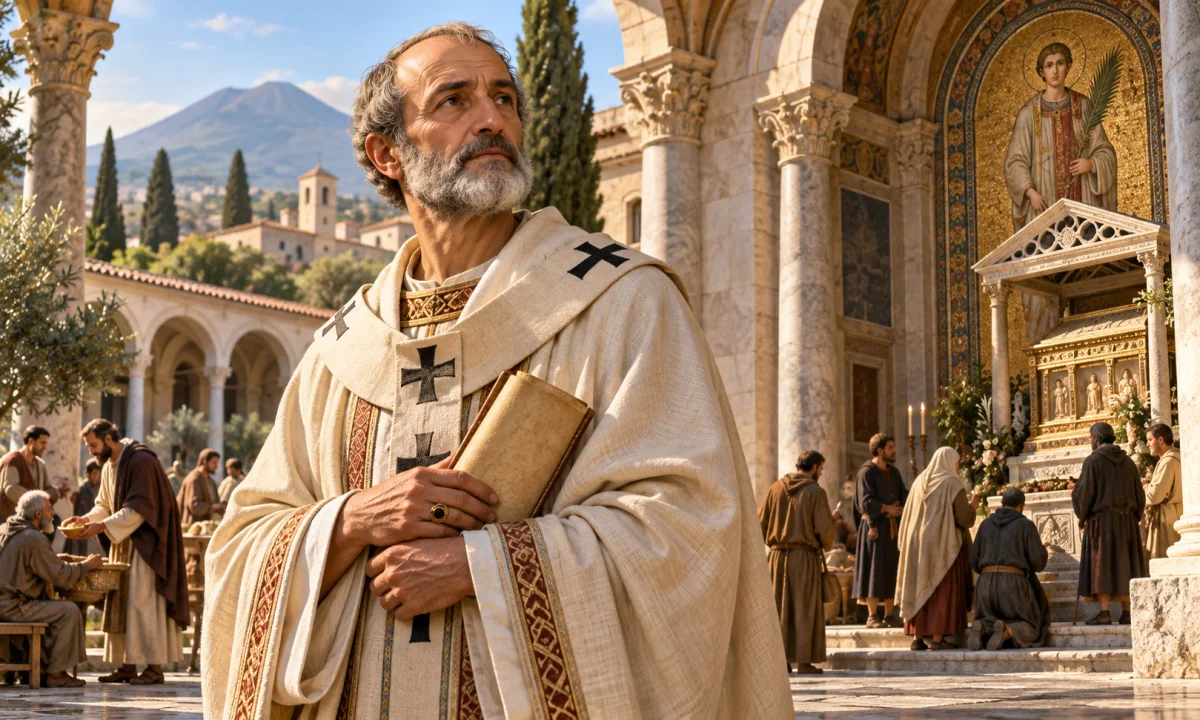
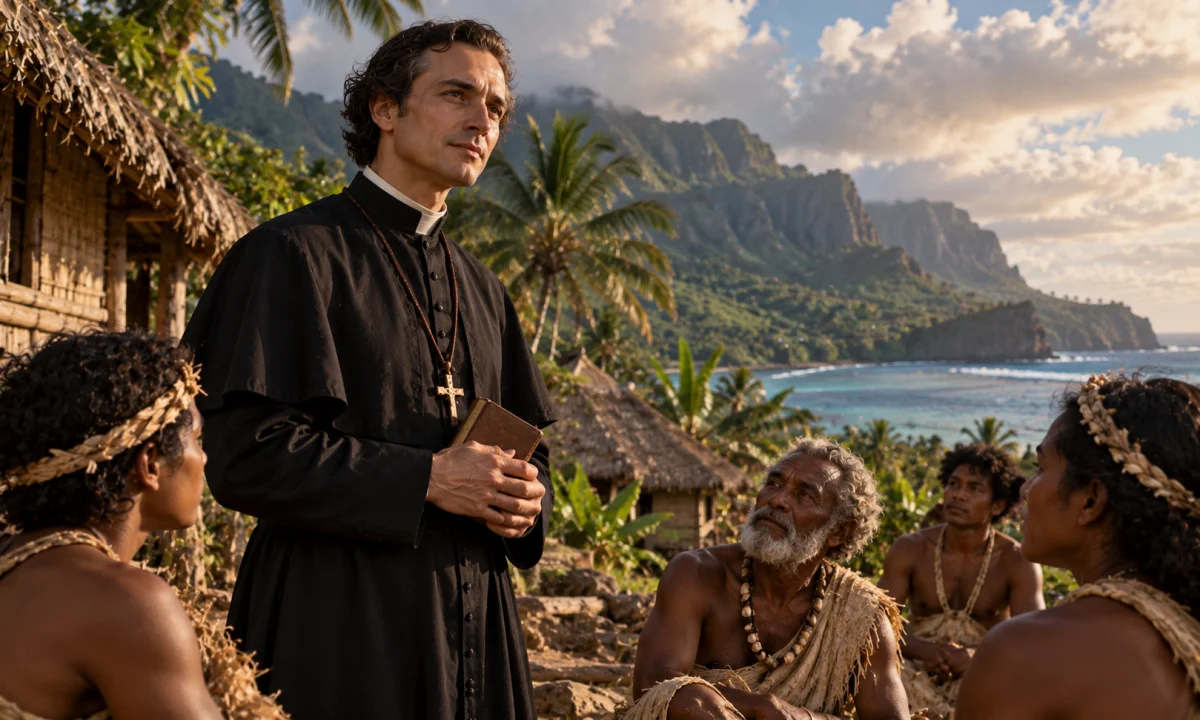
Religious images of St. Peter Chanel commonly portray him as a nineteenth-century Catholic priest wearing clerical or missionary clothing. His usual attributes include a martyr’s palm, symbolizing victory through faithful death, and a cross, representing Christian mission and sacrifice. He may also be shown with a Polynesian landscape, a local community or visual references to Futuna.
Unlike many legendary saints, Chanel is a comparatively recent historical figure with documented connections to particular places, institutions and missionary companions. His significance does not depend on miraculous combat with demons, heroic monsters or supernatural enemies. The central elements of his devotional identity are patient evangelization, service to people in unfamiliar circumstances and death while continuing his religious vocation.
Miracles are associated with Chanel in Catholic devotional tradition, particularly in the process leading to his canonization. Such claims belong to the Church’s religious understanding of sanctity and are not the same as independently established historical evidence. His canonization reflects both the recognition of his martyrdom and the Church’s judgment regarding his holiness.
Interpretation within Catholic tradition
Catholic devotion presents Chanel as a model of missionary perseverance. The traditional emphasis falls on his humility, courage, patience and willingness to serve without immediate success. His story is often used to teach that religious work may bear fruit long after the original missionary has died.
He is also understood as a witness to the universal character of Christianity. In Catholic interpretation, the Church in Oceania is not merely an extension of European religion but part of the worldwide Christian community. Chanel’s memory is therefore linked to the development of local Catholic churches, especially in the Pacific islands.
At the same time, modern historical interpretation can examine the mission critically. European missionaries brought their own assumptions about religion, civilization and social order. Their activities sometimes accompanied or preceded colonial intervention, even when an individual missionary did not exercise political power. Accounts of Chanel should therefore distinguish between devotion to a Christian martyr and claims about the supposedly simple or passive conversion of Pacific peoples. Futunans and other island communities made their own decisions, adapted Christian teachings and shaped the forms that Christianity took in Oceania.
Legacy in Futuna and among the Marists
Chanel remains a central figure in the identity of the Society of Mary. Marist communities remember him as an example of missionary dedication, and institutions bearing his name exist in several countries. His feast is particularly important in places where Marist priests, brothers, sisters and lay communities continue educational or pastoral work.
On Futuna, his memory is tied to the geography of the mission: the landing places, the communities that received Christian teaching, the site of his death and the churches built in his honor. The shrine at Poi gives his veneration a local setting rather than leaving him only as a distant European saint. For Catholic believers there, he is both a martyr of the universal Church and a figure embedded in the island’s own religious history.
St. Peter Chanel is therefore best understood through several connected identities: a French priest of the early nineteenth century, a member of the Marist missionary movement, a historical visitor to Polynesia, a victim of violence during a period of religious and political change, and a canonized Catholic martyr whose memory became important in the Christian history of Oceania.