WORLD
WORLD
St. Peter Canisius
St. Peter Canisius was a sixteenth-century Dutch Jesuit priest, theologian, teacher and missionary whose work helped shape Catholic life in the German-speaking lands during the Reformation. He is especially remembered for his catechisms, his foundation of schools and colleges, his preaching, and his efforts to strengthen Catholic education. The Catholic Church honours him as a saint and a Doctor of the Church, a title recognizing the lasting importance of his teaching.
Origins and historical setting
Peter Canisius was born as Pieter Kanis in Nijmegen on 8 May 1521. Nijmegen was then part of the Duchy of Guelders, within the wider political and religious world of the Holy Roman Empire. The town is now in the Netherlands. His father, Jacob Kanis, was a prosperous civic official and served as mayor of Nijmegen.
Canisius grew up at a time of intense religious change. Martin Luther’s criticism of certain Catholic practices and teachings had developed into a broad reform movement, while Catholic leaders were beginning to respond through preaching, education, pastoral reform and theological clarification. The religious divisions associated with the Reformation affected universities, cities, rulers and ordinary parish communities. In the German-speaking territories, the religious allegiance of a city or principality could influence the worship and education available to its inhabitants.
Canisius belonged to the first generation of Jesuits. The Society of Jesus had been founded by Ignatius of Loyola and formally approved by the papacy in 1540. Its members were expected to combine disciplined religious life with education, preaching, missions and service to the Church. Canisius became one of the Society’s most active representatives north of the Alps.
Name and identity
The saint’s original family name was Kanis. Canisius is the Latin form by which he became widely known in ecclesiastical and scholarly contexts. It should not be confused with a separate legendary figure or with a Christian saint whose name derives from an animal symbol. The similarity between Canisius and the Latin word for “dog” has sometimes encouraged symbolic wordplay, but it is not the basis of his identity or sainthood.
He is also called Peter Canisius, St. Peter Canisius, or Petrus Canisius. In Dutch contexts, his name may appear as Pieter Kanis. These forms refer to the same historical person.
Education and entry into the Jesuits
Canisius studied at the University of Cologne, where he encountered both humanist learning and the theological controversies of his age. He was ordained a priest in 1546. Before and after ordination, he developed a strong interest in religious education and in the renewal of Christian life through disciplined teaching and pastoral work.
His association with the Jesuits began through Peter Faber, one of the original companions of Ignatius of Loyola. Canisius made the Spiritual Exercises and entered the Society of Jesus in 1543. He was among the earliest members of the order and is generally regarded as the first Dutchman to join it.
His early Jesuit activity included preaching, theological study and participation in the Council of Trent. The council met intermittently between 1545 and 1563 to address questions raised by the Reformation and to promote reform within the Catholic Church. Canisius attended one of its early periods, although his most influential work took place through teaching, writing and administration rather than through a leading role in the council’s debates.
Mission in the German-speaking lands
Canisius spent much of his adult life in areas that are now Germany, Austria, Switzerland and the Czech Republic. He was sent by the Jesuit leadership to help establish the Society in territories where Catholic institutions were under pressure or where Catholic education had weakened.
He taught and preached at important centres including Ingolstadt, Vienna and Prague. He also helped found or develop Jesuit colleges. These institutions trained clergy, educated lay students and provided a structured setting for Catholic theology and humanistic learning. Jesuit schools became one of the most important instruments of Catholic renewal in the late sixteenth century.
In 1556, Canisius became the first provincial superior of the Jesuits in Upper Germany. The province covered a large and demanding region. He travelled extensively, inspected communities, encouraged missionaries and helped secure support for new schools. His responsibilities required diplomacy as well as theological knowledge, since the Jesuits depended on cooperation from bishops, princes, city governments and benefactors.
Canisius served as administrator and adviser in difficult circumstances, including a period in which he was chosen as administrator of the Diocese of Vienna. He did not become a diocesan bishop, however. His principal identity remained that of a Jesuit religious, priest, preacher and teacher.
The catechisms of Peter Canisius
Canisius is best known for a series of catechisms. His major catechism, usually known by its Latin title Summa doctrinae christianae, appeared in 1555. It was designed to present Catholic teaching in a clear and orderly form for students and educated readers. Shorter versions followed, including a catechism for younger pupils and a very brief version for basic instruction.
These works addressed subjects such as the Apostles’ Creed, the sacraments, the Ten Commandments, the Lord’s Prayer and Christian moral duties. They also explained disputed points between Catholic and Protestant theologians. The catechisms were written in a question-and-answer style or in other accessible formats, making them suitable for schools and parish instruction.
The success of these books was considerable. They were translated into several languages and repeatedly reprinted. For generations, Catholic children and students in parts of Europe learned the structure of their faith through editions based on Canisius’s work. His writing helped standardize Catholic religious education before the publication and widespread use of later official catechisms.
Canisius’s method combined doctrinal precision with practical instruction. He believed that religious teaching should be understandable to its intended audience, while still preserving the authority of Catholic doctrine. His three principal catechisms therefore differed in length and complexity rather than simply repeating one text for every reader.
Preaching and theological controversy
Canisius was a forceful preacher and a prominent Catholic opponent of Protestant theology. His sermons and writings defended Catholic beliefs concerning the Church, the sacraments, the authority of tradition and the role of the clergy. He also criticized corruption and poor discipline among Catholic clergy, arguing that the Church’s renewal required both doctrinal clarity and moral reform.
His polemical writings reflect the confessional conflict of the sixteenth century. Like many religious writers of that period, he sometimes used language about opposing confessions that modern readers may find severe. Such statements belong to a period of deep institutional rivalry, political conflict and fear of religious disorder. They should not be detached from that historical setting or treated as neutral descriptions of all Protestants or Catholics.
Canisius’s approach was not limited to controversy. He emphasized preaching, schools, personal devotion and the training of priests. His work illustrates a central feature of Catholic reform: the attempt to answer Protestant challenges while also correcting weaknesses within Catholic institutions.
Devotion to the Virgin Mary
Canisius had a strong devotion to the Virgin Mary and defended traditional Catholic teaching about her against Protestant criticism. His Marian theology appeared in sermons, devotional works and theological writing. He presented Mary as the mother of Christ and an example of Christian obedience, while also defending the honour given to her in Catholic worship and devotion.
His Marian writings should be understood within the theological debates of his time. The Catholic and Protestant traditions were developing differing patterns of language concerning Mary, the saints, prayer and the authority of Church tradition. Canisius’s defence of Marian devotion formed part of his wider defence of Catholic identity.
Character and religious ideals
Accounts of Canisius portray him as energetic, disciplined and deeply committed to service. His assignments required long journeys, administrative work, public preaching and sustained correspondence. He was also regarded within the Jesuit tradition as a man of prayer and as someone who combined intellectual activity with pastoral concern.
One of the most important features of his religious ideal was the connection between learning and spiritual formation. For Canisius, education was not merely the transmission of information. Schools and catechisms were intended to form Christian judgment, moral habits and participation in the life of the Church.
He also represented the international character of the early Society of Jesus. Although born in the Low Countries, he worked across several regions and communicated with religious and political leaders in different languages. His career shows how religious orders could operate across the territorial boundaries of the Holy Roman Empire.
Later years and death
Canisius eventually settled in Fribourg, Switzerland, where he continued writing and pastoral work. He spent the final years of his life there and died on 21 December 1597. His remains are associated with the Church of St. Michael, the former Jesuit church in Fribourg, which became an important place of remembrance connected with him.
His death did not end his influence. His catechisms continued to be used, his letters and theological works were preserved, and Jesuit institutions continued to identify him as an important early leader. His reputation developed especially in Catholic regions where the educational and missionary work of the Society of Jesus remained influential.
Canonization and status as a Doctor of the Church
Peter Canisius was beatified by Pope Pius IX in 1864 and canonized by Pope Pius XI in 1925. In the same year, Pius XI proclaimed him a Doctor of the Church. This title does not mean that Canisius was a doctor of medicine or that every statement in his writings is treated as a binding doctrine. It signifies that his teaching and theological contribution have enduring importance for the Catholic Church.
His liturgical memorial in the Roman Catholic calendar is observed on 27 April. Some local calendars or older traditions may have commemorated him on different dates, particularly in connection with the anniversary of his death. Liturgical dates can therefore vary according to the calendar being followed.
He is commonly associated with Catholic education, catechists, teachers and the Catholic press. These associations arise from the practical character of his work: he produced widely used instructional texts, promoted schools and communicated Catholic teaching through preaching and writing. They are devotional and ecclesial classifications rather than evidence that he belonged to a separate legendary class of patron figures.
Iconography and symbols
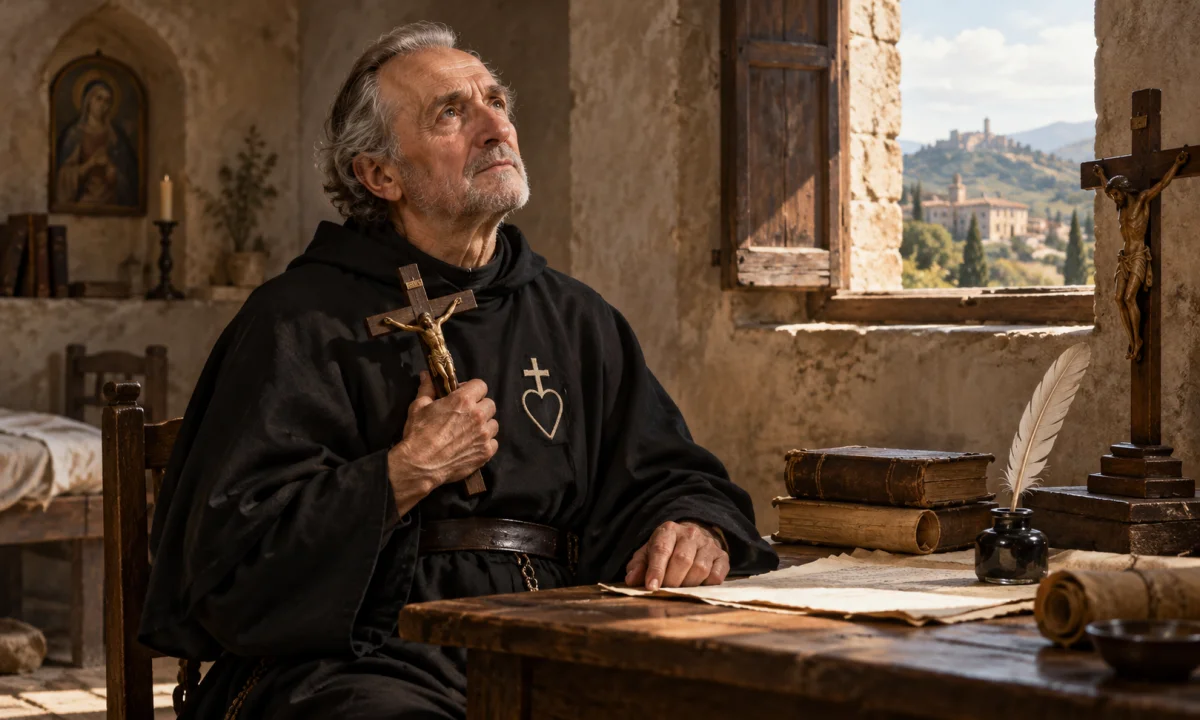
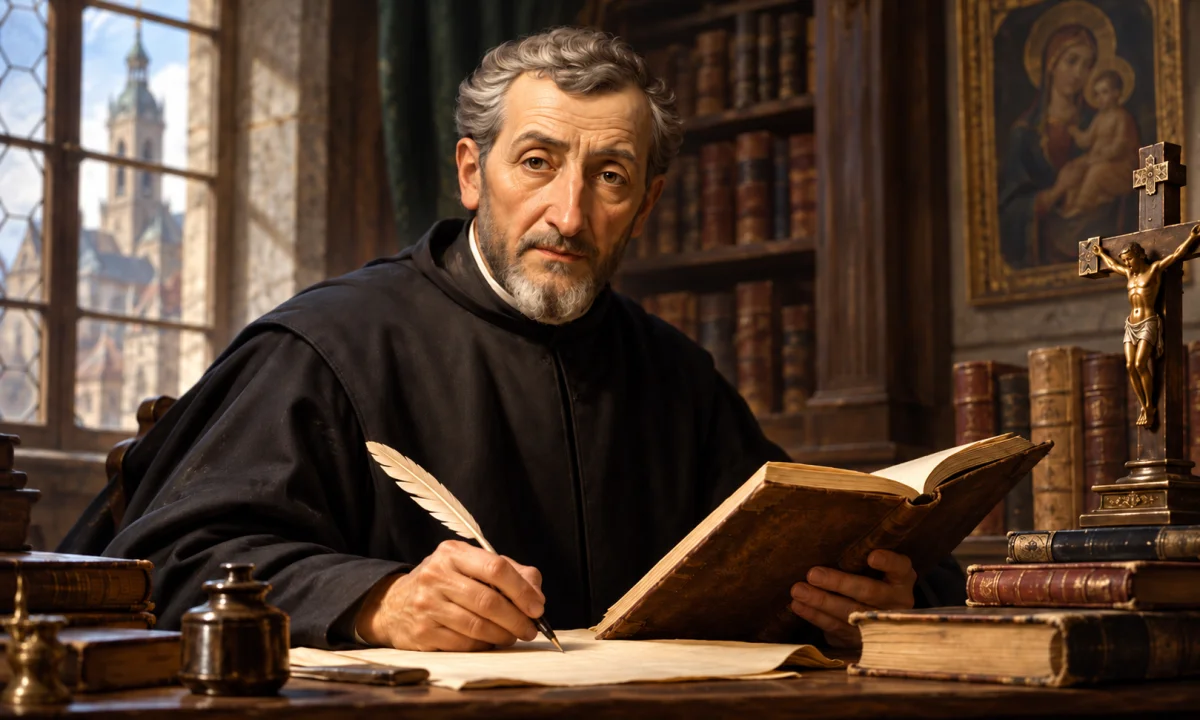
Artistic representations usually show Canisius in the black habit or cassock associated with a Jesuit priest. He may appear as a mature or elderly man with a beard, although artistic details vary. Common attributes include a book, representing his catechisms and theological writing; a crucifix, representing Christian devotion and preaching; and sometimes a rosary or other sign of Catholic religious practice.
A book is particularly appropriate to his imagery because his historical influence rested so heavily on written instruction. Unlike saints whose legends are dominated by dragons, martyrdom instruments or miraculous journeys, Canisius is generally represented through the tools of teaching and ministry. His iconography reflects the kind of saint he was: an educator, administrator, preacher and author.
Historical significance
Canisius is a major figure in the Catholic response to the Reformation, especially in central Europe. His importance did not come from founding a new doctrine or from leading a military movement. Instead, he helped build institutions and habits that allowed Catholic communities to educate clergy and laity, defend their theological position and maintain organized religious life.
His career also demonstrates the importance of catechesis in the formation of religious identity. In a period when confessional boundaries were becoming sharper, a short and comprehensible statement of belief could influence schools, families and parish instruction. The repeated publication of his catechisms gave Catholic teaching a durable educational framework.
From a historical perspective, Canisius should be understood both as a committed Catholic churchman and as a participant in a period of religious division. Catholic tradition venerates him for his holiness, learning and service. Historians also examine his writings as evidence of the institutional development of the Jesuits, the educational strategies of Catholic reform and the polemical culture of sixteenth-century Europe.
Distinction from other saints named Peter
Peter Canisius is distinct from several other well-known Christian figures named Peter. He was not St. Peter the Apostle, the first-century disciple of Jesus and traditional first bishop of Rome. He was also not St. Peter Claver, the seventeenth-century Jesuit who worked among enslaved Africans in Cartagena, or St. Peter of Alcantara, the Spanish Franciscan associated with a strict life of penance.
The shared first name reflects the common Christian use of Peter, derived from the Greek Petros, meaning “rock” or “stone.” The surname Canisius identifies the sixteenth-century Jesuit from Nijmegen and should be retained when discussing his particular life, writings and historical contribution.