WORLD
WORLD
St. Pelagia Of Antioch
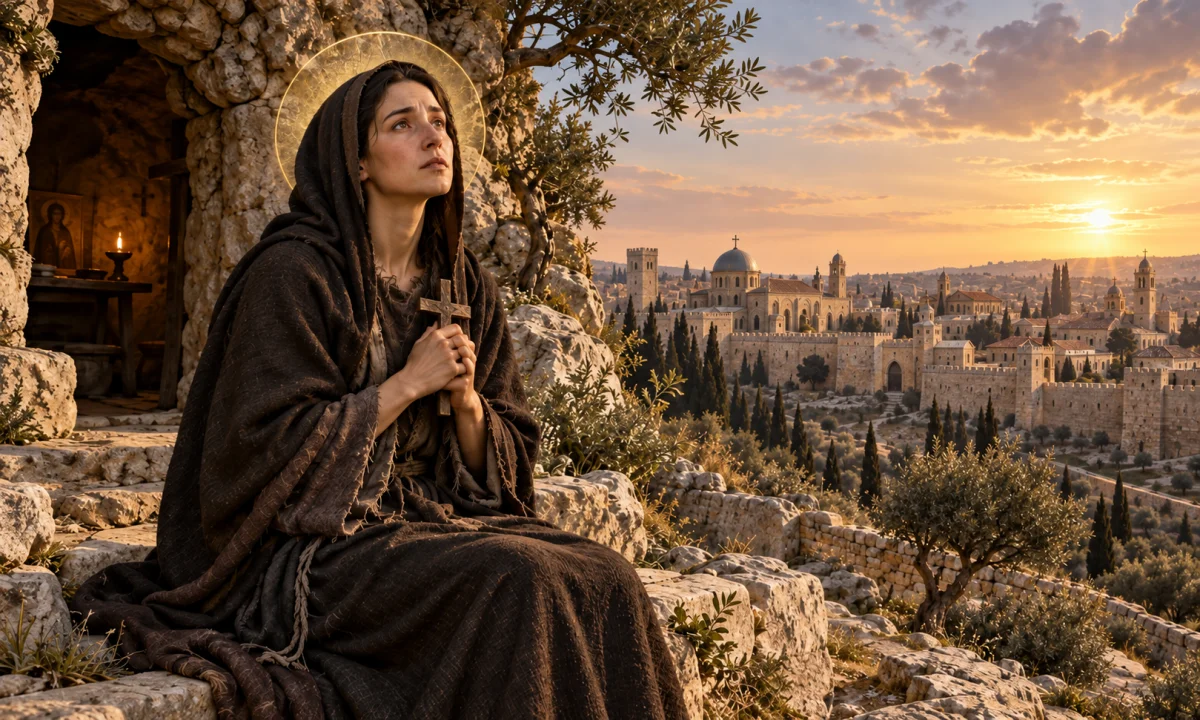
St. Pelagia of Antioch is traditionally remembered as a wealthy and celebrated woman who renounced her former life, received Christian baptism, and lived thereafter as an ascetic in Jerusalem. In the best-known account, she was associated with Antioch and was converted after hearing a sermon by Bishop Nonnus. She then adopted male clothing, took the name Pelagius, and lived in seclusion on the Mount of Olives until her death. Her story belongs to the Christian tradition of penitential saints, especially narratives about dramatic conversion, voluntary poverty, and hidden holiness.
The name “Pelagia of Antioch” can create confusion because Christian calendars and hagiographical collections also preserve a separate Pelagia of Tarsus, a virgin martyr traditionally associated with persecution under the Roman emperor Diocletian. The two women are not the same figure. The Pelagia discussed here is usually called Pelagia the Penitent or Pelagia of Antioch, and her traditional feast is observed on 8 October in several Eastern Christian calendars.
Origins and historical setting
Pelagia’s story is set in the late Roman Christian world, probably in the fifth century, when Antioch was one of the most important cities of the eastern Mediterranean. Antioch was a major centre of trade, education, public entertainment, and Christian theological debate. Its population included Christians, Jews, and followers of traditional Roman and Greek religions. Wealthy women in urban society could possess considerable property, employ servants, and participate in elite social life, although their public independence was limited by family, legal, and religious expectations.
The traditional narrative presents Pelagia as a woman whose beauty, wealth, and public reputation were connected with a morally disordered way of life. Some versions describe her as an actress or dancer, while others call her a courtesan or prostitute. The exact social description varies, and the language of the surviving story reflects the moral conventions of Christian ascetic literature rather than a verifiable biography. The account is intended chiefly to show the possibility of repentance, not to provide a precise record of Antioch’s entertainment industry or of Pelagia’s early career.
The principal narrative is a Greek hagiographical work commonly known as the Life of Pelagia. It is presented as the work of a deacon named James, who is said to have accompanied Bishop Nonnus. The text is preserved in later manuscripts and circulated widely in Christian collections. Its precise date, authorship, and relationship to earlier oral traditions are uncertain. Like many saints’ lives, it combines religious teaching, memorable scenes, and conventions drawn from older ascetic literature. The existence of a written account does not establish every detail as historical fact.
Name and identity
Pelagia is the feminine form of the Greek name Pelagios, meaning “of the sea” or “maritime.” In the story, the saint later uses the masculine form Pelagius when living as a solitary monk. This change of name is connected with her adoption of male clothing and her desire to conceal her former identity. The narrative’s use of the masculine name also allowed her to be treated by other monks as a male ascetic.
Her traditional identity is therefore built around a deliberate transformation. She is first portrayed as publicly famous and associated with luxury, adornment, and sexual temptation. After conversion, she becomes a penitent who gives away her possessions, changes her appearance, and withdraws from society. The contrast is central to the story’s spiritual meaning: the person known to the world as Pelagia disappears, while the unknown ascetic called Pelagius becomes an example of prayer and self-denial.
Some modern readers have discussed Pelagia’s story in relation to gender, bodily identity, and the religious possibilities created by adopting a monastic identity. The ancient text, however, presents her clothing and name primarily as instruments of concealment and ascetic discipline. It does not offer a modern account of gender identity. Interpretations should therefore distinguish between the narrative’s own religious framework and later discussions of its implications.
The conversion of Pelagia
The best-known episode begins when Bishop Nonnus is preaching in Antioch. The story describes him speaking forcefully about divine judgment, repentance, and the contrast between earthly beauty and the glory of heaven. Pelagia is said to hear the sermon while passing by, or while observing the bishop and other clergy. She is deeply affected by his words and begins to reconsider her life.
In some versions, Pelagia sends a message to Nonnus asking for instruction. The bishop receives her with seriousness rather than contempt. He teaches her about Christian repentance and agrees to baptize her after she has shown sincere remorse. The narrative emphasizes that conversion is not merely an emotional reaction. Pelagia must renounce her former life, abandon her wealth, and accept the demanding discipline associated with Christian asceticism.
One prominent scene describes Pelagia’s baptism and spiritual transformation. She is said to confess her sins, receive Christian instruction, and emerge from the baptismal rite as a new person. The story then presents her as having given away her jewels, costly clothing, money, and household goods. Her former identity as a rich and admired woman is replaced by the identity of a poor penitent.
The story also contains a dramatic account of her disappearance. After distributing her possessions, Pelagia leaves Antioch and travels to Jerusalem. There she adopts male clothing and presents herself as the monk Pelagius. This episode reflects a wider pattern in Christian literature about “transvestite saints,” women who entered male monastic environments by disguising themselves as men. Such narratives often focus on humility, the rejection of social status, and the ability of holiness to remain hidden from public recognition.
Life on the Mount of Olives
According to the traditional account, Pelagia settles in a small cell on the Mount of Olives, a site already associated with the life of Jesus and with Christian prayer. She lives as a solitary ascetic, spending her time in fasting, prayer, and repentance. Visitors come to seek advice from the holy monk Pelagius, believing that the occupant is a man.
The cell is often identified with a cave or small dwelling near the summit or slopes of the Mount of Olives. The location links Pelagia’s personal penitence with the wider sacred geography of Jerusalem. In late antique Christianity, the Mount of Olives was a place of pilgrimage, monasteries, chapels, and hermit settlements. Its association with the Ascension and with the final days of Jesus’ earthly ministry gave it powerful devotional significance.
Pelagia’s ascetic life is deliberately hidden. She does not seek a public following, and she is not described as performing spectacular miracles during her lifetime. Her authority comes from prayer, endurance, and the renunciation of privilege. The narrative suggests that true holiness may be invisible to ordinary observers and that a person’s social reputation cannot reveal the state of the soul.
Pelagia eventually dies in her cell. The monks who attend the burial discover that the revered ascetic Pelagius was biologically female. They are astonished, and the revelation causes them to recognize the depth of her humility and discipline. The discovery is the story’s final reversal: a person whom society had known as a beautiful and notorious woman had become a hidden saint, while those around her assumed that holiness belonged to a male monk.
Bishop Nonnus and the religious meaning of the story
Nonnus functions as Pelagia’s spiritual guide and as the preacher whose words awaken her conscience. In the story, he is generally identified as a bishop connected with Edessa who is present in Antioch. The details of his office and movements vary in retellings, and the narrative should not be treated as a straightforward record of his historical career.
The relationship between Pelagia and Nonnus is not presented as a romance. It is a relationship between a penitent and a Christian teacher. Nonnus represents the Church’s role in preaching, baptism, and spiritual discernment. His response to Pelagia is important because he does not simply condemn her past. Instead, he recognizes her repentance and helps her enter the Christian life.
In theological terms, the story illustrates the Christian teaching that repentance can bring radical change. Pelagia’s former behaviour is not treated as an obstacle that makes salvation impossible. At the same time, the narrative’s language is severe. It reflects an ascetic ideal in which wealth, adornment, sexual reputation, and public entertainment are frequently portrayed as dangers to the soul. Modern readers may therefore value the story’s emphasis on transformation while also recognizing the moral assumptions of the period in which it was written and transmitted.
Attributes and symbolism
- Male monastic clothing: Pelagia’s disguise expresses her withdrawal from her former social identity and her entry into a life of ascetic discipline. It also allows the story to explore the hiddenness of holiness.
- Jewels and luxurious clothing: These objects symbolize wealth, beauty, public reputation, and attachment to worldly status. Giving them away marks Pelagia’s rejection of her previous life.
- The solitary cell: Her cell on the Mount of Olives represents prayer, separation from ordinary society, and the spiritual struggle of the hermit.
- Repentance: Pelagia is chiefly a saint of penitence. Her sanctity does not arise from martyrdom but from a sustained change of life.
- Hidden identity: The revelation after death teaches that external appearance and social reputation can conceal a person’s spiritual condition.
- The Mount of Olives: Jerusalem’s sacred landscape gives her conversion a geographical and devotional setting, connecting personal transformation with Christian pilgrimage.
Images of Pelagia may show her in monastic clothing, sometimes with the features of a bearded monk, and sometimes as a woman in ascetic dress. Artistic traditions are not uniform. An image of a woman with rich clothing may refer to Pelagia before her conversion, while an image of a monk named Pelagius usually refers to her hidden life rather than to a different saint.
Pelagia in Christian devotion
Pelagia became an example for Christians who emphasized repentance, monastic withdrawal, and the healing of a morally troubled past. Her life was particularly suitable for sermons and devotional reading because it contains a clear movement from public prominence to hidden sanctity. The narrative could be read by urban Christians, monks, clergy, and penitents as a reminder that conversion required more than verbal regret.
Her feast is commonly observed on 8 October in Eastern Christian tradition. Calendar practices can differ according to denomination, region, and liturgical book. Some Western sources also remember her on 8 October, although the prominence of her cult has varied over time. The story has been translated and adapted into several Christian languages, helping it circulate beyond the Greek-speaking world.
Pelagia is not generally invoked as a patron saint of a single universally recognized occupation or place. Her devotional importance rests more on the theme of repentance than on a specialized patronage. She may be regarded as an example for those seeking moral renewal, renunciation of luxury, or a life of prayer after a dramatic personal change.
Distinguishing Pelagia the Penitent from other saints
The most important distinction is between Pelagia of Antioch, the penitent, and Pelagia of Tarsus, the martyr. Pelagia of Tarsus is traditionally said to have been a young Christian virgin who suffered death during persecution. Her story belongs to the category of martyr legends, whereas Pelagia the Penitent is a convert and ascetic whose death occurs after a hidden monastic life.
There are also other Christian women named Pelagia, and names can be shortened, translated, or rendered differently in various languages. The masculine name Pelagius introduces another possible source of confusion, since several male saints and ecclesiastical figures bear that name. In the penitential narrative, however, Pelagius is the concealed monastic identity adopted by Pelagia of Antioch.
Some retellings call her an actress, dancer, courtesan, or prostitute without distinguishing among those terms. These descriptions should not be treated as equally precise historical categories. They derive from different translations and from the moral vocabulary of hagiography. The central tradition consistently portrays her as a famous woman of wealth and sexual notoriety who turns to Christianity, but the exact details of her former profession are uncertain.
Historical interpretation
Historians and scholars of religion generally approach Pelagia’s life as a work of hagiography rather than as a modern biography. The narrative may preserve memories of ascetic practices, pilgrimage sites, and Christian preaching in the late antique eastern Mediterranean, but its speeches, dramatic scenes, and moral contrasts cannot be independently verified from the story alone.
The tale belongs to a larger group of Christian narratives in which a person with a compromised reputation becomes a holy ascetic. Similar stories appear in accounts of Mary of Egypt, Thaïs, and other penitential figures, although these saints should not be merged with Pelagia. Such narratives served several purposes: they praised divine mercy, encouraged repentance, defended the value of asceticism, and demonstrated that holiness could overturn conventional judgments about social status and gender.
Pelagia’s adoption of male clothing is especially significant for the history of Christian literature. It reflects the existence of women who sought forms of religious life not easily available within ordinary female social roles. At the same time, the story remains shaped by the literary convention that the saint’s biological sex must be revealed after death. The narrative celebrates her sanctity while still presenting concealment and exceptional behaviour as extraordinary rather than ordinary.
Later reception
Pelagia’s story has continued to appear in collections of saints’ lives, sermons, religious art, and accounts of Christian asceticism. Its dramatic structure makes it memorable: a glamorous public figure hears a sermon, gives away her possessions, becomes an anonymous monk, and is recognized as a woman only after death. Yet the story’s traditional purpose is religious rather than theatrical. Its central concern is the power of repentance and the possibility that sanctity may remain hidden from the world.
Modern discussions may also focus on the story’s treatment of sexuality, wealth, women’s religious agency, and gender presentation. These interpretations can illuminate aspects of the narrative, but they should be kept distinct from the beliefs of the late antique Christian communities that transmitted it. There is no strong basis for treating Pelagia as a modern fictional heroine or as evidence for a contemporary identity category. She remains, within her own tradition, a Christian penitent and ascetic whose life dramatizes the transformation of reputation into hidden holiness.