WORLD
WORLD
St. Paulinus Of Nola
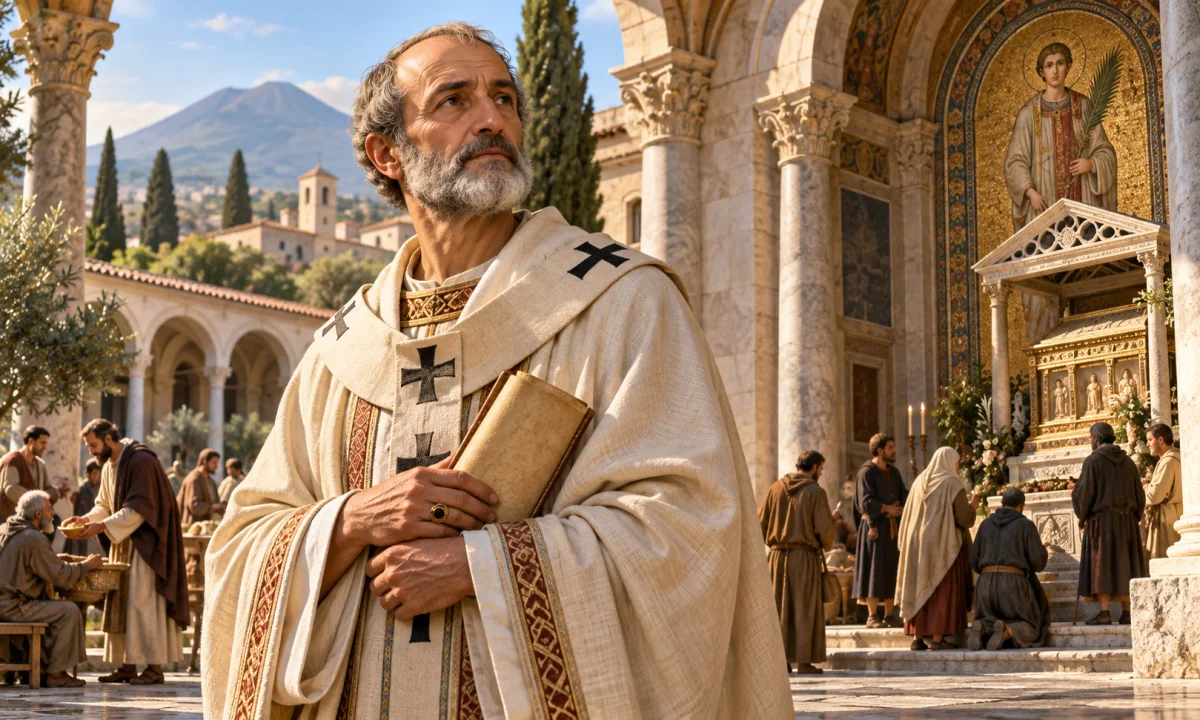
Saint Paulinus of Nola was a Roman Christian bishop, poet, patron of pilgrims and prominent figure in the religious culture of late antiquity. Born into an aristocratic family in Bordeaux around the middle of the fourth century, he abandoned a successful public career and much of his inherited wealth to devote himself to Christian service. He became bishop of Nola in southern Italy, where he promoted the cult of Saint Felix and developed a major centre of pilgrimage.
Paulinus is remembered in Christian tradition especially for his poetry, letters, ascetic life and devotion to the poor. His surviving writings also offer valuable evidence for the transformation of Roman society during the fourth and fifth centuries, when Christianity was becoming increasingly influential within the former Roman imperial world.
Origins and Roman background
Paulinus was born as Pontius Meropius Anicius Paulinus, probably around 353 or 354, in Burdigala, the Roman city now known as Bordeaux in France. He belonged to the wealthy Anician aristocracy, a family whose members held important offices in the Roman Empire. His father, Pontius Paulinus, was a senior imperial official, and the family possessed substantial land and political influence.
The young Paulinus received the education expected of a member of the Roman elite. He studied rhetoric, literature and law, and entered public life. His career included service as a Roman magistrate and governor in Campania, the region of Italy in which Nola was located. Although he later rejected the values of aristocratic competition and public ambition, his writings show that he retained a deep knowledge of classical poetry, Roman history and literary style.
Paulinus married a wealthy Spanish woman named Therasia. The couple had a son, who died soon after birth. This loss had a decisive effect on their lives. Paulinus and Therasia increasingly turned toward Christian devotion, charity and ascetic discipline. Their decision was not simply a private change of belief: it involved redistributing much of their property and withdrawing from the social expectations associated with senatorial wealth.
Conversion and Christian vocation
Paulinus had been raised in a society where Christianity was already established but existed alongside traditional Roman religious practices. His movement toward a more intense Christian life took place gradually. He was baptized at Bordeaux by Bishop Delphinus, probably in 389. After baptism, he and Therasia spent time in the region of Barcelona and adopted a disciplined form of Christian life.
In 393, the people of Barcelona acclaimed Paulinus as a priest, apparently with the support of Bishop Lampius. Paulinus did not initially seek a prominent ecclesiastical career. His writings present his ordination as an act to which he reluctantly consented, although such descriptions also belong to the conventional language of Christian humility. He soon travelled to Italy and settled at Nola, near the tomb of Saint Felix.
At Nola, Paulinus and Therasia established a religious household devoted to prayer, hospitality and care for the poor. Their property supported the building and maintenance of Christian institutions around the shrine of Felix. Paulinus eventually became bishop of Nola, probably in 409. He remained associated with the city until his death.
Nola, Saint Felix and the cult of a martyr
The central devotional figure in Paulinus’s life was Saint Felix of Nola. Felix was a Christian martyr or confessor associated with Nola, although the surviving traditions about his life contain variations and uncertainties. Paulinus did not treat Felix as a rival to Christ or as an independent divine power. Like other saints in late antique Christianity, Felix was understood as a holy intercessor whose tomb provided a place of prayer, healing, remembrance and communal identity.
Paulinus helped make the shrine at Cimitile, outside Nola, one of the best-known pilgrimage centres in Italy. He expanded and decorated the complex, provided facilities for visitors and composed poems for the annual festival of Felix. These poems, commonly called the Carmina Natalicia, celebrate the saint’s feast day and describe the buildings, paintings, inscriptions and rituals associated with the sanctuary.
The shrine served several purposes at once. It was a place of worship, a burial area, a charitable institution and a symbol of Nola’s Christian identity. Pilgrims could visit the tomb, take part in liturgical celebrations and receive hospitality. Paulinus’s work illustrates how Christian communities transformed older Roman landscapes by developing basilicas and pilgrimage sites around the graves of martyrs and holy people.
Appearance and traditional attributes
Paulinus is generally represented as a Christian bishop. His customary attributes include episcopal robes, a crozier and sometimes a book, reflecting his roles as pastor, writer and teacher. In images connected with Nola, he may appear near Saint Felix’s shrine or in a setting associated with the bishop’s care for pilgrims and the poor.
Unlike many saints, Paulinus is not chiefly associated with a single dramatic miracle or instrument of martyrdom. His significance rests more on his conversion, renunciation of wealth, literary work and pastoral activity. The most important symbolic themes connected with him are charity, spiritual friendship, pilgrimage, Christian poetry and the redirection of aristocratic wealth toward religious and social service.
He was not a martyr in the usual sense. He lived through political and military upheavals affecting Italy and the western Roman Empire, but traditional accounts do not present him as someone executed for his faith. His sanctity is instead linked to ascetic commitment, episcopal service and devotion to the memory of a local holy figure.
Paulinus as a Christian poet
Paulinus wrote in Latin and belonged to the learned literary culture of late Roman Christianity. His poems combine biblical themes with forms and techniques inherited from classical Roman poetry. He wrote hymns, poems of praise, elegies and works connected with the cult of Felix. The annual poems for Felix are especially important because they reveal how sacred buildings, images and liturgical celebrations were understood by a Christian author who was also trained in the classical tradition.
His poetry does not simply abandon Roman literary culture. Instead, it redirects that culture toward Christian subjects. Classical language, poetic metre and images of civic celebration are used to describe the Church, the saints and the hope of salvation. In this respect, Paulinus represents a wider development in late antiquity: Christian writers appropriated the educational and artistic tools of the Roman elite while challenging the religious assumptions traditionally associated with them.
His works also show that Christian devotion was not limited to private belief. The architecture of the shrine, the arrangement of public festivals, the use of inscriptions and the distribution of charity all formed part of religious life. Paulinus’s poems preserve details about this world that are not always recorded in formal ecclesiastical histories.
Letters and religious friendships
Paulinus maintained correspondence with several important Christian writers. His surviving letters include exchanges with Augustine of Hippo, Jerome, Sulpicius Severus and other religious figures. These letters discuss prayer, asceticism, biblical interpretation, friendship, the responsibilities of wealth and the meaning of Christian conversion.
His correspondence with Augustine is particularly significant because it reflects the intellectual and devotional networks connecting Christian communities across the western Mediterranean. Paulinus and Augustine did not always write as detached theologians. Their letters combine theological questions with personal encouragement, news about churches and reflections on the demands of religious life.
Paulinus’s relationship with Sulpicius Severus, a writer known for his life of Saint Martin of Tours, illustrates the importance of Christian literary friendship. Letters and poems allowed holy men living in different regions to support one another, exchange books and promote shared models of sanctity. These relationships helped create a Christian culture that crossed local and political boundaries.
Charity, renunciation and the care of the poor
Paulinus’s conversion was closely connected with the Christian critique of wealth. As a member of the Roman elite, he inherited resources that could have supported a conventional aristocratic career. Instead, he and Therasia devoted much of their wealth to churches, monasteries, charitable work and the poor. His example reflects a period when wealthy Christians were increasingly encouraged to treat property as a responsibility rather than merely as a sign of status.
He did not reject all forms of social organisation or education. His own writings demonstrate the continued value of learning, and his work at Nola required administration, building, fundraising and relationships with local communities. His renunciation was therefore not a disappearance from society but a reorientation of privilege toward religious and charitable purposes.
Later Christian readers often viewed Paulinus as an example of the wealthy convert who gives away worldly possessions in order to gain spiritual freedom. At the same time, his life should be understood within the structures of late Roman society. He remained connected to influential families and bishops, and his ability to establish institutions depended partly on the resources and education he had received as an aristocrat.
War, captivity and later legends
Paulinus lived during a period of political instability and military pressure in the western Roman Empire. The sack of Rome by the Visigoths in 410 and the wider disruption of Roman authority affected Christian communities throughout Italy. Nola and neighbouring regions also experienced insecurity, displacement and the loss of property.
Later stories associate Paulinus with the ransom of captives during raids and invasions. One popular account says that he gave himself into servitude in exchange for the freedom of the son of a poor widow. This story fits the Christian ideal of a bishop who sacrifices his own status for another person, but its historical details are difficult to establish with certainty. It should be treated as part of the later tradition surrounding his reputation for charity rather than as an independently secure account of a specific event.
Such narratives helped communities express the social role expected of a bishop. In late antique Christianity, bishops could act as advocates, organisers of relief, negotiators and protectors of vulnerable people. Whether or not every story about Paulinus is historically verifiable, the traditions reflect a real cultural expectation that Christian leaders should use authority and wealth on behalf of those in danger.
Death and feast day
Paulinus died at Nola on 22 June 431. His death occurred shortly after the Council of Ephesus, a major event in the history of Christian doctrine, although he was not one of its principal theological figures. He was buried in the Christian complex associated with Saint Felix at Cimitile.
His feast is traditionally observed on 22 June. Nola continues to honour him alongside Saint Felix, and his memory is connected with the city’s religious history, its churches and its long-standing traditions of procession and festival. He is especially important in local devotion because he helped shape Nola as a Christian pilgrimage centre rather than merely serving there as an administrator.
Historical importance and interpretation
Paulinus is important to historians for several related reasons. His life shows how a Roman aristocrat could become a Christian ascetic without abandoning literary culture or public responsibility. His poems document the emergence of monumental Christian pilgrimage sites. His letters reveal networks of communication among bishops, monks and educated Christian households. His career also demonstrates the growing influence of bishops in local society.
His writings should not be read as neutral records. They are devotional and literary works, shaped by biblical interpretation, humility conventions and the desire to honour Saint Felix. Descriptions of miracles, visions or the power of a saint’s shrine belong to the religious worldview of the period. They are evidence for what communities believed, practised and valued, even when they cannot be verified as modern historical events.
Paulinus’s Christianity also had a strong sense of place. Nola was not simply the location of his episcopal office. It became a spiritual home defined by the tomb of Felix, the buildings around it, the annual festival and the community formed through hospitality and prayer. His example helped establish a model in which local saints shaped the identity of cities and regions throughout Christian Europe.
Distinction from other Paulinus figures
Saint Paulinus of Nola should not be confused with other Christian figures named Paulinus. The name was common in the Roman world, and several bishops, writers and saints bore it. In particular, he is distinct from Paulinus of Pella, a fifth-century Christian poet who wrote about his life during the decline of Roman Gaul, and from Paulinus of Trier, a fourth-century bishop associated with the Arian controversy.
He is also distinct from Saint Paul of Tarsus, whose name is sometimes shortened or translated in ways that can create confusion in informal discussions. Paulinus of Nola was a later Roman Christian, a bishop and poet devoted to Saint Felix; he was not one of the apostles and did not belong to the earliest generation of Christianity.
Continuing religious significance
Within Christian tradition, Paulinus represents a form of holiness based on conversion, generosity and faithful service rather than martyrdom. His life joins the worlds of Roman education, episcopal leadership, pilgrimage and care for the poor. He is remembered not only for renouncing wealth but also for putting his learning and resources to work in a particular community.
The enduring tradition of Saint Paulinus of Nola therefore rests on both the man and the institutions he helped create. His poems preserve the voice of a Christian aristocrat reshaping classical culture, while the shrine at Nola preserves the local setting in which his ideals of worship, hospitality and charity were enacted.