WORLD

Napi
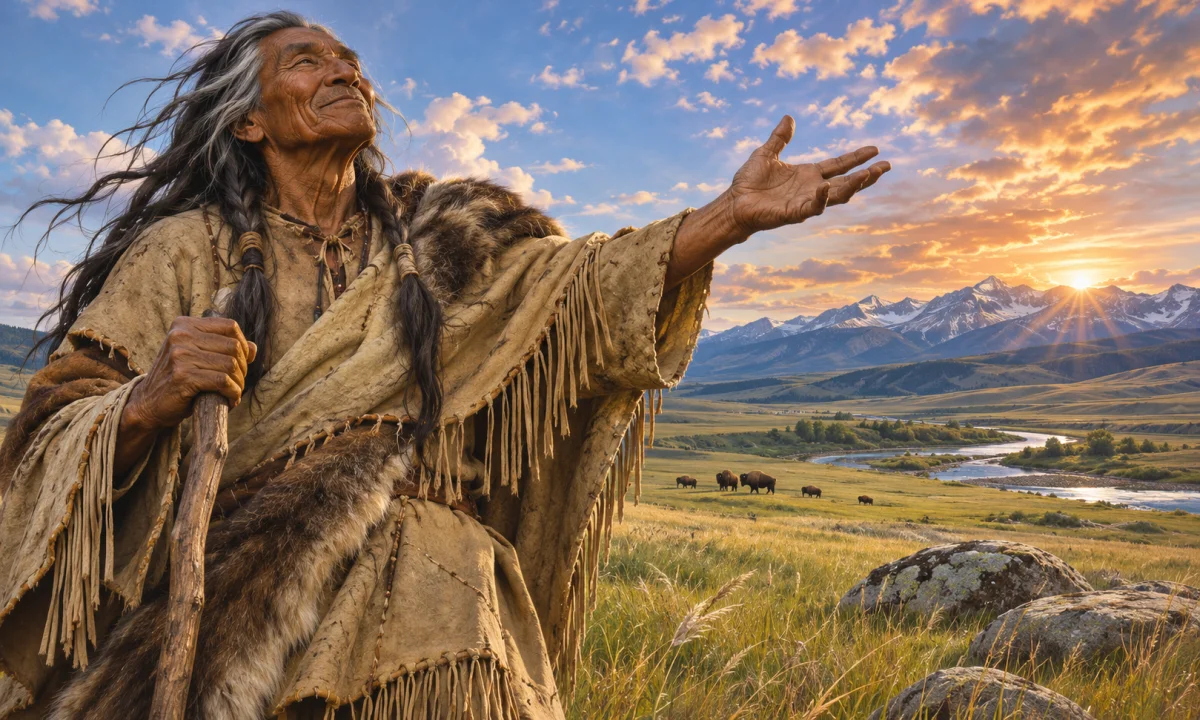
Napi, also written Naapi or Na'pi in different spellings, is a major culture hero and trickster figure in the traditional stories of the Blackfoot peoples of the northern Great Plains. He is especially associated with the Siksikaitsitapi, a confederacy that includes the Siksika, Kainai, Piikani and Amskapi Piikani communities. His name is commonly translated into English as “Old Man,” although the English translation does not convey every meaning or association carried by the Blackfoot name.
Napi is often described as a creator because stories attribute the shaping of the land, the ordering of animals and the establishment of aspects of human life to his actions. He is not, however, a simple equivalent of an all-powerful creator god. Napi can be generous, inventive and helpful, but he is also vain, hungry, impatient and foolish. His successes and failures explain features of the world while showing the consequences of greed, arrogance and poor judgment.
Cultural setting
Blackfoot traditions belong to the cultural and religious world of the northern Plains, a region extending across parts of present-day Alberta, Saskatchewan and Montana. The Blackfoot peoples have maintained distinct community identities and histories, even though outsiders have often grouped them under a single broad label. “Blackfoot mythology” is therefore a useful general term, but it should not be taken to mean that every story, name or interpretation is identical in all Blackfoot communities.
Napi stories were preserved primarily through oral transmission. Elders and knowledgeable storytellers related them in particular social, educational or ceremonial contexts, and the meaning of a story could depend on the audience, the occasion and the storyteller’s interpretation. There is no single ancient Blackfoot book that presents a fixed canon of Napi narratives. Many versions were recorded by non-Indigenous collectors during the nineteenth and early twentieth centuries, often through translation and selective transcription. Those records are valuable, but they do not capture the full performance, language, cultural setting or authority of the original traditions.
Stories about Napi can entertain listeners while also discussing proper conduct, relations between humans and animals, the character of the landscape and the limits of human knowledge. Their humour does not make them merely childish tales. Trickster narratives often permit serious subjects to be approached indirectly, using exaggeration and embarrassment to expose behaviour that threatens social balance.
Name and identity
The spelling Napi is common in English-language writing, but forms such as Naapi and Na'pi also occur. Differences in spelling may reflect changes in orthographic systems, pronunciation and the conventions used by particular writers. The translation “Old Man” is widely used, but it can be misleading if it suggests only an ordinary elderly human being. Napi is a powerful mythic person whose age, knowledge and behaviour shift from story to story.
In some narratives he appears at the beginning of the world or during a period when the land is still being arranged. In others, he behaves like a wandering man dealing with immediate practical problems. These presentations are not necessarily contradictory. Trickster figures commonly move between cosmic and ordinary levels: they may shape the landscape in one episode and be deceived by an animal in the next.
Napi is generally characterized as male, and some traditions place him in stories with an Old Woman figure. The Old Woman may be presented as a companion, adviser, counterpart or participant in the ordering of human life, depending on the version. Her presence should not be reduced to a minor role simply because Napi is more widely known in English-language discussions. The surviving record is uneven, and the relationships among named figures vary across tellings.
Creator, transformer and trickster
Napi’s creative activity is often better understood as transforming and arranging rather than creating everything from absolute nothing. He encounters a world that may be incomplete, undifferentiated or in need of adjustment, and his actions give its features their present form. Mountains, rivers, stones, animals, plants and human customs can be connected with his travels and decisions.
In some accounts, Napi is responsible for making or shaping human beings and for determining important differences among living creatures. Other stories explain why animals have particular habits, why a landscape has a distinctive appearance or why humans must live under certain conditions. These explanations belong to a traditional narrative system rather than to a single universally agreed account of creation.
His trickster qualities are central to his identity. Napi frequently wants food, comfort, status or sexual success, and his schemes often become more complicated because he refuses to accept ordinary limits. He may deceive others, but he is also deceived. He may make a clever plan and then ruin it through impatience. The humour usually depends on his exaggerated confidence: Napi acts as though he understands everything, while the story demonstrates that he does not.
Unlike a morally perfect creator, Napi can cause trouble through selfishness or carelessness. Yet his mistakes are not always portrayed as purely destructive. The world may acquire a new custom, boundary or feature as the unintended result of an episode. This combination of creativity and error makes him a particularly vivid example of the transformer-trickster pattern found in many Indigenous traditions, without making him interchangeable with tricksters from other nations.
Appearance and powers
Napi is often imagined in human form as an old man, but traditional narratives do not require a single fixed physical appearance. His “old man” identity can indicate experience and ancient presence, while his conduct reveals impulsiveness and childish appetites. The contrast between his appearance and behaviour is part of the humour of many stories.
His abilities include travelling through the early world, speaking with animals and affecting the shape or distribution of natural things. He can participate in events beyond ordinary human power, but he is not invulnerable or omniscient. He can be frightened, hungry, embarrassed, injured or forced to flee. His power is therefore situational rather than absolute.
Animals in Napi stories are not simply decorative symbols. They can act as independent persons with their own intelligence and social relationships. An animal may help Napi, expose his dishonesty, punish his carelessness or outwit him. Such episodes reflect a world in which humans are not the only beings with agency. They also help explain why respectful relations with animals and the wider environment matter.
Stories of shaping the world
One group of Napi narratives concerns the formation of the world as people know it. Napi moves through a landscape that is being established and contributes to the placement or character of natural features. A cliff, stone, body of water or other landmark may be associated with one of his actions. These stories do more than explain physical geography: they connect places with memory, movement and moral meaning.
Other accounts describe Napi’s dealings with animals and the distribution of resources. Food, clothing, shelter and knowledge may become available through a mixture of skill, accident and conflict. Buffalo are especially important within the cultural life of the Plains, and narratives involving buffalo can reflect the practical and spiritual significance of the animal. However, no single “Napi buffalo story” should be treated as the definitive version for all Blackfoot communities.
Several stories explain how humans came to possess particular abilities or conditions. Napi may establish a custom deliberately, or a feature of human life may arise because one of his plans fails. The pattern is significant: the world is not presented as the product of flawless planning. It is a place shaped by relationships, consequences and the accumulated effects of action.
Napi and the Old Woman
Stories involving Napi and an Old Woman are important in discussions of Blackfoot narrative tradition, although translations and descriptions vary. The two figures can be associated with the creation or organization of human life and with decisions about how people will live. In some versions, the Old Woman challenges Napi’s assumptions or provides a perspective he lacks.
Their interactions can also reveal differences in power and judgment. Napi may want a result that benefits him immediately, while the Old Woman recognizes a broader consequence. When the story is read only as a tale about Napi’s actions, her contribution can disappear; when it is read within its cultural setting, the exchange may show that the ordering of life is not the work of one isolated male figure.
Because English-language collections sometimes use simplified labels such as “Old Man” and “Old Woman,” it is important not to assume that these translations identify a universally fixed divine couple. Their roles and relationship belong to particular tellings and interpretive traditions.
Humour, failure and moral meaning
Napi’s failures are among the most memorable elements of his character. He may attempt to obtain something without effort, violate a warning or presume that others are less intelligent than he is. The resulting humiliation makes the story comic, but it also teaches that cleverness without restraint is dangerous.
His stories can address hunger, sexuality, rivalry, laziness, deception and the desire for social recognition. Napi often wants the privileges of a powerful person without accepting the responsibilities that accompany them. He provides a negative example, but not always a simple one. His actions may lead to useful outcomes even when his motives are selfish, and an apparently foolish episode may explain a lasting feature of the world.
This ambiguity is part of the religious and cultural importance of trickster narratives. Napi is neither a straightforward villain nor an ideal model. He is a being through whom listeners can explore the instability of the world and the need for practical intelligence, humility and good relations. The stories invite laughter at Napi while also warning that his weaknesses exist, in less exaggerated form, among ordinary people.
Traditional context and interpretation
Napi should not be treated as a fictional “character” in the modern entertainment sense alone. The narratives belong to a living Indigenous cultural tradition, although their forms of transmission and public presentation have changed under the pressures of colonization, residential schools, language loss and the removal of children from their communities. Some stories may be shared publicly, while others may be restricted by community practice or considered inappropriate outside their original setting.
Researchers have interpreted Napi as a creator, transformer, culture hero, clown or trickster. These terms can be useful, but none completely defines him. “Culture hero” emphasizes his role in establishing knowledge and customs. “Transformer” highlights the shaping of an existing world. “Trickster” draws attention to his appetite, deception and comic reversals. In Blackfoot traditions, these aspects belong together rather than forming separate identities.
Modern readers should also be cautious about assuming that all Indigenous mythologies follow the same pattern. The presence of a trickster in Blackfoot tradition does not mean that Napi is equivalent to Coyote, Raven, Nanabozho or Iktomi. Similar narrative functions do not establish shared identity, and each figure belongs to a specific language, people and cultural history.
Distinguishing Napi from similar figures
Napi is most closely associated with the Blackfoot peoples, not with every Indigenous nation of North America. English-language summaries sometimes combine traditions because they use broad categories such as “the Native American trickster.” This approach obscures important differences in language, territory, ceremony and worldview.
- Napi and Coyote: Coyote is a major trickster and creator figure in many Indigenous traditions, especially in parts of the western United States, but Coyote is not simply another name for Napi.
- Napi and Raven: Raven has important transformer and culture-hero roles among several peoples of the Northwest Coast and circumpolar regions. Those traditions should not be merged with Blackfoot Napi stories.
- Napi and Nanabozho: Nanabozho, also known by related names in Anishinaabe traditions, belongs to a different cultural and linguistic setting, even though both figures can combine creative and trickster qualities.
- Napi and Iktomi: Iktomi is a spider-associated trickster in Lakota traditions. The shared presence of humour and deception does not make him a Blackfoot form of Napi.
The name “Old Man” can also create confusion because it is an English translation rather than a unique personal name. Other cultures may have beings translated with the same words. Similar translations do not indicate that the figures are historically or religiously connected.
Written records and modern reception
Many Napi stories became known to wider English-speaking audiences through ethnographic publications and collections made from Blackfoot narrators. These records helped preserve portions of the tradition, but they were produced in unequal colonial circumstances. A written version may shorten a performance, omit ceremonial context, standardize names or present a storyteller’s version as though it were universal. Comparing accounts can reveal recurring themes, but differences should not automatically be treated as errors.
Napi appears today in educational discussions of Indigenous literature, mythology and the history of the Plains. He may also be represented in museums, children’s books and general mythology websites. Such adaptations can introduce readers to the figure, but they often simplify his cultural setting or portray him as a generic North American trickster. Responsible treatments identify his Blackfoot context and avoid presenting one translated narrative as the complete tradition.
There is no broad modern popular-culture version of Napi comparable to globally commercialized figures such as Greek or Norse gods. When he appears in contemporary works, the portrayal should be distinguished from Blackfoot tradition, especially if the character is turned into a fantasy hero, comic mascot or universal symbol of Indigenous mythology.