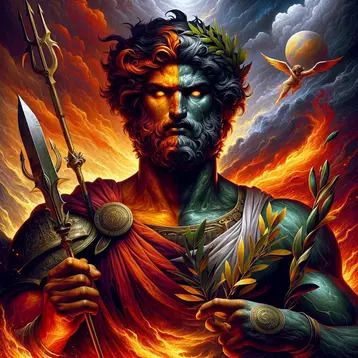
In Greek mythology, Perses is a figure that embodies the themes of darkness and destruction. He is often associated with the concept of chaos, representing the forces that exist beyond human understanding. Perses is a Titan, which means he belongs to a generation of gods that predate the Olympians. The Titans were the children of Uranus (the sky) and Gaia (the earth), and they played a significant role in the ancient Greek belief system. Perses, in particular, is sometimes linked to the more well-known Titan, Kronos, who is famous for overthrowing his father and later being overthrown by his own son, Zeus.
The Role of Perses in Greek Mythology
Perses is not as widely known as other figures in Greek mythology, but his role is crucial in understanding the larger narrative of the Titans. He is often identified as the personification of destruction and is associated with the violent aspects of nature. Unlike the Olympian gods, who often represent order and civilization, Perses symbolizes the chaos that can arise in the world. This duality between order and chaos is a recurring theme in many mythological stories.
 Perseus
Perses is also connected to the concept of darkness. He is sometimes depicted as a figure who dwells in the shadows, representing the unknown and the fears that come with it. This association with darkness can be seen in various myths where he is mentioned alongside other primordial deities who embody similar traits. The interplay between light and dark is a significant aspect of Greek mythology, and Perses plays an essential role in this dynamic.
Perses and His Family
Perses is often linked to his family, particularly his father, Hyperion, and his mother, Theia. Hyperion is one of the Titans of light, while Theia is associated with sight and the shining sky. This familial connection highlights the contrast between light and dark, which is central to Perses’ character. Despite being a Titan of darkness, his lineage ties him to the brighter aspects of the cosmos, creating a complex narrative about his nature.
 Perso
PersoIn some myths, Perses is also associated with his siblings, who include Helios (the sun), Selene (the moon), and Eos (the dawn). Each of these figures represents different aspects of light and time, which further emphasizes the duality of Perses’ existence. While he embodies darkness, his family members symbolize the various forms of illumination that exist in the world. This relationship among the Titans illustrates the interconnectedness of all things in Greek mythology.
The Myths Surrounding Perses
Although there are not many myths that focus solely on Perses, he is often mentioned in the context of other stories. For instance, he is sometimes depicted as a figure who aids the Titans in their struggle against the Olympian gods. This rebellion against Zeus and his siblings is a pivotal moment in Greek mythology, representing the conflict between the old order (the Titans) and the new order (the Olympians). Perses’ involvement in this struggle underscores his role as a symbol of chaos and destruction.
In some accounts, Perses is also linked to the concept of war. He is sometimes portrayed as a figure who brings about conflict and turmoil, which can be seen in the way he interacts with other gods and mortals. His association with war and destruction makes him a formidable figure in the pantheon of Greek mythology. This connection to violence and chaos is a recurring theme in many myths, as gods often reflect the struggles and conflicts that humans face in their lives.
 Petesuchos
Perses in Literature and Art
Perses has been depicted in various forms of literature and art throughout history. While he may not be as famous as other mythological figures, his character has inspired many artists and writers. In ancient texts, he is often portrayed as a dark and foreboding figure, representing the unknown aspects of existence. This portrayal can be seen in works of art that depict the Titans and their struggles against the Olympian gods.
In modern literature, Perses has also made appearances in various retellings of Greek myths. Authors often explore his character in the context of the larger narrative, examining the themes of chaos and destruction that he embodies. These modern interpretations often highlight the relevance of ancient myths to contemporary issues, such as the struggle between order and chaos in society. Through these retellings, Perses remains a significant figure in the exploration of human nature and the challenges we face.
Perses and the Concept of Chaos
The concept of chaos is integral to understanding Perses and his role in Greek mythology. Chaos is often depicted as a primordial state from which the universe was formed. In this sense, Perses can be seen as a representation of the chaotic forces that exist in the world. His character serves as a reminder of the unpredictable nature of existence and the challenges that arise from it. This connection to chaos is particularly relevant in the context of the Titanomachy, the war between the Titans and the Olympians.
In many myths, chaos is portrayed as a necessary force that allows for creation and transformation. Perses, as a Titan of darkness and destruction, embodies this duality. He represents the idea that without chaos, there can be no order, and without destruction, there can be no creation. This complex relationship between chaos and order is a central theme in Greek mythology, and Perses serves as a key figure in exploring these ideas.
The Legacy of Perses
Despite his lesser-known status in Greek mythology, Perses has left a lasting legacy that continues to resonate today. His character serves as a reminder of the complexities of existence and the balance between light and dark. The themes associated with Perses—chaos, destruction, and darkness—are universal concepts that are relevant in various aspects of life. This legacy can be seen in literature, art, and even modern interpretations of mythology.
Perses also represents the idea that every story has multiple perspectives. While he is often seen as a figure of destruction, it is essential to recognize that his role is part of a larger narrative. The interplay between the Titans and the Olympians illustrates the ongoing struggle between opposing forces, which is a fundamental aspect of human experience. Through this lens, Perses can be understood as a complex character who embodies both the challenges and the transformative power of chaos.
Perses in Contemporary Culture
In contemporary culture, Perses has been referenced in various forms of media, including books, films, and video games. His character has been adapted and reinterpreted to fit modern narratives, often highlighting themes of chaos and destruction. These adaptations demonstrate the enduring relevance of ancient myths and the ways in which they can be applied to contemporary issues. Through these modern interpretations, Perses continues to captivate audiences and inspire new stories.
Moreover, the figure of Perses serves as a reminder of the importance of acknowledging the darker aspects of existence. In a world that often emphasizes positivity and order, the character of Perses invites us to confront our fears and uncertainties. This exploration of darkness can lead to a deeper understanding of ourselves and the world around us. By engaging with the complexities of characters like Perses, we can gain insight into the human condition and the struggles we face.
Perses, as a figure in Greek mythology, represents the intricate relationship between chaos, destruction, and the duality of existence. His role as a Titan highlights the complexities of the mythological narrative, showcasing the ongoing struggle between light and dark. Through various myths, literature, and modern interpretations, Perses continues to resonate with audiences, serving as a reminder of the challenges we face in our lives. As we explore the character of Perses, we gain a deeper understanding of the human experience and the balance between order and chaos.